DD
MM
YYYY

PAGES

DD
MM
YYYY

spot_img

PAGES

Home Blog Page 2270

Trade War Erupts as Canada, and Mexico Retaliate Against Trump’s Tariffs

0

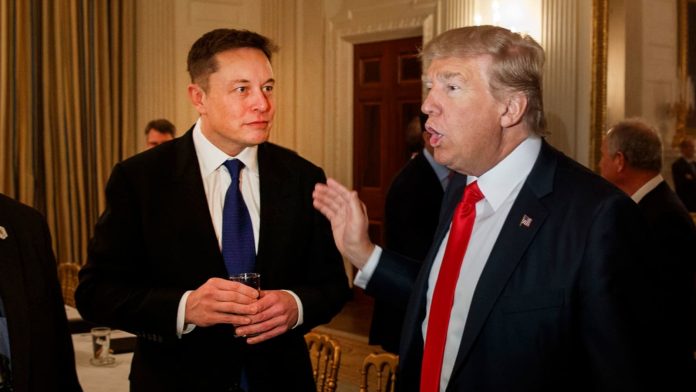
The economic standoff between the United States and its closest trading partners escalated dramatically on Saturday as Canada and Mexico announced sweeping retaliatory tariffs in response to U.S. President Donald Trump’s new trade restrictions.

The move comes just days after Trump signed an executive order imposing a 25% tariff on Canadian and Mexican imports and an additional 10% tariff on Chinese goods, citing a national emergency related to illegal immigration and drug trafficking, particularly fentanyl.

With the tariffs set to go into effect on Tuesday, Trump’s protectionist policy has already provoked fierce resistance from global partners, raising fears of an international trade war that could exacerbate inflation, slow economic growth, and destabilize financial markets.

Canada Hits Back: ‘We Will Not Back Down’

Canadian Prime Minister Justin Trudeau wasted no time in condemning the White House’s decision, warning that the tariffs would harm workers and businesses on both sides of the border. In response, Canada is imposing reciprocal 25% tariffs on up to $155 billion worth of U.S. imports, including alcohol, fruit, and other key commodities.

“The actions taken today by the White House split us apart instead of bringing us together,” Trudeau said in an impassioned address, expressing the deep sense of betrayal that many Canadians feel. He reminded Americans that Canada has stood by the U.S. in times of crisis, from military engagements in Afghanistan to providing assistance during Hurricane Katrina and California wildfires.

“We were always there standing with you, grieving with you, the American people,” he said.

Despite the strong response, Trudeau stopped short of escalating the conflict further, encouraging Canadians to prioritize domestic products over American goods while maintaining hope for a resolution.

“This is going to have real consequences for people, for workers on both sides of our border,” he cautioned. “We don’t want to be here. We didn’t ask for this. But we will not back down in standing up both for Canadians and for the incredibly successful relationship between Canada and the United States.”

Further fueling the dispute, British Columbia Premier David Eby called for a boycott of American-made liquor, particularly products from Republican-led states, and directed provincial agencies to remove U.S. alcohol brands from government store shelves.

“In response to the American tariffs, I have directed government and crown agencies to exclude U.S. suppliers from any new purchasing or procurement agreements,” Eby said. “It’s just one of the actions we are taking to prioritize Canada first.”

Mexico Rejects U.S. ‘Slander,’ Warns of Economic Fallout

Mexico, which has also been targeted by Trump’s trade barriers, issued an equally defiant response. President Claudia Sheinbaum pushed back against Trump’s justification for the tariffs, calling his claims about Mexican involvement in drug trafficking a slanderous and false narrative.

“We categorically reject the White House’s slander that the Mexican government has alliances with criminal organizations,” Sheinbaum said in a post on X. “As well as any intention of meddling in our territory.”

She also took direct aim at the U.S. government’s failure to address its own drug crisis, particularly the fentanyl epidemic, which Trump cited as justification for the trade restrictions.

“If the United States government and its agencies wanted to address the serious fentanyl consumption in their country, they could fight the sale of drugs on the streets of their major cities, which they don’t do,” she said. “They could also tackle the laundering of drug money, which fuels the very criminal networks they claim to oppose.”

While Sheinbaum acknowledged that Mexico’s economy remains “very strong”, she confirmed that her administration had already ordered retaliatory tariffs and other countermeasures, signaling an escalation of economic tensions between the two nations.

China Joins the Fight, Vows WTO Action

Trump’s tariff policy has also drawn immediate backlash from China, which vowed to take the dispute to the World Trade Organization (WTO) and implement “corresponding countermeasures” to protect its own economy.

“China is strongly dissatisfied and firmly opposes this,” the country’s Commerce Ministry declared in a statement, making it clear that Beijing is prepared to respond forcefully.

With China’s retaliation looming, experts warn that Trump’s trade aggression could ignite a global economic firestorm, leading to further disruptions in supply chains, higher consumer prices, and prolonged economic uncertainty.

A study by the Budget Lab at Yale University estimates that the average U.S. household will lose approximately $1,170 in income due to higher costs of imported goods.

Furthermore, with Canada, Mexico, and China all planning countermeasures, economists predict that the trade war will worsen inflation and slow down economic growth—the very problems Trump had vowed to fix on the campaign trail.

Adding to the controversy, Trump’s executive order extends U.S. import restrictions to shipments valued under $800, eliminating an exemption that previously allowed smaller imports to enter the country without customs duties. According to experts, this change will further strain small businesses and increase costs for American consumers.

What Happens Next?

With Trump pledging to raise tariffs even further if foreign governments retaliate, the prospect of a full-scale trade war now seems more inevitable than avoidable.

With 77% of Canada’s exports and 84% of Mexico’s exports going to the U.S., the United States remains their largest trading partner, and a prolonged trade dispute could have devastating consequences for key industries, including agriculture, manufacturing, and energy.

For American consumers, the fallout will be felt at the checkout line, as higher tariffs translate into more expensive groceries, gas, cars, and everyday goods.

And for the global economy, the uncertainty surrounding Trump’s aggressive trade policies poses a serious risk, threatening to destabilize markets and slow international growth.

Against the backdrop of escalating tension, Trump’s willingness to back down from his protectionist stance remains uncertain. If recent history is any indication, the president may be more inclined to double down—no matter the cost.

Digital Banks Saw The Highest Fraud Peak in 2024 – Report

0

In 2024, Digital Banks experienced an unprecedented surge in fraud, marking the highest peak to date, according to Smile ID’s 2025 Digital Identity Fraud in Africa Report.

The report which is based on a comprehensive and anonymized analysis of over 110 million identity checks, revealed that digital banks recorded increased fraud, reaching 35%, surpassing the 42% peak seen in payments in 2023.

The rise in fraud cases is attributed to the increasing sophistication of cyber threats, as criminals leverage Artificial Intelligence, Deepfake technology, and advanced phishing techniques to bypass security systems. Also, weak identity verification and KYC loopholes further contribute to the problem, as fraudsters exploit inadequate screening processes using stolen or synthetic identities to open accounts. It is worth noting that some digital banks prioritize seamless onboarding over rigorous verification, increasing exposure to fraud.

To combat these issues of rising fraud cases, digital banks are urged to adopt stronger Al-driven fraud detection mechanisms that analyze transaction patterns in real-time. Implementing multi-factor authentication (MFA) and biometric verification can enhance account security, while stricter KYC and AML compliance measures can help detect fake identities and prevent money laundering.

Microfinance institutions closely followed, with fraud attempts peaking at 30%, driven by the increasing digitization of financial services and the growing sophistication of cybercriminals. As more Microfinance institutions adopt banking solutions to expand financial inclusion, they have become attractive targets for fraudsters exploiting security gaps. Investment businesses recorded the lowest fraud attempts, peaking at 10% all year.

In a broader perspective, the finance industry recorded increased fraud rates, ranging between 14% and 23% through the year, compared to 10% to 15% in 2023. On average, fraud rates for authentication jobs were 4X higher than registration jobs, highlighting the need for stronger fraud prevention during authentication. The largest gap was in May, with fraud rates for authentication at 30%, compared to 11% for registration.

Notably, in a significant discovery of fraud trends in 2024, fraudsters shifted to operating later, with attempts peaking at 11 PM GMT, compared to 9 PM GMT in 2023. This aligns with global trends, where fraud spikes occur during the late-night to early-morning hours, exploiting periods of low user activity and reduced oversight. These hours are reported to create vulnerabilities due to limited real-time support and delayed detection.

Rising Adoption of Fraud-as-a-Service(FaaS)

Fraud-as-a-Service (FaaS) is a criminal business model where hackers and fraudsters offer tools and services designed to facilitate fraudulent activities. These illicit services, often marketed through underground forums, are sold to aspiring fraudsters with features like customer support and user reviews, mirroring the professionalism of legitimate businesses.

The adoption of FaaS is expected to grow significantly in 2025, driven by the growing accessibility of digital tools and an increased demand for scalable fraud solutions. Powered by Al, these tools could operate autonomously, with fraudsters simply supplying the necessary computing resources.

The Next Fraud Challenge: Real Identities in the Crosshairs

Fraud involving real identities has become one of the most dangerous threats to digital security, driven by tools that allow fraudsters to manipulate legitimate identity elements like ID photos or videos. In 2024, this trend grew significantly as fraudsters shifted from creating synthetic identities to exploiting real ones, a tactic expected to accelerate in 2025 as digital ID verification systems become better at detecting fakes.

Fraudsters acquire real identities through breaches, phishing, or social engineering, often targeting underserved or digitally vulnerable individuals. They may also pay or offer a share of stolen funds to recruit accomplices for laundering money.

With stolen identity data widely available on dark web marketplaces often bundled with personal and financial details, this approach has become scalable and accessible to a broader range of bad actors. The threat is especially alarming in industries like financial services, telecommunications, and e-commerce, where trust in user identity is critical. Tools that enable easy alteration of photos or the creation of lifelike deepfake videos further amplify the risk, making it harder for businesses to detect fraud during verification processes.

To combat the rise in digital fraud, businesses/ organizations are urged to collaborate to build a unified front against fraud. The increasingly sophisticated nature of modern fraud schemes allows them to cross industries and borders, making it difficult for individual institutions to combat fraud in isolation. Fraudsters who evade detection in one institution can exploit gaps in others, amplifying their impact.

USAID Website Goes Offline And That Is A Reset for Africa

1

This is a tsunami-earthquake-storm kind of leadership that Trump has shut down usaid. gov. This is unprecedented in all ways because he is telling the world that they have “no rights” for America to fund them, and influence them, via soft power.  Yet, this may even be a good outcome if African leaders can lead.

Those aid agencies distort markets and cause harm to nation’s abilities to develop sustainable solutions. You create a product with a clear market traction in the healthcare, education or agro area. Then 2 years later, an aid agency comes and makes a similar product FREE. You struggle and shut down, and in 3 years, the aid funds are gone, and the people return back to the floor level.

So, if Trump is cutting these funds, people should not panic. It may even be good. What needs to happen is for African governments to create a database to know citizens who need help, as local companies rise to capture opportunities without the aid agencies’ distortions. Citizens who need help and cannot afford products should be supported even as local companies fill the market voids. Africa has histories of dealing with such issues for centuries; return back to them.

In my village of Ovim, there is a framework which has enabled the rise of the free market and support of the vulnerable so that people do not go to bed on empty stomachs. In Agbongele Ugwunta, it is an ordinance till TODAY that any crop grown there belongs to the community. The idea is that you can have a big farm which you run and make money, but there is a chance that not everyone can afford the produce.

To help those who may be unable to pay, you willingly go to Agbongele and plant things and nurture things knowing that your fellow citizens will use those things. It is an abomination to harvest and sell anything in Agbongele as it is for in-need consumption. While in the village, I did plant and was proud to see it grow, knowing that one day someone will need it to avoid hunger!

So, our governments can have a structure to ensure the free market while covering the needs of the vulnerable citizens. Trump is giving Africa a huge opportunity and this is a time for a reset.

Comment on Feed

Comment: Ndubuisi Ekekwe : Your perspective is both insightful and inspiring. I agree that aid, while well-intentioned, can sometimes distort local markets and stifle sustainable growth. It’s refreshing to see examples like Agbongele Ugwunta, where community-driven initiatives ensure that even the vulnerable are supported without undermining local innovation. Trump’s decision might indeed serve as a catalyst for a much-needed reset—one where African leaders can harness their rich histories of resilience and self-reliance to build robust, locally-tailored solutions. Thank you for sharing this thought-provoking take on how we might move forward!

Ethereum and AI Coin Ready For Epic Price Explosion, Shiba Inu Teams Burns 1B SHIB

0

The crypto market is heating up as Ethereum (ETH) eyes a significant breakout. Crypto Caesar forecasts the value of the altcoin might pump to $5k if successful. Meanwhile, the spotlight is on IntelMarkets (INTL), an AI-driven trading platform that has been gaining attention due to its remarkable growth.

With the latest technology and a growing user base, IntelMarkets is becoming the preferred choice for investors looking for 10x returns. At the same time, Shiba Inu’s (SHIB) recent burn of 1 billion SHIB has ignited speculation about a possible supply squeeze. Shib Spain forecasts the value of the memecoin might pump to $0.000036.

Ethereum (ETH) Ready To Explode, $5K is the Next Target

In a recent post on X, TraderPA told his followers the Ethereum coin is about to go parabolic. According to him, the ETH/BTC pair has dropped to the same level it did before the price rally began in 2021.

Meanwhile, Crypto Caesar believes the value of Ethereum (ETH) might pump to $4k soon. The analyst told his followers that $5k would be the next target if the altcoin crosses the $4k level.

At the moment, the Ethereum token is still grappling with bears. CoinMarketCap data shows the value of ETH has been trading along the $3k region. Its value has declined by 2.3% in the weekly timeframe.

Based on technical analysis, the Ethereum price might witness a massive surge soon. The Stochastic Fast (14) and Williams Percent Range (14) are flashing buy signals which means bulls are in charge. The market might experience a major price uplift in the coming weeks.

Shiba Inu (SHIB) Set To Hit $0.0000360

Shiba Inu (SHIB) has been trading above a critical support level after a corrective decline recently. CoinMarketCap data shows the price of the Shiba Inu coin has declined by 7.0% on the weekly level and 9.1% on the monthly chart.

The Shiba Inu crypto is currently at a pivotal point which could determine its price movement in the coming weeks. A breakout above $0.0000200 could confirm a bullish scenario. However, a drop below $0.00001800 might lead to more downtrends.

In the meantime, the Shiba Inu team has ShibTorch V2 to increase the amount of SHIB tokens burnt. The team even burnt 1 billion SHIB to celebrate the launch.

Going forward, Shib Spain forecasts the price of the Shiba Inu token might pump to $0.0000360. The analyst noted the memecoin has been consolidating between $0.000018 and $0.000020. They said the longer the consolidation, the higher the price pump.

IntelMarkets (INTL) Gains Traction, On Track To Hit $10M In Funding

IntelMarkets (INTL) is currently making waves in the presale stage. It is among the best in the market, drawing lots of interest from investors. IntelMarkets raised over $7.8 million in funding and could reach the $10 million milestone in February. IntelMarkets’ token is priced at $0.082455, outperforming even the best altcoins with an 810% pump.

IntelMarkets is also building a crypto trading platform with AI and blockchain.  This is a unique selling proposition of IntelMarkets. It is working on a decentralized intelligence marketplace and AI-based bots that can monitor price movements.

With this data at their disposal, the possibility of arriving at the right trading decisions is quite high. Information has always been a factor between highly paid persons and small earners, especially in the period of several months.

That is why IntelMarkets was created, to establish an open competition. Another important sphere that has not been left without attention by IntelMarkets is the sphere of security. This gives quantum-proof protection with the Route X21 protocol; the assets are protected from being hacked using quantum computers.

The Best Crypto To Buy Now: Ethereum, Shiba Inu, and IntelMarkets

As Ethereum (ETH) gears up for a potential rise and Shiba Inu (SHIB) enthusiasts await the impact of the latest burn, IntelMarkets is positioning itself as a strong contender in the quest for the next major crypto breakout. With its AI-enhanced trading solutions and increasing popularity, INTL could soon be the asset making headlines. Its price is expected to skyrocket to $1.

For more information about IntelMarkets (INTL) visit the links below:

Presale: https://intelmarkets.io/

Telegram: https://t.me/IntelMarketsOfficial

Twitter: https://x.com/intel_markets

How Far Will Shiba Inu and Rexas Finance Crypto Price Climb if Ethereum Hits $1 Trillion Market Cap in 6 Months?

0

Ethereum’s trajectory toward a $1 trillion market cap has the crypto market excited. If this milestone is achieved within six months, its ripple effects could be transformative. Shiba Inu and Rexas Finance (RXS) are positioned to benefit significantly, with both cryptos offering unique investment opportunities. While Shiba Inu banks on its community and token burn strategies, Rexas Finance is making strides in real-world asset tokenization, offering groundbreaking potential for investors.

Shiba Inu’s Path to a 10x Surge

Shiba Inu has seen a 6% price dip over the past week, trading near $0.000019. Despite this decline, its community’s efforts to burn tokens to reduce supply are gaining traction. Analysts predict this move could elevate Shiba Inu’s value by 10x, potentially hitting $0.00019. The reduction in circulating supply aims to create scarcity, driving demand upward. However, while these efforts signal optimism, some investors are shifting their focus to projects with stronger fundamentals and innovative utility, such as Rexas Finance.

Rexas Finance Revolutionizing Real-World Asset Tokenization

Rexas Finance (RXS) is redefining how investors interact with real-world assets (RWAs) using blockchain technology. By tokenizing assets like real estate, gold, and art, the platform opens doors to a global audience, enabling fractional ownership and enhanced liquidity. With just a click, investors can purchase assets or tokenize their own, eliminating traditional barriers. For instance, someone in Asia can own a share of a restaurant in Europe, earning passive income—a revolutionary step in asset management.

Rexas Token Builder and Launchpad

RXS offers tools like the Rexas Token Builder, simplifying asset tokenization for users of all experience levels. Whether it’s real estate or financial assets, anyone can create tokens representing fractional ownership, fostering accessibility and liquidity. Additionally, the Rexas Launchpad allows users to raise funds for tokenized projects. By hosting token sales, it connects innovators with investors, fueling growth and innovation across industries. Rexas QuickMint Bot simplifies minting tokens through Telegram and Discord, making blockchain adoption seamless.

With compatibility across multiple Ethereum-based blockchains, this tool empowers users to select networks that best fit their needs. The platform also boasts advanced AI features, including Rexas GenAI and Rexas AI Shield, which enhance security and user experience. These innovations bridge the gap between blockchain and traditional asset markets, putting virtually every real-world asset on the blockchain. 

Token Details and Growth

RXS operates as an ERC-20 token with a total supply of 1 billion. It’s allocated strategically—50% for presale, 15% for liquidity, and 22.5% for staking pools. Stage 1–11 of the presale sold out swiftly, raising $41 million. Now in Stage 12, tokens are priced at $0.20, marking a 6.6x increase from the Stage 1 price of $0.03. The presale has raised $43.57 million, with a listing price of $0.25. The official launch date is set for June 19, 2025, offering investors a chance to join before prices soar. Notably, Etherscan records show a notable transaction where 500,000 RXS tokens were bought, with a total investment of about $100,000.

This purchase reflects a deep faith in the potential of Rexas Finance to revolutionize asset tokenization. The RXS $1M Giveaway further amplifies excitement. Twenty winners will each receive $50,000 in USDT by completing simple tasks, including submitting their ERC-20 wallet and referring friends. Additionally, listings on CoinMarketCap and CoinGecko provide visibility to millions of investors, bolstering its legitimacy. The CertiK audit further assures users of the platform’s security and reliability.

Conclusion

If Ethereum reaches a $1 trillion market cap, it could redefine the crypto market’s dynamics. Shiba Inu’s potential 10x surge showcases its resilience, but Rexas Finance emerges as a frontrunner with its innovative approach to real-world asset tokenization. Offering tangible solutions and robust tools, RXS is primed for exponential growth.


For more information about Rexas Finance (RXS) visit the links below:

Website: https://rexas.com

Win $1 Million Giveaway: https://bit.ly/Rexas1M

Whitepaper: https://rexas.com/rexas-whitepaper.pdf

Twitter/X: https://x.com/rexasfinance

Telegram: https://t.me/rexasfinance