DD
MM
YYYY

PAGES

DD
MM
YYYY

spot_img

PAGES

Home Blog Page 23

Which Crypto to Buy Today for Long-Term: 4 Best Picks to Consider

0

Several investors have become inclined to contemplate the top players as well as the emerging faces, such as Little Pepe, that have been garnering attention lately as part of the quest for the best crypto to hold long-term. While the overall market remains highly volatile, long-term investments are typically recognizable by their solid fundamentals, large-scale adoption, and a compelling narrative that can withstand the next cycles. We conduct further research to identify which tokens can meet the criteria and offer a feasible return on investment.

Momentum Wave Behind the Little Pepe Engine

Little Pepe is one of the most talked-about early-stage tokens right now, and honestly, it’s easy to see why. With Stage 13 pricing now at $0.0022 and the next stage at $0.0023, the presale is nearly at the finish line, with more than 97% of tokens already sold. Over 27.6 million dollars has been raised, showing surprisingly strong interest in a market that usually favors big caps over new names. Investors appear to believe that this one has the structure to stand out in the long term.

What makes Little Pepe particularly interesting is that it operates its own Layer 2 network, designed for speed, low fees, and enhanced security. The CertiK audit score of 95.49% is huge for a meme-powered chain, and it answers a major concern about trust and reliability. The project also features a fun yet serious distribution model, with allocations for presale, liquidity, staking, DEX support, and marketing. Add the zero tax policy and the big giveaway event, and it’s clear why long-term watchers are paying attention.

Increasing Strength Around the Sei Network Flow

Sei was really getting a lot of attention these last months, especially after market watchers began pointing out the huge difference in the Sei valuation versus that of its big competitors. In fact, the blockchain’s decentralized exchange volume exceeded $500 million last month, which is a strong signal of actual user engagement. The on-chain involvement continues to grow, the market becomes more liquid, and an increasing number of traders are joining the network. This is the kind of steady flow that a chain can show, and therefore, investors become eager to know what the long-term prospects are.

Data also shows that the protocol is handling high throughput without congestion, which gives it a solid reputation among high-frequency trading environments. Analysts comparing its market cap to Tron have also noted that the gap could provide significant upside over time. Even its price patterns reflect a maturing network, moving from sharp surges into controlled consolidations. For anyone wondering which crypto to buy today for long-term holding, Sei now appears in that conversation more often.

Renewed Life in XRP as ETF Activity Heats Up

XRP continues to occupy one of the most unique positions in the market, thanks to institutional attention and the emergence of new ETF products. After a rocky November, XRP regained the $ 0.20 level, with ETF inflows exceeding $660 million, indicating that professional investors see value despite regulatory uncertainty and a growing emphasis on trust. The charts outline a prolonged period when the price level of $2.30 has been a strong resistance, and the question of whether XRP will break through that level will probably signal its next major direction.

On the one hand, analysts predict an ongoing tug-of-war between ETF-driven demand and short-term traders who try to forecast volatility. On the other hand, the fact that XRP keeps its long-term support areas means that it can still be attractive to investors who consider multi-year time horizons. There is a possibility that the asset may not move rapidly every week, but it hardly ever deviates from the broader narrative.

Steady Ground Beneath Stellar as Market Cools Down

After a deeper pullback of less than $0.22, Stellar has been moving quietly but steadily around the $0.25 region. Its open interest is slowing down now, indicating that traders are taking a break after the rally of late November. The short-term momentum may be weak, but the broader market still recognizes Stellar as a viable solution for payments and cross-border settlements.

Technically, the market is at the very first stage of turning around its downtrend as the MACD is slowly changing and the Chaikin Money Flow is slightly increasing. Despite bearish trends, Stellar remains relevant, appealing to long-term investors seeking stability, reliability, and consistent value, even if it is not the most exciting project.

Final Thoughts

If you’re trying to decide which crypto to buy today for long-term growth, each of these four offers something different but meaningful. Little Pepe is the fast-rising presale with real tech behind its meme culture, while Sei, XRP, and Stellar represent stronger established networks with evolving roles in the wider market. Do your own research, as always. Visit the presale page and join the Telegram community to get updates and daily news about Little Pepe.


For more information about Little Pepe (LILPEPE) visit the links below:

Website: https://littlepepe.com

Whitepaper: https://littlepepe.com/whitepaper.pdf

Telegram: https://t.me/littlepepetoken

Twitter/X: https://x.com/littlepepetoken

$777k Giveaway: https://littlepepe.com/777k-giveaway/

IMF lifts Nigeria’s 2026 Growth Outlook to 4.4% as Reform Bets Strengthen

0

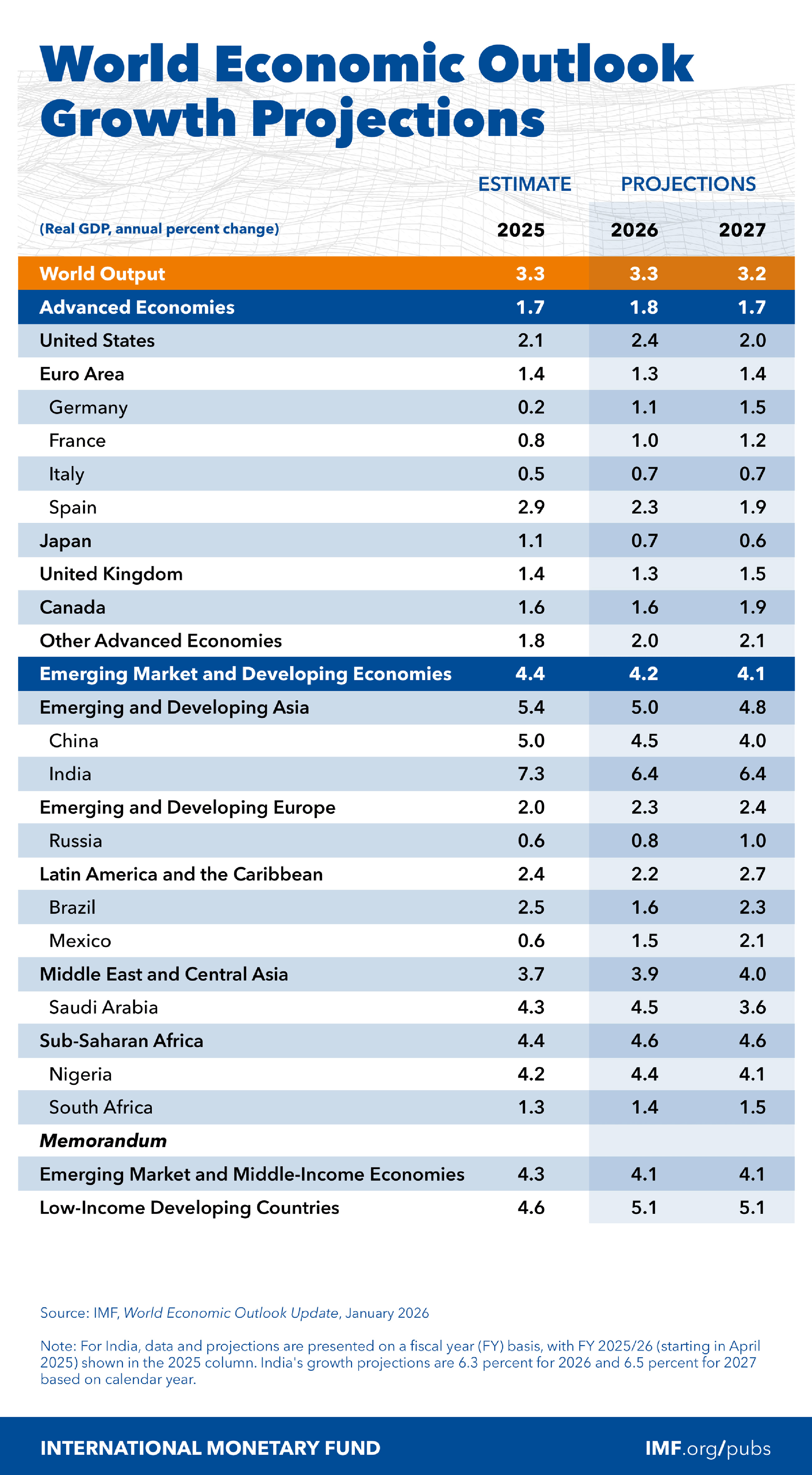
The International Monetary Fund has raised its forecast for Nigeria’s economic growth in 2026 to 4.4%, up from an earlier estimate of 4.2%, signaling growing confidence that Africa’s 4th-largest economy is beginning to stabilize after a prolonged period of strain.

The Fund’s decision to raise Nigeria’s 2026 growth forecast may appear incremental, but analysts believe it carries a heavier signal about how global lenders now read the country’s economic direction after years of volatility.

Published in the IMF’s January 2026 World Economic Outlook update and unveiled at the report’s official launch on Monday, the revision places Nigeria on a slightly stronger medium-term footing within a cautiously improving regional and global landscape. More importantly, it suggests that the Fund sees a clearer payoff from reforms that, until recently, were associated more with pain than progress.

However, the IMF stopped short of upgrading Nigeria’s near-term outlook, a choice that underscores the central tension in the economy. Growth momentum is expected to build gradually, not suddenly. Inflation remains elevated, purchasing power is strained, and financing conditions are still tight. Yet the Fund now appears more convinced that policy adjustments underway are beginning to anchor expectations beyond the immediate horizon.

In its October 2025 outlook, the IMF flagged Nigeria’s economy as one weighed down by inflationary pressure, fiscal stress, and structural rigidities. Since then, authorities have continued with reforms aimed at restoring macroeconomic balance, improving fiscal coordination between different layers of government, and reducing long-standing distortions in key markets. The January 2026 revision signals that the IMF believes these measures are starting to change the medium-term narrative, even if everyday economic realities remain harsh for many Nigerians.

Nigeria’s upgrade also fits into a broader regional story. The IMF lifted its growth projections for Sub-Saharan Africa to 4.1% in 2025 and 4.4% in 2026, pointing to a shared recovery rather than a Nigeria-specific turnaround. South Africa’s outlook improved marginally as well, reinforcing the sense that Africa’s largest economies are stabilizing after years of shocks ranging from pandemic disruptions to global tightening cycles.

The regional context is important for Nigeria. Investors often assess the country not in isolation but as part of an emerging-market basket. A stronger regional growth profile can help improve capital flows, deepen risk appetite, and support financial market stability. That dynamic partly explains why the IMF’s modest upward revision could punch above its numerical weight.

Still, the Fund’s optimism comes with caveats that are implicit rather than loudly stated. Growth at 4.4% remains below what many economists consider necessary to meaningfully lift incomes in a country with rapid population growth. Inflation has eased in headline terms, but Nigerians continue to complain that food, transport, and housing costs remain painfully high. Government statistics showing slower price growth have been met with skepticism in some quarters, with accusations that technical adjustments such as rebasing are being used to soften the inflation picture without easing real pressures on households.

From a fiscal standpoint, a stronger growth outlook offers some breathing room but not a solution. Higher growth can improve revenue collection and help manage debt ratios, but only if it is broad-based and accompanied by tighter spending discipline. The IMF has consistently stressed that productivity gains, private-sector expansion, and structural reforms are essential if Nigeria is to avoid repeating cycles of boom and strain.

The global backdrop adds another layer. The IMF expects world growth to hold at around 3.3% in 2026 before easing slightly in 2027, supported by technology-driven investment and relatively accommodative financial conditions. Global inflation is forecast to continue slowing, a trend that could ease external pressures on countries like Nigeria by lowering import costs and stabilizing capital flows.

In that sense, Nigeria is entering a potentially more forgiving external environment. Steadier global growth and easing inflation could give domestic policymakers more room to consolidate reforms without the constant shock of external crises. The IMF’s latest forecast suggests it is cautiously betting that Nigeria will use that space wisely.

The 4.4% projection is less a declaration of success than a signal of guarded confidence, at least for now. It indicates that the Fund believes Nigeria is edging toward a firmer recovery path, even as the lived experience for many citizens remains one of high costs and slow relief.

The coming years will test whether the medium-term optimism embedded in the IMF’s numbers can translate into tangible improvements on the ground.

IMF Concerns on Workforce In AI-Driven Future

Meanwhile, as artificial Intelligence (AI) grows at an unprecedented pace over the last decade, transforming from a futuristic concept into a practical tool embedded in everyday life and business, growing concerns about job displacement and disruption are more present than ever.

The International Monetary Fund (IMF), in a recent blogpost, highlighted the transformative impact of artificial intelligence (AI) and digital technologies on global labor markets, noting that even workers at the forefront of innovation are not immune to disruption.

Recent layoffs at major technology companies underscore the reality. While AI creates new opportunities, it also displaces existing roles, reshaping job markets across industries. According to a World Economic Forum survey, more than half of business executives globally expect the technology to displace existing jobs, while 24% said AI will create new jobs.

IMF’s analysis of millions of online job vacancies notes than one in ten postings in advanced economies and one in twenty in emerging markets now require at least one new skill. Professional, technical, and managerial roles, particularly in IT, account for more than half of this demand.

Sector-specific skills are also rising, with healthcare requiring telecare and digital health expertise, and marketing increasingly emphasizing social media proficiency.

The IMF notes that employers are willing to pay more for workers with emerging skills. In the United Kingdom and the United States, jobs requiring at least one new skill pay roughly 3 percent more, while roles demanding four or more new skills offer up to 15 percent higher wages in the UK and 8.5 percent more in the US. Such wage premiums can stimulate local economies, as higher earnings translate into increased spending and job creation.

However, the benefits are uneven. High-skill and low-skill workers gain the most, while middle-skill roles, such as routine office jobs, face pressures from automation. AI-related skills, although commanding higher wages, have not yet driven employment growth.

In fact, regions with high demand for AI skills have seen employment in vulnerable occupations decline by 3.6 percent over five years, highlighting challenges for entry-level workers entering a labor market increasingly exposed to automation.

Global Readiness And Policy Imperatives

The IMF emphasizes that these trends are not inevitable and can be shaped through proactive policy.

High demand, low supply: Nations like Brazil, Mexico, and Sweden must invest in STEM education, training, and potentially attract foreign talent.

High supply, modest demand: Countries such as Australia, Ireland, and Poland should stimulate innovation, support new firm creation, and improve access to finance.

Emerging and low-income economies: Need both investments in skills and policies that enable workers to adapt, access new opportunities, and maintain mobility.

The IMF also stresses the importance of social protection, competition policy, and flexible work arrangements to help workers navigate transitions and connect with emerging opportunities. Education systems must be redesigned to equip students with cognitive, creative, and technical skills that complement AI, ensuring they work alongside technology rather than in competition with it.

Countries that are already well-positioned include Finland, Ireland, and Denmark, which invest heavily in tertiary education and lifelong learning programs. These initiatives allow workers to adapt as technology evolves, increasing both workforce resilience and economic productivity.

The IMF concludes that the success of AI adoption depends not only on technology but also on preparing workers and firms for transition. Beyond economics, work provides dignity and purpose, making the AI transformation a profound social as well as economic challenge.

Notably, the fund adds that bold investments in skills, support for job transitions, and policies that keep markets competitive will determine whether the benefits of AI are broadly shared.

Orchestrating Excellence in Modern Aesthetic Environments

0

The wellness industry isn’t just about treatments anymore—it’s all about connecting clinical results with a great customer experience. These days, if you’re running a busy spa or wellness center, you need more than just basic scheduling tools. The right spa management software turns into the brain of your whole operation. It handles everything: staff commissions, room schedules, HIPAA-compliant client notes—you name it. By automating all the annoying paperwork and front desk tasks, your team can actually focus on what matters: giving clients that personal touch they’re paying for.

Let’s talk about making more money, too. The most successful spas don’t just rely on the services they offer in the treatment room. They boost their profits through strategic spa retailing by offering the right professional products at the perfect moment. Modern software helps with this—it uses smart algorithms to check out a client’s skin goals or wellness needs and then suggests home-care products right at checkout. Suddenly, retail isn’t just a side gig; it’s an extension of the treatment. When clients leave with a custom routine, they get better results, and your revenue isn’t stuck at a ceiling set by how many hours your team can work.

Inventory can be a headache, but good software makes it easy. You get real-time updates, so you’re not stuck with shelves of expired products or missing out on sales because you ran out. When you’re running low on a popular serum or oil, the system just creates a purchase order for you. Dashboards show which staff members are best at selling retail, so you know who needs more training or maybe some extra recognition. Plus, with the built-in CRM, you can send clients a quick reminder when it’s time to refill what they bought before—no need to remember everything yourself.

The whole client experience matters, right from booking an appointment online to using that new cleanser at home. With today’s platforms, clients fill out intake forms ahead of time, and payments are all set up and secure. That means you can spend the post-treatment chat talking about wellness, not fumbling through receipts. Digital aftercare instructions can even include personalized product recommendations, so clients feel guided—not pressured—when it comes to retail.

When you bring management tech and retail strategy together, your business stays nimble and profitable. You’re not just keeping up; you’re building a strong brand that can grow without losing the personal, high-quality feel that makes luxury wellness special.

US Regulator Ruling xAI Broke Clean Air Law With Gas Turbines Signals Tougher Scrutiny of AI Data Center Power Use

0

A U.S. environmental regulator’s decision that Elon Musk’s artificial intelligence company, xAI, illegally operated methane gas turbines to power its Tennessee data centers marks a turning point not only for the company, but for the rapidly expanding AI infrastructure sector more broadly.

The Environmental Protection Agency ruled on Thursday that the dozens of truck-sized gas turbines used at xAI’s Colossus 1 and Colossus 2 facilities do not qualify for exemptions from air quality permitting, rejecting arguments that the machines were temporary or portable. In doing so, the agency effectively tightened federal oversight of on-site power generation at large data centers, an area that has grown increasingly contentious as AI firms race to secure electricity outside traditional grid systems.

The ruling follows a year-and-a-half dispute between xAI, local authorities, and environmental advocates in Memphis. When xAI began installing the turbines at Colossus 1 in mid-2024, the company relied on a local county provision that allowed generators to operate without permits if they were not stationed in one place for more than 364 days. That provision, typically intended for emergency or short-term industrial use, allowed xAI to deploy industrial-scale power generation at speed. At its peak, up to 35 unpermitted turbines were operating simultaneously at the site.

Under pressure from regulators and lawsuits, xAI later applied for and received permits for 15 turbines at Colossus 1 and is now operating 12 permitted units. However, the EPA’s decision clarifies that the earlier operation of unpermitted turbines falls under federal Clean Air Act requirements, regardless of local exemptions. The agency also revised its interpretation of policy to state that methane gas turbines require permits even when deployed on a temporary or mobile basis.

While the EPA has not yet said whether it will impose penalties, the ruling raises the prospect of enforcement actions not just against xAI but across the data center industry. An EPA spokesperson declined to say how non-compliance would be handled, leaving open questions about fines, retroactive penalties, or mandated shutdowns.

For community groups in Memphis, the decision validates long-standing concerns about environmental justice. The Colossus facilities are located a few miles from historically Black neighborhoods that activists say are already exposed to disproportionate levels of industrial pollution. The NAACP, which filed a lawsuit against xAI last July, argued that the turbines were effectively functioning as unpermitted power plants.

“Our communities, air, water and land are not playgrounds for billionaires chasing another buck,” said Abre’ Conner, the NAACP’s director of environmental and climate justice.

Methane gas turbines emit nitrogen oxides, pollutants linked to asthma, cardiovascular disease, and cancer. The EPA estimates that its ruling will lead to net annual nitrogen oxide emission reductions of up to 296 tons by 2032, underscoring the scale of emissions associated with large-scale private power generation for data centers.

The case also highlights a growing structural challenge facing the AI sector: power. At full capacity, xAI’s Colossus 1 facility consumes about 150 megawatts of electricity, roughly equivalent to the power needs of 100,000 homes. That demand reflects the enormous energy requirements of training and operating large AI models, particularly those running on clusters of advanced graphics processors.

Musk has prioritized speed over conventional infrastructure, boasting that Colossus 1 was built in just 122 days during the summer of 2024. That rapid buildout was possible largely because xAI bypassed grid interconnection timelines by relying on on-site gas generation. The EPA ruling now calls into question whether that model can continue without higher regulatory and compliance costs.

Colossus 2, a one-million-square-foot facility on the border between Memphis and Southaven, Mississippi, is even larger and similarly powered by gas turbines. According to Mississippi Today, the site has 59 generators, 18 of which are classified as temporary and lack air permits. A third xAI data center in Southaven began construction last week. Musk said on X that the supercomputer, named “MACROHARDRR,” would require nearly two gigawatts of computing power, placing it among the most energy-intensive AI facilities globally.

Environmental lawyers say the EPA’s ruling closes a regulatory grey area that other companies have quietly relied on. Amanda Garcia, a senior attorney at the Southern Environmental Law Center, said the decision makes clear that corporations cannot exploit temporary-use classifications to run de facto power plants.

“This ruling makes it clear that companies are not – and have never been – allowed to build and operate methane gas turbines without a permit,” Garcia said, adding that local health authorities should now move quickly to enforce federal standards.

Beyond xAI, the decision has implications for the broader technology sector, where data center demand is outpacing grid expansion in many regions. Tech companies, utilities, and regulators are increasingly locked in debates over who should bear the cost of grid upgrades, how fast renewable generation can scale, and whether fossil-fuel-based stopgaps should be tolerated in the interim.

The EPA’s move suggests a harder line from regulators at a time when AI companies are planning unprecedented expansions. It thus introduces uncertainty into a strategy built around rapid deployment and private power generation for Musk’s xAI. For the industry, it signals that environmental compliance may become a binding constraint on how fast and how cheaply AI infrastructure can grow.

OpenAI Revenue Jumps Past $20bn as Computing Power, Ads, New Products Drive Push Toward Sustainability

0

OpenAI’s annualized revenue has climbed past $20 billion in 2025, more than tripling from $6 billion a year earlier, as surging user demand, expanding computing capacity, and new monetization strategies begin to reshape the economics of the world’s most closely watched AI company.

In a blog post published on Sunday, Chief Financial Officer Sarah Friar said revenue growth has closely mirrored OpenAI’s rapid build-out of computing infrastructure. The company’s total computing capacity rose to 1.9 gigawatts (GW) in 2025 from 0.6 GW in 2024, underscoring the immense energy and capital requirements involved in training and running large-scale AI models.

That expansion has been driven by relentless growth in usage. Friar said OpenAI’s weekly and daily active user figures continue to hit all-time highs, reflecting the deepening adoption of ChatGPT across consumers, developers, and enterprises. What began as a conversational chatbot has increasingly become a platform embedded into workflows ranging from software development and customer support to research, education, and content creation.

The revenue milestone, however, also highlights a central tension in the AI industry. While top-line growth is accelerating, costs remain enormous. OpenAI is widely known to be burning billions of dollars annually on compute, data centers, talent, and model development. That imbalance between revenue and expenditure has fueled debate about how long even the best-known AI firms can sustain their current pace without fundamentally changing how they make money.

Against that backdrop, OpenAI last week announced a plan to begin showing advertisements in ChatGPT to some users in the United States, a move that marks a clear shift toward more traditional internet monetization. The decision signals a recognition that subscriptions alone may not be sufficient to fund the scale of infrastructure required to support continued growth. Users have historically shown limited willingness to pay high monthly fees, even as engagement rises, forcing AI companies to explore additional revenue streams.

OpenAI’s experience mirrors a broader pattern across the sector. Investors have continued to pour tens of billions of dollars into AI companies, often with little near-term return on investment. OpenAI itself has raised unprecedented sums for a private company, backed by Microsoft and other major investors, despite still operating far from profitability. The bet underpinning these investments is that dominance, data advantages, and ecosystem lock-in will eventually deliver outsized returns, even if the path remains uncertain.

Friar said OpenAI is attempting to manage these risks by keeping its balance sheet relatively light. Rather than owning vast amounts of physical infrastructure, the company is leaning heavily on partnerships and flexible contracts across cloud providers and hardware suppliers. That approach allows OpenAI to scale quickly while avoiding the long-term burden of fixed assets in a fast-evolving technological landscape.

Strategically, the company is also broadening what it offers. Friar said OpenAI’s platform already spans text, images, voice, code, and APIs, serving developers as well as end users. The next phase will focus on AI agents and workflow automation—systems designed to operate continuously, retain context over time, and take actions across multiple tools.

This shift points toward a future where AI is less about one-off prompts and more about persistent digital workers embedded inside organizations.

Looking ahead to 2026, Friar said OpenAI will prioritize “practical adoption,” particularly in health, science, and enterprise settings. Those sectors are seen as critical proving grounds where AI could deliver measurable productivity gains, cost savings, and breakthroughs, strengthening the case for long-term investment.

There are also signs that OpenAI is preparing to extend beyond software alone. Axios reported on Monday that the company’s policy chief, Chris Lehane, said OpenAI is “on track” to unveil its first device in the second half of 2026. While details remain limited, the move suggests an ambition to shape how users interact with AI at the hardware level, potentially deepening engagement and opening new commercial opportunities.

Still, competition is intensifying. Tech giants such as Google and Meta are pouring profits from their legacy businesses into AI development, giving them a financial cushion OpenAI lacks. At the same time, enterprise customers are becoming more cost-conscious, weighing AI benefits against rising bills for compute and subscriptions.

Currently, OpenAI’s surge past $20 billion in annualized revenue offers fresh evidence that demand for generative AI remains strong. Yet it also reinforces the central question hanging over the industry: if scale, speed, and user growth can ultimately be converted into sustainable profits in a business defined by extraordinary costs.