DD
MM
YYYY

PAGES

DD
MM
YYYY

spot_img

PAGES

Home Blog Page 237

$10K in BTC Might Double—Ozak AI Could 100x the Same Amount

0

Crypto traders realize that bull markets create exceptional opportunities—however, how capital is located could make all of the difference between precise returns and life-changing ones. Bitcoin stays the most relied on and dominant asset within the market, able to deliver consistent and dependable profits as institutional demand grows.

But even as BTC can double in value all through a robust cycle, early-stage projects often supply the most important multipliers. That’s why many investors and whales are looking to allocate a slice of their Bitcoin profits into Ozak AI, a rising AI-pushed project with 100x ability.

Bitcoin (BTC)

Bitcoin is presently trading around $114,246 and displaying robust bullish momentum. Key resistance levels sit down at $120,000, $132,500, and $150,000, even as solid support holds at $107,000, $101,800, and $96,000.
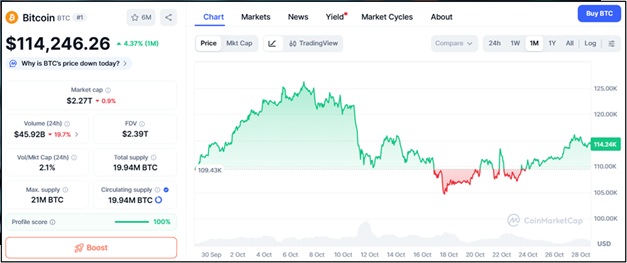
This price structure reflects a healthy and growing market, fueled by way of institutional inflows, ETF demand, and increasing macro confidence in BTC as a store of price. Many analysts trust Bitcoin ought to realistically double in the next bull leg, probably accomplishing or surpassing the $125K–$150K variety. For buyers searching for stability and dependable returns, Bitcoin remains a cornerstone asset.

Why Investors Look Beyond Bitcoin for Bigger Gains

While Bitcoin is powerful, it’s rarely the top-performing asset during a bull run. Historically, once BTC rallies, profits often rotate into altcoins with higher upside. This happened with Ethereum, Solana, and even Shiba Inu in previous cycles.

Investors who positioned early in such assets saw returns many multiples higher than those who stayed solely in BTC. That’s why smart money is now scanning for early-stage projects with explosive potential—and Ozak AI is increasingly at the center of that conversation.

Ozak AI’s Presale Creates Rare Early Presale Entry

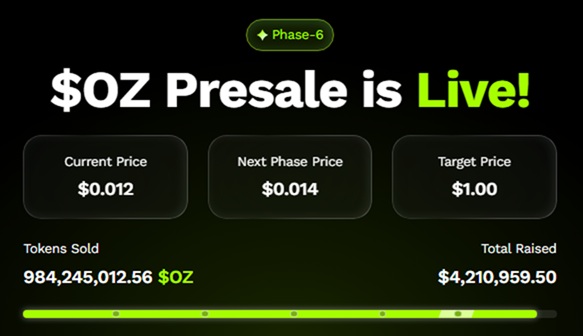
Ozak AI is currently in its 6th OZ presale stage at $0.012, having already raised over $4.2 million and sold more than 980 million tokens. What’s driving this momentum isn’t just hype but a powerful AI + crypto narrative with real utility.

Ozak AI’s AI-powered prediction agents are designed to deliver real-time trading signals, intelligent market insights, and automated strategies, giving traders a competitive edge. Early-stage pricing means that even modest allocations can turn into massive upside if the project performs as expected.

Ozak AI’s growing credibility is backed by its partnerships with Perceptron Network, HIVE, and SINT. These alliances enhance its predictive infrastructure, expand data processing power, and ensure deeper integration into blockchain ecosystems. This isn’t just a speculative token—it’s a project with a technological foundation and a clear growth vision that appeals to both retail investors and whales.
$10K in BTC vs. $10K in Ozak AI

A $10,000 investment in Bitcoin could reasonably double to $20,000 if BTC reaches the upper end of its next target range. That’s a solid return for a blue-chip crypto. But the same $10,000 allocated to Ozak AI at its early presale price carries the potential to 100x, turning it into $1 million if the project performs as forecasted. This asymmetric risk-reward profile is why whales are quietly rotating a portion of their BTC gains into early-stage altcoins like Ozak AI.

As the 2025 bull run approaches, the smartest investors aren’t abandoning Bitcoin—they’re leveraging it as a base while positioning themselves into high-upside projects. Ozak AI is fast becoming one of the most promising plays in that category, offering both narrative strength and technological substance to back its explosive growth potential.

About Ozak AI

Ozak AI is a blockchain-based crypto project that offers a technology platform that specializes in predictive AI and advanced facts analytics for financial markets. Through machine learning algorithms and decentralized community technology, Ozak AI enables real-time, accurate, and actionable insights to help crypto enthusiasts and businesses make the precise decisions.


For more, visit:

Website: https://ozak.ai/

Telegram: https://t.me/OzakAGI

Twitter: https://x.com/ozakagi
How to Sell Cryptocurrency Without Rushing Into Mistakes

0

In the world of digital assets, speed is often seen as an advantage. Markets move quickly, and prices can change within seconds. This constant motion convinces many traders that selling fast is always the right choice. Yet rushing can lead to serious mistakes. Understanding how to sell cryptocurrency properly means learning when to act and when to wait, recognizing that patience often protects profits better than impulsive decisions.

Why Rushing Feels Tempting
Volatility creates urgency. A sudden price drop sparks panic, while a rapid surge triggers fear of missing out. Sellers rush into trades believing that hesitation will cost them everything. This emotional pressure is powerful, especially for beginners. But mastering how to sell cryptocurrency requires resisting these impulses and remembering that not every movement demands immediate action.

The Real Costs of Acting Too Quickly
Selling without preparation often results in disappointing outcomes. Hidden fees reduce profits, withdrawal charges eat into returns, and poor timing can mean exiting just before the market rebounds. Many traders who rush later regret their decisions, realizing that a few extra hours of analysis would have saved them money. Anyone asking how to sell cryptocurrency responsibly must calculate costs and assess conditions before confirming a transaction.

The Value of Strategic Planning
Patience allows for planning, and planning transforms selling into a deliberate act. Setting clear price targets, identifying acceptable risks, and deciding in advance when to exit eliminates the chaos of rushed decisions. With a strategy in place, the question of how to sell cryptocurrency becomes less stressful. Sellers can act confidently, knowing that their choices align with long-term goals rather than short-term emotions.

Tools That Support Patience
Modern platforms offer features that help traders avoid rushing. Stop-loss orders trigger automatic sales if prices fall too far, while limit orders execute only at predetermined levels. These tools reduce emotional pressure by handling decisions mechanically. For those exploring how to sell crypto, using automation is a way to stay disciplined even when markets become unpredictable.

When Waiting Brings Better Results
Sometimes the wisest decision is to wait. Prices often fluctuate before settling, and selling too early can mean missing out on stronger gains. Experienced investors understand that patience can turn small profits into significant returns. The ability to step back and observe rather than act immediately is one of the most valuable skills in learning how to sell crypto.

Turning Patience Into Confidence
The real benefit of slowing down is not just better timing but greater confidence. Sellers who plan, wait, and execute carefully feel more in control of their financial journey. Instead of regretting rushed sales, they build habits that strengthen every future transaction. They learn that how to sell cryptocurrency effectively is not about speed but about discipline, perspective, and balance.

Selling too quickly is one of the most common errors in the digital market. By slowing down, planning carefully, and using the tools available, traders transform selling from a reaction into a strategy. In a world where markets move faster than ever, patience is not a weakness — it is a decisive advantage.

A Foray Into France Bitcoin’s Reserve Bill

0

The French National Assembly debated a landmark cryptocurrency bill introduced by Éric Ciotti, leader of the center-right Union of the Right and Centre (UDR) party.

This is the first comprehensive legislative proposal on crypto in France, positioning Bitcoin as “digital gold” to enhance financial sovereignty amid global economic shifts.

The bill proposes creating a national Bitcoin Strategic Reserve equivalent to 2% of Bitcoin’s total supply—approximately 420,000 BTC valued at around $48 billion at current prices—accumulated over 7–8 years.

However, no formal vote occurred during the debate; the bill is now advancing to committee stages for review, amendments, and potential parliamentary voting, which could take weeks or months.

The proposal is structured around three pillars: building the reserve, promoting stablecoins, and supporting the crypto industry. Public mining using surplus nuclear/hydroelectric energy; retain seized BTC from legal proceedings instead of auctions.

It allocate 25% of inflows from popular savings schemes via Livret A and LDDS for daily purchases ~€15M/day, or ~55,000 BTC/year; allow tax payments in BTC pending constitutional review.

Euro-Denominated Stablecoins; Recognize stablecoins as payment alternatives to Visa/Mastercard. Daily payment cap: €200 tax- and contribution-free. Authorize tax payments in euro stablecoins.

EU advocacy for ease MiCA regulations for issuance by European banks/companies; oppose the EU’s digital euro (CBDC) as overly centralizing. This reduces barriers for mining and institutional adoption.

Adjust electricity taxes: Progressive excise based on price tiers; flexible tariffs for mining data centers. It allows Bitcoin/crypto ETNs in PEA plans; revise EU rules to enable “Lombard” loans backed by crypto current risk weighting up to 1,250%.

The bill ties into France’s energy strengths, emphasizing sustainable mining (Bitcoin now uses 58% renewables globally) and protecting domestic firms from foreign takeovers, like U.S. bids for French miners.

UDR holds only 16 of 577 seats in the National Assembly, limiting its influence. The bill is an independent initiative, not tied to the ongoing Finance Bill, and lacks cross-party support.

Environmental concerns over energy use, skepticism from the ruling majority, and EU coordination hurdles could lead to amendments or rejection. Analysts estimate low passage odds in its current form, but it tests political appetite for crypto amid U.S. trends such as Trump’s pro-Bitcoin stance.

If advanced, France could lead Europe in sovereign Bitcoin adoption, following models like El Salvador (3,000+ BTC) or Bhutan (13,000 BTC). It aligns with France’s 70+ licensed crypto firms and ambitions for EU crypto dominance.

El Salvador pioneered national Bitcoin adoption in 2021 by making it legal tender, while Bhutan has quietly built a substantial reserve through sustainable mining since 2019.

France’s proposed bill, debated in late October 2025, aims to create a strategic Bitcoin reserve but remains in early stages without a vote. All three leverage Bitcoin as a hedge against economic volatility—El Salvador for financial inclusion, Bhutan for diversification amid tourism slumps, and France for sovereignty in a shifting global landscape.

El Salvador employs dollar-cost averaging (DCA) with one BTC daily purchase for over 1,000 days, plus bulk buys during dips and geothermal mining ~474 BTC. Funding came from sovereign bonds and remittances via the Chivo wallet.

Despite a 2024 IMF $1.4B loan requiring reduced public accumulation, the government continues via non-governmental entities, adding ~12–13 BTC monthly in early 2025. Recent moves include dispersing reserves across 14 addresses for security.

Bhutan: Focuses on green mining using abundant hydropower via Druk Holdings & Investments, the sovereign wealth fund, avoiding direct market buys. This low-cost approach has yielded 12,000 BTC peak, with expansions via partnerships like Bitdeer target: 600 MW capacity by H1 2025.

Unlike pure HODLers, Bhutan sells portions (350–512 BTC) during price surges like $59M in July 2025 at $123K/BTC to fund salaries and imports, treating BTC as both reserve and cash flow tool.

France: Proposes a multi-pronged, sustainable model: public mining with surplus nuclear/hydro energy; retaining seized BTC from crimes vs. auctions; 25% of daily inflows from popular savings accounts and optional BTC tax payments. This avoids heavy debt reliance, emphasizing energy efficiency.

Mining in Bhutan bolsters a tourism-dependent economy hit by COVID revenue down 70%, generating revenue without mandates. Holdings ~40% GDP fund public salaries and diversification into ETH/BNB; one city adopted a crypto reserve in Jan 2025.

France aims for institutional integration and stablecoin promotion to rival Visa/Mastercard, opposing EU CBDCs. Could protect 70+ French crypto firms from foreign takeovers, but environmental pushback and EU rules pose hurdles. No adoption data yet; focus on sovereignty amid U.S. trends.

France’s proposal, if realized, could scale this to a G7 economy, blending mining innovation with fiscal tools—but success hinges on parliamentary buy-in. As BTC surges, these strategies highlight Bitcoin’s evolution from fringe asset to sovereign tool, with unrealized gains proving prescient amid inflation and de-dollarization fears.

Co-founder of The Big Whale, detailed the bill’s provisions in a viral thread, noting its role in defending French crypto interests. NekoZ called it a “MAJOR shift,” emphasizing opposition to the digital euro.

Mounir Laggoune, CEO of Finary, analyzed the Livret A funding angle as “surprising” but innovative for autonomy. This development underscores growing governmental interest in Bitcoin as a reserve asset, even if the path forward remains uncertain.

From Ethereum to Solana and Beyond: How Mono Protocol Creates a Unified Balance Across Chains

0

Mono Protocol is reshaping how blockchains connect and communicate. The project’s crypto presale has advanced to Stage 15, raising $2.83 million of a $3 million goal. Tokens are now priced at $0.0450, while the launch price remains $0.500, offering early backers a potential 1011% return.

Unlike typical presale crypto campaigns focused on quick speculation, Mono Protocol introduces a cross-chain system where users can view and manage every digital asset from a single account. The platform merges balances from Ethereum, Solana, and other networks, transforming blockchain use into one streamlined experience.

Unified Balances and Seamless Transfers

Mono Protocol’s web3 crypto presale centers on chain abstraction — a framework that hides the differences between networks. Users can swap, send, or stake tokens across supported chains without changing networks or using bridges. Each transaction becomes a single-click operation that saves time and lowers costs.

The network connects to WalletConnect, Chainlink, Celestia, and LI.FI, ensuring accurate routing and reliable transfers. This setup prevents failed transactions and enables instant settlements. With this structure, Mono Protocol simplifies decentralized finance and enhances real-time usability across chains.

Its unified account design also helps developers build multi-chain applications without maintaining several integrations. This focus on practicality has positioned Mono among the most functional new crypto presale projects of 2025.

Rewards Hub and Ecosystem Expansion

Following its official launch, Mono Protocol introduced the Rewards Hub, a platform rewarding early participants with measurable engagement points. These rewards recognize user activity and contribution to ecosystem growth.

The next development phase includes onboarding decentralized applications, expanding liquidity networks, and integrating more blockchains such as Solana and Base. Governance participation, staking, and validator incentives are also part of the near-term rollout, extending the utility of the presale coin beyond initial fundraising.

Token Design and Long-Term Development

The native MONO token powers the ecosystem as both a payment and governance asset. Half of the total supply is allocated to cryptocurrency presales, with 10% each for liquidity and marketing. Remaining allocations go to community incentives, team rewards, and treasury reserves.

Mono Protocol finalized its technical base in 2025, completing the architecture for unified balances and MEV-resilient execution. The roadmap now focuses on scaling through SDK upgrades and network partnerships. As adoption rises, its consistent performance across chains distinguishes it from outdated pre sale cryptocurrency systems that rely on bridges and manual transfers.

Transparent Framework and Global Access

Investors can participate in the crypto presales using more than 200 assets, including ETH, BNB, USDT, and USDC. All progress metrics, wallet addresses, and contracts are visible through the official dashboard, promoting accountability and verifiable reporting.

This transparent design appeals to both developers and retail investors seeking credibility before joining any presale cryptocurrency. The project’s stage-based structure offers predictable pricing and helps participants measure potential returns without hidden variables.

The Road Ahead

Mono Protocol’s presale crypto campaign continues to attract attention worldwide. Its chain abstraction and cross-network balance system form the foundation for a more accessible Web3 experience.

As Stage 15 nears full allocation, the project is moving toward ecosystem scaling and developer integration. With clear tokenomics, functional technology, and real use cases, Mono stands out among leading cryptocurrency presales of 2025.

By linking Ethereum, Solana, and other blockchains through one unified balance, Mono Protocol could redefine how users experience Web3 — replacing fragmentation with a seamless, connected network.

Learn More about Mono Protocol


Website: https://www.monoprotocol.com/

X: https://x.com/mono_protocol

Telegram: https://t.me/monoprotocol_official

LinkedIn: https://www.linkedin.com/company/monoprotocol/

Nvidia Becomes First Company to Hit $5tn Valuation as AI Boom Drives Record Market Rally

0

Nvidia on Wednesday became the first company in history to cross the $5 trillion market capitalization threshold, capping a meteoric rise that underscores its central role in the artificial intelligence revolution and its dominance in the global semiconductor industry.

Shares of the Santa Clara-based tech giant surged more than 4% during trading, extending gains from Tuesday when the stock closed up 5%. Nvidia’s valuation milestone marks another high point in a rally that has already lifted its shares more than 50% year-to-date, making it the world’s most valuable company and the biggest beneficiary of the ongoing AI investment wave.

The company’s remarkable ascent—from a maker of graphics processors for video games to the undisputed leader in AI computing—has reshaped global markets and investor sentiment. Nvidia’s chips now power everything from OpenAI’s large language models to supercomputers used in scientific research, defense, and autonomous driving.

The latest rally came shortly after CEO Jensen Huang revealed that Nvidia expects to receive $500 billion in AI chip orders, an outlook that further boosted investor optimism about long-term demand. Huang also announced that the company will build seven new supercomputers for the U.S. government, strengthening its leadership in the race for advanced AI infrastructure.

Separately, Nvidia disclosed a major new investment, taking a $1 billion stake in Nokia as part of a strategic partnership to develop next-generation 6G cellular technology. The collaboration will focus on integrating AI into future telecommunications systems, signaling Nvidia’s intention to extend its reach beyond data centers and cloud computing into core network infrastructure.

The company’s $5 trillion milestone also comes amid a broader surge across the U.S. stock market, largely fueled by AI-related optimism. On Tuesday, all three major indexes closed at record highs, driven by gains in technology stocks. Apple and Microsoft each topped the $4 trillion valuation mark, joining Nvidia in a record-setting trio that now dominates global equity markets.

The extraordinary rally, however, has raised concerns among economists and regulators about the sustainability of current valuations. Both the International Monetary Fund (IMF) and the Bank of England recently warned that global stock markets could face sharp corrections if investor appetite for AI-driven assets begins to cool.

Even amid those warnings, leading investors remain bullish on AI’s long-term potential. Cathie Wood, CEO of Ark Invest, acknowledged the possibility of a short-term “reality check” but dismissed fears of an AI bubble. Speaking to CNBC on the sidelines of the Future Investment Initiative (FII) summit in Riyadh on Tuesday, Wood said: “If our expectations for AI are correct, we are at the very beginning of a technology revolution.”

Some analysts believe Nvidia’s ascent to $5 trillion represents more than just a symbolic milestone—it reflects a structural shift in the global economy, where artificial intelligence, semiconductors, and computing infrastructure have become the new cornerstones of growth and innovation.

With demand for AI chips still accelerating, Nvidia’s next challenge will be to maintain its technological lead amid intensifying competition from rivals such as AMD, Intel, and a growing list of AI-focused startups. But for now, its record valuation stands as the clearest testament to the scale of the AI-driven transformation sweeping across global markets.