DD
MM
YYYY

PAGES

DD
MM
YYYY

spot_img

PAGES

Home Blog Page 2435

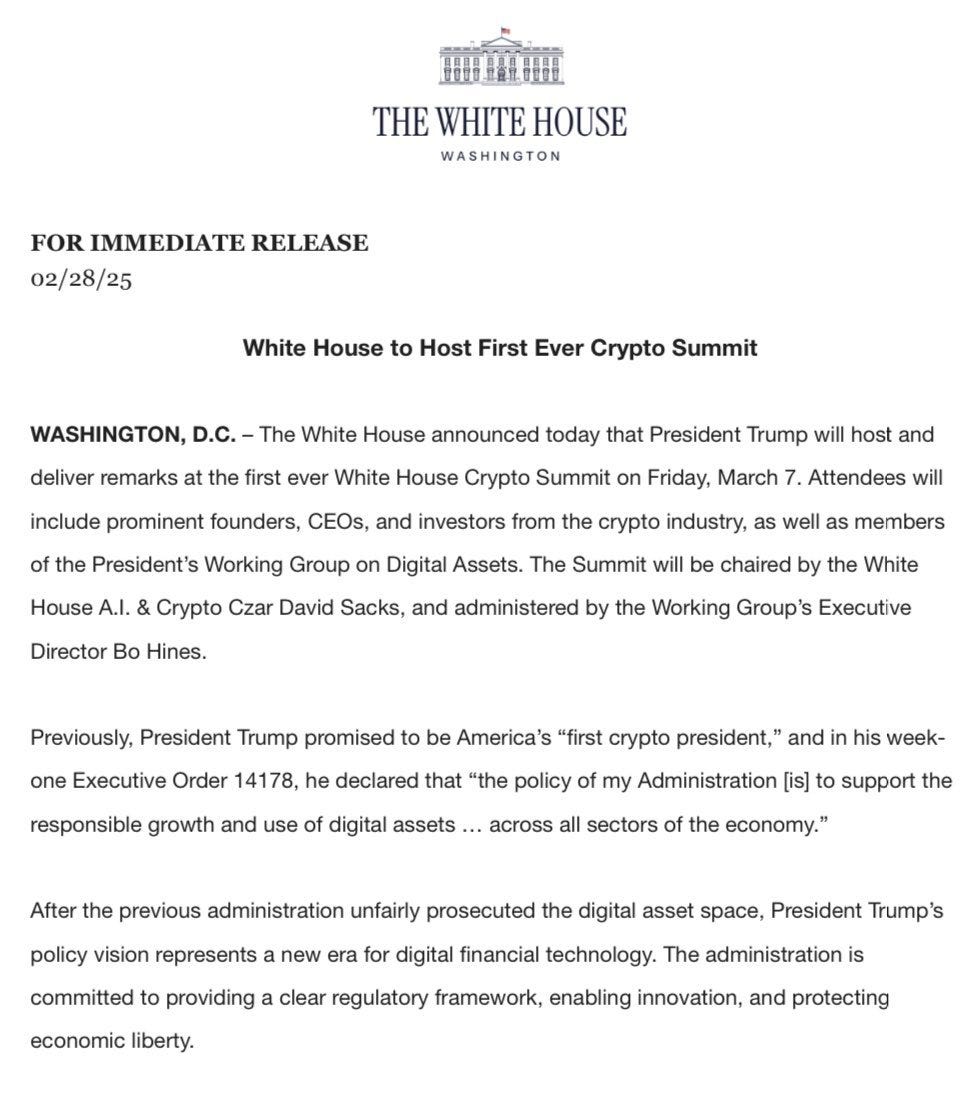
President Trump to Host Whitehouse Crypto Summit on Friday

0

President Donald Trump will host and deliver remarks at the first-ever White House Crypto Summit on Friday, March 7, 2025. The summit will include prominent founders, CEOs, and investors from the crypto industry, as well as members of the President’s Working Group on Digital Assets. It will be chaired by White House A.I. & Crypto Czar David Sacks and administered by the Working Group’s Executive DirectorBo Hines.

President Trump signed Executive Order 14178 shortly after taking office, establishing a policy to support the “responsible growth and use of digital assets, blockchain technology, and related technologies across all sectors of the economy.” This order revoked Executive Order 14067 (March 9, 2022), which focused on ensuring responsible development of digital assets under the previous administration and directed the Treasury Department to revoke its “Framework for International Engagement on Digital Assets” from July 7, 2022.

The order explicitly prohibits the establishment of Central Bank Digital Currencies (CBDCs) in the U.S., citing threats to financial stability, individual privacy, and U.S. dollar sovereignty. It emphasizes protecting citizens’ ability to use public blockchain networks, promoting U.S. dollar sovereignty through stablecoins, and ensuring fair access to banking services for crypto companies.

The executive order created a Working Group on Digital Assets, chaired by White House A.I. & Crypto Czar David Sacks and administered by Executive Director Bo Hines. The group includes officials from key agencies such as the Treasury Department, Department of Justice, Securities and Exchange Commission (SEC), and Commodity Futures Trading Commission (CFTC). Within 180 days of the order, the Working Group is tasked with submitting a report to the President, proposing a federal regulatory framework for digital assets, including:

Governance of the issuance and operation of digital assets, such as stablecoins. Market structure, oversight, consumer protection, and risk management. Evaluation of a national digital asset stockpile, potentially using cryptocurrencies seized through law enforcement efforts, and criteria for establishing such a stockpile.

The summit, hosted by President Trump, aims to bring together prominent founders, CEOs, investors from the crypto industry, and members of the Working Group to discuss regulatory policies. It is expected to provide clarity on upcoming crypto regulations, with a focus on:

Stablecoin Regulation: There is significant interest in creating a regulatory framework for stablecoins to extend the U.S. dollar’s dominance internationally and ensure consumer protection.

Bitcoin and Digital Asset Reserves: The summit may address the feasibility and structure of a U.S. Strategic Crypto Reserve, which Trump has indicated will include Bitcoin (BTC), Ethereum (ETH), XRP, Solana (SOL), and Cardano (ADA), among other “valuable cryptocurrencies.” This aligns with state-level initiatives in at least 24 U.S. states exploring Bitcoin reserves.

Regulatory Clarity and Innovation: The administration is committed to providing a “clear regulatory framework” that enables innovation, protects economic liberty, and prevents the regulatory overreach seen under the previous Biden administration, which faced criticism for aggressive enforcement against crypto firms.

The SEC, under acting Chair Mark Uyeda, has taken steps to signal a pro-crypto stance, including Creating a “Crypto Task Force” to clarify the regulatory framework for crypto assets. Rescinding Staff Accounting Bulletin No. 121 (SAB 121), which had required crypto custodians to treat held assets as liabilities on their balance sheets, a move seen as stifling institutional adoption. This was replaced with new guidance (SAB 122) to encourage crypto custody.

Dropping or pausing lawsuits and investigations against major crypto firms like Coinbase, Binance, ConsenSys, Gemini, Uniswap and the Tron Foundation, reflecting a shift away from the Biden-era crackdown on fraud and money laundering. The administration has also pushed for bipartisan crypto-friendly legislation, with some Republican senators advocating to remove IRS reporting requirements for decentralized finance and new rules from the Consumer Financial Protection Bureau for digital wallets.

President Trump has positioned himself as “America’s first crypto president,” aiming to make the U.S. the “crypto capital of the world.” His administration seeks to reverse the previous administration’s tough regulatory approach, which included lawsuits against exchanges like FTX, Coinbase, and Binance, and to foster an environment where digital financial technology can thrive.

The policy emphasizes technology-neutral regulations, transparent decision-making, and well-defined jurisdictional boundaries to support a vibrant digital economy, permissionless blockchains, and distributed ledger technologies. The crypto community remains divided, with some skeptical of the administration’s motives, given Trump’s past criticism of crypto as a ”scam” and his family’s involvement in memecoins.

The Whitehouse Crypto event aims to support the responsible growth and use of digital assets across all sectors of the economy, reflecting President Trump’s commitment to providing a clear regulatory framework, enabling innovation, and protecting economic liberty in the digital financial technology space.


Shopping, Dining, and More with Digital Coins

0

While they were a mostly novel concept years ago, digital assets have become much more mainstream. 2024, for example, saw major tokens like Bitcoin reaching new all-time highs, the approval of spot ETFs in the United States, and more visibility for the asset class than ever before.

But do you know all the things that you can do with cryptocurrency? Those who are newer to the industry might assume that its use cases are limited but this is far from the truth. In this article, we’ll touch on some of the things you can do with digital coins.

– Investment

One of the most popular things to do with digital coins is to use them as an investment vehicle. While some traditional investors might be sceptical, they have more than proven themselves over the years. For example, Bitcoin was declared the highest-performing asset of the 2010s, even beating out legacy assets like gold. The good thing about cryptocurrencies is that you will never be short of options, allowing investors to find more options to put their money into. So, anyone looking to diversify their Investments should consider cryptocurrency.

– Gambling

Another exciting way to use your digital coins is for online gambling. Many online casinos now accept cryptocurrency, offering players a fast, secure, and often more anonymous way to place their bets. Bitcoin casinos, in particular, have gained popularity due to their provably fair gaming systems, lower transaction fees, and faster payouts compared to traditional fiat-based platforms. Whether you enjoy slots, poker, or live dealer games, there are plenty of options to explore. To find the best platforms that support Bitcoin and other digital assets, read this page for a curated list of top-rated Bitcoin casinos.

– Dining

Fun fact:  one of the first-ever purchases made with Bitcoin was of two Papa John’s pizzas. Today, the amount spent on those pizzas is worth millions of dollars and there are more options to spend crypto on food than ever before.

Major brands like Starbucks, KFC, and Burger King in different countries have begun accepting cryptocurrency for their products, which means that you can dine using digital coins. Local establishments are also known to accept cryptocurrency, though this is obviously on a case-by-case basis. If you’d like to spend your cryptocurrency on dining, you are best off reaching out to the establishments in your area to see which accepts them.

– Booking Hotels

Just like with food, there is a growing number of avenues through which you can book hotels and other accommodations using cryptocurrency. One of the most common is Travala, which accepts not only third-party tokens but has its own native token. Several independent and forward-thinking hotels also now accept cryptocurrency for bookings, so this is something to look into. Usually, all you need to do is select your room of choice and select cryptocurrency as your payment method at checkout. As cryptocurrency becomes even more popular, the number of hotels you can book using it will increase.

– Shopping

These days, you can pay for all sorts of consumer goods using cryptocurrency and this works in several ways. Brands like Microsoft have started accepting cryptocurrency directly but there is also the option to go through gift card platforms. Sites like Bitrefill sell gift cards for major brands like the Apple app store, Starbucks, Nike, and so on. These allow customers to buy gift cards using cryptocurrency, so you can access all these different businesses using your digital assets. What’s more, you can buy these for yourself or gift them to others. Over time, more retailers should begin accepting cryptocurrency directly, Plus the rise of crypto-backed credit and debit cards means that you can shop with crypto as easily as you would fiat currency.

– Paying Bills

One of the most consistent expenses we deal with is our bills and utilities. But did you know that you can pay for these using cryptocurrency? Sites like RelayPay allow customers to set up direct debits for their bills such as electricity, streaming services, and so on. What’s more, the accounts that make these payments can be funded with cryptocurrency. By depositing crypto onto these platforms, your tokens are converted to fiat currency and then automatically deducted when your bills are due. Those who are very committed to using their cryptocurrency for recurring expenses will find this to be a big benefit.

– Book Travel

Booking flights, trains, cabs, and so on can be done with cryptocurrency these days. Sites like Alternative Airlines, Travala, and others allow customers to book travel using crypto alongside fiat currency. Just like with hotels, all it takes is selecting the flight you want to book and choosing cryptocurrency as your payment method at checkout.  Those who want to put their tokens to good use or want to unlock rewards by paying with crypto should definitely consider this. While no major airlines accept crypto currently, some industry experts believe that this will change over time.

Conclusion

Digital assets can unlock a world of potential and use cases. As we’ve pointed out in this article, there are so many things you can do with your digital assets. From spending them on food and entertainment to investing in them, you should seek to take advantage of these assets and use them to their full potential.

Zhipu AI Secures Over 1bn Yuan In State-backed Funding Amid China’s Booming AI Race

0

In a bold stride that underscores the intensifying artificial intelligence (AI) race in China, Beijing-based startup Zhipu AI has raised over 1 billion yuan ($137.22 million) in fresh funding.

This new investment, which comes just months after a 3 billion yuan infusion, signals strong investor confidence as Chinese AI firms vie for supremacy in a rapidly evolving market.

The latest funding round saw participation from state-backed entities, including Hangzhou City Investment Group Industrial Fund and Shangcheng Capital, according to a WeChat statement from Zhipu AI on Monday. The company plans to use the funds to enhance its Generative Language Model (GLM) and expand its AI ecosystem, particularly targeting businesses in Zhejiang province and the Yangtze River Delta economic zone.

China’s AI Strategy for Building Domestic Resilience through Competition

While much of the world remains cautious about Chinese technology—especially AI—over concerns ranging from data privacy to geopolitical risks, Beijing is adopting a strategic approach to building a resilient domestic AI market. Instead of backing a single national champion, the Chinese government appears to be cultivating a competitive ecosystem by supporting numerous startups.

At the forefront of this strategy is Hangzhou, a city positioning itself as a major AI hub. Hangzhou City Investment Group’s participation in Zhipu AI’s latest funding round highlights the eastern Chinese city’s active role in fostering AI innovation. The city’s push is underscored by its year-old industrial fund and its support for multiple AI ventures, including the rising star DeepSeek.

DeepSeek recently gained significant attention by launching open-source large language models (LLMs) that claim to match Western giants like OpenAI while offering lower operational costs. However, contrary to expectations that Beijing might solely focus on DeepSeek, the government has also backed several other AI firms, including Zhipu AI, to maintain a dynamic and competitive market.

The Crowded Chinese AI Market

The competition in China’s AI sector is fierce. At least 20 prominent AI startups, often referred to as China’s “AI tigers,” are jostling for market dominance. These include companies like Baichuan Intelligence, MiniMax, and SenseTime, all developing generative AI models that aim to rival Western offerings. The diversity of investment reflects a deliberate strategy to avoid a monopolistic scenario and instead drive innovation through competition.

Zhipu AI, founded in 2019, has emerged as a strong contender. According to the business registration platform Qichacha, the company has completed 16 funding rounds, with significant backing from state-owned entities. Its December 2023 funding round, which raised 3 billion yuan, included investments from Zhongguancun Science City, highlighting its robust ties with government-backed innovation hubs.

In its latest statement, Zhipu AI announced plans to introduce a suite of new AI models under an open-source framework. These models will span foundation models, inference models, multimodal models, and AI agents. The pivot to open-source aligns with industry trends emphasizing transparency and collaborative development, a strategy that has benefited competitors like DeepSeek.

Open-source models have gained traction in China as companies aim to differentiate themselves from Western rivals while maintaining lower costs. By adopting this approach, Zhipu AI hopes to attract developers and businesses seeking customizable and adaptable AI solutions.

The Hangzhou As An Example of State-Driven Innovation

The involvement of Hangzhou City Investment Group highlights a broader trend in China where regional governments are actively fostering tech ecosystems. Hangzhou is not only home to Zhipu AI and DeepSeek but also hosts several other AI initiatives through state-owned enterprises. The city’s strategy is part of a nationwide effort to create tech hubs outside of traditional centers like Beijing and Shenzhen, spreading innovation and reducing regional inequalities.

This decentralized approach also builds a buffer against international market uncertainties. As global scrutiny over Chinese technology intensifies, Beijing’s emphasis on cultivating a strong domestic market ensures that its AI startups can thrive even with limited access to Western markets.

Balancing Domestic Growth with Global Ambitions

Despite the push for a strong internal market, Chinese AI firms are not abandoning global aspirations. Companies like Zhipu AI and DeepSeek are increasingly looking to regions like Southeast Asia and Africa, where Chinese technology has historically been well-received. The versatility and cost-effectiveness of open-source models could provide an edge in emerging markets where affordability is crucial.

Zhipu AI’s focus on the Yangtze River Delta economic zone, a vital industrial and economic corridor, is a strategic move to secure stable revenue streams. This region offers a fertile ground for AI applications in manufacturing, logistics, and e-commerce, sectors that are rapidly digitizing and require advanced AI solutions.

While the funding boost provides a strong foundation, Zhipu AI faces considerable challenges. The AI market is crowded, and maintaining technological and cost competitiveness is critical. The success of DeepSeek’s models has set a high bar, and the open-source strategy, while promising, requires rapid innovation and community engagement to be effective.

The next big test for Zhipu AI will be the launch of its new models. The company must demonstrate that its technology not only matches but exceeds market expectations to secure its place among China’s AI leaders. The ability to offer specialized solutions to businesses in the Yangtze River Delta could also serve as a case study for scalability and impact, potentially attracting more investors.

China’s AI strategy, marked by a multi-front competition among startups, offers a unique model of state-driven innovation. Unlike the U.S., where market forces primarily drive the tech industry, China’s blend of government support and competitive market principles aims to create a robust and self-sustaining AI ecosystem.

European Allies Push to Broker Peace Between U.S. and Ukraine As Funding Takes Center Stage of Mediation

0

European leaders have unveiled new peacekeeping initiatives for Ukraine, seeking to reassert the continent’s influence in potential peace negotiations. The move comes as tensions between Kyiv and Washington hit a boiling point following last Friday’s contentious Oval Office meeting, where U.S. President Donald Trump and Vice President J.D. Vance sharply rebuked Ukrainian President Volodymyr Zelenskyy.

The U.S. leaders accused Zelenskyy of ingratitude for U.S. aid and of “gambling with World War III,” charges that Zelenskyy strongly denied.

The hastily arranged summit in London on Sunday showcased a united front among European leaders, who are keen to mediate in any future peace talks. The meeting was meant to position Europe as a relevant player amid the deepening rapprochement between the U.S. and Russia. However, while European leaders discussed peacekeeping strategies, they stopped short of pledging the substantial financial support Ukraine needs.

Zelenskyy has previously stated that Ukraine requires at least $250 billion from Europe to sustain its war effort against Russia. Despite these calls, Europe has yet to provide firm financial commitments, leaving Ukraine heavily reliant on the U.S., which remains its largest donor by a wide margin. The lack of European funding underscores a critical gap in the continent’s strategy, as its leaders push to play a central role in peacekeeping without offering the financial resources needed to back their ambitions.

A Coalition of the Willing – But Not Funding

British Prime Minister Keir Starmer announced that a “coalition of the willing” was prepared to deploy peacekeeping troops to Ukraine if a peace deal materializes. The U.K. and France led the discussions, promoting an initial one-month truce between Ukraine and Russia to test Moscow’s commitment to peace.

“Through my discussions over recent days, we’ve agreed that the U.K., France, and others will work with Ukraine on a plan to stop the fighting. Then we’ll discuss that plan with the United States and take it forward together,” Starmer told the BBC.

However, beyond troop commitments, Europe’s reluctance to offer financial aid weakens its position. With the U.S. already providing billions of dollars in military and humanitarian assistance, the burden of sustaining Ukraine’s war economy remains disproportionately on Washington.

Returning to the U.S. As The Last Resort

With Europe hesitating on financial support, Ukraine may have no choice but to return to the U.S. for more aid. Analysts say this dependence on Washington gives the U.S. considerable leverage in shaping any peace agreement between Ukraine and Russia. Should a peace deal emerge through U.S.-led negotiations, the terms are likely to favor American interests, potentially at the expense of Ukraine’s strategic goals.

A U.S.-brokered peace deal would effectively allow Washington to dictate the settlement’s parameters, sidelining both European input and Ukraine’s autonomy in negotiations. This scenario presents a significant risk for Kyiv, as Trump’s previous statements indicate a preference for a quick ceasefire, possibly achieved through economic deals with Russia, such as mineral extraction agreements, rather than robust security guarantees for Ukraine.

Europe’s attempt to mediate between Kyiv and Washington is also complicated by recent developments. U.S. and Russian officials began discussions two weeks ago to lay the groundwork for ending the war, sidelining European influence. The lack of a financial commitment from Europe only amplifies the perception that the continent is struggling to back up its diplomatic aspirations with tangible support.

Gesine Weber, a fellow at the German Marshall Fund, highlighted this challenge saying: “We’re now basically in a wait-and-see position as to what extent Washington can be brought on board with this plan that they’re presented with.”

This implies that without financial leverage, Europe’s proposals may lack the necessary weight to influence outcomes.

The Financial Divide

The European Union has so far provided around €70 billion ($75 billion) in combined military, financial, and humanitarian aid to Ukraine, a figure that pales in comparison to the over $113 billion committed by the U.S. since the war began. European nations are grappling with their own economic challenges, from inflation to rising defense budgets, limiting their ability to contribute further to Ukraine.

Moreover, Europe has struggled to meet its broader defense spending goals. Despite repeated calls to increase military budgets, many European countries remain heavily dependent on U.S. military support through NATO. Trump’s frequent criticisms of Europe’s defense contributions have only added to the strain, pushing European leaders to assert a more independent stance without the means to support it financially.

Challenges to European Peacekeeping Proposals

Russia has consistently opposed the idea of European troops on Ukrainian soil, and the U.S. has reiterated that no American soldiers would participate in a peacekeeping mission. Without clear commitments from both Washington and Moscow, Europe’s peacekeeping plans risk falling flat.

Carsten Nickel, deputy director of research at risk consultancy Teneo, noted, “After the London summit on Ukraine, the concrete outcomes are limited. Apart from new air defense missiles and financial aid, the next task will be to substantiate, beyond the U.K. and France, the ‘coalition of the willing’ of countries ready to deploy troops to Ukraine.”

Nickel emphasized that Europe’s proposals must be backed by substantial financial and military resources to avoid being perceived as symbolic gestures without real impact.

While European leaders emphasized unity, the U.S. and Russia have not publicly reacted to the proposals. President Trump, in a post on Truth Social, questioned Europe’s strategy, saying, “We should spend less time worrying about Putin and more time concerned about crime, so that we don’t end up like Europe.”

Trump’s statement underscores a broader hesitation within the U.S. administration to deepen its involvement in the conflict. Analysts suggest that Trump’s preference for a quick ceasefire, possibly through economic incentives to Russia, contrasts sharply with Europe’s more intricate peacekeeping proposals.

The Risk of Undermining Ukraine’s Position

A peace deal dictated by Washington would likely focus on immediate stabilization rather than long-term security guarantees for Ukraine. Analysts warn that such a deal might involve concessions that Kyiv would find difficult to accept, such as territorial compromises or restrictions on its future military alliances.

“The European plea for involvement potentially complicates the equation between Russia and the U.S.,” Nickel explained. He noted that Europe’s ambition to serve as a mediator might clash with Trump’s more transactional approach, which prioritizes quick results over strategic depth.

For Ukraine, the options are increasingly stark. Without the necessary funding from Europe, Zelenskyy might be forced to accept terms set by the U.S., risking a settlement that could undermine Ukraine’s long-term sovereignty and security. Meanwhile, analysts believe that Europe’s inability to offer a robust alternative leaves the continent on the periphery of critical negotiations that could reshape the geopolitical landscape.

As the war in Ukraine grinds on, the question remains whether Europe can transition from a peripheral role to a central figure in crafting a lasting peace—or whether its ambitions will be overshadowed by the geopolitical realities dictated by Washington and Moscow.

ChatGPT-4o Says Rexas Finance (RXS) at $0.20 Will Skyrocket 41x Before Cardano (ADA) Breaks $4

0

Due to its fundamental value and comprehensive research, Crypto investors focus on Cardano (ADA). It has faced difficulties surmounting its all-time high of $3.10, and analysts predict it will take a long time before ADA could breach the $4 marker. ADA is currently trading at $0.78; however, a new altcoin with a price of $0.20 is capturing a significant market share of both retail and institutional investors. According to ChatGPT-4o, this emerging token—Rexas Finance (RXS)—could surge 41x before Cardano reaches $4. RXS has positioned itself as one of the best investments under $1. Its major exchange is due on June 19, 2025, and its final presale stage is nearly sold out. As the cryptocurrency market evolves, a paradigm shifts towards value-oriented projects with rich real-world applications and solid economics. Rexas Finance is at the forefront of this movement, spearheading the asset tokenization, DeFi revolution, and blockchain finance to the world.

Why Rexas Finance Is Outpacing Cardano’s Growth

Together with Ethereum, Cardano is one of the major contenders in the smart contract sphere. It leads the way in DeFi, NFTs, and commercial use cases. However, its price movements have been slow compared to newer blockchain projects. The reason? Cardano’s progress relies heavily on long-term upgrades and gradual ecosystem expansion. In contrast, Rexas Finance is targeting an entirely new market—real-world asset tokenization. As a result, investors can own and trade fractional shares of real estate, gold, fine arts and other sought-after assets utilizing blockchain technology. RXS unites traditional finance and DeFi through an innovative concept with exceptional potential for demand generation. Another key factor is price accessibility. Despite the project’s strengths, many investors think ADA has already left its early growth phase. On the contrary, RXS is on its presale stage at $0.20, and its launch price is $0.25. This allows early investors to take advantage of the token’s significant upside before it hits the market.

Strong Tokenomics and CertiK Audit Enhance Investor Confidence

Rexas Finance’s attractive aspects include its tokenomics, as its structure ensures sustainability and long-term value appreciation. Designed to accommodate inflation, the project offers a total supply of 1 billion RXS,, which is sufficient to support ecosystem growth, liquidity management, and staking rewards.

Here’s how RXS tokens are distributed:

  • 5% allocated to staking pools—offering passive income opportunities.
  • 10% dedicated to the treasury—ensuring long-term development and innovation.
  • 5% allocated to the presale—providing early investors with a chance to buy in before listing.
  • 3% reserved for the team—keeping developer incentives aligned with project success.
  • 15% dedicated to liquidity—supporting healthy market activity after launch.

Furthermore, CertiK, a prominent firm in blockchain security, has conducted a thorough security audit on Rexas Finance, which is known for assessing leading crypto projects. This audit stamps out any prospective threats and assures investors that RXS is reliable and, therefore, safe for investment.

With hacks and exploits taking billions of dollars from investors each year, security has become a formidable concern in cryptocurrency. A Rexas Finance CertiK audit places the firm higher as an honest and diversifiable blockchain investment other than speculative meme coins and untrusted projects.

Real-World Utility and DApp Expansion Set RXS Apart

The cryptocurrency sector appears to be shifting its preference towards projects that have real-world applications rather than speculation driven by hype. While meme coins like Dogecoin rely on price pumps within the community, Rexas Finance has an easily understandable use case—liquifying traditionally illiquid assets. Through its decentralized applications (DApps), Rexas Finance enables:

  • Tokens connect real-world assets, allowing investors to trade, purchase, and sell fractional interests in real estate, valuable art pieces, and other commodities.
  • The incorporation of DeFi empowers multi-chain swaps, lending, and borrowing.
  • NFT-backed assets—bridging digital ownership with tangible value.

This multi-layered ecosystem ensures that RXS remains relevant beyond speculation, positioning it as a long-term player in blockchain finance. As institutional and retail investors look for the next high-growth project, RXS stands out as a token with real utility, robust security, and strong financial incentives.

Conclusion: The Best Bet for Explosive Gains in 2025

While Cardano remains a strong project, its price trajectory is expected to be slow and steady. In contrast, Rexas Finance is emerging as one of the fastest-growing tokens, potentially skyrocketing 41x before ADA reaches $4. With its nearly sold-out presale, CertiK-audited security, and real-world asset tokenization model, RXS is positioned to be one of the best-performing cryptocurrencies of 2025. For investors looking to maximize gains under $1, Rexas Finance presents a rare opportunity for exponential growth. As its listing date approaches, the window for buying RXS at a discount is closing fast.


For more information about Rexas Finance (RXS) visit the links below:

Website: https://rexas.com

Win $1 Million Giveaway: https://bit.ly/Rexas1M

Whitepaper: https://rexas.com/rexas-whitepaper.pdf

Twitter/X: https://x.com/rexasfinance

Telegram: https://t.me/rexasfinance