DD
MM
YYYY

PAGES

DD
MM
YYYY

spot_img

PAGES

Home Blog Page 2466

Artificial Intelligence Stocks Pushing S&P New All-Time High Run

0

The S&P 500’s most recent performance shows it hit a new all-time high earlier this week, but it’s worth noting the very latest updates. Reports from February 18, 2025, indicate the S&P 500 closed at a record high, driven by a late rally with standout performances from stocks like Intel and Supermicro.

However, some market chatter from yesterday, February 20, suggest it retreated from that peak, with mentions of a 0.9% drop and the Dow sliding over 600 points, tied to concerns like Walmart’s cautious profit forecast. The S&P 500 was indeed on a tear, hitting intraday and closing records recently, like 6,122.8 on January 24, 2025, and climbing further into mid-February. But yesterday’s pullback might’ve paused that streak.

The explosion of interest in artificial intelligence has been a massive tailwind. Companies like Nvidia, with its dominance in AI chips, have seen astronomical gains—its stock was up over 173% in the past year as of late January 2025. This isn’t just Nvidia; the broader “Magnificent Seven” tech cohort (think Apple, Microsoft, Alphabet, etc.) has fueled nearly two-thirds of the S&P’s gains in 2024, driven by AI optimism and strong earnings.

Despite high interest rates, U.S. companies have posted robust profits. For Q4 2024, S&P 500 earnings grew about 8% year-over-year, beating expectations, with tech leading but even cyclical sectors like industrials chipping in. Goldman Sachs noted on February 18 that 2025 earnings forecasts were revised up to $268 per share, reflecting confidence in sustained growth. This resilience has bolstered stock valuations.

The U.S. economy has defied recession fears. GDP growth held steady—around 2.8% annualized in late 2024—while inflation cooled to 2.6% by December, per CPI data. Unemployment ticked up slightly to 4.2%, but consumer spending remained solid, especially in services. This “soft landing” vibe has kept investors bullish, as seen in market reports from mid-February.

The Federal Reserve cut rates by 25 basis points in December 2024 to a 4.25%-4.5% range, signaling a pivot from its hawkish stance. While rates are still elevated, the anticipation of a less restrictive policy in 2025—maybe two more cuts—has eased pressure on equities. Analysts from January note how this shift sparked a rally, though some caution lingered after Fed Chair Powell’s less-dovish-than-expected comments.

The AI sector’s impact on the S&P 500’s recent all-time highs has been nothing short of transformative, acting as a turbocharger for the index’s gains. The “Magnificent Seven”Apple, Microsoft, Alphabet, Amazon, Meta, Tesla, and especially Nvidia—have been the backbone of the S&P 500’s rally, with AI as their secret sauce. These companies accounted for roughly 60-65% of the index’s 28% gain in 2024, per market analyses from late January.

Nvidia’s role stands out: its stock soared over 173% in the past year as of January 22, 2025, pushing its market cap past $3 trillion. Why? Its chips power the AI revolution—think ChatGPT, autonomous driving, and enterprise AI tools. X posts from early February buzz with phrases like “Nvidia’s AI monopoly,” reflecting investor hype. Nvidia’s Q4 2024 earnings (reported in early 2025) smashed estimates, with revenue up 200% year-over-year, driven by AI data center demand. Microsoft and Alphabet also reported double-digit growth, tying profits to AI cloud services and ad tech enhancements.

it’s not just the giants. Companies like Super Micro Computer (Supermicro), up 7% on February 18, 2025, have ridden the AI wave by supplying servers for AI workloads. Intel’s late rally that day tied to its AI chip ambitions shows broader sector momentum. Even smaller players in the S&P 500—like Palantir, with its AI-driven data analytics—saw stock pops after earnings beats in early February. Tech’s share of the S&P 500 hit 32% by late 2024, per S&P Dow Jones Indices, and AI-focused firms amplify that influence. The SPDR S&P Semiconductor ETF (XSD) was up 40% in 2024, signaling how AI hardware demand lifts the tide.

Shiba Inu Fluctuating Between $0.00001560 and $0.00001530 – Is Aureal One the Top Crypto Presale in 2025?

0

Are you considering an investment in Shiba Inu and wondering when the right time might be? Then you’re in the right place! SHIB’s price fluctuates between key support and resistance levels. Let’s dive into the price analysis without delay and uncover the answer.

Shiba Inu Price Analysis of the Last 24 Hours

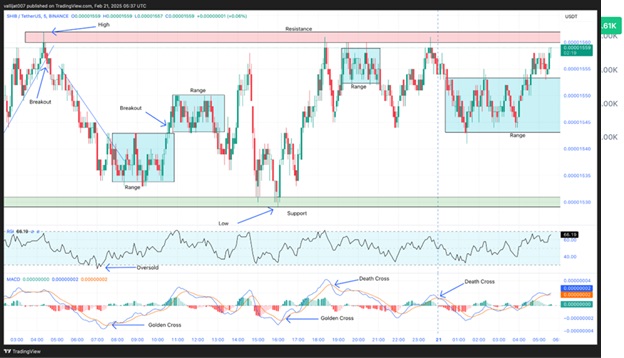
The price had already risen to $0.00001530 when it broke to the downside from the upward trendline around 4:30 UTC. This level became a resistance level since the price was unable to break it. The RSI fell below the 30 mark at 7:00 UTC, and the Golden Crossover at 07:35 UTC produced a range in price. At 10:35 UTC, the range broke out and produced a new range. Golden Crossover at 16:15 drove the price up to its resistance level of $0.00001560 after the price fluctuated to the day’s low of $0.00001530. The price created a range below the resistance level once more.

Chart 1: Analysed by vallijat007, published on TradingView, Feb 21, 2025

The price found it difficult to break through the resistance level due to the MACD Death Cross at 18:45. The price has been fluctuating between its support and resistance levels since the early hours of February 21. Shiba Inus trades in an extreme range, indicated by the RSI’s oscillation between 70 and 30 levels. Before making any breakout trades below the resistance level of $0.00001560 and above the support level of $0.00001530, traders should use caution.

Shiba Inu in Trading Range – What Are the Best Crypto Presales

Shiba Inu’s price movement is in the trading range, and investors are always on edge due to its high range-bound trading. Shiba Inu’s breakthrough potential is still unclear as the price fluctuates between important levels. Investors are searching for high-growth prospects in the best crypto presales as Shiba Inu consolidates. Aureal One, Dexboss, and Bitcoin are some of the projects currently in their presales. Let’s take a look at them and find out which one stands out.

Aureal One (DLUME) – The Best Coin to Invest in 2025

Aureal One is redefining the crypto space with its cutting-edge innovation and utility. As one of the top crypto presales, it presents an unmatched opportunity for early investors. Designed for scalability and efficiency, Aureal One stands out as the best coin to invest in for those seeking high potential returns. With a strong focus on security and decentralized governance, Aureal One is set to dominate the market. Early adopters can benefit from exclusive rewards, making Areal One the best crypto to buy now in 2025.

Click here to know more about Aureal One

Aureal One Presale Details

  • Funds Raised: $3,248,258 out of $4,500,000
  • Current Price: $0.0013
  • Listing Price: $0.005
  • Potential 323.08% increase
  • Next Price Jump: 15.4%

DexBoss (DEBO): The Top Crypto Presale in DeFi

DexBoss’s cutting-edge trading capabilities and flawless user interface are transforming decentralized finance. It provides a strong environment that enables traders with fast transactions and minimal costs, making it the next big crypto. DexBoss is positioned as the next big crypto for anyone wishing to profit from the DeFi boom because of its creative tokenomics and community support. Its presale is rapidly growing, offering early investors a fantastic chance to make large profits. With the support of state-of-the-art blockchain technology, DexBoss is poised to revolutionize decentralized trade.

DexBoss Presale Details

  • Raised: $588,853 out of $750,000 (79%)
  • Current Offer Price: $0.011
  • Listing Price: $0.0505
  • Potential Gain: 5x

Connecting Ecosystems with EVM Compatibility: SolanaVM (SVM)

By directly integrating Ethereum’s Virtual Machine features onto the Solana blockchain, SolanaVM (SVM) gives developers more control. This greatly cuts down on development time and effort by allowing programs created on Ethereum to be transferred to Solana without requiring a whole rebuild. With SVM, writers can maintain the recognizable structure of Ethereum smart contracts while benefiting from Solana’s fast throughput and cheap transaction fees.

SolanaVM Presale Details

  • Raised: 4,933,459 USD out of 4,996,359 USD
  • Current Offer Price: $0.07727
  • Next Round: $0.07804

Bitcoin Minetrix (BTCMTX): Using Staking to Democratise Bitcoin Mining

By removing the need for pricey hardware configurations, Bitcoin Minetrix (BTCMTX) transforms Bitcoin mining. Users stake their BTCMTX tokens in order to gain cloud mining credits. By avoiding the technological difficulties and high energy requirements connected with conventional mining, the stake-to-mine enables players to get mining rewards in a straightforward and environmentally responsible way. Users are kept informed about their returns thanks to the platform’s transparent and automated procedures, which offer real-time insights about mining rewards.

Concluding Words

Shiba Inu is still trading in a narrow range, and traders are unsure of what they will do next. Investors are looking for high-growth chances at the top cryptocurrency presales as long as the volatility continues. For now, the top crypto presale to invest in is Aureal One (DLUME), which is revolutionizing blockchain gaming through smooth transactions and metaverse integration. This project provides some of the greatest investment prospects for 2025 because of its groundbreaking breakthroughs.

Jumia Reports Mixed Q4 2024 Results Amid Operational Gains And Revenue Decline

0

Africa’s e-commerce giant Jumia, on Thursday released its fourth quarter (Q4) 2024 report, showcasing a mixed performance with operational improvements tempered by revenue decline.

Jumia reported a revenue of $167.5 million, down 10% year-over-year, compared with $186 million recorded in the previous year. The Gross Merchandise Value (GMV) dropped 12% to $206.1 million.

The company’s operating loss widened significantly to $17.3 million from $4.5 million in Q4 2023, with liquidity decreasing to $133.9 million.

Despite the negative trends, Jumia also recorded positive developments, which include the following

Operational Strength: Jumia saw 18% growth in Physical Goods Orders (excluding South Africa & Tunisia) and 8% growth in Quarterly Active Customers without increasing marketing costs.

Strategic Expansion: The company expanded in secondary cities and strengthened supply from international sellers, which accounted for 31% of items sold in Q4.

Black Friday Success: Strong sales performance underscored improving customer demand and product expansion.

International seller contribution rose to 31% of items sold, and Net Promoter Score improved, indicating stronger customer satisfaction.

Customer repurchase rates increased by 375 basis points.

Full-year 2024 operating loss improved by 10% YoY, decreasing to $66.0 million from $73.3 million in 2023.

Commenting on the report, Jumia’s CEO Francis Dufay expressed satisfaction, noting that he is proud of what the company accomplished in 2024.

He said,

“I am proud of what we have accomplished in 2024. We saw robust growth in secondary cities, expanded our supply from international sellers, and further improved marketing efficiency. In the fourth quarter, excluding South Africa and Tunisia, we achieved strong acceleration in our key usage metrics, with Physical Goods Orders and Quarterly Active Customers increasing by 18% and 8%year-over-year, respectively, without an increase in marketing costs. We closed the year on a high note with strong Black Friday sales, underscoring that our strategy is working”.

Dufay further expressed optimism about 2025 noting that the business is stronger and more efficient than it was just two years ago. He noted that Jumia is well-positioned to deliver sustainable growth and achieve profitability.

Notably, despite financial setbacks, Jumia made notable operational strides. The 18% order growth in core markets achieved without increased marketing spend, demonstrates improving unit economics and platform efficiency. Additionally, expansion into secondary cities now accounts for 56% of total orders, up from 49%, marking a strategic push for market penetration.

The rise in international sellers to 31% (a 9.5 percentage point increase YoY) signals a more diversified product selection while reducing inventory risk and working capital needs. This shift mirrors marketplace strategies successfully deployed in other emerging markets, potentially leading to stronger gross margins over time.

2025 Outlook

Jumia projects a 15-20% increase in physical goods orders, with GMV estimated between $795-830bmillion. The company also expects a loss before income tax of $65-70 million, reflecting a 28-33% reduction in losses.

To achieve these targets, Jumia is focusing on expanding cashless payments through JumiaPay and optimizing logistics. However, execution risks and currency volatility remain potential challenges. While operational efficiency is improving, sustained growth will depend on the company’s ability to manage costs and drive profitability in the coming quarters.

The company also plans to enhance its product assortment with competitive pricing and strengthen relationships with international sellers.

“The business is stronger and more efficient than it was just two years ago, and I believe we have a good opportunity ahead of us. We plan to double down on expansion outside the main urban centers, expand our product assortment with competitive pricing, and strengthen relationships with international sellers. To improve our path to profitability, we will continue to enforce cost discipline and enhance operational and marketing efficiency” Jumia wrote.

Apple CEO Tim Cook to Meet Trump Amid Tariff Scare and Privacy Clashes

0

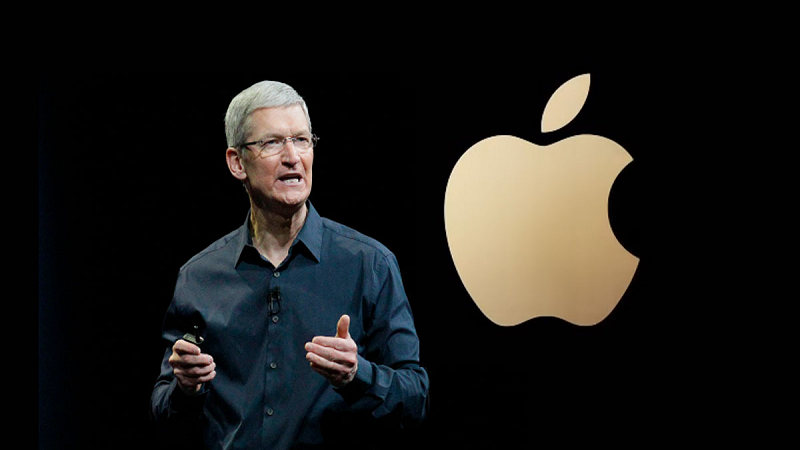
Apple Inc. CEO Tim Cook is set to meet with President Donald Trump at the White House on Thursday, as the tech giant faces growing uncertainty over U.S.-China trade tensions and privacy disputes with the U.S. government.

The meeting, first reported by Bloomberg, comes at a time when business leaders across industries are scrambling to mitigate the impact of Trump’s proposed tariffs, which could disrupt supply chains and drive up costs for American consumers.

A source familiar with the meeting said Cook and Trump will discuss a range of issues, but the agenda was not disclosed. However, analysts expect the conversation to revolve around two critical challenges for Apple: Trump’s tariffs on Chinese-made goods and Apple’s continued resistance to government demands for backdoor access to encrypted iPhones.

Since Trump’s reelection, Cook has made a concerted effort to maintain a working relationship with the administration, attending Trump’s inauguration last month and visiting his Mar-a-Lago estate during the presidential transition. However, the growing threat of sweeping tariffs on tech products has prompted Apple and other U.S. companies to seek clarity on how they will be affected—and what they can do to protect their businesses.

Apple, the most valuable company in the world, is particularly vulnerable to Trump’s aggressive trade policies, given its heavy reliance on China for manufacturing and the U.S. for sales. The president has repeatedly vowed to impose tariffs on a broad range of imports, arguing that higher duties will force U.S. companies to shift production back home.

Apple relies on Chinese manufacturers like Foxconn and Pegatron to assemble its flagship devices, including the iPhone. With a 10% tariff on Chinese-made goods already in place and the possibility of even steeper duties in the coming months, Apple could face higher production costs, forcing the company to either raise prices for consumers or absorb the financial hit.

During Trump’s first term, Cook was able to negotiate tariff carve-outs for some Apple products, ensuring that key devices like the iPhone and MacBooks remained exempt from new duties. However, this time around, Trump has suggested that those special exemptions may not be granted.

Adding to Apple’s troubles, China is reportedly considering launching an antitrust probe into the company’s App Store fees, a move that could jeopardize Apple’s dominance in one of its largest markets.

U.S. Companies Scramble to Limit Tariff Fallout

Apple is not alone in its concerns. Business leaders across multiple industries have been scrambling to assess the potential impact of Trump’s tariffs and devise strategies to limit the damage.

Since Trump’s reelection, CEOs of major corporations—including automakers, tech firms, and retail giants—have been holding internal meetings and strategy sessions to determine how to curtail the financial burden of new tariffs. Some companies are considering diversifying supply chains, shifting production to other countries, or pushing price increases onto consumers.

Walmart CFO John David Rainey recently warned that while two-thirds of Walmart’s products are sourced domestically, tariffs on imported goods from Canada, Mexico, and China would still have a ripple effect, raising costs for businesses and consumers.

“We’ve lived in a tariff environment for the last seven or eight years, and we’ll do what we know how to do,” Rainey told CNBC. “We’ll work with suppliers, lean into our private brand, and shift supply where necessary.”

Many companies fear that steep new tariffs could reignite inflation, which had begun to ease after a period of rapid price increases during the post-pandemic economic recovery. The Federal Reserve has already factored the tariff debate into its calculations, recently warning that potential new trade restrictions could push inflation higher, forcing the central bank to delay interest rate cuts.

The Federal Reserve noted in its recent report that business contacts in a number of districts indicated that firms would attempt to pass on to consumers higher input costs arising from potential tariffs.

Privacy Battle: Trump vs. Apple on Encrypted Phones

Beyond trade concerns, Apple and Trump’s administration have clashed over data privacy, particularly regarding encrypted iPhones. Trump has long pressured Apple to help law enforcement unlock devices linked to criminal investigations. However, Apple has repeatedly refused to build a backdoor into its iOS system, citing user security risks.

Trump has criticized Apple’s stance on encryption, arguing that the company should cooperate more with federal law enforcement.

Apple, on the other hand, has defended its privacy policies, arguing that creating a backdoor for one case would weaken security for all users.

With Trump pushing for tougher regulations on tech companies, privacy advocates worry that Apple may come under renewed pressure to compromise its encryption policies.

What’s at Stake for Apple?

Analysts expect that Cook’s meeting with Trump could have significant implications for Apple’s future, particularly in three key areas:

  • Trade and Tariffs – If Apple fails to secure exemptions, it risks higher production costs, potential supply chain disruptions, and higher prices for consumers.
  • China’s Regulatory Threats – An antitrust investigation in China could undermine Apple’s App Store revenue and threaten its market position in Asia.
  • Privacy and Government Access – Trump may push Apple to weaken its encryption policies, setting a dangerous precedent for digital privacy.

While Cook has successfully navigated political challenges in the past, analysts warn that Apple’s current situation may be different.

Bank of America estimates that whatever Apple does with manufacturing, and wherever it does it, the company will face a minimum of a 10% tariff. In its calculation, the Bank of America added that Apple would face a loss of 26 cents in earnings per share. That amounts to a drop of around 3% across calendar year 2026.

Binance-US Resume USD Services in the United States

0

As of February 19, 2025, Binance.US has officially resumed USD services for its customers in the United States, marking the end of a nearly 19-month period during which these services were suspended. This development allows eligible users to once again deposit and withdraw U.S. dollars via ACH bank transfers with zero processing fees, purchase cryptocurrencies using bank transfers, and trade USD pairs. The rollout of these services began on February 19 and is being phased in gradually over the following days to ensure all eligible customers regain access.

The restoration follows a challenging period for Binance.US, which suspended USD transactions in June 2023 due to regulatory pressures, including a lawsuit from the U.S. Securities and Exchange Commission (SEC) alleging compliance failures. The company was forced to operate as a crypto-only platform during this time, a move interim CEO Norman Reed described as a significant setback. However, recent regulatory clarity and efforts to secure compliant banking partners have enabled Binance.US to reinstate these fiat services. At launch, trading is supported for 10 USD pairs, including BTC/USD, ETH/USD, and SOL/USD, with plans to expand further.

Regulatory pressures refer to the challenges and constraints imposed on businesses, like Binance.US, by government agencies and laws designed to oversee and control their operations. In the context of cryptocurrency exchanges like Binance.US, these pressures often stem from efforts to ensure compliance with financial regulations, protect consumers, and prevent illegal activities such as money laundering or fraud. Let me break it down based on what happened with Binance.US and the broader crypto industry:

Binance.US, the American arm of the global cryptocurrency exchange Binance, faced significant regulatory scrutiny starting in 2023. The key event was a lawsuit filed by the U.S. Securities and Exchange Commission (SEC) in June 2023. The SEC alleged that Binance.US (and its parent company) violated securities laws by offering unregistered securities—essentially claiming that certain cryptocurrencies traded on the platform should be treated as regulated financial products rather than just digital assets. The SEC also accused the exchange of failing to properly register as a broker-dealer and of commingling customer funds, which raised concerns about financial transparency and user safety.

At the same time, Binance.US encountered issues with its banking partners. The crypto industry as a whole has faced a phenomenon dubbed “Operation Choke Point 2.0” by some observers—a term suggesting that U.S. regulators were pressuring banks to cut ties with crypto firms, making it hard for exchanges to maintain USD fiat services. For Binance.US, this led to the suspension of USD deposits and withdrawals in June 2023, as their banking partners either withdrew support or imposed stringent conditions due to regulatory risks.

Securities Regulation: The SEC argued that many tokens on Binance.US qualified as securities under U.S. law (based on the Howey Test, which defines an investment contract). If true, Binance.US needed to register these offerings and comply with strict disclosure and investor protection rules—something it allegedly hadn’t done.

Anti-Money Laundering (AML) and Know Your Customer (KYC): Crypto exchanges are subject to the Bank Secrecy Act (BSA), enforced by the U.S. Treasury’s Financial Crimes Enforcement Network (FinCEN). Regulators expect robust systems to verify customer identities and monitor transactions for suspicious activity. Any perceived lapses can lead to penalties or operational restrictions.

Banking Relationships: Banks, wary of regulatory backlash, often hesitate to service crypto firms. After high-profile incidents like the FTX collapse in 2022, U.S. regulators signaled heightened oversight, making banks cautious about facilitating fiat on- and off-ramps for crypto exchanges like Binance.US.

State-Level Rules: Beyond federal oversight, Binance.US had to navigate a patchwork of state regulations. For instance, it withdrew from certain states or faced bans (e.g., New York due to the BitLicense requirement) where compliance was too costly or complex.

These pressures forced Binance.US into a crypto-only mode for nearly 19 months, limiting its ability to serve U.S. customers with USD functionality. The company had to lay off staff, scale back operations, and work tirelessly to find new banking partners willing to operate within the regulatory framework. The SEC lawsuit also damaged its reputation and market position, contributing to a reported $1 billion loss in assets under management during this period.

By February 2025, Binance.US managed to alleviate some of these pressures. The broader Binance entity settled with U.S. authorities in late 2023, paying a $4.3 billion fine and agreeing to stricter compliance measures, which likely paved the way for Binance.US to regain trust. Additionally, a shifting regulatory tone—possibly influenced by growing crypto adoption and political changes—encouraged banks to re-engage. Binance.US secured new banking partners and demonstrated compliance with SEC and FinCEN expectations, enabling the resumption of USD services on February 19, 2025.

Regulatory pressures on crypto firms like Binance.US reflect a tension between innovation and oversight. Governments aim to protect markets and consumers, but the crypto industry often argues these rules stifle growth. The reinstatement of USD services suggests Binance.US successfully navigated this landscape, though ongoing vigilance will be required as regulations evolve. Does that clarify the regulatory pressures for you? If you’d like deeper details on any specific aspect—like the SEC lawsuit or AML rules—let me know!

This move is seen as a significant step for Binance.US, reflecting a shift in the U.S. regulatory environment and the company’s commitment to compliance, as highlighted by both Reed and General Counsel Dan Wong. The return of USD services is expected to enhance user convenience and potentially boost the platform’s growth in the American market.