DD
MM
YYYY

PAGES

DD
MM
YYYY

spot_img

PAGES

Home Blog Page 2469

Nigeria’s Central Bank Retains MPR at 27.5% Despite Significant Drop in Inflation Rate

0

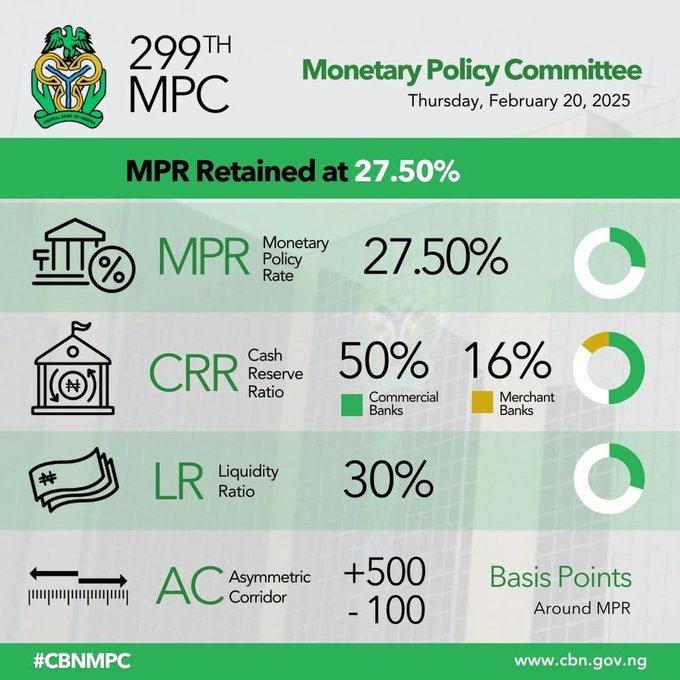
The Monetary Policy Committee (MPC) of the Central Bank of Nigeria (CBN) has opted to retain the Monetary Policy Rate (MPR) at 27.5%, despite widespread expectations that it would cut interest rates following a significant drop in Nigeria’s inflation rate.

CBN Governor Olayemi Cardoso announced the decision on Thursday at a press conference in Abuja, following the committee’s 299th meeting. The decision to maintain the current rate comes after months of aggressive monetary tightening by the CBN, which has raised the MPR 15 times since May 2022 in a bid to combat surging inflation.

However, with the National Bureau of Statistics (NBS) reporting a sharp drop in inflation from 34.8% to 24.48% in January due to a rebasing of the Consumer Price Index (CPI), many analysts expected the MPC to ease monetary policy. The committee’s decision to hold the rate has cast further doubt on the credibility of the NBS’ inflation recalibration, which many argued misrepresents Nigeria’s economic reality.

The NBS’ revision of Nigeria’s CPI methodology significantly altered inflation calculations. The new methodology adjusted the weight of various components in the consumer basket to better reflect current spending patterns, leading to a drastic decline in reported inflation.

Cardoso acknowledged the revised CPI calculations but noted that committee members were still concerned about persistent inflationary pressures, particularly in food prices.

“Members, however, were not oblivious to the risk of persisting inflationary pressures driven largely by food prices,” Cardoso stated.

The controversy surrounding the NBS figures has been fueled by widespread complaints from Nigerians, who lament that prices of essential goods and services remain alarmingly high despite the reported drop in inflation. Many economic observers believe that the CPI rebasing does not reflect actual market conditions, and the MPC’s refusal to lower interest rates is believed to have reinforced doubts over the accuracy of the NBS’ inflation report.

Foreign Exchange Stability and Fiscal-Monetary Coordination

Beyond inflation, the CBN also factored in foreign exchange market stability in its decision to hold rates. Cardoso highlighted that the appreciation of the naira and the gradual convergence of exchange rates between the official and parallel markets were key factors in the committee’s deliberations.

“The committee highlighted the benefits of the improvements in the external sector to exchange rate stability, including the convergence of rates between the Nigeria foreign exchange market and the bureau de change,” he said.

This comes as the CBN continues to implement measures aimed at boosting liquidity in the FX market, with policies designed to tighten control over currency speculation and improve dollar inflows.

Additionally, the MPC stressed the importance of fiscal-monetary coordination, calling for stronger collaboration between the CBN and the federal government to achieve price stability and sustained economic growth. With Nigeria facing external shocks, volatile oil revenues, and a decline in foreign investment, such coordination is seen as crucial for long-term economic stability.

Other Key Policy Decisions: CRR and Liquidity Ratio Maintained

In addition to holding the MPR at 27.5%, the committee also kept the Cash Reserve Ratio (CRR) at 50% and the liquidity ratio at 30%. These measures aim to ensure stability in the banking system while controlling inflationary pressures.
Furthermore, the CBN reiterated its commitment to deepening financial inclusion, managing inflation expectations, and improving the monetary policy transmission mechanism.

“The committee also urged the bank (CBN) not to relent in its efforts to boost market liquidity,” Cardoso stated.

Is the NBS’ Inflation Report Credible?

With the MPC deciding to hold rates despite the inflation decline, the question remains: Does the NBS’ rebasing truly reflect Nigeria’s economic reality?

Public perception suggests otherwise as rising food and energy costs remain high, contradicting the official inflation figures. Against this backdrop, the business community remains skeptical, with concerns that the revised CPI paints an overly optimistic picture of Nigeria’s inflationary environment.

Analysts believe that investors may take caution as conflicting signals from the CBN and NBS raise questions about policy transparency and data reliability.


Kas (KAS) and Kusama (KSM) Investors Anticipate 1Fuel’s Rise to $1.00: Encouraged by Up to 40% Purchase Bonuses

0

Whatever the 1Fuel team is doing behind the scenes, it appears to be working and pushing boundaries. Holders of Kaspa (KAS) and Kusama (KSM) assets are increasingly putting stakes in the 1Fuel (OFT), one of the cheapest cryptocurrencies to buy at the moment for just $0.018. Early adopters continue to seize the opportunity to secure coins, as 1Fuel, according to analysts, holds the potential to be the next crypto to hit $1 upon official launch.

The 1Fuel presale, over the next five days, offers up to 40% purchase bonuses, with an imminent beta wallet release if sales reach 3 million by Sunday, 23rd. Since the announcement of this latest initiative, presale traction,out of which KAS & KSM investors are key participants,has increased.

Beyond bonuses, what is there to benefit from 1Fuel? Dive into the article for some clarity.

Why KAS and KSM investors are buying into 1Fuel

Kaspa and Kusama are major blockchains in their own right, with strong user bases behind them. The recent transitioning of their holders into 1Fuel, however, indicates that they are seeking tangible and sustainable opportunities.

Kaspa is a proof-of-work network that adopts an innovative GHOSTDAG tech to ensure quick and scalable operations. Kaspa has been regarded as one of the most technically ambitious crypto projects, and its DAG feature is a testament to this. The move by Kaspa holders into 1Fuel could be simply an exploration of the new terrain to confirm if its hype holds any water.

On the other hand, Kusama is a Polkadot-inclined public blockchain valued for developmental speeds. It serves as a testbed for Polkadat, offering early-stage experiments. The KSM price value has in a while been meandering between the range of $18 and $21. In the last 30 days, it has recorded a 30% decrease, causing it to underperform the global cryptocurrency market. Hence the transition by its investors into 1Fuel.

1Fuel’s cryptocurrency wallet: A game-changer for adoption

The imminent 1Fuel beta wallet release is another major catalyst of investor interest, as it seeks to simplify cross-chain transactions with its ingrained one-click solution. This solution helps the trader to maintain effortless operations across multiple networks. Traders simply click on the token they want to transact with and the wallet manages all other technicalities.

Another component of the 1Fuel wallet is a peer-to-peer solution, a feature that allows traders to make transactions directly with each other without any agent in between. Other features users can access from the cryptocurrency wallet include debit and credit cards, cold storage solutions, AI-powered offerings, a multi-layered security architecture, and a lucrative tokenomics structure.

1Fuel’s plans to roll out Beta Wallet amid exclusive bonus offers

The 1Fuel team has announced that if the presale,inching close to the $2.3 million mark with over 215,000,000 tokens sold,hits 3 million sales by Sunday, the 23rd, then its Beta Wallet could launch ahead of schedule.

Additionally, investors holding over 2,000 1Fuel tokens get to test the platform’s usability before its full rollout and all purchases from now leading to the 23rd attract up to 40% bonuses. This exclusivity has further impacted presale demand, especially among high-profile KAS and KSM investors who recognize the value of getting in early on promising projects.

Conclusion

As 1Fuel inches closer to a full market launch, its valuation could soar significantly making it the next crypto to hit $1. With the stage 4 presale price at just $0.018, some investors are eyeing a potential 50x–100x gains, making 1Fuel one of the cheapest cryptocurrencies to buy right now.

Join the 1Fuel presale now and enjoy a 40% bonus on your purchase!


To Find Out More About The 1Fuel Presale, Use The Links Below:

Website: https://1fuel.io/

Telegram: https://t.me/Portal_1Fuel

Twitter / X: https://x.com/1Fuel_

OpenAI Weekly Active Users Surge to 400 Million, Amid Deepseek Emergence

0

OpenAI, an American Artificial Intelligence research organization, has continued to experience remarkable growth despite increasing competition in the AI space.

The San Francisco-based AI powerhouse is reported to have seen a significant increase in its user base, reaching 400 million weekly active users as of February. This represents a 33% increase from December’s 300 million, according to Chief Operating Officer Brad Lightcap.

Lightcap referenced the natural progression of the company’s AI popular chatbot ChatGPT, as it becomes more useful and familiar to a broader group of people. As users discover its diverse applications, the platform gains momentum across both individual and enterprise use cases.

He said,

“People hear about it through word of mouth. They see the utility of it. They see their friends using it. It takes time for individuals to find use cases that resonate. There’s an overall effect of people wanting these tools, and seeing that these tools are really valuable.”

The enterprise segment has seen a significant boost, with 2 million paying business users- double the figure reported in September. Organizations across industries, including Uber, Morgan Stanley, Moderna, and T-Mobile, have integrated OpenAl’s technology into their operations. Additionally, developer engagement has skyrocketed, with traffic doubling in the past six months and usage of OpenAl’s reasoning model, 03, increasing fivefold.

Lightcap compared this trend to the early days of cloud computing, predicting that Al will become an essential backbone for businesses, much like cloud services pioneered by Amazon Web Services.

OpenAI’s impressive weekly user base growth, comes amid the emergence of Deepseek, an AI development firm based in Hangzhou, China. Recall that the Chinese AI firm made headlines in January 2025, worldwide after it topped app download charts, and caused US tech stocks to crash.

The AI firm released its latest model, DeepSeek R1, which it said rivaled technology developed by ChatGPT-maker OpenAI in its capabilities while costing far less to create.

Its popularity and potential rattled investors, wiping billions of dollars off the market value of chip giant Nvidia, and called into question whether American firms would dominate the booming artificial intelligence (AI) market, as many assumed they would.

Notably, DeepSeek revealed that it uses less memory compared to its rivals, ultimately reducing the cost of performing tasks for users. That combination of performance and lower cost helped DeepSeek’s AI assistant become the most downloaded free app on Apple’s App Store when it was released in the US.

In line with Deepseek’s emergence, OpenAI accused the company of improperly extracting its model outputs through a technique known as distillation. Also, OpenAI warned that Chinese companies are actively attempting to replicate its advanced AI models, prompting closer cooperation with US authorities.

The Future of OpenAI

Despite the competitive AI landscape, OpenAI’s growth trajectory remains strong. The company has intensified its AI model by rolling—out upgraded features. Earlier this month, it unveiled a ChatGPT tool called “deep research” ahead of high-level meetings in Tokyo.

OpenAI whose ChatGPT fronted generative AI’s emergence into public consciousness in 2022, said its new tool “accomplishes in tens of minutes what would take a human many hours”.

“Deep research is OpenAI’s next agent that can do work for you independently if you give it a prompt, and ChatGPT will find, analyze, and synthesize hundreds of online sources to create a comprehensive report at the level of a research analyst,” it said in a statement.”

49% of Africans Use Both Mobile Payments And Mobile Banking For Daily Transactions

0

A recent survey reveals a significant surge in mobile financial services adoption across Africa. Nearly half of the respondents (49%) use both mobile payments and mobile banking, while 36% rely solely on mobile banking, and 10% use only mobile payments.

Only 5% of respondents reported not using any mobile financial service.

Growing Mobile Finance Adoption in Africa

Across Africa, mobile finance is revolutionizing how people access and manage money. With traditional banking infrastructure limited in many regions, mobile financial solutions have emerged as a game-changer, bridging gaps in financial inclusion, and empowering millions.

Mobile money services, led by platforms like M-Pesa, Airtel Money, and MTN MoMo, have experienced explosive growth. From enabling peer-to-peer transactions to facilitating bill payments and cross-border remittances, these services have become a financial lifeline for individuals and businesses.

According to industry reports, Africa accounts for nearly 70% of the world’s mobile money transactions, highlighting the continent’s leadership in digital financial innovation. The use of mobile financial services has seen a remarkable increase, rising from 63% in 2023 to 85% in 2024. Currently, 95% of respondents use either mobile banking, mobile payments, or both.

Kenya leads in mobile payment adoption, with 28% of respondents actively using mobile payment apps far above the continental average of 10%. South Africa and Morocco report higher-than-average mobile banking usage, with 50% and 52% adoption rates, respectively, compared to the continental average of 36%.

The Security Challenge of Mobile Transactions

Despite its rapid growth, mobile finance in Africa faces challenges such as cybersecurity threats, regulatory complexities, and digital literacy gaps. The Communications Authority of Kenya (CA) reported a 333% surge in mobile application threats between July and September 2024, with cybercriminals targeting user data, including login credentials and financial details.

However, these hurdles present opportunities for further innovation. Strengthening digital infrastructure, improving financial education, and enhancing cybersecurity measures will be crucial in sustaining the momentum of mobile finance adoption.

Looking more broadly, the continued rise in mobile data usage underscores Africa’s mobile-first approach to internet connectivity. This trend has significant implications for cybersecurity.

Increased digital financial inclusion: The rise in mobile banking and payments indicates greater financial inclusion through digital means, which is generally positive for economic development in Africa.

Increased attack surface: Firstly, more mobile usage and mobile financial services users mean a larger attack surface for cybercriminals. Users are generally less vigilant on their smartphones and tablets compared to traditional computers, making them more susceptible to malicious attacks.  Secondly, with more people conducting financial transactions on potentially unsecured and secondhand devices, the risk and impact of cybercrime have increased.

The growing trend of unlocked cellphone theft in the region highlights this issue. In South Africa, an average of 189 cell phones are stolen daily, with women being predominantly targeted. Stolen devices, particularly when unlocked at the time of theft, grant criminals’ access to sensitive data including banking apps and personal information.

Blurred lines between personal and professional: The increase in WhatsApp usage for work (from 89% in 2023 to 93% in 2025) shows a further blurring of lines, between users’ personal and professional lives. This can lead to increased risks, as personal devices may not have the same level of security as corporate-managed devices.

Need for mobile-centric security education: The survey results suggest a pressing need for cybersecurity education that focuses specifically on mobile security and best practices for using personal devices for work-related tasks. There’s also a clear need for cybersecurity education specifically tailored to mobile financial services, focusing on secure transaction practices and recognizing financial fraud attempts.

The Future of Mobile Finance in Africa

As mobile transaction continues to gain traction, its impact will extend beyond payments and banking. Sectors like agriculture, healthcare, and education are increasingly integrating mobile financial solutions to streamline operations and improve service delivery.

With advancements in blockchain, artificial intelligence, and open banking, the next phase of mobile finance in Africa promises to be even more transformative, driving economic inclusion and financial empowerment across the continent.

7 Ways to Prepare for a Tax Sales Auction

0

Tax sales auctions can be great opportunities for investors and homebuyers. These events let individuals buy properties with unpaid taxes, leading to new ownership and possible financial gains. Proper preparation allows you to navigate these auctions and discover valuable properties.

Here are some easy ways to prepare for a tax sales auction.

Understand Tax Delinquent Properties

Tax delinquent properties offer excellent opportunities for those willing to explore them. When a property owner fails to pay taxes, the government places a lien on it. This can lead to the property being auctioned to recover the unpaid taxes. Many of these properties can be bought for much less than their market value, making them accessible for investment.

Some properties may need minor repairs or might be located in growing areas, which can increase their value over time. By viewing these properties as opportunities instead of problems, you can approach the auction with a positive attitude.

Do Your Homework

Preparation is key to success at tax sales. Before the auction, research the properties up for bidding. Most counties provide lists of properties that will be auctioned. Look at these listings carefully, considering location, property condition, and potential value after repairs. Online databases and local government websites can help you learn more about each property’s history.

Visiting properties in person can also give you helpful information. Checking the exterior and the surrounding area will help you understand the neighbourhood and see if the property meets your expectations. Knowing the strengths and weaknesses of each property will help you with your bidding strategy and make you a more confident bidder.

Set a Budget

Bidding at a tax sale auction can be exciting, but keeping your emotions in check is important. Set a clear budget ahead of time. Decide how much you will spend on a property, including renovation costs and additional expenses like taxes, insurance, and maintenance.

Having a budget helps you avoid getting caught in bidding wars that drive prices too high. Stick to your budget, and remember that there will always be other chances if a property goes beyond your limit.

Understand the Auction Process

Each auction has its rules and format, so learning how it works is important. Some auctions happen in person, while others take place online. Knowing how the auction will go can help you prepare.

Pay attention to the auction format, the bidding increments, and the payment requirements. Many auctions need a deposit to participate, so ensure you have the needed funds. Being prepared will help you feel more confident during the event.

Connect with Experienced Bidders

Meeting experienced bidders can give you helpful tips on handling tax sales. Go to local real estate meetings, join online groups, or talk to community members who have been to tax auctions.

These connections might share useful strategies, common mistakes to avoid, or details about specific auctions. Learning from others can help you better understand the bidding process and market trends.

Check Property Titles

Before you bid, check the title of the property you’re interested in. Properties sold at tax auctions usually have a tax lien, but you should also look for any other liens or issues that might affect your ownership. Knowing what you’re buying can prevent problems and extra costs later.

Some properties may have additional liens you need to sort out, while others may have a clear title. Spending time understanding the titles ensures you make a good investment. Many local counties provide title search services to help with your research.

Be Ready for What Comes Next

Winning an auction is just the start. Have a plan for what to do after winning. Depending on the property, you may need to hire contractors for repairs, explore financing options for renovations, or deal with tenant issues if someone lives there.

Having a clear plan can turn your investment into a profitable one. A well-prepared strategy helps you manage the property, sell it, or rent it out effectively. This preparation will help you get the most out of your investment.

Preparing for a tax sales auction can be exciting and rewarding. You can find investment opportunities with the right approach, proper research, and a positive attitude. These auctions can change not just properties but also neighbourhoods. If you prepare well, you might discover some hidden gems.