DD
MM
YYYY

PAGES

DD
MM
YYYY

spot_img

PAGES

Home Blog Page 2482

A Significant Number of Africans Worry About Financial Losses From Cybercrime – Survey Finds

0

A recent survey has revealed that a significant number of Africans are worried about the potential financial losses they could suffer due to cybercrime. This concern is understandable given the increasing reliance on digital transactions and the growing sophistication of cybercriminals.

The survey, conducted by KnowBe4 AFRICA, which polled results from 800 adults aged between 30 to 60 across seven African countries (Morocco, South Africa, Nigeria, Ghana, Egypt, Kenya, and Botswana), found that 58% of respondents were very concerned about cybercrime, while 26% were concerned.

All of the respondents were employed in sectors ranging from financial services, government, and health care to real estate and telecommunications. When asked what concerns them about cybercrime, almost half of the respondents (49%) said they feared falling victim to online fraud and losing money, while 26% feared identity theft.

18% were concerned for their children and family and 7% said they did not understand how to protect themselves. Comparing the 2024 and 2023 survey results, the most striking finding is that the number of respondents who are very concerned about cybercrime almost doubled from 29% to 58%. Fear of online fraud and losing money remain the top concern, with 49%.

The significant jump in high-level concern about cybercrime has both positive and negative implications such as;

Increased awareness: This dramatic increase suggests that awareness campaigns and possibly personal experiences have significantly raised consciousness about cyber threats. This heightened awareness can potentially lead to more cautious online behavior.

Potential for cybersecurity fatigue: However, such a high level of concern also risks leading to cybersecurity fatigue – a phenomenon where individuals become overwhelmed by constant security warnings and may ignore them.

Focus on financial impact: The persistent focus on financial fraud suggests that economic consequences remain the most tangible and concerning aspect of cybercrime for most individuals. Future awareness campaigns could leverage this to make cybersecurity more relatable and urgent.

Cybercrime Escalates Across Africa

Cybercrime is rapidly escalating across Africa, posing both challenges and opportunities. Threats such as ransomware, digital extortion, and online scams are becoming more prevalent. South Africa alone lost $3 billion to mobile app and digital banking fraud in 2023, according to the SA Banking Risk Information Centre.

Cybercriminals are leveraging advanced tactics, including Al-generated deepfakes to impersonate business leaders, making social engineering attacks more effective than ever.

How Security Conscious Are Africans

To gauge the security consciousness of Africans against falling victim to cybercriminals, the survey revealed that most respondents are hesitant to give away personal information, with 15% saying they tend not to share personal details such as their identity number.

47% say they would share this information only if there was a real need to do so and 24% parting with personal information if they can’t avoid it. Surprisingly, 14% revealed that they are comfortable sharing personal information, with 8% saying they are likely to do so if they can get something in return such as a discount. 6% say they share personal information all the time.

Among respondents very likely to give away their personal information are those living in Egypt (11%), Nigeria (10%) and Kenya (7%). South African respondents were more cautious, with only 4% very willing to give away their personal data, compared to the average of 5.5%.

However, there a positive trend was spotted, when compared to the previous survey. The percentage of respondents very unlikely to give away personal information almost halved from 29% to 14%.

Conclusion

The 2025 survey reveals a nuanced picture of cybersecurity awareness in Africa. Overall, there are positive trends in awareness and corporate training, as well as an increase in the adoption of mobile banking and payments. However, there are also concerning developments, particularly in personal information security and the practical application of cybersecurity knowledge.

While cybersecurity awareness is growing in Africa, there is still a significant need for more comprehensive and effective human risk management and training programs. The high use of mobile devices and applications, particularly for financial transactions, underscores the importance of mobile-centric security education.

Nigeria’s Inflation Drops to 24.48% After CPI Rebasing, But Prices Remain High

0

Nigeria’s inflation rate dropped to 24.48% in January following the rebasing of the Consumer Price Index (CPI), the National Bureau of Statistics (NBS) has disclosed, marking a sharp decline from the 34.80% recorded in December under the old CPI methodology.

However, this statistical drop does not mean that the prices of goods and services have fallen. Instead, it reflects a change in how inflation is measured, following an update to the reference year and the basket of goods and services used for calculations.

The rebasing of the CPI is part of the NBS’s broader initiative to update economic indicators. In January, the agency also announced plans to include illegal and hidden activities, such as drug trafficking and prostitution, in the calculation of Nigeria’s Gross Domestic Product (GDP). This move sparked widespread criticism, with many viewing it as an attempt to mask the government’s economic failings.

The controversy follows a similar rebasing of the unemployment rate last year, which resulted in Nigeria’s jobless rate dropping to around 4%—a figure widely dismissed as unrealistic given the country’s economic struggles. Economists warn that while these adjustments might make Nigeria’s economic indicators appear better on paper, they risk distorting reality, misleading policymakers, and deterring investors.

Understanding the CPI Rebasing

CPI rebasing involves changing the base year for price comparisons, ensuring that inflation calculations reflect current consumer spending patterns. It also updates the basket of goods and services used to measure inflation, replacing outdated items with those that better represent present-day consumption.

Previously, Nigeria’s CPI was calculated using 2009 as the base year. With the rebasing, 2024 is now the reference year, meaning inflation is measured against more recent price levels rather than those from over a decade ago. The NBS claims this adjustment makes inflation figures more representative of Nigeria’s economic realities.

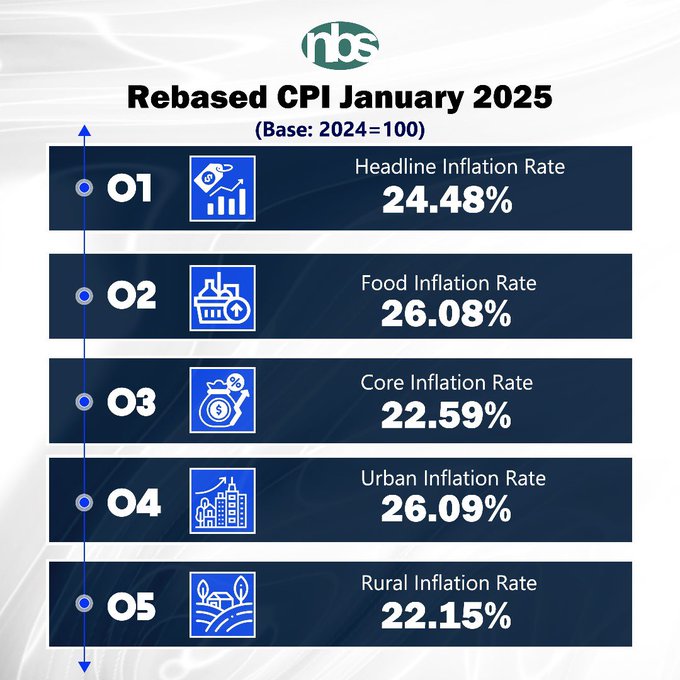
According to the rebased CPI, food inflation stood at 26.08% year-on-year in January, a significant drop from 39.84% in December under the old methodology. Core inflation, which excludes volatile agricultural products and energy prices, fell to 22.59% from 29.28%.

Urban inflation under the rebased CPI was recorded at 26.09% in January, compared to 37.29% in December. Similarly, rural inflation dropped to 22.15% from 32.47%.

Inflation Drop Raises Skepticism

Despite these lower inflation figures, Nigerians continue to grapple with the high costs of essential goods and services. The NBS itself admitted that the decline does not mean that prices have actually dropped. Instead, the major factor behind the statistical decrease is the new base year being closer to the current period.

“The decline in the rebased inflation does not mean the general price level is falling,” the agency stated. “The major factor responsible for the decline was the base year being closer to the current period.”

Many Nigerians and economic analysts have criticized the move, arguing that the NBS is simply using statistical adjustments to downplay the severity of inflation. Economist Kalu Aja noted the irony of the situation, pointing out that while inflation has suddenly dropped by 10%, real-life conditions remain unchanged.

“Just like that, inflation drops by 10%. The same way unemployment dropped to 4%. Keep in mind prices have not fallen; the NBS has simply ‘rebased’ what it counts to measure CPI that measures inflation,” he said.

Aja further suggested that if inflation has truly dropped, the Central Bank of Nigeria (CBN) should respond by lowering the Monetary Policy Rate (MPR), which dictates bank lending rates. “Since inflation is down, the CBN should reduce the MPR rates so bank lending rates fall,” he added.

Concerns Over GDP Rebasing and Inclusion of Illegal Activities

Beyond inflation, the NBS’s announcement that Nigeria’s GDP calculation will now include illegal activities such as drug trafficking and prostitution has sparked major concerns. The agency claims this move aligns with international standards, as some developed nations also account for shadow economy activities in their GDP measurements.

However, many view this as an attempt to artificially inflate Nigeria’s GDP figures, making the economy appear stronger than it really is. Critics argue that this will only erode trust in the country’s economic data.

Nigeria had previously rebased its GDP in 2014, leading to an overnight expansion that made it Africa’s largest economy at the time. However, the country has since struggled with economic stagnation, currency depreciation, and declining foreign investment. Economists worry that the inclusion of illegal activities in GDP calculations could further undermine investor confidence and distort policy decisions.

The rebasing of the unemployment rate to around 4% had already drawn sharp criticism, as it conflicted with widespread job losses and economic hardship. By adopting similar adjustments to inflation and GDP, the NBS risks creating an economic narrative that is disconnected from the experiences of everyday Nigerians.

Nevertheless, the Statistician-General of the Federation (SGF)/Chief Executive of the NBS, Adeyemi Adeniran, said contrary to speculations, the exercise was not meant to suit the “expectations of anyone or entity, but simply to measure accurately in line with the global standards and practice.”

Africa’s Startup Funding Landscape: The Rise of East Africa

0
Fund, money cash dollar

In Africa’s startup funding landscape, East Africa and Kenya have solidified their dominance in start-up funding across the African continent, maintaining top positions in 2024.

As highlighted in Africa: The Big Deal report, both the region and the country have consistently attracted the most Venture Capital investment, excluding exits, for two consecutive years.

East Africa’s Rise to The Top

While East Africa briefly led in 2020 with 31% of total funding edging out West Africa by a mere $6 million from a $1.1 billion pool, the region’s dominance has been firmly established since the end of the funding boom in mid-2022. Over the past two years, East Africa has captured 30% of all venture funding, surpassing all other regions.

This marks a significant shift from the previous 2.5-year period (2020 to mid-2022), where East Africa held a distant second place with 22% of funding compared to West Africa’s commanding 41%.

Since 2019, start-ups in East Africa have raised a total of $4 billion, representing 25% of the continent’s total funding. Kenya has been the driving force behind this growth, securing $3.3 billion, which accounts for a staggering 84% of the region’s total investment. Kenya’s dominance has only increased in recent years. Since mid-2022, it has consistently been the top-funded country in Africa, a position that previously belonged to Nigeria.

Notably, Kenya significantly outperforms its economic weight despite accounting for just 4% of Africa’s nominal GDP and population in 2024, the country attracted 29% of total start-up funding on the continent.

Startups With The Most Funding in Kenya

The bulk of Kenya’s funding has gone to well-established players in the pay-as-you-go off-grid energy sector. Three companies which include Sun King, M-Kopa, and dlight have collectively raised nearly $1.5 billion, representing 44% of all funding secured in Kenya since 2019.

Following closely are companies revolutionizing retail and supply chains, including Twiga Foods, Wasoko, and Copia Global, which together secured $400 million during the same period. However, this sector has faced significant challenges recently, with Copia liquidating and both Twiga and Wasoko undergoing restructuring. Beyond these heavyweights, over 150 start-ups in Kenya have raised at least $1 million since 2019, underscoring the country’s dynamic entrepreneurial ecosystem.

Funding Across the Rest of East Africa

While Kenya dominates, other East African nations have also seen significant funding activity. Tanzania ranks as the second-largest funding recipient in the region, attracting nearly $300 million since 2019, with half of that funding going to Zola Electric and Nala.

Uganda follows as the third-largest market in the region, securing funding primarily through Tugende and Asaak, which together account for half of the country’s total investment. Rwanda is also emerging as a notable player, nearing the $100 million milestone, while Ethiopia and Sudan follow closely behind. Sudan, in particular, has gained attention through YC-backed fintech Elevate.

In contrast, Mauritius and Madagascar have seen minimal start-up investment over the period, and no recorded deals above $100,000 were identified in the remaining six East African markets, aside from offshore crypto exchanges registered in Seychelles for tax purposes.

Looking Ahead

With Kenya leading the charge and East Africa asserting itself as a venture capital hub, the region’s start-up ecosystem is poised for continued growth. However, challenges remain, particularly in ensuring sustainable business models and navigating economic fluctuations.

The coming years will reveal whether Kenya can maintain its dominant lead in startup funding, and whether the East African region will continue to attract significant funding ahead of other promising region like West Africa.

Nigeria’s Magic on Economic Data And The Risk Ahead

1

What a country: “Nigeria’s inflation rate has dropped to 24.48% in January 2025 from 34.80% in December 2024, following the rebasing of the Consumer Price Index (CPI) by the National Bureau of Statistics (NBS). This rebasing involved updating the methodologies and changing the base year to 2024”.

Smart playbook because when you are on the floor, the variance is muted. Yes, by changing the base year to 2024, you can make inflation appear low since 2024 was already inflated. But if you had used say 2022 when it was largely marginal, inflation would have remained high when compared with Jan 2025 data.

Good People, no one eats statistics but statistics does influence monetary policies as promulgated by the Central Bank of Nigeria. Provided the apex bank does not become complacent that it has solved inflation, the new number may not be a big deal, but if we see it the way we are seeing the unemployment rate in Nigeria where the employment rate is so good that it embarrasses you for quoting it!

In other words, people have jobs in Nigeria that the governments at all levels do not need to worry about job creation or invest in innovation to boost employment. As of October 2024, the unemployment rate in Nasarawa State, Nigeria was 0.5%, the lowest in the country.  At the national level unemployment rate data, the World Bank recorded 35% for Nigeria, but Nigeria recorded 3.07% for itself.  That number was better than unemployment rates in Canada, UK, USA and many other economies.

I am hoping we do not prematurely celebrate data points as most governors are now doing, reminding everyone how they took down unemployment from 35% to 1% within 18 months! 

In this age of rebasing methodologies, what do you think NBS will provide as Nigeria’s new GDP? I expect them to push it from the current number of $300 billion to around $700-800 billion. GDP rebasing loading…expect something interesting.

==From Twitter NBS Publication

The National Bureau of Statistics has released the rebased Consumer Price Index (CPI), reflecting an updated price reference period (base year) of 2024 and weight reference period of 2023. 

Nigeria’s inflation rate for January 2024 stood  at 24.48% year on year. 

  • Food Inflation rate stood at 26.08%
  • Core Inflation rate stood at 22.59%
  • Urban Inflation rate stood at 26.09%
  • Rural Inflation rate stood at 22.15%

Special indices introduced and their inflation rates. (Base Period: 2024 = 100)

  • Farm Produce – 10.50%
  • All items less farm produce- 10.70%
  • Energy index  – 8.9%
  • Services Index – 10.41%
  • Imported food index – 11.47%

Note: the rates reported for the new indices are for January 2025 compared to the base year. 

Bitcoin Purchase Sparks 2x Surge for HK Asia Holdings! Is DexBoss the Next Crypto to Explode Amid this Crypto Frenzy?

0

Will BTC reserves become a trend among corporate investors? Shares of HK Asia Holdings Limited nearly doubled in value after the firm announced buying one Bitcoin for $96,150. The Hong Kong-based company used internal resources to purchase Bitcoin on February 13, fueling investor interest. After the announcement, the firm’s shares surged 93%, closing at 5.50 Hong Kong dollars (71 cents). This marked their highest level since June 2019, according to Google Finance.

As cryptocurrency adoption increases, investor confidence grows, boosting the rise of promising crypto projects. As such, these emerging assets have a greater chance of becoming the next crypto to explode. To help investors identify these high-potential crypto investments, we have searched and found four of the best options in the market. Keep reading to discover your next life-changing investment!

Top 4 Crypto with Explosive Potential

1.   DexBoss (DEBO)

2.   Aureal One (DLUME)

3.   yPredict (YPRED)

4.   Aave (AAVE)

These undervalued cryptos are built on innovative technology, offering real-world applications that go beyond simple transactions. They thrive on strong community support and active development, which play a crucial role in their long-term success. Keeping an eye on them now could lead to major investment opportunities, so stay with us and explore more.

1.  DexBoss (DEBO): Merging Traditional Finance with Crypto Innovations

DexBoss transforms digital finance by merging traditional and decentralized financial systems, creating a revolutionary experience. This creates a fluid trading environment for expert traders and beginners alike. It also attracts users with high liquidity solutions, reducing slippage and increasing trade execution speeds. As such, these features make DexBoss an appealing choice for those seeking efficiency and reliability in the evolving crypto landscape.

Click here to know more about DexBoss

Key Financial Highlights of DEBO

  • USD Raised: $586,408.5 out of a target of $750,000
  • Presale Progress: 78%
  • Current Price: $0.011
  • Listing Price: $0.0505

Aiming for Market Dominance

DexBoss is more than a token; it’s a platform built for long-term growth in decentralized finance. User-friendly features help DexBoss expand and attract more users, and community-driven governance empowers users to shape its future. These strategies position DexBoss for success in the next market surge. As such, Investors searching for the next crypto to explode should closely watch this rising powerhouse.

2.  Aureal One (DLUME): The Ultimate Blockchain for Gamers

Aureal One excels by integrating advanced blockchain technology tailored for gaming and metaverse applications. It incorporates zero-knowledge-proof technology to guarantee transaction privacy and efficiency. This innovation allows Aureal One to execute transactions swiftly while maintaining top-tier security. Such rapid processing ensures seamless digital and virtual experiences, making it perfect for environments demanding instant responsiveness. As such, Aureal One is set to lead the blockchain industry into the next generation.

Key Financial Metrics for DLUME

  • Total funds raised to date: $3,232,638.2 / $4,500,000 goal
  • Current token price: $0.0013
  • Initial listing price: $0.005
  • Estimated profit potential: 15.4%

Scalability and User Engagement

Aureal One processes many transactions quickly, ensuring scalability as the platform expands. The system supports numerous users simultaneously, making it ideal for large digital ecosystems. It fosters a user-driven economy where players trade and monetize digital assets. This approach increases engagement and encourages investment. Aureal One enhances gaming experiences through its advanced transaction capabilities and economic opportunities, making it the best crypto to invest in 2025.

3.  yPredict (YPRED): Harness AI for Smart Crypto Trading

yPredict (YPRED) uses artificial intelligence to offer traders real-time analytics and predictive insights. It provides sentiment analysis, AI-powered technical analysis, and trading signals to help users make smart investment choices. By recognizing over 25 chart patterns, yPredict equips traders with essential tools. This system allows investors to confidently navigate cryptocurrency markets and identify profitable opportunities in dynamic trading conditions.

Key Financial Metrics

  • Tokens Sold: 80,000,000
  • Funds Raised: $6,507,551
  • Listing Price: $0.12
  • Total Supply: 100,000,000 YPRED

YPRED Token: A Powerful Investment Tool

The YPRED token plays a key role in the yPredict ecosystem, unlocking premium platform features. Holders can access predictive models created by expert AI developers and quants, gaining crucial market insights. Users can also stake YPRED tokens to earn rewards and generate passive income. These features increase the token’s utility and make it attractive to investors looking for the best crypto to invest in 2025.

4.  Aave (AAVE): A Leading Name in the Crypto Industry

Aave has become a dominant force, securing $33 billion in net deposits. Its rapid expansion highlights continuous innovation and increasing market adoption. The Aave v4 update and the launch of its native stablecoin, GHO, across multiple blockchains strengthen its ecosystem. These advancements position Aave as a leader in reshaping financial systems and driving mainstream DeFi adoption.

Key Insights for AAVE

  • Current Price: $257.58
  • 1-Year Price Prediction: $448.93
  • Market Capitalization: $3.88B
  • Total Token Supply: 16M AAVE

Aave’s Growth and Market Influence

Aave experienced a breakthrough year in 2024, fueled by strategic partnerships and cutting-edge technology. Collaborations with Balancer V3 and its LCX Exchange listing boosted liquidity and enhanced user engagement. These improvements reinforced its infrastructure, attracting institutional investors and strengthening its reputation. With sustained innovation, Aave continues to thrive, making it one of the most promising undervalued cryptos in the market.

Final Thoughts

The crypto market keeps evolving, with investors searching for the next crypto to explode beyond Bitcoin. DexBoss stands out as the top option by merging traditional and decentralized finance and offering efficient solutions that attract traders. Next in line is Aureal One, which enhances blockchain gaming, creating seamless virtual experiences. Other options include yPredict, which leverages AI-driven insights to empower smarter trading decisions, and Aave, which strengthens DeFi security.

As demand for innovative crypto solutions grows, these assets could see significant value increases. So, now is the time to research these promising opportunities and start investing before they surge.