DD
MM
YYYY

PAGES

DD
MM
YYYY

spot_img

PAGES

Home Blog Page 2542

Here’s Where FX Guys Could Be Heading Before 2025, According to Experts

0

Emerging projects like FXGuys are gaining significant traction among investors as the cryptocurrency market evolves. Currently positioned as a Top PropFi Project, FXGuys is shaping up to be a game-changer in the decentralized finance (DeFi) and proprietary trading spaces.

Experts are optimistic about FXGuys’ $FXG token, projecting substantial growth as the platform’s innovative ecosystem and robust utility continue to attract traders and investors. Let’s explore where FXGuys could be heading before 2025 and what makes it stand out among high-potential altcoins.

>>>BUY $FXG TOKENS HERE<<<

Expert Predictions for FXGuys Before 2025

A Path to $2 and Beyond

Analysts predict that the $FXG token could reach $2 by 2025, driven by growing adoption of its ecosystem and increasing demand for its unique features.

With its current presale price of $0.04, FXGuys presents an attractive entry point for investors looking to capitalize on its potential growth.

Competing with Industry Giants

As FXGuys continues to expand its offerings, experts believe it could rival established platforms like Solana and Ethereum in terms of utility and market appeal.

Unlike many high potential altcoins, FXGuys focuses on providing real-world solutions for traders, including same-day payouts, decentralized trading without KYC, and access to multiple trading platforms.

A Top PropFi Project

The integration of decentralized finance (DeFi) and traditional finance (TradFi) positions FXGuys as a leader in the PropFi space. Its ability to deliver tangible rewards, such as staking and profit-sharing, makes it a favorite among analysts and investors.

What Makes FXGuys a Smart Investment?

Real Utility for Traders

FXGuys offers features like:

  • Multiple Markets & Assets: Access to the world’s most active and liquid markets.
  • Advanced Analytics: Tools such as charts, AI-driven insights, and social trading to improve performance.
  • Simulated Trading Challenges: Opportunities to hone trading skills without financial risk.

These tools empower traders while driving the platform’s growth.

Growing Community and Ecosystem

As more traders join FXGuys, the demand for $FXG tokens is expected to rise, fueling its price growth. With features like governance, where community members shape the platform’s future, FXGuys fosters a strong, engaged user base.

Stability in a Volatile Market

While many altcoins face volatility, FXGuys’ focus on real-world utility and consistent rewards ensures a more stable investment proposition. Its staking program and revenue-sharing model provide predictable returns, appealing to risk-averse investors.

>>>BUY $FXG TOKENS HERE<<<

Conclusion: The Future Looks Bright for FXGuys

As we approach 2025, FXGuys is positioned to become a major player in the crypto market. Features like Trade2Earn, Trader Funding Program, and staking offer multiple pathways for earning and wealth creation.

Analysts are confident in FXGuys’ potential to outpace competitors and achieve significant growth, making it one of the top defi coins and a leading proprietary trading company.

For investors seeking a project with long-term potential and tangible rewards, FXGuys could be the perfect choice. With predictions of a $2 price target by 2025, now is the time to consider joining the FXGuys ecosystem and unlocking its wealth-building opportunities.


To find out more about FXGuys follow the links below:

Presale | Website | Whitepaper | Socials | Audit

It’s Tekedia Mini-MBA Graduation Day – It’s Time to Build

0

Good People, it’s graduation day at Tekedia Institute and Tekedia Mini-MBA edition 15 will conclude today. It has been a great academic excursion on the mechanics of market systems. Yes, over the last 13 weeks, more than 80 faculty members have led those excursions across different business topics and domains.

We have mastered the fundamental constructs of business management & leadership, and acquired skills and knowledge from executives in leading global and local companies, on innovation, business growth and operational execution.

Today, we will have the digital grand finale* with a lecture titled “It’s Graduation Day – It’s Time to Build”. Yes, opportunities everywhere; let’s build solutions and unlock them. Zoom link in the class board.

Sat, Dec 7 | 7pm – 8.30pm WAT | It’s Graduation Day – It’s Time to Build – Ndubuisi Ekekwe | Zoom Link

The #knowledge of a people is the #wealth of a people. To our co-learners, graduating today, you are #ready2lead .

*Some physical graduation events will be held next week including the one planned in Lagos. I thank all the sponsors for making this possible. To the Local Organizing Committee (will get all the names later), well done for raising all the funds you need for this. You studied Business Fundraising here, and I am happy someone is already deploying the capabilities. Our graduation events across cities are independently organized by learners.

Proposed VAT Reform Will Reduce, Not Increase Inflation in Nigeria – Taiwo Oyedele

0

Taiwo Oyedele, the Chairman of the Presidential Tax Reform Committee, has once again provided answers to frequently asked questions about the presidential tax bills that have generated a lot of controversy across the country.

In a post he shared on social media, titled: “Proposed VAT Reform Will Reduce, Not Increase Inflation”, Oyedele outlined 10 answers, explaining why the proposed tax bills will not lead to inflation as many have claimed.

“Some people have expressed the view that the proposed VAT rate increase as part of the Tax Reform Bills will fuel inflation and lead to more hardship for the people,” he said.

He provided answers to the following frequently asked questions:

Question 1: There are concerns that the VAT reform contained in the tax bills including the proposed increase in the VAT rate will lead to inflation. Is this so?

Answer 1: No. The VAT reform, including the proposed increase in the VAT rate, is part of a package involving several measures designed to reduce, NOT increase prices and therefore will not lead to inflation.

Question 2: But this position seems inconsistent with the views expressed by major actors in the current reforms when the previous government planned to increase the VAT rate in 2019. What has changed?

Answer 2: The major actors argued at the time that an increase in VAT rate would lead to inflation, which would reduce the purchasing power of Nigerians and increase economic hardship in the country.

However, unlike the 2019 VAT rate increase proposal which was not accompanied by measures to reduce costs, the current proposal is a package of reform, which is much broader than just a rate increase. The reform involves several measures to reduce production costs, reduce the incidence of VAT on most essential consumptions, and exempt more small businesses from charging VAT.

Question 3: Can you make it make sense?

Answer 3: Inflation occurs when there is a general increase in the prices of goods and services. An increase in VAT rate may lead to an increase in prices thereby causing inflation. However, the proposed VAT reform is not just about an increase in rate, it contains several proposals to eliminate VAT or reduce the rate which altogether is unlikely to cause inflation.

Specifically, the VAT reform measures include:

a) A reduction in the VAT rate to 0% and exemption for essential items accounting for 82% (about 4 out of 5 items) consumed by the masses including food, medical services and pharmaceutical products, tuition and other educational expenses, transportation, fuel products, and rent. (See the Consumer Price Index basket of goods and services).

b) Businesses will be granted tax credits for VAT paid on their assets and all expenses incurred to produce VATable goods and services. This means up to a 7.5% reduction in the cost of production compared to the 2019 proposal where companies were not allowed to claim tax credits for their VAT costs which they then passed on to customers by way of higher prices. This proposed measure will eliminate the VAT cost currently borne by businesses and should therefore lead to lower prices. Going forward, this measure will ensure that businesses in Nigeria no longer bear VAT costs regardless of the rate.

c) An increase in the VAT exemption threshold for small businesses from N25m to N50m. This will remove the VAT burden on the margin of goods and services sold by such businesses which are usually patronized by the masses.

d) An increase in the VAT rate on a limited number of goods and services constituting only 18% (about 1 in 5 items) of average consumption items in the inflation basket such as beverages, entertainment, cars, etc. These items are consumed more by the middle and high-income earners than the poor.

Question 4: Okay, but won’t a business that pays a higher VAT rate for any item such as company vehicles, other assets, and raw materials, eventually pass it on to its customers by way of higher prices?

Answer 4: No. Remember that under these proposed reforms, businesses will be allowed to claim input credit for any VAT paid for the purpose of producing their VATable goods and services, so such businesses will become VAT cost-neutral. This input VAT credit will also reduce the financing cost of assets and working capital for businesses, and encourage formalization for the informal sector given that a business needs to be registered with the FIRS to claim input VAT on its assets and other costs. In addition, the reform will improve Nigeria’s competitiveness and ability to attract investment within the African region and globally.

Question 5: Isn’t there a risk that businesses may not get the VAT credit on time or ever from the tax authority? What is the assurance that this will be effectively implemented?

Answer 5: There is no risk that a business will be denied credit for its valid VAT claim. The VAT system has an inbuilt mechanism whereby a business is allowed to offset its input VAT by itself against its output VAT. The permission or approval of the tax authority is not required. In the event that a company does not have sufficient output VAT to offset its input VAT, a faster refund process is contained in the tax bills to grant such refunds within 30 days either in cash or with the option to utilize it for the payment of other taxes, at the discretion of the taxpayer.

Question 6: Alright, but why is it necessary to increase the VAT rate on any item? Why not just reduce VAT and move on?

Answer 6: The various rate reductions and VAT credits will result in a significant decline in government revenue from VAT which is a major source of government funding particularly for the states and local governments who share 85% of VAT (proposed to increase to 90%). Without an increase in the rate for some non-essential items to partly offset the reduction in revenue, many of the states and local governments may face financial difficulties. The limited rate increase also ensures that the VAT regime is progressive, whereby the masses bear little or no VAT burden while high-income earners progressively bear a higher incidence of VAT based on their consumption patterns and preferences. This promotes fairness and equity in the system by redistributing income, a major objective of the tax reforms.

Question 7: So, rather than generalizing that the proposed VAT rate increase will lead to inflation, we need to check the details of the reforms before drawing such conclusions.

Answer 7: Absolutely. Unlike the previous proposal to increase the VAT rate, the current VAT reform seeks to:

• Reduce VAT to 0% and exempt basic items constituting 82% of consumptions

• Grant input VAT credit on assets and other costs to businesses making them VAT neutral

• Increase the VAT exemption threshold for small businesses

Context matters. Any generalization that the reforms will increase poverty is unfounded. Rather, these reforms will actually provide relief for the masses, reduce inflation, enhance purchasing power, and reduce poverty.

Question 8: So, what happens if some businesses take advantage of the rate increase to raise their prices in order to make more profit despite a reduction in their costs?

Answer 8: This is where a basic understanding of the proposed VAT reform and its impacts is important to avoid creating an expectation of price increase which some businesses may exploit. We should all therefore equip ourselves with the basic knowledge and ask questions to discourage any such exploitation or price gouging.

Question 9: Okay. Can you summarize everything in a simpler manner?

Answer 9: Yes. Let’s do this using a VAT Reform Equation; assuming:

  • Current prices of goods and services are (CP)

  • Input VAT credit amounting up to 7.5% reduction in the cost of production is (IC)

  • Reduction of VAT rate to 0% and exemption on 82% of all items consumed by the masses is (RR)

  • VAT exemption for small businesses on all their goods and services mostly patronized by the masses is (SB)

  • VAT increase on 18% of consumptions is (RI)

Therefore, CP – IC – RR – SB + RI = Lower Prices

Question 10: Anything else we should know about the reforms?

Answer 10: Yes, a lot. Please visit our website http://fiscalreforms.ng and social media accounts for more information including copies of the tax reform bills.

Nigeria’s Criminal Justice System Is Weak, Sick, and Needs Overhaul, Says Police Boss

0

Inspector General of Police (IGP) Kayode Egbetokun has called for a complete overhaul of Nigeria’s criminal justice system, describing it as weak, sick, and in desperate need of revival.

Speaking at the 2024 Annual Lecture and Award Ceremony organized by the Crime Reporters Association of Nigeria (CRAN) on Thursday, Egbetokun highlighted the systemic challenges facing the country’s justice system and urged collective action for reform.

Represented by the Force Public Relations Officer, ACP Muyiwa Adejobi, the IGP noted that the police alone cannot shoulder the blame for the system’s inefficiencies.

“Police is not the only pillar or stakeholder in the criminal justice system in this country. We have challenges, we accept, but we will try our best to make sure we have a better system,” he said.

Egbetokun emphasized the need for collaborative efforts to strengthen the administration of justice, which he argued would ultimately benefit all Nigerians.

“All of us must come together to help perfect criminal justice or justice system administration in Nigeria. If this system is working well, it is going to affect you, it is going to affect us.”

The Chairman of the Independent Corrupt Practices Commission (ICPC), Dr. Musa Adamu Aliyu, SAN, also spoke at the event, acknowledging the corrosive effects of corruption on all sectors of Nigerian society, including the justice system.

Aliyu highlighted how corruption undermines critical aspects of governance, including policy-making, resource mobilization, and service delivery.

“Corruption remains one of the most persistent challenges affecting all sectors and institutions of the Nigerian society, undermining policy-decision making, resource mobilization and utilization, policy execution and service delivery,” he said.

The ICPC chairman pointed out specific challenges plaguing the justice system, such as inadequate funding, poor infrastructure, and a shortage of human resources. However, he emphasized that the most fundamental issues lie in the widespread corruption within the sector, including bribery and influence peddling.

“The widespread corruption within the justice system, including bribery, influence peddling and attitudinal challenges, are more fundamental and daunting. Judicial officials exhibit relatively high bribery prevalence, hence the need for targeted anti-corruption measures in this sector,” Aliyu said.

The Call for Multi-Faceted Reforms

Both Egbetokun and Aliyu advocated for a multi-pronged approach to revitalize Nigeria’s justice system. According to Aliyu, the fight against corruption requires more than enforcement; it demands a proactive strategy focused on prevention, deterrence, and systemic reforms.

“Our experience at the ICPC, in partnership with key stakeholders, has shown that tackling corruption effectively across sectors and institutions requires a proactive, multi-faceted approach,” Aliyu stated.

The speeches at the CRAN event brought into sharp focus the urgent need to address the justice system’s failings, which have cascading effects on public trust, security, and governance. Egbetokun’s metaphor of a “sick person” seeking medical help poignantly illustrates the critical state of Nigeria’s criminal justice system.

The weakness of Nigeria’s judiciary is exemplified by controversial rulings that have undermined public confidence in the justice system. One glaring example is the Imo State gubernatorial election of 2019.

In what many have described as a judicial anomaly, the Supreme Court declared Hope Uzodimma, a candidate of the ruling All Progressives Congress (APC), as the winner of the election despite his finishing fourth in the official results announced by the Independent National Electoral Commission (INEC). The court based its decision on votes from polling units that had not been included in the original tally, overturning the victory of Emeka Ihedioha of the People’s Democratic Party (PDP).

The ruling sparked nationwide outrage and raised serious questions about the integrity of Nigeria’s judicial system, with critics accusing the judiciary of acting under political influence.

Another case that highlights the failures of the justice system is that of Senator Orji Uzor Kalu, a former governor of Abia State. Kalu was convicted in 2019 of embezzling N7.1 billion in public funds during his tenure as governor and was sentenced to 12 years in prison.

However, in 2020, the Supreme Court overturned his conviction on technical grounds, ruling that the judge who presided over the case had been elevated to the Court of Appeal and therefore lacked jurisdiction. Despite the overwhelming evidence against him, Kalu walked free, underscoring how procedural technicalities often take precedence over substantive justice in Nigeria’s legal system.

These cases illustrate a justice system riddled with procedural delays, corruption, and inefficiencies that not only compromise high-profile cases but also affect ordinary Nigerians.

Research shows that the challenges of navigating Nigeria’s justice system are not limited to the elite. From delays in getting basic court dates to fighting for procedural fairness, ordinary citizens face a justice system that is expensive, slow, and often inaccessible.

According to a recent survey conducted and published by the National Bureau of Statistics (NBS), in collaboration with the United Nations Office on Drugs and Crime, UNODC, the judiciary is the most corrupt institution in Nigeria; judges are the biggest takers of bribes in this country.

The 160-page report titled “Corruption in Nigeria: Patterns and Trends”, noted that Nigeria’s public officials received N721 billion cash bribes in 2023, and judges topped the list of the recipients.

Early Buyers Already Up Over 100% On Cutoshi, Could $CUTO Skyrocket 2000%?

0

Cutoshi has been making headlines recently and for good reason. Early presale buyers are already sitting on gains of over 100%, with the token price climbing through each stage. But the big question isn’t how far it’s come – it’s how far it could still go.

Cutoshi’s Presale Progress – A Quick Recap

The presale for $CUTO has been pretty remarkable so far.

Cutoshi launched approximately one month ago, with tokens first launched at $0.015 to reward early backers with a steep discount.

The price has risen with each stage and $CUTO is now for sale at $0.031, doubling the returns for those who got in early. The presale is now in stage four and even those who got in on stage three are up by a 19% profit right now.

The presale has 10 stages in total and so far the Cutoshi project has raised a total of $1,292,416 since the beginning of November.

It’s at this point that things could get really exciting in terms of price action, but first let’s consider what’s making Cutoshi do so well, in order to correctly estimate future gains.

For context, projects like PEPE and Shiba Inu once saw early adopters secure similar multipliers – but what sets Cutoshi apart is its blend of meme appeal and real utility.

Why Is Cutoshi Doing So Well?

  1. Meme + Utility = MemeFi

Memes and meme coins come and go, so that’s one of the reasons that Cutoshi is special. It’s a meme coin but with DeFi style utility. In fact, Cutoshi is building a whole ecosystem with the goal of making DeFi tasks like swapping, trading and bridging easier and cheaper.

Targeting the huge meme market widens the potential for new people to discover the benefits of DeFi in a fun and non-overwhelming way.

  1. Community Excitement

From meme competitions to viral campaigns, Cutoshi has cultivated a passionate community. Recent social media trends show increasing mentions, with #Cutoshi trending multiple times on X in November.

One of the ways Cutoshi is introducing people to DeFi topics is through their yield farming group quest. It’s like a token farming game except you actually get to keep the tokens you find! And the team has said that over 3500 people are taking part. 

  1. Low Market Cap With High Potential

For those who know about the maths, you’ll know that the price isn’t the important thing in terms of growth, but rather the market cap. This shows how much the total of the token is worth and gives us a metric with which to compare Cutoshi with other coins.

Could $CUTO Realistically Achieve 2000% Gains?

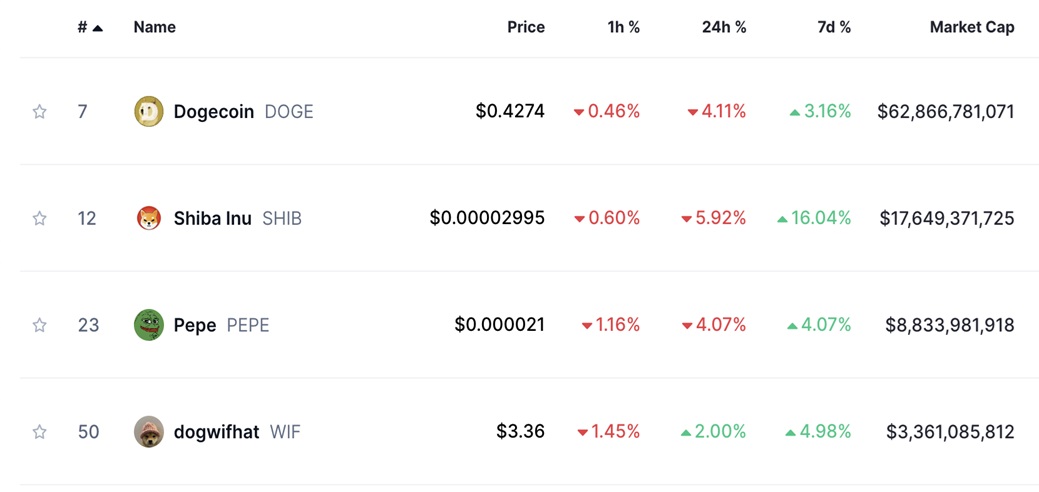
Here’s the math: a 2000% gain from the current presale price would bring $CUTO to $0.62. Sounds reasonable, right? But now let’s check the market cap and see how it stacks up to coins like Doge, Shiba Inu, Pepe and DogWifHat.

Cutoshi’s token supply is fixed at 440,000,000. If we multiply that by the current price, we get $13,640,000. With the top meme coins boasting market caps in the billions, this is next to nothing.

Now what happens if we multiply that by 2000% we get $272,800,000.  This is still only 272 million. If we look at the top four meme coins we can see that the biggest is DOGE at $62 billion, while the fourth on the list (WIF) is $3.3 billion and way down the overall crypto market cap list at number 50.

MemeFi With A Mission

Cutoshi is proving itself as a meme coin with a vision and a plan, something that can promote the possibility of long-term growth, just like DOGE, SHIB and PEPE have seen.

A 2000% gain from here is a market cap of $272 million; this seems highly achievable and possibly conservative, given the math and bullish factors above.


For more information on the Cutoshi (CUTO) Presale:

https://cutoshi.com/  

Join and become a community member:

https://twitter.com/CutoshiToken

https://t.me/cutoshi