DD
MM
YYYY

PAGES

DD
MM
YYYY

spot_img

PAGES

Home Blog Page 259

China and ASEAN Sign Upgraded Trade Pact as Beijing Seeks to Diversify Exports Amid U.S. Tariff Tensions

0

China and the Association of Southeast Asian Nations (ASEAN) have signed a major upgrade to their free trade agreement, marking one of the most ambitious expansions of regional economic cooperation since the pact was first established in 2010.

The new deal — known as the ASEAN–China Free Trade Area 3.0 — aims to deepen integration in the digital economy, green industries, and other emerging sectors, representing a key step in China’s effort to diversify its export economy amid escalating trade tensions with the United States.

The agreement was finalized during the ASEAN Summit held in Malaysia on Tuesday, attended by Chinese Premier Li Qiang and President Donald Trump, who began his Asia tour in Kuala Lumpur. It reinforces Beijing’s intent to tighten its economic ties with Southeast Asia at a time when U.S. tariffs are reshaping global trade flows and forcing China to seek new partners for its industrial output.

According to ASEAN statistics, trade between China and the bloc reached $771 billion in 2024, making ASEAN China’s largest trading partner. With a combined GDP of about $3.8 trillion, ASEAN represents both a crucial export destination and a supply chain hub for Chinese manufacturers navigating shifting tariff barriers and reconfiguration of global production networks.

Premier Li described the agreement as a “landmark achievement in regional economic cooperation,” adding that both sides “must accelerate trade and investment liberalization and strengthen industrial interdependence.” He emphasized that the new framework would ensure that regional trade remains stable despite global headwinds, positioning ASEAN as an indispensable partner in Beijing’s long-term trade strategy.

The ASEAN–China Free Trade Area 3.0 follows months of negotiation that began in November 2022 and concluded in May 2025, shortly after President Trump’s administration intensified its tariff measures on several major economies, including China. The upgraded deal introduces new provisions for cross-border digital trade, e-commerce regulation, clean technology, and sustainable industrial practices — all aimed at modernizing the economic relationship between both sides.

Singapore’s Prime Minister Lawrence Wong said the new accord would “reduce trade barriers, strengthen supply chain connectivity, and unlock opportunities in future growth areas.” He noted that the inclusion of digital and green sectors will create fresh pathways for ASEAN economies to participate in the global value chain while benefiting from China’s expanding consumer market and manufacturing infrastructure.

The pact also aligns with China’s broader economic strategy of diversifying away from overreliance on Western markets. As Washington continues to impose restrictions on Chinese exports — including tariffs, semiconductor curbs, and sanctions targeting strategic industries — Beijing has been working to deepen its economic footprint across Asia, Africa, and Latin America. Analysts see the ASEAN partnership as one of China’s most effective avenues for offsetting potential losses from U.S. trade measures.

Beijing has framed the 3.0 upgrade as a demonstration of its commitment to economic openness and multilateralism, despite concerns from Western governments over its export controls on rare earths and other critical minerals. While China maintains these measures are for national security, critics argue that they undercut its message of fair trade and transparency.

The agreement also builds on the foundation of the Regional Comprehensive Economic Partnership (RCEP), the world’s largest trade bloc, which includes both China and ASEAN and covers about one-third of global GDP. RCEP’s first in-person summit in five years, held in Kuala Lumpur a day earlier, highlighted growing regional alignment on trade liberalization even as geopolitical tensions simmer in the background.

Yet, those tensions were palpable during the ASEAN meetings. Philippine President Ferdinand Marcos Jr. sharply criticized China’s “aggressive actions” in the South China Sea, warning that Beijing’s conduct risked destabilizing the region. In response, China’s foreign ministry accused Manila of provocation. The disputed waters, rich in resources and strategically important, have long been a flashpoint between China and several ASEAN members, including Vietnam, Malaysia, and Brunei.

Premier Li sought to calm tensions, calling for “strategic mutual trust” and an accelerated conclusion of a long-delayed Code of Conduct for the South China Sea.

“We must strengthen dialogue and mutual understanding to safeguard peace and stability,” Li said, stressing that economic cooperation should not be overshadowed by security disputes.

Prime Minister Wong echoed this sentiment, noting that while “differences of views” are inevitable, all member states agree that “peace, stability, and freedom of navigation” are critical for maintaining prosperity in the region.

The backdrop to the agreement is a volatile global trade environment dominated by the Trump administration’s tariff campaign against China. The tariffs have disrupted global supply chains, prompting both sides to seek a temporary truce. Negotiators from Washington and Beijing met in Kuala Lumpur over the weekend and agreed to extend the current trade pause, setting the stage for a meeting between Trump and Chinese President Xi Jinping in Seoul later this week.

Since Trump departed from Malaysia on Monday, China has accelerated efforts to consolidate its economic partnerships across Asia. Premier Li, in a separate address, warned against rising protectionism, saying, “The world must not slip back into the law of the jungle where the strong prey on the weak. We must uphold free trade and create a high-standard regional trade network that benefits all.”

Analysts say the upgraded ASEAN–China pact is not only a diplomatic success for Beijing but also an economic necessity. Through deepening regional integration, China is expected to cushion itself from U.S. tariffs while ensuring continued access to vital markets for its exports.

Transcorp Group Reports 54% Jump in Q3 Profit as Energy Business Powers Growth

0

Transnational Corporation Plc (Transcorp Group) has reported a pre-tax profit of N38.81 billion for the third quarter of 2025, representing a 53.84% year-on-year increase compared to the same period in 2024, underscoring continued momentum in its energy operations and operational efficiency.

The performance lifted the nine-month pre-tax profit to N124.52 billion, up 18% year-on-year, putting the conglomerate just 8% short of its full-year 2024 profit. Revenue for Q3 surged 53.97% year-on-year to N133.76 billion, while nine-month revenue climbed 38.89% to N413.44 billion, already surpassing the company’s full-year 2024 figure.

The growth was largely driven by the energy business, which generated N270.91 billion, accounting for 66% of total nine-month revenue, reflecting the strategic focus on power and energy efficiency across subsidiaries such as Transcorp Power and Transafam Power.

Financial highlights

The company’s unaudited results show continued improvement across key financial metrics compared to Q3 2024:

  • Revenue: N133.76 billion, up 53.97% YoY
  • Cost of sales: N68.08 billion, up 43% YoY
  • Gross profit: N65.68 billion, up 67.26% YoY
  • Operating profit: N45.73 billion, up 64.40% YoY
  • Net finance income: N5.79 billion, up 68.01% YoY
  • Post-tax profit: N26.24 billion, up 55.57% YoY
  • Earnings per share: N1.26, up 530% YoY
  • Total assets: N940.89 billion, up 26.19%
  • Shareholders’ funds: N309.57 billion, up 13.94%

Operational efficiency and margins

A detailed review shows that revenue growth outpaced both cost of sales and operating expenses, resulting in improved profit margins. Gross profit margin rose to 49% from 45% in Q3 2024, while operating profit margin increased to 34.19% from 32.02%.

Net finance income expanded by 68%, supported by improved treasury operations and a reduction in finance costs. Total borrowings dropped to N80.05 billion from N88.51 billion, reflecting stronger leverage management.

Balance sheet strength

Total assets expanded by 26% to N940.89 billion, primarily due to a 157% increase in investments in financial assets, which now stand at about N47 billion. Property, plant, and equipment remained the largest component, at N318.99 billion.

On the equity side, shareholders’ funds grew 13.94%, supported by retained earnings and improved profitability. Retained losses narrowed to N149.69 billion, compared to N112.32 billion in 2024. However, trade and other payables remained elevated at N357.61 billion, representing over 57% of total liabilities — a sign that working capital pressures persist despite improved cash flows.

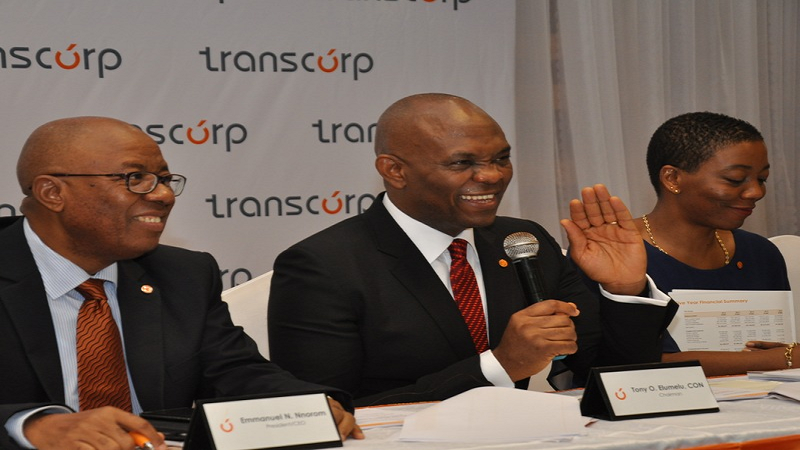
Commenting on the results, Dr. Owen Omogiafo, OON, President/Group CEO of Transcorp Plc, said the performance “demonstrates the successful execution of strategic direction, operational excellence, and portfolio-wide efficiency.” She added:

“Driven by our core purpose to ‘Improve Lives and Transform Africa’, we continue to optimize our businesses to deliver superior stakeholder value.”

However, Transcorp’s share price fell slightly by 0.5% to N48.15 at the close of trading on October 27, 2025, though the stock has gained 10.1% year-to-date, reflecting investor confidence in the company’s long-term growth.

Energy Market Growth

Analysts say Transcorp’s strong energy performance aligns with Nigeria’s ongoing electricity sector reforms, which are encouraging private investment in generation and grid efficiency. With its growing footprint in hospitality, power, and oil and gas, Transcorp is increasingly positioned as a diversified infrastructure and energy conglomerate.

Analysts also note that the group’s performance reflects a broader shift among Nigerian listed companies toward cost optimization amid inflationary pressures. While Transcorp’s borrowings have declined, high trade payables indicate that short-term liabilities remain an area to monitor.

In comparison with other listed Nigerian conglomerates, Transcorp’s growth trajectory has outpaced several of its peers in profitability and sector diversification. Transcorp’s 55.6% post-tax profit growth therefore positions it among the best-performing diversified groups on the Nigerian Exchange.

Analysts have noted that Transcorp’s power business remains the primary earnings catalyst and differentiator in the Nigerian conglomerate landscape, citing its ability to sustain growth even amid tight macroeconomic conditions.

Looking ahead, analysts believe Transcorp’s ongoing investment in financial assets, hospitality, and power infrastructure could strengthen earnings stability through 2026. The group’s balance sheet position and declining leverage also signal room for expansion financing if new opportunities arise in the power or upstream energy segments.

SharpLink Gaming Acquires $78M in Ethereum, Boosting Treasury Holdings

0

SharpLink Gaming (NASDAQ: SBET), a sports gaming technology firm chaired by Ethereum co-founder Joseph Lubin, has resumed its aggressive Ethereum accumulation strategy after a month-long pause.

On October 27, 2025, the company purchased 19,271 ETH for approximately $78.3 million at an average price of around $4,060 per token, according to on-chain data from analytics firm Lookonchain. This acquisition was funded through a recent $76.5 million direct stock offering, completed on October 17.

The move elevates SharpLink’s total ETH holdings to 859,853 tokens—comprising 601,143 native ETH and 258,710 ETH equivalents from liquid staking tokens—valued at over $3.6 billion at current prices ETH trading above $4,200.

This positions SharpLink as the second-largest corporate ETH holder globally, trailing only BitMine Immersion Technologies. Over 95% of its holdings are staked to generate yield, aligning with the company’s equity-only treasury approach that avoids debt.

This purchase signals renewed institutional confidence in Ethereum amid its price rebound, potentially influencing market sentiment as corporate adoption grows. SharpLink’s “ETH Concentration” metric—measuring ETH per diluted share—has doubled since June 2025, benefiting shareholders without additional dilution.

The firm’s strategy, backed by a $425 million private placement led by ConsenSys in June, underscores Ethereum’s role in modern corporate treasuries, similar to MicroStrategy’s Bitcoin playbook.

JPYC Inc. Launches World’s First Regulated Yen-Pegged Stablecoin

Tokyo-based fintech JPYC Inc. officially debuted JPYC, the world’s first fully regulated stablecoin pegged 1:1 to the Japanese yen (JPY). Issued under Japan’s revised Payment Services Act and licensed by the Financial Services Agency (FSA), the token is backed entirely by yen-denominated bank deposits and Japanese Government Bonds (JGBs), ensuring full redeemability and stability.

Users can mint or redeem JPYC via the new JPYC EX platform, with an initial daily limit of 1 million yen (~$6,600) per user and zero transaction fees for the first year to drive adoption.

Deployed on Ethereum, Polygon, and Avalanche blockchains, JPYC aims to enable low-cost, near-instant cross-border payments and settlements, reducing Asia’s dependence on USD-pegged stablecoins like USDT and USDC. JPYC Inc. targets issuing 10 trillion yen ~$66 billion worth of the token within three years, earning revenue from JGB yields currently over 3% at the long end rather than user fees.

CEO Noritaka Okabe highlighted its potential to spur innovation for startups and enhance global interoperability, with openness to capital partnerships. This launch marks Japan’s entry into the $230-300 billion global stablecoin market, where USD tokens dominate 99% of volume.

DeFi & payments upgrade: Instant, fee-free 1st year yen transfers on Ethereum/Polygon/Avalanche. 10T JPY $66B target in 3 years; boosts JGB demand, strengthens yen in global crypto flows.

While experts like former Bank of Japan executive Tomoyuki Shimoda predict 2-3 years for mainstream traction—due to Japan’s cash-heavy culture cashless payments at 42.8% in 2024—JPYC could boost JGB demand, strengthen the yen’s digital role, and facilitate USD/JPY trading on DeFi platforms.

It precedes similar efforts in South Korea (won-backed) and China (yuan-backed), positioning Japan as a regulatory leader in fiat-pegged digital assets. These developments highlight growing corporate and national embrace of blockchain for treasury management and payments, potentially accelerating crypto’s integration with traditional finance.

SharpLink Gaming’s $78M ETH Buy Bullish ETH signal: Second-largest corporate holder now holds >$3.6B in ETH; reinforces Ethereum as a treasury asset. Shareholder value boost: ETH-per-share doubled since June; no debt, 95%+ staked for yield.

Resumes accumulation post-$425M raise; may trigger institutional FOMO as ETH >$4,200. World’s first regulated JPY-pegged token; challenges USD dominance in Asia.

Qualcomm Unveils New AI Chips to Challenge Nvidia’s Market Dominance

0

In a move to expand beyond its traditional mobile processor business, Qualcomm has announced two new artificial intelligence chips — the AI200 and AI250 — designed to rival Nvidia’s dominance in the fast-growing AI hardware market.

The company said the AI200 will launch in 2026, followed by the AI250 in 2027, marking its most ambitious push yet into high-performance computing. Both chips are built on Qualcomm’s Hexagon neural processing unit (NPU) architecture, the same technology that powers AI features in its Snapdragon chips for smartphones and laptops.

Unlike Nvidia’s flagship GPUs, which are designed for both training and inference, Qualcomm’s new chips are focused solely on AI inference — the process of running already-trained models efficiently in data centers or edge computing systems.

According to CNBC, Qualcomm’s AI processors can be deployed inside large data racks, with up to 72 chips operating as a single computer, mirroring Nvidia’s and AMD’s multi-GPU configurations.

The AI200 chip will feature 768GB of RAM, optimized for inference workloads such as generative AI applications, voice assistants, and multimodal reasoning tasks. Qualcomm said the next-generation AI250 will deliver a “generational leap in efficiency,” offering “much lower power consumption” while maintaining high processing power — a critical advantage as energy costs rise across AI data centers.

Qualcomm’s expansion into AI datacenter hardware has already attracted major partnerships. Humain, the AI firm backed by Saudi Arabia’s Public Investment Fund (PIF), announced plans to adopt both the AI200 and AI250 chips to power its AI datacenters across the Middle East. The collaboration is part of a broader effort by Saudi Arabia to position itself as a regional AI hub, with large-scale investments in generative AI and cloud infrastructure.

The partnership pinpoints Qualcomm’s growing importance in AI infrastructure beyond consumer electronics, extending its reach into sovereign computing and national AI strategy projects.

Taking Aim at Nvidia’s Stronghold

The move comes as Nvidia continues to dominate the global AI hardware market, controlling more than 80% of the market for AI chips used in data centers. Qualcomm’s approach — emphasizing energy-efficient inference rather than high-cost training — is expected to carve out a niche in a sector that’s increasingly focused on cost-effective scalability.

Qualcomm aims to position its AI200 and AI250 chips as attractive alternatives for enterprises and governments seeking AI infrastructure with lower operating costs by leveraging its expertise in low-power, high-efficiency chips honed through years of building processors for mobile devices.

It is believed that Qualcomm’s decision to focus on inference chips aligns with the next wave of AI deployment, where companies are shifting from training massive models to running and scaling them efficiently across devices and servers.

The launch represents a major strategic shift for the company, which has traditionally derived most of its revenue from smartphone and telecommunications chips. The company’s growing investment in AI semiconductors signals its intention to diversify revenue streams and participate in what many analysts call the “AI compute boom.”

The AI200 and AI250 chips are expected to help Qualcomm secure a foothold in a market long dominated by Nvidia and AMD — a move that may redefine the global semiconductor market.

How This New Crypto Is Making Bitcoin Payments Easy and Affordable

0

Your favorite local store probably doesn’t accept crypto, and there’s a reason for that. Business owners take one look at the complexity, the fees, and the volatile prices, then decide it’s not worth the trouble.

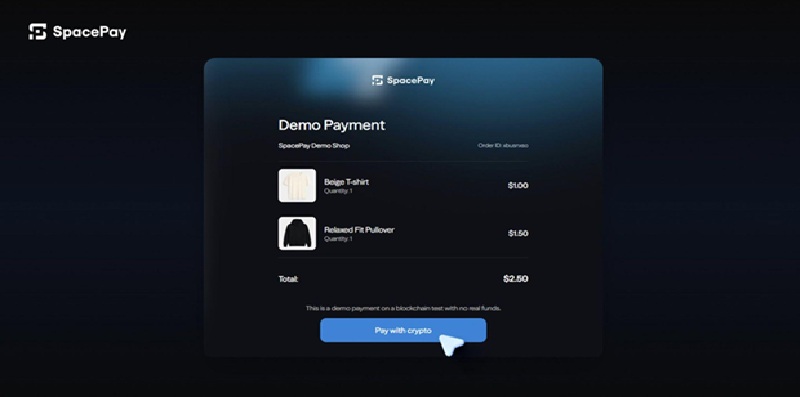
SpacePay from London figured out how to eliminate these problems. Their platform lets merchants accept cryptocurrency using the card readers already sitting on their counters. No new equipment, no complicated training, and no worrying about Bitcoin crashing overnight.

The startup has already raised over $1.4M during its presale phase, with $SPY tokens currently available at $0.003181. What makes this different is how they’ve stripped away everything that typically stops businesses from accepting digital currencies.

Why Bitcoin Payments Have Been So Hard

Around 400 million people worldwide own cryptocurrency, yet most can’t spend it anywhere except online exchanges. The problem isn’t a lack of interest from either side. Business owners would love to serve crypto customers, and crypto holders would love to spend their digital assets at regular stores.

Traditional crypto payment solutions create too many obstacles. They require expensive new terminals, extensive staff training, and force merchants to deal with blockchain technology they don’t understand. Most shop owners look at the requirements and pass.

Bitcoin payments face another major issue – price volatility. A merchant might accept payment worth $50 today, then discover it’s worth $42 tomorrow. This unpredictability makes crypto seem more like gambling than accepting payment for goods and services.

Best Crypto to Buy: SpacePay Takes a Different Path

When looking for the best crypto to buy, projects with real-world utility stand out from speculative tokens. SpacePay addresses actual problems that prevent cryptocurrency adoption in physical retail locations.

The platform works with Android-based point-of-sale terminals that millions of businesses already use. A simple software update enables crypto acceptance. Coffee shops, bookstores, auto repair garages – any business with an existing card reader can start accepting digital currencies immediately.

SpacePay handles over 325 different cryptocurrency wallets. Customers can stick with whatever crypto wallet they already have on their phone. MetaMask, Trust Wallet, or that random app they downloaded months ago works the same.

Merchants never have to worry about Bitcoin tanking overnight because the system converts everything to regular money instantly. When someone pays with Bitcoin or Ethereum, SpacePay immediately converts it to traditional currency. The business receives dollars or euros within seconds, completely bypassing the risk of price fluctuations.

Visit SpacePay Presale

SpacePay One Testnet Shows Real Progress

SpacePay One Testnet recently went live, giving developers and early testers a chance to explore the platform’s capabilities. The V1 release includes a functional payment widget with an API-first design and seamless checkout flow.

The testnet currently supports Base Sepolia and Ethereum Sepolia networks. Users can test the system at the provided link and experience how the payment process works. Desktop use is recommended for now while the team addresses mobile-specific issues.

This testnet represents the foundation for SpacePay’s broader vision of enabling instant, gasless crypto-to-fiat payments. Having working technology before asking for investment money sets SpacePay apart from projects that launch with only promises and marketing materials.

The development team actively requests feedback through their Telegram channel. This open approach to testing and improvement suggests they’re building for long-term success rather than quick profits.

Low Fees Change the Economics

Credit card processors usually grab between 2% and 4% of every sale. For a small business watching every penny, those fees hurt. SpacePay only takes 0.5%, which makes a real difference at the end of each month.

Consider a restaurant processing $25,000 monthly. Traditional payment processors would take $500 to $1,000 in fees. SpacePay’s 0.5% rate means just $125. That difference could cover utilities, pay for ingredients, or fund employee bonuses.

The transparent fee structure eliminates surprise charges. Business owners know exactly what each transaction costs without hidden fees appearing later. This predictability helps with budgeting and financial planning.

Lower processing costs also benefit customers indirectly. Merchants can offer better prices when they’re not losing thousands to payment processors each month. Everyone wins when transaction fees drop.

Getting Started With the $SPY Presale

Getting involved is pretty simple. Head over to SpacePay’s official website and connect your crypto wallet. You can pay with Ethereum, Binance Coin, Polygon, Avalanche, Tether, or USD Coin. If you don’t own any crypto yet, standard bank cards work just fine.

Tokens currently cost $0.003181 each. The price increases as each presale stage completes, so earlier participants receive better pricing. After connecting your wallet, enter your desired investment amount and confirm the transaction. Keep records of your purchase for when token claiming becomes available.


JOIN THE SPACEPAY ($SPY) PRESALE NOW

Website    |    (X) Twitter    |  Telegram