DD
MM
YYYY

PAGES

DD
MM
YYYY

spot_img

PAGES

Home Blog Page 26

IBM and Red Hat Bet $5 Billion on Open-Source Security as AI-Driven Vulnerability Risks Escalate

0

IBM is making one of its largest cybersecurity commitments in years, pledging $5 billion to a new initiative aimed at tackling a growing problem at the heart of modern software development: securing the open-source code that underpins much of the global digital economy.

The project, dubbed Project Lightwell, is a joint effort between IBM and Red Hat that will combine more than 20,000 engineers with artificial intelligence systems to identify, verify, and remediate vulnerabilities across open-source software widely used by businesses.

The initiative comes as enterprises face mounting concerns that advances in AI are dramatically changing the cybersecurity landscape. While AI is helping companies improve productivity and automate software development, it is also giving attackers new tools to discover and exploit vulnerabilities at unprecedented speed.

IBM senior vice president of software Rob Thomas told Reuters that the commercial service is expected to launch within 30 days and will likely be offered through subscription-based pricing tied to the number of software packages a customer uses.

At its core, Project Lightwell aims to function as a trusted verification layer for open-source software, providing enterprises with what Thomas described as a “stamp of approval” that specific software packages are safe for production deployment.

The initiative addresses a challenge that has become increasingly critical as software supply chains grow more complex. More than 90% of Fortune 500 companies rely on open-source software, according to IBM. Modern applications often contain thousands of external software components maintained by distributed communities rather than centralized vendors.

IBM itself reportedly uses more than 62,000 open-source packages across its technology ecosystem.

The widespread adoption of open-source software has accelerated innovation and reduced development costs, but it has also created a vast attack surface. A single vulnerability in a widely used package can cascade across thousands of organizations worldwide.

Recent years have demonstrated how vulnerable these software supply chains can be. High-profile incidents involving compromised open-source components have affected governments, financial institutions, healthcare providers, and critical infrastructure operators, prompting regulators and cybersecurity agencies to increase scrutiny of software supply chains.

IBM estimates publicly disclosed software vulnerabilities could reach 59,000 by 2026, citing data from CVE.org. The sheer volume of potential threats has made traditional manual security reviews increasingly difficult to scale.

AI Becomes Both The Problem And The Solution

Project Lightwell reflects a broader shift occurring across the cybersecurity industry: using AI to defend against threats that AI itself is helping create. The initiative will employ artificial intelligence systems to scan massive open-source code bases, identify potential vulnerabilities, and prioritize which issues require immediate attention. Human engineers will then validate findings, develop patches, maintain affected software, and coordinate fixes with open-source communities.

The approach is designed to address one of cybersecurity’s biggest bottlenecks: separating genuine threats from false alarms.

IBM pointed to recent findings from Anthropic’s cybersecurity research efforts as evidence of AI’s growing capabilities in vulnerability discovery. According to IBM, Anthropic’s Project Glasswing used its Mythos Preview model to identify nearly 3,900 vulnerabilities rated as high or critical severity within open-source software.

Among the vulnerabilities reviewed, Anthropic reported that 90.6% were legitimate security issues, while 62.4% were confirmed to be high- or critical-severity threats. Those figures suggest AI systems are becoming increasingly effective at uncovering software weaknesses that might otherwise remain undetected for extended periods.

The same capabilities, however, can also be used by malicious actors, creating an arms race between defenders and attackers.

Wall Street Joins The Effort

One notable aspect of Project Lightwell is the roster of early participants. IBM and Red Hat have already piloted the initiative with several major financial institutions, including Bank of America, JPMorgan Chase, and Visa. Additional participants include BNY, Citi, Goldman Sachs, Mastercard, Morgan Stanley, Royal Bank of Canada, State Street, and Wells Fargo.

The participation of some of the world’s largest financial institutions highlights how software supply-chain security has become a boardroom issue rather than merely an IT concern. Banks face particularly high risks because they depend on complex technology infrastructures while also operating under stringent regulatory oversight.

IBM says Project Lightwell is intended to cover the entire software lifecycle, from development through production deployment. Companies will be able to report sensitive vulnerabilities privately, receive validated patches, and coordinate fixes with upstream maintainers before vulnerabilities become widely known.

The platform is also designed to work without requiring direct access to a company’s proprietary source code. Using dependency manifests such as pom.xml files, the system can identify affected software components, determine exposure, and deliver patched artifacts directly into repositories controlled by enterprise customers.

The initiative also addresses one of the most persistent challenges in enterprise software management: maintaining older software versions.

Many organizations continue running applications built on legacy dependencies because upgrading can disrupt operations. Project Lightwell aims to provide backported security fixes, allowing organizations to remain on tested software versions while still receiving security updates.

That capability could be particularly valuable in heavily regulated industries where software changes require extensive testing and approval processes.

Expanding Beyond Red Hat

Although Red Hat’s enterprise Linux ecosystem remains central to the initiative, IBM says the project will extend far beyond its existing platforms. Coverage will include independent open-source libraries, language toolchains, AI frameworks, data-streaming technologies, and infrastructure software.

Among the technologies highlighted by IBM are widely used platforms such as Kafka, Ansible, Terraform, Flink, and Cassandra, all of which play critical roles in enterprise computing environments.

The breadth of coverage reflects the reality that modern enterprises rarely rely on a single software stack. Instead, they operate sprawling ecosystems assembled from thousands of interconnected open-source components.

Project Lightwell also positions IBM to capitalize on a rapidly expanding cybersecurity market. As software supply-chain attacks become more sophisticated and regulators demand greater transparency, enterprises are showing more willingness to pay for independent validation and security assurance services.

Government agencies worldwide have pushed for greater adoption of Software Bills of Materials (SBOMs), which provide detailed inventories of software components and dependencies. At the same time, organizations are struggling to manage vulnerabilities buried deep within complex dependency chains.

By combining AI-powered vulnerability discovery with human validation and enterprise-grade support, IBM is seeking to create a new category of security service centered on trusted open-source software certification.

Data On Trial: MTN Throws Open Its Billing Systems as Internet Subscribers Allege Arbitrary Data Charges

0

For years, accusations of unexplained data depletion have remained one of the most contentious issues in Nigeria’s telecommunications sector, fueling customer frustration, regulatory scrutiny, and widespread distrust of mobile network operators.

As smartphones become the primary gateway to banking, entertainment, commerce, and work, disputes over disappearing data have evolved from isolated complaints into a reputational challenge for the industry.

In a rare move aimed at addressing those concerns, MTN Nigeria has opened its data billing and network operations to public scrutiny through an initiative tagged “Data on Trial,” allowing subscribers, consumer groups, regulators, and industry stakeholders to examine how data is measured, consumed, and billed on its network.

The telecom giant said the exercise is intended to provide transparency around data usage while creating a platform for customers to question its technical teams directly and raise concerns about alleged discrepancies.

Speaking in Lagos, MTN Nigeria’s Chief Corporate Services and Sustainability Officer, Tobe Okigbo, said the company wants an evidence-based examination of the issue to determine whether complaints stem from technical problems, consumer misconceptions, or a lack of understanding of how modern digital applications consume data.

“We want Nigerians to tell us what is wrong, ask questions and help us identify issues so that we can collectively find solutions,” Okigbo said.

The initiative comes at a crucial period for Nigeria’s telecom industry. Data services have become the sector’s fastest-growing revenue stream as operators contend with declining voice revenues, rising operating costs, and surging demand for digital connectivity. That shift has placed data consumption patterns under greater scrutiny than ever before.

Okigbo noted that MTN had confronted a similar crisis in the past when subscribers complained about unauthorized value-added service subscriptions that led to unexpected deductions. According to him, the company responded by suspending affected services, subjecting its systems to regulatory reviews, and implementing stricter controls that helped restore customer confidence.

Industry observers say the current controversy presents an even greater challenge because data consumption has become increasingly complex. Unlike voice calls, which are relatively easy for customers to track, data usage is influenced by dozens of factors that operate simultaneously across multiple devices and applications.

Attempting to address some of those concerns, MTN’s General Manager for Network Quality, Mike Ndukwe, rejected claims that telecom operators arbitrarily deduct customer data.

Instead, he argued that much of today’s data consumption occurs through routine digital activities that many users underestimate or do not notice at all.

Using TikTok as an example, Ndukwe explained that streaming high-definition video consumes significantly more data than standard-definition content. He added that automatic software updates, cloud backups, application synchronization, hotspot sharing, autoplay features, and background processes running on smartphones can continue consuming data even when users are not actively using their devices.

The transition to 4G and 5G networks has further amplified consumption patterns. Faster internet speeds allow platforms to automatically deliver higher-quality videos, images, and content, resulting in larger volumes of data being used within shorter periods.

“Subscribers can better manage their data usage by reducing video quality, restricting background applications, and monitoring device settings regularly,” Ndukwe said.

He also sought to clarify how data usage is measured, explaining that telecom billing systems operate according to internationally recognized standards. However, apparent differences may arise because customer devices, network equipment, and billing platforms often record data at different stages of transmission.

According to him, MTN’s billing systems undergo periodic audits by the Nigerian Communications Commission (NCC) as well as independent assessors to ensure compliance with industry standards.

The debate over data depletion has intensified in recent years as Nigeria’s internet economy expands rapidly. Millions of consumers now rely on mobile networks for activities that were previously conducted offline, from video streaming and online learning to digital payments and cloud-based services.

That growth has also exposed a significant knowledge gap between how consumers believe data should be consumed and how modern applications actually function.

For regulators, the challenge has become one of balancing consumer protection with technological realities. The NCC has increasingly pushed operators to demonstrate greater transparency in their billing systems. One outcome of that pressure is the introduction of daily data usage notifications, allowing subscribers to receive reports showing how much data was consumed on the previous day.

Telecom operators are also exploring additional transparency tools, including real-time data calculators and usage-monitoring platforms that could show subscribers exactly which applications consume the largest share of their data.

Analysts say such measures may become increasingly necessary as artificial intelligence applications, high-definition streaming, cloud gaming, and other bandwidth-intensive services become more common across Nigeria.

For MTN, Africa’s largest mobile operator by subscribers, the “Data on Trial” initiative is ultimately a test of credibility as much as technology. The company is wagering that greater transparency can help narrow the trust gap between operators and consumers.

Polymarket Completes Six-Figure On-Chain Institutional Hedge Tied to Nvidia GPU Compute Prices

0

The convergence of decentralized finance, prediction markets, and artificial intelligence infrastructure has reached a new milestone as Polymarket successfully facilitated a six-figure on-chain institutional hedge linked to Nvidia GPU compute prices. The transaction highlights how blockchain-based financial tools are evolving beyond speculative trading and into sophisticated risk-management solutions for institutions operating in the rapidly growing AI economy.

Nvidia has become one of the most important companies in the global technology sector due to its dominance in AI hardware. Its graphics processing units (GPUs) power many of the world’s leading artificial intelligence models, cloud computing services, and data centers. As demand for AI continues to expand, the cost of accessing Nvidia-powered compute resources has become a critical variable for businesses, developers, and investors.

Fluctuations in GPU availability and pricing can significantly affect operating costs, profit margins, and long-term investment decisions.

Traditionally, organizations seeking protection against price volatility in technology infrastructure have relied on private contracts, long-term supplier agreements, or customized financial instruments. However, these solutions often lack transparency, liquidity, and accessibility. Polymarket’s latest institutional hedge demonstrates how decentralized prediction markets can offer an alternative approach by allowing participants to gain exposure to future outcomes related to compute pricing through transparent, blockchain-based mechanisms.

The six-figure transaction is significant not only because of its size but also because it reflects growing institutional confidence in on-chain financial infrastructure. Institutions have historically been cautious about participating in decentralized markets due to concerns surrounding liquidity, regulatory uncertainty, and operational risks. The successful execution of a hedge tied to Nvidia GPU compute prices suggests that these concerns are gradually being addressed as blockchain platforms mature and attract more sophisticated users.

The development also reflects a broader trend in financial markets: the emergence of AI as a new asset class. While investors have traditionally focused on equities, commodities, currencies, and interest rates, AI infrastructure is increasingly becoming a critical economic resource. Compute power, data storage, and model training capacity are now essential inputs for businesses competing in the AI era.

As a result, market participants are seeking new ways to hedge risks associated with these resources.

Prediction markets are uniquely positioned to serve this need. By aggregating information from a wide range of participants, they can create market-based forecasts that reflect collective expectations about future events. In the case of Nvidia GPU compute pricing, these markets provide valuable signals about supply constraints, demand trends, and future pricing conditions.

Institutions can use these signals not only for speculation but also for operational planning and financial risk management. The hedge executed on Polymarket may also serve as a proof of concept for future products tied to AI infrastructure metrics. Similar markets could eventually emerge around cloud computing costs, data center utilization rates, semiconductor supply chains, or even AI model performance benchmarks.

Such instruments would allow businesses to manage risks more effectively while creating entirely new categories of financial markets. Looking ahead, the successful completion of this institutional hedge represents an important step in the evolution of decentralized finance. It demonstrates that blockchain-based platforms are increasingly capable of supporting real-world financial needs beyond cryptocurrency trading.

As AI continues to reshape the global economy, the intersection of prediction markets, decentralized finance, and compute infrastructure could become one of the most innovative areas of modern finance. Polymarket’s six-figure on-chain hedge tied to Nvidia GPU compute prices signals a future where digital markets help institutions navigate the complexities of the AI-driven world with greater transparency, efficiency, and flexibility.

Brazilian Raízen Secures Support for Record $12.6bn Debt Restructuring as Shell Backs Turnaround Effort

0
FILE PHOTO: A Shell logo is seen at a gas station in Buenos Aires, Argentina, March 12, 2018. REUTERS/Marcos Brindicci

Brazilian sugar and ethanol giant Raízen has cleared a critical hurdle in its effort to stabilize its finances after securing enough creditor support to proceed with a massive 65 billion reais ($12.57 billion) out-of-court restructuring, the largest corporate debt workout ever recorded in Brazil.

The agreement marks a major feat for a company that was once viewed as one of Latin America’s most ambitious renewable energy champions but later became a cautionary tale about the risks of aggressive expansion during a period of rising borrowing costs and operational challenges.

In a statement issued late Friday, Raízen said creditors representing more than 75% of the unsecured financial obligations covered by the restructuring had signed onto the proposal, surpassing the threshold required under Brazilian law.

The company, a joint venture between Shell and Cosan, can now move forward with a plan designed to reduce debt, strengthen liquidity, and provide breathing room for its operations.

The scale of the transaction highlights the severity of Raízen’s financial challenges and the growing pressure facing highly leveraged companies in capital-intensive industries. At approximately 65 billion reais, the restructuring ranks among the largest corporate debt overhauls in Latin American history and underscores how rapidly conditions deteriorated for a company that had been one of Brazil’s most prominent renewable fuel producers.

The restructuring offers creditors three alternatives for managing their claims, including exchanging existing obligations for new debt securities or converting part of their holdings into equity. Under the equity conversion option, creditors would exchange 45% of their restructured debt for newly issued units composed of one common share and one preferred share. The securities will be issued at 0.50 reais per unit, equivalent to 0.25 reais per share.

The remaining 55% of the debt would be rolled into new financial instruments, allowing the company to extend maturities and ease immediate repayment pressures.

The structure follows a growing pattern in large restructurings globally, where creditors increasingly accept ownership stakes in exchange for preserving long-term value and avoiding more disruptive insolvency proceedings.

Shell provides a vote of confidence

A key element of the plan is fresh capital from existing shareholders. Shell has committed 3.5 billion reais in new funding, demonstrating continued support for the company despite its financial difficulties. Raízen Chairman Rubens Ometto, through Aguassanta Participações, may contribute an additional 500 million reais.

In return, both investors would receive common shares, helping recapitalize the business while diluting existing ownership structures.

Shell said it supports the agreement and emphasized that the restructuring preserves its role in the company’s governance.

“We will continue to work with Raízen’s management team, its creditors and other stakeholders to support implementation of the plan and the long-term sustainability of the company,” the company said in a statement.

The commitment is significant because it signals that one of the world’s largest energy companies still sees strategic value in Raízen’s operations despite recent setbacks.

How a renewable energy success story unraveled

Raízen’s financial troubles stem from a combination of strategic missteps, operational challenges, and unfavorable macroeconomic conditions.

The company spent heavily in recent years expanding its second-generation ethanol operations, a technology designed to produce biofuel from agricultural waste such as sugarcane residue. Management viewed the investments as a way to position Raízen at the forefront of the global energy transition and capitalize on growing demand for lower-carbon fuels. At the same time, the company expanded into renewable energy projects and pursued a broad growth strategy requiring substantial amounts of capital.

The problem was that expected returns failed to materialize quickly enough.

Weaker-than-anticipated sugarcane harvests reduced feedstock availability and pressured production volumes. Higher interest rates increased financing costs across the business. Large-scale expansion projects consumed cash while generating limited near-term earnings.

The combination created a severe squeeze on cash flow, leaving the company with a debt burden that became increasingly difficult to manage.

Now, the restructuring raises broader questions about financing the energy transition in emerging markets. Brazil has long been regarded as one of the world’s leaders in biofuels, with sugarcane ethanol playing a central role in the country’s energy mix. Companies such as Raízen were expected to be major beneficiaries of global decarbonization trends.

Instead, the company’s difficulties highlight the financial risks associated with scaling new technologies and infrastructure projects before demand and profitability are fully established. Investors globally have become more cautious toward capital-intensive energy-transition projects as higher interest rates increase funding costs and extend the timeline required to generate returns.

What comes next?

The success of the restructuring does not eliminate Raízen’s challenges. Management must now execute a complex turnaround while restoring profitability and rebuilding investor confidence. The company will likely face pressure to improve operational efficiency, prioritize cash generation, and adopt a more disciplined approach to capital allocation.

At the same time, creditors who choose equity conversion will effectively become long-term stakeholders, aligning their interests with the company’s recovery.

SpaceX Draws $150bn in Investor Demand for Historic IPO, Highlighting Sky-High Expectations for Musk’s Space and AI Vision

0

Signaling extraordinary enthusiasm for what is set to become the largest IPO in history, SpaceX has attracted roughly $150 billion in investor demand for its upcoming initial public offering, double the $75 billion it is seeking to raise, according to two people familiar with the matter cited by Reuters.

The rocket and satellite company is still in the early stages of its marketing process, and the sources cautioned that demand figures reflect indications of interest rather than final allocations. Some large institutional investors typically submit orders late in the process, meaning the final book could shift before pricing next week. Bloomberg first reported the oversubscription on Friday.

An oversubscription rate of two times would be viewed as modest for many hotly anticipated listings, but bankers and investors described the level as impressive given the unprecedented scale of the offering.

“Lots of people will have to explain why they don’t own it rather than justifying a decision to buy it,” One hedge fund manager said.

SpaceX launched its roadshow this week with a bold narrative positioning the company as a gateway to entirely new multi-trillion-dollar markets. The presentation highlighted the company’s dominance in space launch, accounting for the lion’s share of mass sent into orbit over the past three years, and the rapid growth of its Starlink satellite internet business, which is bridging the digital divide for billions of unconnected people.

A central pillar of the pitch is SpaceX’s vision for space-based AI infrastructure. The company outlined a potential $23 trillion market opportunity, arguing it is uniquely positioned to overcome Earth-bound limitations by deploying solar-powered data centers in orbit.

According to the roadshow materials, U.S. electricity generation and computing capacity growth have lagged behind China due to regulatory and infrastructure hurdles on the ground. SpaceX believes its low-cost launch capabilities can solve this bottleneck.

“By dramatically reducing the cost of access to space, we have been able to expand our mission to address some of the Earth’s most pressing challenges, including bridging the digital divide by aiming to connect over three billion unconnected people to the internet and humanity’s collective knowledge,” the company said in its presentation.

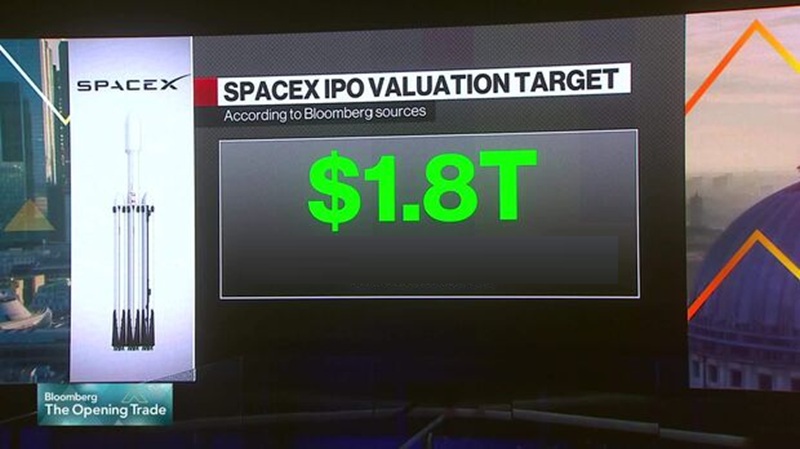
The offering is structured with a fixed price of $135 per share, targeting a $1.75 trillion valuation. This would value SpaceX at nearly 94 times its projected 2025 revenue. While rich by conventional metrics, investors appear willing to underwrite the premium given Musk’s track record and the company’s strategic positioning at the intersection of space, internet connectivity, and artificial intelligence.

The IPO is all-primary, meaning proceeds will flow directly to the company for expansion of AI computing resources and Starlink. Musk will face a 366-day lock-up on his shares, and the company is planning a significant retail allocation of up to 30% to tap into his broad following.

Despite the strong demand, the offering is facing substantial challenges. Two of SpaceX’s three main businesses are still unprofitable, with only Starlink consistently generating cash. The valuation relies heavily on yet-to-be-proven technologies and markets, including large-scale orbital data centers and eventual Mars missions.

Execution risk remains high, as does dependence on regulatory approvals, launch cadence, and competition in satellite broadband.

Still, the combination of proven capabilities in reusable rocketry, a rapidly scaling broadband network, and Musk’s ability to capture imagination has created a compelling story. The IPO is expected to kick off a wave of major technology listings, with OpenAI and Anthropic also preparing debuts that could collectively add nearly $4 trillion in market capitalization.

SpaceX’s reception is seen by analysts as a signal of deep conviction in the long-term convergence of space infrastructure and artificial intelligence. By positioning itself as the only player capable of operating at a planetary scale, SpaceX is asking investors to look far beyond traditional valuation metrics and toward a future where orbital assets become foundational to global computing and connectivity.

For the markets, a successful debut of this magnitude would represent a landmark moment, reopening the door to mega-cap IPOs after years of subdued large-listing activity. So far, the overwhelming demand suggests that many investors are prepared to bet big on Musk’s vision of a multi-planetary future powered by AI.