

Signaling extraordinary enthusiasm for what is set to become the largest IPO in history, SpaceX has attracted roughly $150 billion in investor demand for its upcoming initial public offering, double the $75 billion it is seeking to raise, according to two people familiar with the matter cited by Reuters.
The rocket and satellite company is still in the early stages of its marketing process, and the sources cautioned that demand figures reflect indications of interest rather than final allocations. Some large institutional investors typically submit orders late in the process, meaning the final book could shift before pricing next week. Bloomberg first reported the oversubscription on Friday.
An oversubscription rate of two times would be viewed as modest for many hotly anticipated listings, but bankers and investors described the level as impressive given the unprecedented scale of the offering.
Register for the next Tekedia Mini-MBA.
Register for Tekedia AI in Business Masterclass.
Join Tekedia Capital Syndicate and co-invest in great global startups.
“Lots of people will have to explain why they don’t own it rather than justifying a decision to buy it,” One hedge fund manager said.
SpaceX launched its roadshow this week with a bold narrative positioning the company as a gateway to entirely new multi-trillion-dollar markets. The presentation highlighted the company’s dominance in space launch, accounting for the lion’s share of mass sent into orbit over the past three years, and the rapid growth of its Starlink satellite internet business, which is bridging the digital divide for billions of unconnected people.
A central pillar of the pitch is SpaceX’s vision for space-based AI infrastructure. The company outlined a potential $23 trillion market opportunity, arguing it is uniquely positioned to overcome Earth-bound limitations by deploying solar-powered data centers in orbit.

According to the roadshow materials, U.S. electricity generation and computing capacity growth have lagged behind China due to regulatory and infrastructure hurdles on the ground. SpaceX believes its low-cost launch capabilities can solve this bottleneck.
“By dramatically reducing the cost of access to space, we have been able to expand our mission to address some of the Earth’s most pressing challenges, including bridging the digital divide by aiming to connect over three billion unconnected people to the internet and humanity’s collective knowledge,” the company said in its presentation.
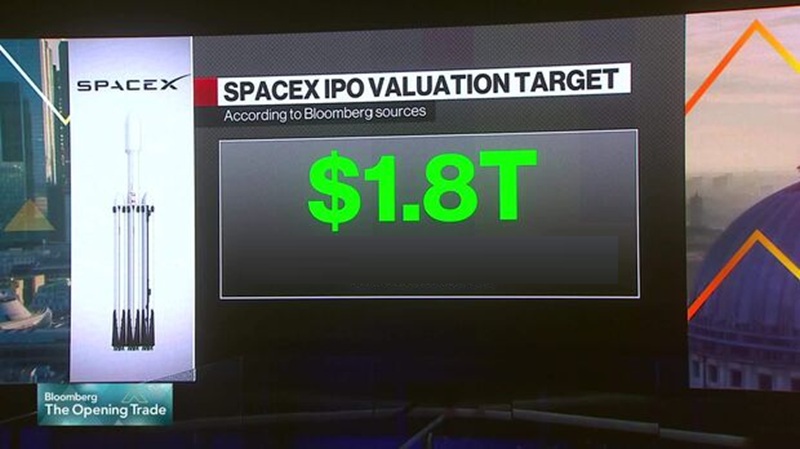
The offering is structured with a fixed price of $135 per share, targeting a $1.75 trillion valuation. This would value SpaceX at nearly 94 times its projected 2025 revenue. While rich by conventional metrics, investors appear willing to underwrite the premium given Musk’s track record and the company’s strategic positioning at the intersection of space, internet connectivity, and artificial intelligence.

The IPO is all-primary, meaning proceeds will flow directly to the company for expansion of AI computing resources and Starlink. Musk will face a 366-day lock-up on his shares, and the company is planning a significant retail allocation of up to 30% to tap into his broad following.
Despite the strong demand, the offering is facing substantial challenges. Two of SpaceX’s three main businesses are still unprofitable, with only Starlink consistently generating cash. The valuation relies heavily on yet-to-be-proven technologies and markets, including large-scale orbital data centers and eventual Mars missions.
Execution risk remains high, as does dependence on regulatory approvals, launch cadence, and competition in satellite broadband.
Still, the combination of proven capabilities in reusable rocketry, a rapidly scaling broadband network, and Musk’s ability to capture imagination has created a compelling story. The IPO is expected to kick off a wave of major technology listings, with OpenAI and Anthropic also preparing debuts that could collectively add nearly $4 trillion in market capitalization.
SpaceX’s reception is seen by analysts as a signal of deep conviction in the long-term convergence of space infrastructure and artificial intelligence. By positioning itself as the only player capable of operating at a planetary scale, SpaceX is asking investors to look far beyond traditional valuation metrics and toward a future where orbital assets become foundational to global computing and connectivity.
For the markets, a successful debut of this magnitude would represent a landmark moment, reopening the door to mega-cap IPOs after years of subdued large-listing activity. So far, the overwhelming demand suggests that many investors are prepared to bet big on Musk’s vision of a multi-planetary future powered by AI.