DD
MM
YYYY

PAGES

DD
MM
YYYY

spot_img

PAGES

Home Blog Page 26

Musk Moves to Open-Source X’s Algorithm as EU Pressure Mounts Over Transparency and Content Rules

0

Elon Musk has announced plans to make X’s recommendation algorithm fully open-source, a move he says is intended to bring unprecedented transparency to how content and advertising are ranked on the platform.

The decision, unveiled on Saturday, lands at a moment when X is under sustained regulatory scrutiny in Europe, facing investigations, fines, and ongoing demands from authorities to explain how its algorithms shape the spread of content online.

In a post on X, Musk said the company would release its new algorithm within seven days, including “all code for organic and advertising post recommendations.” He added that the disclosure would not be a one-time exercise.

According to Musk, X plans to repeat the process every four weeks, publishing updated versions of the code alongside detailed developer notes explaining what has changed and why.

The announcement positions X as an outlier among major social media platforms, which typically guard recommendation systems as closely held intellectual property. Algorithms sit at the heart of how platforms drive engagement and monetize attention, influencing what users see, what goes viral, and how advertising is targeted. By pledging to open-source this technology, Musk is framing transparency as both a principle and a differentiator, consistent with his repeated claims that X should function as a digital public square.

However, the timing of the move is difficult to separate from the regulatory challenges X is facing in the European Union. Earlier this week, the European Commission said it had decided to extend a retention order sent to X last year, prolonging it until the end of 2026. According to commission spokesperson Thomas Regnier, the order relates to X’s algorithms and the dissemination of illegal content on the platform. Such retention orders require companies to preserve internal documents, data, and technical materials that could be relevant to enforcement actions under EU law.

The extension suggests that regulators remain concerned about how X’s systems operate and whether the company is meeting its obligations under the Digital Services Act (DSA). The DSA imposes strict requirements on large online platforms, including duties to assess and mitigate systemic risks, provide transparency around recommender systems, and grant vetted researchers access to platform data. Algorithms that amplify content are a central focus of the law, given fears that they can promote harmful material or unlawful content at scale.

X’s relationship with European authorities has been strained for months. In July 2025, Paris prosecutors opened an investigation into the platform over suspected algorithmic bias and fraudulent data extraction. At the time, X described the probe as a “politically-motivated criminal investigation” and warned that it threatened users’ free speech. French authorities have not publicly detailed the full scope of the case, but it added to growing pressure on the company across the bloc.

That pressure intensified last month when the EU imposed a 120 million euro ($140 million) fine on X for breaching transparency obligations under the DSA. Regulators said the violations were linked to multiple issues, including the platform’s “blue checkmark” subscription model, shortcomings in transparency around its advertising repository, and failures to provide researchers with access to public data. EU officials argued that these gaps made it harder to scrutinize how X manages risks associated with content dissemination.

Musk responded angrily to the fine, replying with an obscenity under a European Commission post announcing the penalty. The reaction underscored the increasingly confrontational tone between X’s owner and EU regulators, even as authorities insist that compliance with the DSA is non-negotiable for platforms operating in the bloc.

Against this backdrop, Musk’s plan to open-source X’s algorithm can be read in multiple ways. Supporters are likely to view it as a bold step toward accountability, giving developers, researchers, and users the ability to inspect how recommendations are generated. Musk has argued in the past that exposing algorithms to public scrutiny can build trust and counter claims of hidden manipulation or political bias.

Regulators and critics, however, may argue that publishing code alone does not resolve their core concerns. Recommendation systems are complex and constantly evolving, shaped not just by code but by data inputs, training processes, and real-time adjustments that may not be fully captured in an open-source release. There are also fears that making algorithms public could enable bad actors to game the system, amplifying spam, misinformation, or illegal content.

Still, the move raises broader questions for the industry. If X follows through on regular, detailed releases of its recommendation code, it could challenge rivals to explain why similar transparency is not possible elsewhere. It may also force regulators to clarify what meaningful algorithmic transparency should look like in practice, beyond access to source code.


Register for Tekedia AI Lab, Starting Jan 24

0

You use AI and if you want to understand how it is created, pick a seat at Tekedia AI Lab which begins Saturday, Jan 24, 2026. Over 4 weekends, I will teach you how to create your own mini-AI. Yes, on your laptop, and personal web server, you will have your own ChatGPT: KunleGPT, MusaGPT, AdaGPT, etc. Begin here.

Greetings. We are excited to announce that Tekedia Institute has opened registration for the next edition of Tekedia AI Lab: from Technical Design to Deployment. In this program, you will learn how to build AI agents such as WinSupport, WinJob, WinLearn, etc. You will also master how to deploy such in your personal domain like mywebsite.com. Besides, we will teach how you can deploy agents on your local computer; such will include:

  • AI chatbot
  • Web SEO keyword & title page analyzer
  • Structured data classifier
  • Web content summarizer
  • Essay writer and story planner

More so, Tekedia will educate you on how you can create a personal AI chatbot on your computer, and how to deploy agents in virtual private servers. Every knowledge you need to connect AI foundation models like Google Gemma 3, DeepSeek, etc to power codes your local machine and VPS environments, you will learn. No coding or programming experience is required and this is not a coding program. The full program syllabus is here.

While the AI Lab focuses on code-based, open source model framework, Tekedia AI in Business Masterclass which comes at no additional cost for registration has case studies on how to use no-code, natural language prompting to create AI agents.  With our two programs, you will have the knowledge needed to thrive in this AI era.

How To Register and Pay

The cost is $500 or N350,000 and you can pay at the program website here. We support Naira bank transfer, PayPal, Stripe, Zelle, etc. 

Upon completion, we award Advanced Diploma in AI Technical Design and Deployment, and Advanced Diploma in Artificial Intelligence (AI) in Business certificates.

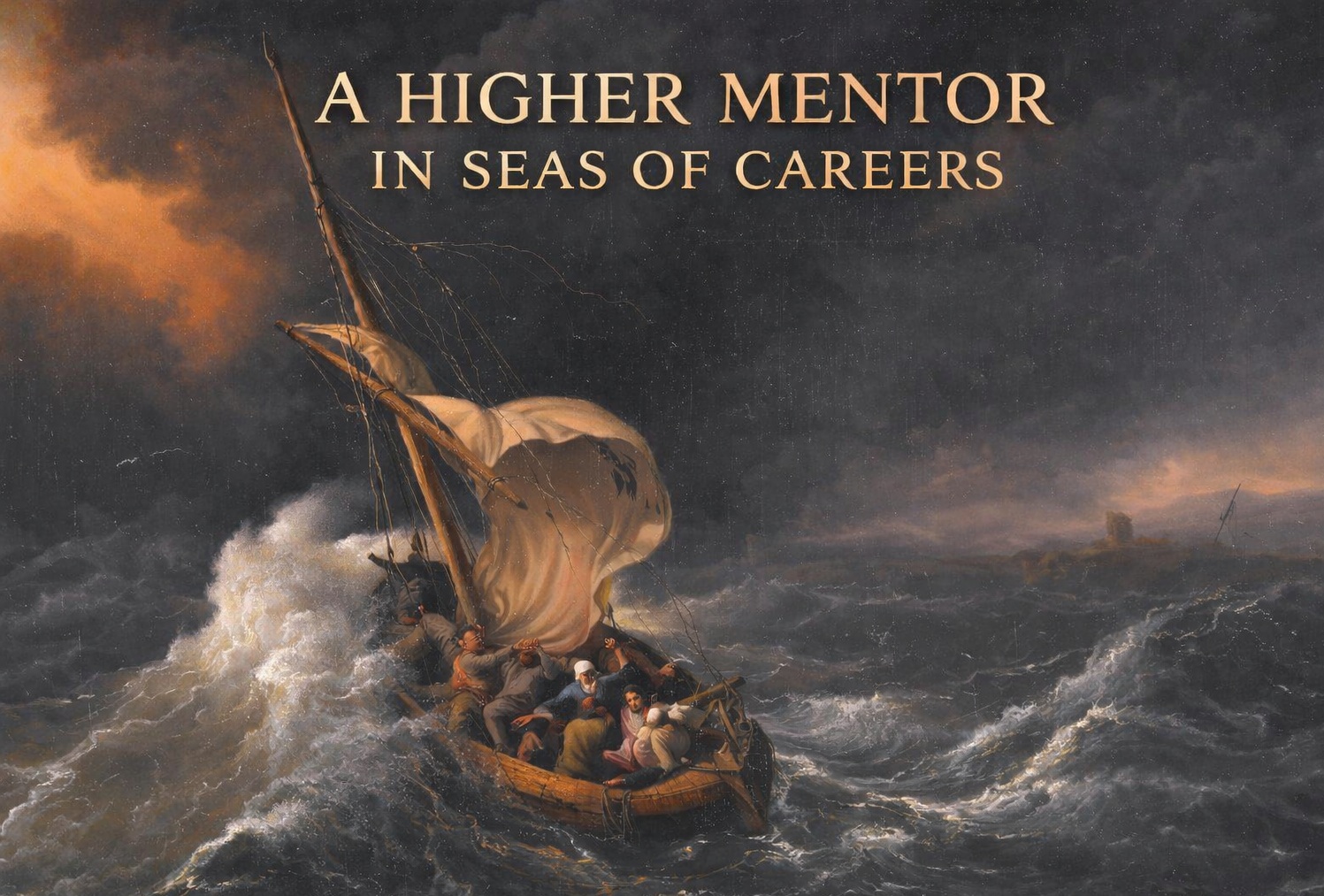
A Higher Mentor in Seas of Careers

0

They were men of immense capabilities, and seasoned professionals of their era. Masters of the waters. Experts who understood the moods of the sea, its temperaments, its rhythms and its paths. Their competence was not theoretical; it was earned through dawns and dusks spent navigating the waves as fishermen.

Yet one day, on the familiar Sea of Galilee, shallow in depth but fierce in temperament, the lowest freshwater lake on earth, fed by the River Jordan and framed by the Golan Heights, the currents gathered unusual momentum. Trouble rose from a place they thought they had mastered! Yes, a place they imagined they knew and understood.

On that fateful day, the disciples, four of whom were recruited by Christ from that very same sea, suddenly saw their core capabilities stretched beyond limits. The storm was merciless. The waves disrespected experience, mocked expertise, and humbled mastery.

The men battled with every ounce of strength. They rewired their survival instincts, rebuilt their procedures on the fly, and re-engineered new playbooks in real time to confront the tempest. But nothing worked.

Then, when their strength and skill were no longer enough, they reached upward for help. “Peace, be still,” came the command, and the storm obeyed. Yes, the storm stopped!

In our careers, we take pride in our education, knowledge, and experiences. We believe they can carry us through any turbulence in the professional seas. Yet, life will always produce moments when our competencies alone are insufficient. At those points, the storms require mentors, and higher anchors, systems greater than our personal capabilities.

Today’s labour market mirrors the Sea of Galilee, unpredictable, tech-disrupted, globalized, and unforgiving. Skills remain essential, but so do alternate pathways, new networks, and supportive structures for moments when capabilities are temporarily overwhelmed, just as the fishermen were nearly submerged in the waters they had mastered. Their saving grace was simple: they were in the right company with a Higher Mentor, to guide them to safety. You need someone to guide you to a safer professional and career journey.

Invest to be in the right company because sometimes, survival is not about the skill of the sailor, but the strength of the boat and the greatness of the One you sail with.

The next praise will be better because new songs will be discovered. Have a great Sunday and anchor to a Higher Mentor in your career and life.

– Ndubuisi Ekekwe, ex-unit cell coordinator, Scripture Union Nigeria, Secondary Technical School Ovim; Sunday School teacher, All Saints Chapel, FUTO; a Bible Teacher. Ndubuisi writes business and professional career cases from Biblical stories. 

This AI Token Could Deliver More Wealth Than Holding BTC Through the Next Two Cycles — Ozak AI’s ROI Math Is Shockingly Strong

0

As the crypto market prepares for what many expect to be an AI-driven supercycle extending from 2026 into the early 2030s, analysts are beginning to compare Ozak AI’s early ROI models to Bitcoin’s strongest historical cycles — and the math is surprising even to veteran market watchers.

Ozak AI, now in Phase 7 at $0.014, has surged 1,300% from its Phase 1 price of $0.001, placing it far ahead of Bitcoin’s early-phase percentage gains during equivalent timeframes. With the project’s $1 target listing price and speculative long-term projections heading far beyond that, some analysts argue that Ozak AI could, under the right conditions, deliver more raw ROI than holding Bitcoin through the next two cycles.

Why BTC Comparisons Are Emerging Now

Bitcoin has historically dominated long-term investment strategies, delivering major returns during each halving-driven cycle. However, as Bitcoin matures, its growth naturally slows — particularly for new entrants. Typical expectations for Bitcoin from 2026 to 2033 range from 4× to 12× across two cycles.

In contrast, early-stage AI tokens like Ozak AI operate under entirely different growth dynamics. With utility-driven adoption, a rapidly expanding AI sector, and an accelerating presale curve, the potential multipliers can be exponentially higher — at least during early phases.

This contrast has led analysts to focus heavily on Ozak AI’s hypothetical return structures, especially for presale buyers who secure tokens at under two cents.

Breaking Down the ROI Math Behind the Buzz

The core of the excitement comes from straightforward math. If Ozak AI hits its $1 listing target, here’s how the ROI unfolds:

  • Phase 1 to $1:
    $0.001 ? $1 = 100,000% return
  • Phase 7 to $1:
    $0.014 ? $1 = 7,042% return

These numbers dwarf Bitcoin’s typical multi-year performance.

But the speculative long-term analysis is what created the headline buzz.
If Ozak AI ever reaches $10, $25, or even $50 across the next two cycles, the multipliers become enormous:

  • Phase 1 to $10: 999,900%
  • Phase 1 to $25: 2,499,900%
    Phase 1 to $50: 4,999,900%
  • Phase 7 to $50: ~357,000%

Even conservative scenarios strongly outperform projections for holding Bitcoin over an equivalent timeframe.

Example: Two-Cycle Wealth Scenario

Consider the difference across two cycles (2026–2033): Holding $500 of Bitcoin (with 6× expected growth): Value in two cycles ? $3,000

Holding $500 of Ozak AI from Phase 7 ($0.014): Tokens: 35,714. If Ozak AI reaches $25 by 2030–2033: Value ? $892,850. Even at $10, the same entry becomes $357,140.

This is why Ozak AI’s ROI math has become one of the most discussed topics in the AI-crypto space. 

The Technology Justifying Long-Term Bullishness

The ROI discourse is not based purely on hype — analysts point to real fundamentals driving long-term interest:

Ozak AI integrates:

  • Deep-learning predictive engines
  • AI-driven market intelligence systems
  • Autonomous AI agents for strategy execution
  • Cross-chain sentiment and macro trend analytics
  • Customizable machine-learning tools for traders

This ecosystem positions Ozak AI as a potential intelligence hub for Web3, a sector expected to expand aggressively as AI becomes more embedded in finance and decentralized technology.

Partnerships Strengthen Market Confidence

Two major ecosystem partnerships have bolstered analyst confidence:

SINT Integration

Allows Ozak AI’s predictive signals to be executed automatically using autonomous AI agents.
This gives traders hands-free execution across multiple blockchains — a feature normally seen in high-end institutional systems.

Weblume Collaboration

Enables developers to integrate Ozak AI’s intelligence features into decentralized applications with no coding required.
This dramatically expands potential utility and adoption.

These partnerships reinforce long-term models that project large-scale usage and token demand.

Could Ozak AI Truly Outperform BTC Over Two Cycles?

Experts emphasize that any comparison must be hypothetical — Bitcoin is the most dominant asset in crypto history.

However, based purely on percentage-based ROI, emerging AI tokens like Ozak AI undeniably hold an advantage due to their early-stage starting points.

If the project executes its roadmap, captures AI-market growth, and maintains strong ecosystem expansion, analysts say Ozak AI could become one of the most profitable early-phase tokens of the 2026–2033 period.

Final Outlook

As the AI market cycle begins to form, Ozak AI stands out as a project with outsized speculative potential, strong underlying technology, and an aggressively accelerating presale.

Whether or not it ultimately surpasses Bitcoin in multi-cycle ROI, one thing is clear:
Ozak AI is shaping up to be one of the most compelling early entries of the coming AI-dominated era.


For more information about Ozak AI, visit the links below:

Website: https://ozak.ai/

Twitter/X: https://x.com/OzakAGI

Telegram: https://t.me/OzakAGI

Bitcoin Hovers Around $90,000 Price Zone as Traders Weigh Next Major Move

0

Bitcoin is currently trading around the $90,000 level following a recent failure to break above the $94,000 resistance zone.

The rejection near this high suggests growing hesitation among buyers, though it does not yet confirm a breakdown of the broader bullish structure.

Since the start of January, Bitcoin has shown steady improvement, forming a tightening consolidation pattern marked by higher lows and higher highs on the daily chart. This structure culminated in a weekly high of approximately $94,800 on Monday.

Data from Hyblock’s 7-day liquidation heatmap reveals notable long liquidation clusters between $89,000 and $87,000, while short positions remain concentrated near the weekly range high around $95,000.

From a technical perspective, Bitcoin’s early-year rally pushed the price above its 20-day moving average, which is now converging with the 50-day moving average. This convergence often signals a potential shift in market direction.

After BTC failed to sustain levels above $95,000 and clear out short positions in that zone, some traders reportedly took profits, anticipating a possible retest of lower support near the 20-day moving average at approximately $89,400.

Market analyst KillaXBT described Bitcoin as being at a critical junction, with equal probability of a bullish or bearish outcome. In a post shared on X, the crypto analyst noted that despite recent volatility, Bitcoin’s price structure remains “clean,” as it continues to react to well-defined technical levels. According to KillaXBT, the $90,000 mark currently serves as a key near-term support zone.

Adding to the discussion, another analyst, Crypto Tice, pointed out that Bitcoin has revisited its so-called “Crash Line” a trendline that has historically acted as a reload point during this bull cycle.

He explained that previous interactions with this level followed a consistent pattern such as price momentum overheats, leverage builds up, a sharp correction follows, and then Bitcoin rebounds from the Crash Line into a new expansion phase.

Meanwhile, market commentator Crypto King stated that Bitcoin remains in a “no trading zone,” suggesting that the market still lacks a clear directional bias. He added that liquidity and participation appear to be drying up, increasing the risk of false breakouts as price moves sideways. According to his analysis, a sustained move above $92,000 could flip that level into support and potentially reignite bullish momentum.

Macroeconomic concerns have also influenced sentiment. Earlier fears that an unfavorable tariff ruling could trigger broader market weakness by forcing higher bond issuance and draining liquidity from risk assets have eased.

The Supreme Court’s decision to delay its timeline on the matter has temporarily reduced pressure on markets, helping stabilize sentiment across both traditional and crypto assets.

Outlook

Bitcoin’s near-term direction hinges on how it behaves around the $90,000 support zone. Holding above this level could strengthen the bullish case, especially if the price reclaims $92,000 and turns it into a firm support. A successful breakout above $95,000 would likely trigger short liquidations and potentially open the door for a fresh rally.

On the downside, failure to maintain the $90,000 region could lead to a deeper pullback toward the $89,000–$87,000 liquidity zone, where long liquidations are clustered. A breakdown below this area may signal a more extended correction.

For now, Bitcoin appears to be consolidating, while traders wait on the sideline for a decisive breakout or breakdown to confirm the next major trend.