
DD
MM
YYYY

PAGES

DD
MM
YYYY

spot_img

PAGES

Home Blog Page 2630

Indispensable Tech for Home Downsizing

0

There are many reasons a person might want to downsize from a larger home to a smaller one. From finding career opportunities in a more convenient location to a desire to try a more minimalist and less ostentatious lifestyle, any choice here is valid. Aside from the appreciable reward of lower air conditioning bills, a smaller home also reintroduces an opportunity to equip your home with tech.

As much as we love technology, it does have an unfortunate habit of scaling significantly with home footprint. The smaller your house, the more affordable it is to install everything you need and live life on the cutting edge. So, what tech here is worth seriously considering to get ahead for a more forward-thinking future?

First Things First

Before looking at the new tech, you’re going to have to determine what you’re going to leave from your old home. This can mean selling old devices, choosing what you’ll really need, and creating a solid plan. It can also require wiping the storage drives and performing a factory reset. Guides on websites like PCMAG can help here if you’re unfamiliar with the process.

You’ll also want to be completely sure of the budget you’re afforded through selling your old home, which can be a time-consuming and frustrating process through the traditional method. There are alternatives here from services like We Buy Any Home that can bypass this issue. Through a simple three-step process, this service can provide a free cash offer within minutes, to have funds to you in seven days to help you move onto the tech part. Once you know how much money you have to work with, the next parts are much easier.

The Best Tech

The first tech we’d suggest keeping in mind is smart home technology for better convenience and saving money through automation. Smart tech which connects to a local network can be accomplished through practically anything electronic, but what you’ll consider worth connecting is a more personal question.

Automated door locks, lights, washing machines, and air conditioning are a great start. These can add up to significant financial savings, and even help keep your home safe by making you appear at home when you’re not. Be sure to invest in open-source systems if possible, as the smart home market has a history of services going under and taking functionality with it, as The Verge reports.

The next step can be investing in more robust network wiring that avoids relying on Wi-Fi. Installing hardware cable connection points guarantees faster and more reliable internet connectivity. Plugging in walls also means you won’t have to run cables through rooms and under doors, which isn’t a great look.

Finally, you’ll also want to take into account the power strain you’ll put on certain outlets, and update home power systems accordingly. This is already a big problem in PC gaming with power-hungry tech like modern graphics cards, and it’s only likely to become a larger issue in the future.

Source: Pixabay

With all of this in mind, you’ll know where to start in supporting your new home with the right tech to support you. Remember to research what you need ahead of time, don’t go with the first choice, and you’ll be happier with the result for years to come.

Alowonle: A Security Litmus Test for Osun Road to 2026

0

The political climate in Osun State is heating up ahead of the 2026 governorship elections. At the center of the storm lies the controversial arrest and shooting of Nurudeen Alowonle, Chairman of the Osun State Transport Management System (OSTMS). What began as a law enforcement operation has morphed into a political flashpoint, with accusations of extrajudicial actions, political manipulation, and deteriorating governance dominating the discourse.

This incident encapsulates key issues that will likely shape the 2026 elections, including security, governance, trust in institutions, and the increasing role of youth advocacy. Our analyst notes that through the divergent narratives of the two major political parties, the Peoples Democratic Party (PDP) and the All Progressives Congress (APC), the contours of the political battlefield in Osun come into sharper focus.

Themes of Convergence and Divergence in Political Narratives

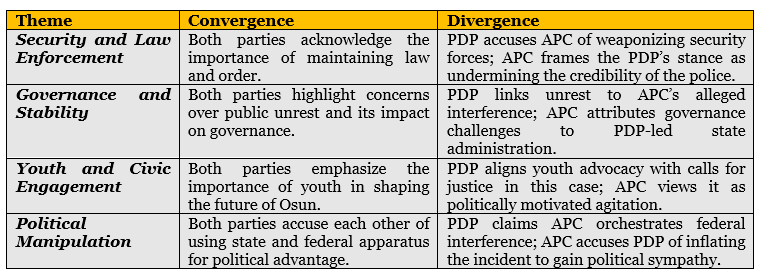
The exhibit below highlights areas of agreement (convergence) and conflict (divergence) between the PDP and APC on the key issues surrounding the Alowonle incident.

Exhibit 1: political parties’ narratives over the incident

Alowonle
Source: Multiple Facebook posts of political parties and their supporters, 2024; Osun State Government’s press release, 2024; Infoprations Analysis, 2024

Law and Order: A Security Crisis in Focus

The PDP has framed the Alowonle incident as a failure of law enforcement and a politically motivated attack. Their narrative emphasizes the excessive force allegedly used by the police, branding it an “assassination attempt” linked to APC’s national ambitions to reclaim the Southwest. The party’s statements resonate with public concerns over police brutality and extrajudicial killings, a recurring theme in Nigeria’s socio-political discourse.

The APC, on the other hand, has largely stayed silent on the matter, likely to avoid drawing further attention to the incident. However, this silence risks being interpreted as complicity, giving the PDP room to dominate the narrative. For the electorate, the incident underscores broader questions about the neutrality and professionalism of law enforcement agencies, a key issue likely to influence the 2026 elections.

Governance and Trust in Institutions

Public reactions, such as those from IleriOluwa Online Media, a group loyal to the former governor Gboyega Oyetola, stress a growing sentiment that Osun has shifted from being a peaceful state to a hotbed of unrest. The disruptions caused by roadblocks and protests illustrate the direct impact of political tensions on governance and daily life.

The PDP has seized this opportunity to criticize the APC for contributing to the destabilization of Osun, drawing a connection between the unrest and national APC leadership. The party’s argument centers on a perceived federal overreach, with PDP officials alleging that the APC uses security forces as tools for political suppression.

Conversely, the APC may frame the unrest as evidence of governance failures under the PDP-led state administration, potentially arguing that the current government has not effectively managed security and public order. This divergence in narratives sets the stage for governance and institutional trust to become central campaign issues.

Youth Advocacy and Political Mobilization

The role of Osun’s youth in demanding justice for Alowonle reflects a broader trend of political consciousness among younger demographics. Youth groups have called on the Inspector General of Police to ensure justice, positioning themselves as watchdogs of institutional accountability.

The PDP has embraced this activism, aligning itself with youth demands and framing the incident as part of a larger struggle for fairness and democracy. This alignment allows the party to tap into the energy and frustration of younger voters, a significant demographic in the state. The APC, however, may interpret youth involvement as politically charged, questioning the neutrality of these movements. While acknowledging the importance of youth engagement, the party might argue that the current activism is being leveraged to undermine its political standing.

Political Manipulation and Polarization

The Alowonle case has deepened polarization in Osun’s political landscape, with both the PDP and APC accusing each other of exploiting the incident for political gain. The PDP alleges that the APC, emboldened by recent national leadership changes, is escalating political violence to destabilize the state. The APC, in turn, might argue that the PDP is inflating the incident to distract from governance challenges and gain public sympathy. This mutual blame underscores the zero-sum nature of Osun’s political competition, where even non-political events are weaponized to score electoral points.

Hindsight

The Alowonle incident serves as a pivotal lens through which broader tensions shaping Osun’s political landscape can be understood. As parties prepare for the 2026 elections, their success will depend on their ability to navigate these challenges while addressing voters’ concerns effectively. For the PDP, aligning with youth advocacy and highlighting governance issues offers a strategic opportunity to strengthen its base. Conversely, the APC must focus on countering these narratives by emphasizing pragmatic governance and stability. In this era of heightened political awareness, the electorate’s decision will ultimately rest on which party presents the most credible and compelling vision for Osun’s future.

What Lies Ahead for 2026

The 2026 Osun governorship election will not merely be a contest of promises but a referendum on leadership, security, and governance. The PDP is likely to position itself as a defender of justice and stability, leveraging incidents like the Alowonle case to critique APC interference. Meanwhile, the APC will aim to challenge the PDP’s governance record, framing the unrest as evidence of the state government’s inadequacies.

For voters, issues such as law and order, trust in institutions, and youth empowerment will take center stage. The incident has also exposed a growing demand for accountability, with the electorate likely to favour candidates who offer clear solutions to Osun’s challenges rather than engaging in blame games.

Australia to Introduce World-First Legislation Banning Under-16s From Social Media Platforms

0

Social media companies in Australia could face fines of up to $50 million under a bold plan by the Federal Government to protect children from online harm. Communications Minister Michelle Rowland is set to introduce landmark legislation on Thursday, aiming to establish a minimum age requirement of 16 years for platforms such as Facebook, X (formerly Twitter), TikTok, Instagram, and potentially YouTube.

The proposed laws will place the responsibility squarely on social media companies to prevent underage users from accessing their platforms, rather than leaving it to parents to monitor their children’s activities.

Under the legislation, platforms that fail to take “reasonable steps” to block under-16s from creating accounts could face hefty penalties, including fines of up to $50 million. The government has warned that tech companies that “systematically” flout the rules will bear the brunt of these punitive measures.

While the exact method for verifying users’ ages has not yet been finalized, Minister Rowland assured her colleagues that users would not need to upload proof of identification directly to social media platforms. The legislation will also mandate strict privacy protections, requiring companies to destroy any personal data they collect as part of compliance efforts.

However, the legislation allows for certain exemptions. Platforms primarily designed for messaging, online gaming, health, or education purposes, such as WhatsApp, will likely be carved out. The inclusion of hybrid platforms like Snapchat, which functions as both a messaging service and a social media platform, remains uncertain.

These exemptions aim to balance child protection with preserving access to essential communication tools and educational resources.

If passed, the minimum age restriction will come into effect 12 months after the legislation is enacted, giving social media companies time to implement compliance measures.

Minister Rowland emphasized the government’s commitment to supporting families and ensuring young people are shielded from the potential harms of social media.

“Social media has a social responsibility for the safety and mental health of young Australians,” he said. “Ultimately, this is about supporting a safer and healthier online environment for young Australians.”

The Coalition, led by Shadow Communications Minister David Coleman, expressed support for the legislation but criticized the government for not acting sooner.

“We’ll work very constructively with the Government and we want to see this bill passed before Parliament rises for the end of the year,” Coleman said in an interview with ABC TV.

Despite some calls for further inquiry and scrutiny, the Coalition’s backing increases the likelihood that the bill will pass swiftly during the current parliamentary sitting fortnight.

Although the legislation represents a significant step in child safety, questions remain about its implementation. How platforms will verify users’ ages without compromising privacy is still unclear.

Experts have raised concerns about potential loopholes in enforcement, as children often find ways to circumvent age restrictions. Some have also highlighted the need for more comprehensive consultation to ensure that the measures are both effective and proportionate.

If successful, Australia’s move could set a precedent for other nations grappling with the challenges of regulating social media and protecting young users from online harm. The legislation underscores growing global expectations for greater corporate responsibility in digital spaces, especially by putting the onus on tech giants to police underage usage.

Major platforms, including Meta, TikTok, and Alphabet, have either declined to comment or not responded to inquiries about the proposed law. However, industry representatives have expressed reservations about the practical challenges of implementing such strict age verification protocols?.

Digital Transformation of Enterprises | Tekedia Mini-MBA

0

From the peerless home of digital payment innovation, we will learn from a business leader, innovator and transformer on how to design, implement and execute a digital enterprise playbook.

Yes, our Faculty, Folasade Femi-Lawal (FCA,FCIT,MBA), Country Manager, Area Business Head, West Africa for Mastercard, and Chairman of Mastercard Ghana, will teach today on the broad theme of digital transformation of enterprises.

Thur, Nov 21 | 7pm-8pm WAT | Digital Transformation of Enterprises – Folasade Femi-Lawal, Mastercard.

If you run a business, and do not have a digital vision, you will not go far in this era. Understand that even 20th century companies like Dangote Cement and agro-firms like Indomie Noodles have used a digital-anchored supply chain framework to drive competitiveness. They use digital to drive aggregation of inputs, price discovery and distribution of products making sure you do not have excess cement in Sokoto when none is available in Ibadan. With digital, Indomie Noodles knows when the trucks should arrive in your town because they see everything in their computers! The empires will be anchored on digital.

Tekedia Institute Mini-MBA >> our product is knowledge, and the best teach here.

Cardano Price Prediction: ADA Ready for a Breakout Rally to $3, as Smart Money Backs Rexas Finance (RXS) for a 10240% Jump from $0.08

0

Cardano (ADA) is gaining traction with a price surge exceeding 12% today, extending its bullish run to $0.83. This performance comes amid an impressive 145% increase in whale accumulation over the past month. ADA has outpaced most of the crypto market, climbing 54% this week and nearing the $1.0 milestone, positioning itself as a top-performing token. Simultaneously, Rexas Finance (RXS) is drawing smart money with its groundbreaking potential, boasting a predicted 10240% rise from $0.08 to $8.60 per token, driven by its real-world asset (RWA) tokenization innovation. 

Cardano Surges with Whale Support

Cardano is experiencing unprecedented momentum, with large wallets holding over $10 million in ADA increasing their positions by 145.72% this month. The blockchain’s DeFi activity is also on the rise, with its Total Value Locked (TVL) climbing to $479.8 million, approaching its all-time high. This surge reflects growing adoption across decentralized exchanges, lending platforms, and other protocols within Cardano’s ecosystem, enhancing its appeal. Analysts suggest that ADA’s on-chain activity signals a continued rally, with its price ratio against Bitcoin reaching an 8-month peak. If these trends hold, Cardano could see a breakout rally, potentially aiming for a significant $6 target. However, while ADA exhibits strong performance, investors are increasingly turning their attention to Rexas Finance (RXS) for exponential returns. 

Rexas Finance Transforming Asset Tokenization

Rexas Finance is at the forefront of RWA tokenization, making high-value assets like real estate, commodities, and art accessible to everyday investors. The platform’s unique tokenization system allows users to buy fractional ownership of assets, breaking down traditional barriers. For example, an investor in Asia can purchase a percentage of a restaurant in Europe, earning passive income effortlessly. Beyond real estate, Rexas Finance enables tokenization of global commodities like gold and oil, tapping into a $121 trillion market.

The platform also targets art and collectibles, valued at $65 billion, making previously exclusive assets available to a wider audience. These innovations are not just concepts—they are actively reshaping how investments are made in the crypto market. The Rexas Token Builder simplifies the process of issuing tokens tied to real-world assets, enhancing liquidity and broadening access. Its QuickMint Bot, available on Telegram and Discord, makes token creation seamless even for beginners. Meanwhile, the Rexas Launchpad supports new projects in raising funds, solidifying Rexas Finance as a one-stop hub for asset tokenization. 

RXS Presale and Unmatched Potential

Rexas Finance has already raised $10.77 million through its ongoing presale, with prices increasing 2.67x from stage one to the current $0.08 in stage six. Investors at this stage could see a 2.5x return upon launch. RXS’s presale strategy, designed to empower public investors rather than venture capitalists, highlights its commitment to inclusivity. The RXS token, an ERC-standard asset with a total supply of 1 billion tokens, is allocated strategically: 42.5% for presale, 22.5% for staking, and other portions for liquidity, marketing, and partnerships. Additionally, the project is CertiK-audited, ensuring robust security and reliability.

Adding to its appeal, Rexas Finance is running a $1 million giveaway, where 20 participants will win $50,000 each in USDT by completing simple actions and referring friends. This initiative, coupled with listings on CoinMarketCap and CoinGecko, has significantly boosted visibility and credibility.

Conclusion

As Cardano’s price ascends with whale accumulation and expanding DeFi use, the crypto market’s attention pivots toward Rexas Finance. By bridging the gap between real-world assets and blockchain, RXS is setting the stage for revolutionary investment opportunities. With a 10240% growth potential, RXS offers a unique chance for investors to ride the wave of innovation in asset tokenization. This is the moment to act—secure your stake in RXS before the presale ends.


For more information about Rexas Finance (RXS) visit the links below:

Website: https://rexas.com

Win $1 Million Giveaway: https://bit.ly/Rexas1M

Whitepaper: https://rexas.com/rexas-whitepaper.pdf

Twitter/X: https://x.com/rexasfinance

Telegram: https://t.me/rexasfinance