DD
MM
YYYY

PAGES

DD
MM
YYYY

spot_img

PAGES

Home Blog Page 27

Instant Digital Payments Reset Consumer Expectations Across Emerging Markets

0

Real?time payment networks are reshaping how money moves across emerging markets, with Africa now one of the fastest?evolving regions for instant digital transactions. The infrastructure rollouts of recent years are beginning to influence everyday behaviour, from how consumers pay merchants to how businesses manage liquidity. Entrepreneurs watching these shifts describe a landscape where immediacy is no longer a luxury but a baseline expectation.

Those expectations now extend across entertainment, commerce and financial services. As users grow accustomed to receiving funds within seconds, they increasingly benchmark experiences across sectors. That is why online casinos with fast payouts are becoming more popular amongst players: they allow near-instant access to any winnings. Likewise, people can now send funds across borders in minutes thanks to crypto and apps like PayPal. It’s no longer necessary to wait for days like before when bank transfers were the only option. The underlying message is the same: trust deepens when money moves quickly and predictably, and users carry that expectation from one digital environment to another.

Businesses building in this space see the pattern clearly. Faster settlement boosts confidence, which in turn encourages higher transaction volumes. The chain reaction is creating new opportunities for startups that can meet this demand for speed while maintaining reliability in markets where infrastructure varies widely.

Real-Time Payment Rails Gain Scale

The expansion of interoperable instant payment systems has been rapid. Data from Premium Times shows Africa’s networks processed nearly $2 trillion in 2024, up dramatically from 2020. This acceleration reflects broader investment in digital infrastructure and the backing of national regulators who see real?time payments as a foundation for financial inclusion.

Governments and central banks have taken on a prominent role. Their support for interoperable rails and local?currency settlement frameworks reduces fragmentation across markets. Platforms aligned with regional blocs demonstrate how integrated payments can lower friction for cross?border commerce.

Startups Build For Instant Trust

Entrepreneurs are now designing products that assume instant settlement as the norm. This is especially relevant for fintech firms targeting consumers who depend on flexible liquidity for daily purchases. According to Weetracker, instant bank transfers accounted for 20% of Nigeria’s e?commerce payments last year, doubling from their previous share. That growth reflects how speed can deepen trust, making buyers more confident in digital transactions.

Stronger infrastructure also helps small businesses that previously operated informally. When payments settle in real time, sellers can better manage stock, negotiate supplier terms and forecast revenue. The reliability of instant transfers becomes a competitive advantage for SMEs navigating unpredictable cash?flow environments.

Use Cases From Banking To Gaming

Financial institutions have been among the earliest beneficiaries of real?time rails, but other sectors are catching up. Nigeria’s NIP system illustrates the scale of consumer appetite, with Ecofin Agency reporting more than 11 billion transactions in 2024 valued at over $1.1 trillion. Such volumes demonstrate how speed has become ingrained in everyday financial behaviour.

E?commerce platforms rely on the same expectation. When buyers know payments clear instantly, refunds and order confirmations feel more dependable. Even digital entertainment services have adopted rapid disbursement models to keep users engaged. The common thread across verticals is the move toward seamless user journeys built on instant liquidity.

What Faster Money Means For Africa

The spread of instant payments has practical implications for growth across African economies. SMEs trading across borders benefit when funds flow seamlessly between sender and receiver, especially through local?currency frameworks emerging in several regional blocs. That reduces exposure to costly settlement delays and currency risks.

For founders building new ventures, the message is clear: speed changes behaviour. Consumers accustomed to real?time confirmation are less tolerant of delays, and businesses that fail to meet these expectations risk losing trust. As infrastructure strengthens, the opportunity lies in creating products that harness this reliability to unlock new markets.

The broader shift suggests that instant money movement is becoming a defining feature of digital life in emerging economies. Entrepreneurs who recognise this shift early can design services that feel intuitive to users who increasingly expect the financial world to operate at the pace of the internet.


Japanese Government Bond Yields Reached ATH

0

Japan’s 30-year Japanese Government Bond (JGB) yield reached a new all-time high (ATH) during trading, hitting an intraday peak of approximately 3.527% before closing around 3.50–3.51%.

The day’s high at 3.527%, with Trading Economics noting the historical all-time high as 3.53% in January 2026 likely referring to this session’s peak. Reuters reported earlier in the session that the 30-year yield touched a record 3.515% amid selling pressure ahead of an upcoming auction.

This surpasses previous records from 2025 around 3.2–3.4% in mid-to-late 2025. The surge reflects ongoing concerns over Japan’s fiscal outlook, including record-high budget spending under Prime Minister Sanae Takaichi, rising debt-servicing costs, and the Bank of Japan’s continued policy normalization, rate hikes and quantitative tightening.

Longer-dated bonds have been particularly volatile, with super-long yields— 20-, 30-, 40-year repeatedly hitting records in recent months due to reduced BoJ dominance in the market and inflation persistence. This marks a dramatic shift from the ultra-low yield era, highlighting increased borrowing costs for the world’s most indebted developed nation.

What is BoJ Policy Normalization?

The Bank of Japan (BoJ) policy normalization refers to the gradual unwinding of its ultra-accommodative monetary policies implemented over the past two decades to combat deflation and stimulate economic growth. These included negative interest rates, massive quantitative easing (QE), and yield curve control (YCC).

Normalization aims to return to a more standard monetary framework, with positive interest rates and reduced central bank intervention in bond markets, while ensuring sustainable 2% inflation supported by a “virtuous cycle” of wage growth and price increases.

The process is deliberate and cautious, reflecting Japan’s history of prolonged deflation and high public debt over 200% of GDP. The BoJ emphasizes data-dependent decisions, monitoring wage negotiations (shunto), inflation trends, and global risks.

Key Milestones in Normalization

March 2024: Ended the world’s last negative interest rate policy NIRP, in place since 2016 by raising the short-term policy rate to 0–0.1%. Also abolished Yield Curve Control YCC, introduced in 2016 to cap 10-year JGB yields around 0% and stopped new purchases of ETFs and REITs.

Subsequent 2024–2025 hikes: Gradual increases, reaching 0.5% by mid-2025. December 2025: Raised the policy rate by 25 basis points to 0.75%, the highest level in 30 years since 1995. This reflected confidence in sustained wage growth and inflation near 2%. Ongoing Components as of January 2026.

Current policy rate: 0.75%. Real interest rates remain deeply negative inflation has exceeded 2% for nearly four years. BoJ Governor Kazuo Ueda has signaled further hikes if economic and price trends align with forecasts, particularly if core inflation stays above 2% and wage growth persists expected >3–5% in 2026 shunto negotiations.

Monthly JGB purchases reduced progressively e.g., to ~3 trillion yen by early 2026, further cuts planned. Slower pace than peers like the Fed or ECB to avoid sharp yield spikes. Analysts forecast 1–2 additional 25bp hikes in 2026, potentially reaching 1.0–1.25% by year-end or mid-2027.

Terminal (neutral) rate estimates: 1–1.5% some up to 1.75–2.5%. Next hike likely in the second half of 2026 e.g., July–October, after assessing spring wage outcomes and core inflation. The January 22–23, 2026, meeting will update quarterly forecasts.

Strong wage-price cycle, persistent inflation, core projected ~1.8–2.0% in FY2026–2027, and reduced external uncertainties. Fiscal expansion under Prime Minister Sanae Takaichi (“Sanaenomics”), yen weakness, global slowdowns, or U.S. trade policies could influence pace.

The BoJ prioritizes avoiding abrupt tightening to prevent economic disruption. This shift has contributed to rising JGB yields e.g., 30-year at record highs in January 2026, reflecting market expectations of higher borrowing costs for Japan’s indebted government.

Overall, normalization marks Japan’s transition from deflation-fighting to managing moderate inflation in a growing economy.

Supreme Court May Enforce Return of $133B of US Tariff Revenue

0

The U.S. Supreme Court is currently considering a major challenge to President Trump’s broad tariffs imposed in 2025 under the International Emergency Economic Powers Act (IEEPA), a 1977 law intended for national emergencies.

These tariffs include “reciprocal” duties on goods from nearly all countries starting at 10-50% from April 2025 and “fentanyl-related” penalties on imports from China, Canada, Mexico, and others starting February/March 2025.

Lower courts ruled these tariffs unlawful, finding that IEEPA does not authorize tariffs the word “tariff” is absent from the statute and that no prior president used it this way for broad revenue-raising measures.

The Supreme Court heard oral arguments on November 5, 2025, where justices from both sides expressed skepticism about the administration’s authority, noting tariffs are traditionally a congressional power.

Potential Refund Amount

As of mid-December 2025, U.S. Customs and Border Protection data shows approximately $133.5 billion in duties collected under these IEEPA-based tariffs are at risk of court-ordered refunds if the Supreme Court rules them invalid. This breaks down roughly as:$81.7 billion from reciprocal duties.

$37.9 billion from China/Hong Kong fentanyl tariffs. Smaller amounts from Mexico, Canada, and punitive duties on countries like Brazil, India, and Japan. Some analyses estimate higher potential refunds up to $168 billion or more depending on the scope and timing.

The Court is expected to issue rulings soon possibly as early as January 10, 2026, based on recent schedules, though no decision has been announced as of January 7. Prediction markets give the administration only a 23-30% chance of prevailing, down from higher odds before arguments.

If the Court sides against the tariffs: They would likely be halted going forward. Refunds could be required for importers who paid them. The Court might limit refunds like prospective only, or to litigants, but historical precedents suggest refunds are the normal remedy for unlawful duties, potentially through administrative processes or protests.

These IEEPA tariffs are separate from other Trump tariffs under Section 232 e.g., 50% on steel/aluminum derivativesor Section 301, which are not part of this case. Tariff revenue in 2025 has been much higher record levels, but only the IEEPA portion is directly challenged here.

This case represents a significant test of executive power versus congressional authority over trade and taxation. The International Emergency Economic Powers Act (IEEPA) was enacted on December 28, 1977, as Title II of Public Law 95-223, signed by President Jimmy Carter.

It emerged from congressional efforts to reform and limit expansive presidential emergency powers under the Trading with the Enemy Act (TWEA) of 1917. TWEA, originally a wartime measure, was amended in the 1930s to allow its use in peacetime emergencies. Presidents invoked it broadly, including President Nixon’s 1971 imposition of a 10% import surcharge during a balance-of-payments crisis.

By the 1970s, a Senate investigation revealed four national emergencies dating back decades still in effect, prompting reforms.In 1976, Congress passed the National Emergencies Act (NEA) to terminate old emergencies, require formal declarations, and enable congressional termination.

In 1977, it enacted IEEPA to restrict TWEA to wartime while providing limited peacetime economic powers for foreign-originated threats. IEEPA authorizes the President, after declaring a national emergency under the NEA, to regulate international economic transactions—including imports—to address “unusual and extraordinary” threats to U.S. national security, foreign policy, or economy with substantial foreign sources.

It deliberately narrowed TWEA by excluding powers like seizing domestic records or vesting assets. The President can investigate, regulate, or prohibit transactions involving foreign property, payments, exports/imports, and more (50 U.S.C. § 1702).

It excludes regulating personal communications, informational materials, humanitarian donations, or purely domestic transactions. Emergencies require annual renewal and congressional reporting. Legislative history emphasized emergencies as “rare and brief,” not for ongoing issues.

Presidents have invoked IEEPA in over 77 national emergencies since 1977, making it central to U.S. sanctions. President Carter in 1979 froze Iranian assets during the hostage crisis—the longest-running emergency.

Blocking assets of foreign governments, terrorists, post-9/11 under Bush, cybercriminals (Obama), and entities in Venezuela or Russia. Initially targeted states; later included non-state actors like terrorists and hackers. Emergencies average over nine years, contrary to “brief” intent.

IEEPA traditionally supported sanctions, not revenue-raising duties. Nixon’s 1971 surcharge used TWEA, not IEEPA. In 2025, President Trump invoked IEEPA unprecedentedly for broad tariffs, February: 25% on Canada/Mexico and 10%+ on China, citing drug trafficking and migration emergencies.

April: “Reciprocal” 10%+ tariffs on nearly all countries, citing trade deficits and non-reciprocity. These collected ~$133 billion by late 2025 but faced challenges. Lower courts ruled IEEPA does not authorize tariffs lacking “tariff” mention; Congress holds trade power.

The Supreme Court heard arguments November 5, 2025; a ruling is pending, potentially invalidating tariffs and triggering refunds. This use tests executive limits, raising separation-of-powers questions amid IEEPA’s evolution into a flexible sanctions tool.

Polymarket Introduced Taker-Only Fees Exclusively on 15-Minute Crypto Prediction Markets 

0

Polymarket has introduced taker-only fees exclusively on its 15-minute crypto prediction markets short-term “up or down” bets on assets like Bitcoin, Ethereum, Solana, and XRP that resolve every 15 minutes.

These fees are not retained by Polymarket as revenue—instead, 100% of the collected fees are redistributed daily in USDC to market makers through the new Maker Rebates Program. This incentivizes deeper liquidity, tighter spreads, and better market efficiency in these high-frequency markets, while discouraging excessive bot activity or wash trading.

Fees apply only to takers those who aggressively fill existing orders. Makers, those posting limit orders that add liquidity receive rebates proportional to their filled volume. The fee structure is dynamic: highest around 50% probability up to ~3%, e.g., ~$1.56 on 100 shares at $0.50, tapering to near-zero at extremes 0% or 100%.

All other markets like political, event-driven, longer-term crypto remain completely fee-free. The change was implemented quietly via updated documentation, without a major public announcement, and has been generally well-received in the community as a sustainability upgrade for these volatile short-duration markets.

The Maker Rebates Program is a liquidity incentive initiative launched by Polymarket in early January 2026, specifically targeting its high-frequency 15-minute crypto prediction markets short-term “up or down” bets on assets like Bitcoin, Ethereum, Solana, and XRP that resolve every 15 minutes.

These fast-moving markets often attract algorithmic traders, bots, and arbitrageurs, leading to volatile liquidity and wider bid-ask spreads. The program aims to encourage market makers to post consistent, competitive limit orders, resulting in deeper order books.

More resilient markets during volatility. Reduced incentives for exploitative bot activity like wash trading or pure taker strategies. 100% of taker fees collected from trades in these 15-minute markets are pooled and redistributed as rebates. Polymarket retains none of the fees as revenue—this is not a traditional platform fee but a redistribution mechanism.

Who Pays: Only takers traders who aggressively fill existing orders, often using market orders pay fees. Who Earns: Makers those who post resting limit orders that add liquidity and get filled receive rebates. Payouts: Calculated and distributed daily in USDC.

Proportional to your share of executed (filled) maker liquidity in eligible markets. You earn based on the actual liquidity you provided that was “taken” by others. Applies only to 15-minute crypto markets. All other Polymarket markets like political, event-driven, longer-term remain completely fee-free.

Fees are dynamic and vary based on:Trade size (scales linearly). Market probability/price: Highest around 50% probability (mid-price), tapering to near-zero at extremes (close to 0% or 100%). Peak rate: Up to ~3.15% at 50/50 odds. This design charges more for trades in competitive, uncertain ranges while minimizing costs for directional bets near certainty.

Positive for makers: Creates sustainable income for liquidity providers, rewarding tight quoting. Discourages pure taker bots: High-frequency strategies relying on market orders become less profitable. Better execution for all traders, reduced bot exploitation, and more efficient markets.

Community feedback from traders and developers has been largely positive, viewing it as a mature step toward sustainability without broad fee imposition. If you’re an API trader or market maker, note that clients may need updates to handle the new structure.

What Is Minimum Viable Demand (MVD)?

0

Market systems are inherently imperfect because information asymmetry makes it difficult for demand and supply to naturally converge at an optimal equilibrium. To correct this imperfection, societies create companies. Companies serve as organizing platforms that bring demand and supply together so that transactions can happen efficiently.

When you are hungry, you do not go from house to house hoping to find someone with food to sell. You go to a restaurant. Likewise, the person who has food to sell does not sit at home waiting for a knock; they bring the food to the restaurant. The company exists to reduce friction and eliminate uncertainty on both sides of the market.

But when you are starting a new venture, the question becomes: where do you begin? Very often, the answer is not by trying to serve everyone. Instead, you focus on creating deeply “passionate” products for a clearly defined, leverageable demand, even if that demand is small at the start. You stand a far better chance of success by winning a small group of believers than by chasing a broad audience and ending up with none.

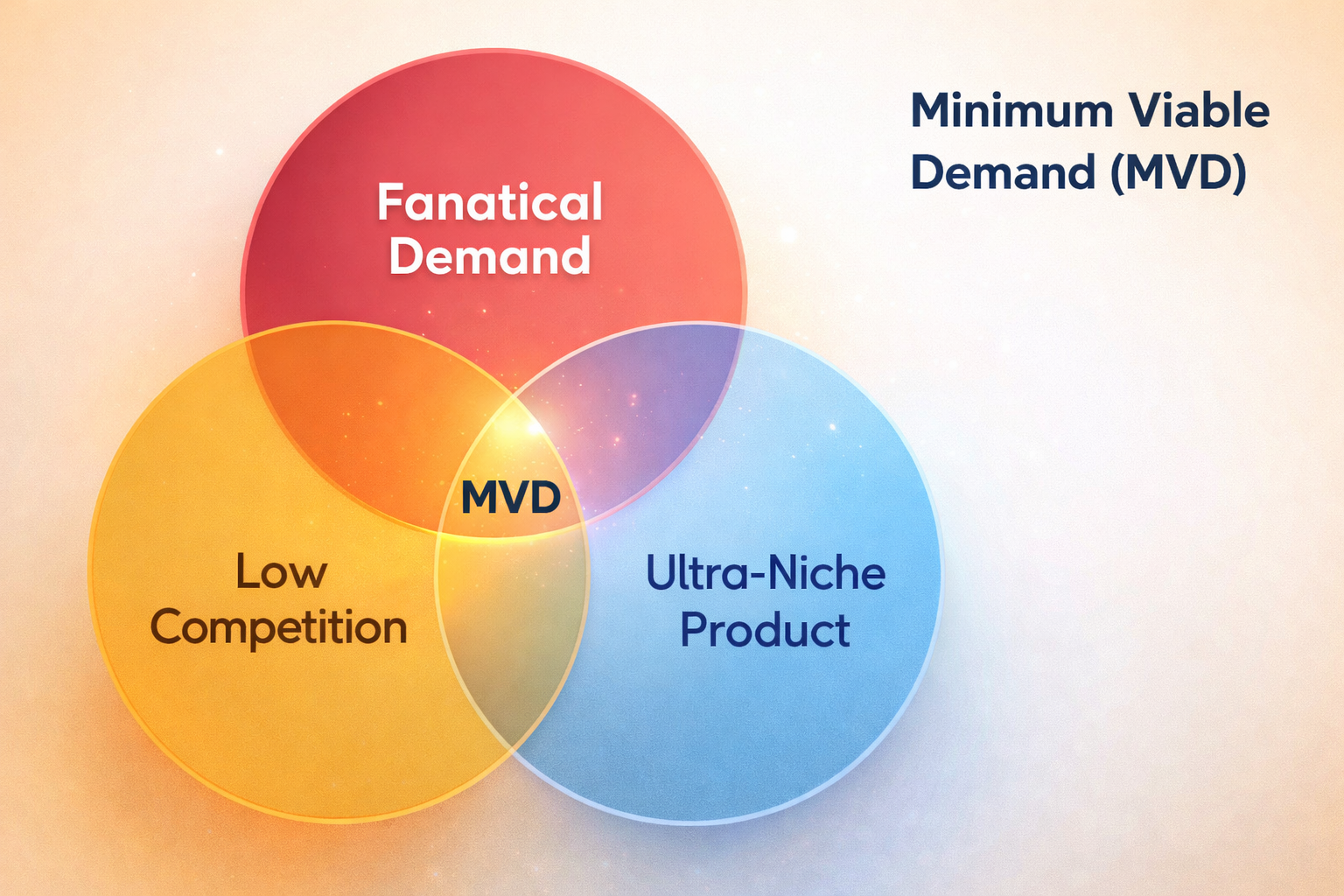
I describe this approach as Minimum Viable Demand (MVD). MVD is especially powerful in digital markets, where iteration is fast and scaling is relatively frictionless. The demand may be small, but it is real, committed, and capable of being leveraged.

The essence of MVD is not size, but viability. The demand must be strong enough to sustain the business and flexible enough to scale over time. When done right, MVD delivers higher margins, lower competition, and fanatical early adopters.

It is often better to build for the first 1,000 users who genuinely care than for one million who do not. Once you have won those first 1,000, you can then design a deliberate path to scale, expanding the market while preserving differentiation, pricing power, and product identity.

In many markets, this strategy creates a quiet disruption. Incumbents ignore the small niche, assuming it does not matter. By the time they realize what is happening, the innovator has expanded the territory and reshaped the market. This dynamic sits at the heart of what I have previously explained as the startup incentive construct.

Understanding Startup Incentive Construct, a Framework by Ndubuisi Ekekwe