DD
MM
YYYY

PAGES

DD
MM
YYYY

spot_img

PAGES

Home Blog Page 2728

AI Now Writes More Than 25% of Google’s Codes

0

As tech giants face scrutiny over the tangible impact of their massive AI investments, Google’s parent company Alphabet is asserting that its long-standing AI efforts are driving productivity gains and financial growth.

On its recent third-quarter earnings call, Alphabet executives highlighted substantial AI contributions across various business segments, pointing to a successful quarter that exceeded analyst expectations. Google CEO Sundar Pichai revealed that AI-generated code now accounts for over a quarter of new programming at the company, underscoring how AI automation is beginning to reshape Google’s internal workflows and increase productivity.

Alphabet’s financial report showed a strong performance, notably in its cloud business, where revenue surged by 35% year-over-year to $11.4 billion. Pichai credited Alphabet’s cloud growth to new enterprise customers attracted by the company’s AI offerings, including tools built on Google’s Gemini models, which reportedly helped increase product adoption by 30% among existing clients.

“We are uniquely positioned to lead in the era of AI because of our differentiated full-stack approach to AI innovation,” Pichai said, adding that the results of these AI-driven efforts are becoming evident at a large scale.

The market’s reception was enthusiastic; shares surged by 6% following the announcement. With Alphabet’s stock rising nearly 30% this year compared to the S&P 500’s 23% gain, the company’s AI initiatives appear to have bolstered investor confidence, even amid occasional fluctuations tied to AI-related spending.

This boost follows a slightly tempered response to Alphabet’s second-quarter earnings when lower-than-expected YouTube ad revenues hinted at investor “AI fatigue.” However, the third-quarter earnings alleviated these concerns, with Alphabet reporting a strong performance in YouTube ad and subscription revenues, which for the first time exceeded $50 billion over the last four quarters.

Outside of cloud and ads, Alphabet executives underscored AI’s transformative effects on search. Chief Business Officer Philipp Schindler remarked that the company’s new AI-powered search features have not only made Google searches more valuable but have also resonated particularly well with younger users. He noted that “AI really supercharges search,” alluding to features such as enhanced language models that help refine search results and make queries more intuitive and context-aware.

Google Search remains Alphabet’s largest contributor to revenue growth, generating $49.4 billion this quarter, a 12.3% increase from last year.

Alphabet’s workforce strategy is also evolving, reflecting AI’s impact on the company’s operations. Following layoffs that reduced headcount by over 1,000 from last year, Alphabet is consolidating teams and expanding its AI-focused units, such as DeepMind, to sharpen its technological edge. CFO Anat Ashkenazi, who joined Alphabet from Eli Lilly in June, emphasized that AI is central to Alphabet’s plans for operational efficiency. She mentioned plans to evaluate how Alphabet can streamline certain processes to free up capital for more strategic opportunities: “I plan to build on these efforts but also evaluate where we might be able to accelerate work and where we might need to pivot,” she said.

For Alphabet, AI is more than a tool for enhancing cloud services or streamlining internal processes—it’s shaping the company’s broader financial strategy, operational efficiency, and long-term market positioning.

While other tech giants may still face questions about the profitability of their AI investments, Alphabet’s quarterly results suggest that its AI integration is not only lifting the bottom line but also providing a blueprint for future growth across multiple business segments.

Nigeria Announces $618m Investment in the Digital and Creative Enterprises (iDICE) Project

0

While Nigeria’s creative industry is widely viewed as a potential economic powerhouse, capable of driving significant economic growth and global cultural recognition, it has long been stymied by a lack of substantial support. Made up of vast potential sectors like film, music, and festivals, past governments had often failed to back these sectors with the necessary funding and infrastructure, limiting their growth, but that looks like it’s about to change.

The Federal Government has announced a major $618 million investment in the Digital and Creative Enterprises (iDICE) project to boost the country’s creative industries, with a specific focus on the carnival sector. This initiative was announced by Vice President Kashim Shettima during a meeting with representatives from the Abuja International Carnival at the Presidential Villa, earlier this week, sparking optimism within the industry.

This investment aims to boost various segments of the digital and creative industries, focusing on carnivals and other cultural showcases as viable economic drivers.

With carnivals playing an increasingly central role in both cultural expression and economic growth, the Nigerian government’s strategy is reflective of global trends in cultural investment.

Shettima emphasized the $5 billion valuation of the global carnival market, underscoring the potential economic gains such a project could yield for Nigeria.

The iDICE initiative is crafted to offer essential support across Nigeria’s digital and creative sectors, spotlighting carnival events as valuable cultural and economic assets. Shettima highlighted the cultural significance of carnivals, viewing them not only as festivities but as avenues for promoting national unity, preserving heritage, and generating significant revenue.

“Beyond promoting our rich cultural heritage, it is a driver for national unity and cohesion. We also have to look at the potential for economic value addition,” he remarked.

Nigeria’s approach to nurturing this sector aligns with successful global examples. Shettima referenced international carnivals like the world-renowned Rio de Janeiro Carnival, which draws nearly 200 million attendees annually, as evidence of the economic benefits such cultural showcases can deliver.

Nigeria’s own carnivals, including the famous Calabar Carnival, hold strong cultural and economic significance, especially for the Efik/Ibibio people, drawing thousands of tourists each year and serving as economic engines for local communities.

However, given that previous funding efforts for creative industries have often faltered, skepticism surrounds the likelihood of this initiative making a tangible impact.

Nigeria’s creative industry, while rich in talent and unique cultural products, has often been left to develop on its own without comprehensive government backing. Filmmakers, artists, musicians, and other creatives have historically had to rely on private funding or foreign grants, with minimal assistance from the government.

Many industry professionals argue that previous government pledges to support the creative sector have rarely materialized, creating a trust deficit between creatives and policymakers.

However, Shettima’s $618 million pledge and remarks acknowledging the carnival industry’s role in economic development signal a shift in narrative, suggesting the administration may see cultural projects as an asset in the country’s economic growth plan. But the short history of the present government has cast a shadow of doubt on the pledge.

Many highlight that the current administration, led by President Bola Tinubu, has been accused of making well-publicized policy announcements without concrete follow-through. Some argue that government support is often more symbolic than substantive, with few policy initiatives resulting in sustained industry development.

If history is any indicator, these fears are not unfounded. Previous funding initiatives, including past investments in digital and creative projects, have frequently fallen short of expectations, with funds often disappearing in bureaucratic red tape or being distributed ineffectively.

Calls for Sustainability

The recent investment in iDICE could indeed offer a turning point, but stakeholders insist that for it to be successful, the government must establish mechanisms to ensure effective fund distribution, monitor the implementation process, and prevent bureaucratic mismanagement. Experts also suggest that the government consider partnerships with private-sector organizations that have experience in managing creative projects, as these entities are often better positioned to ensure efficient resource allocation and project execution.

Industry voices are also advocating for the development of policies that support intellectual property rights, artist protection, and funding security, all of which would help the industry flourish beyond this initial investment. If the government can establish a solid policy foundation to accompany its financial support, this could signal a new era of growth for Nigeria’s creative industry.

Kehinde Adegbite, CEO of the Abuja International Carnival, expressed gratitude for the support, sharing plans to collaborate with the Ministry of Art, Culture, and the Creative Economy.

“The carnival brings unity, empowers the youths, and helps discover talents,” Adegbite stated, pointing to the impact these events have on youth empowerment and cultural promotion.

However, for the creative industry to contribute meaningfully to Nigeria’s economy, it is believed that the government must demonstrate a sustained commitment to its development.

Tinubu’s administration has been advised to seize this opportunity to build on the global interest in Nigerian culture by backing creative projects with reliable funding, transparent implementation, and an infrastructure that supports talent development. Industry stakeholders believe that if the iDICE project is implemented effectively, it could lay the groundwork for future investments and partnerships, bolstering confidence in the government’s support of the industry.

Nigerian Investment Platform Bamboo Expands Into Remittance With Launch of “Coins by Bamboo”

0

Bamboo, a Nigerian investment platform empowering Africans with global investment access, has announced its expansion into remittance with the launch of its new app, “Coins by Bamboo”.

This new product marks the company’s first step beyond its primary investment business into facilitating cross-border transfers, providing seamless fee-free transfers and competitive exchange rates for Africans to send money internationally.

Now available both on Google PlayStore and AppleStore, the “Coins by Bamboo” app allows Nigerians in the diaspora to make fast, secure, and low-cost money transfers to loved ones directly from their mobile phones. The remittance service is licensed under the Canadian Money Service Business, underscoring Bamboo’s commitment to regulatory compliance and secure transactions.

Speaking on the launch, Co-founder and CEO of Bamboo, Richmond Bassey, expressed excitement about the launch of the product to the public, stating that it is a logical evolution of its core values. According to him, these values revolve around providing an opportunity for Africans to participate in the global investment economy.

In his words,

“We believe that one of the most preferred and important investments of Africans is in other Africans – investing in people and their futures through human capital development, and we want to contribute to making this a seamless process. For us, this new app further ignites our mission to democratize access to investment opportunities for Africans by fostering social impact and opportunities to invest in the well-being of those who matter the most to them”.

Bamboo’s recent launch of “Coins by Bamboo”, is coming after the investment platform expanded operations to South Africa in June 2024, marking an entry into its third African market.

Founded in 2019 by Richmond Bassey and Yanmo Omorogbe, Bamboo provides both retail investors and institutions real-time access to the US stock market, other global capital markets, and investment products that provide real, inflation-adjusted returns.

Also, the platform offers customers the necessary resources for selecting stocks and exchange-traded funds (ETFs) to reach their investment goals. 

Bamboo’s products include;

Stocks

This enables customers to discover US publicly listed companies to invest in. Customers can get unrestricted access to the U.S. stock market right from their mobile phones or computers.

For Institutions

This enables institutions to build or integrate their applications with Bamboo’s suite of products or use the platform’s trading tool for managers and brokers. Also, this will enable them to give their clients more access to buy stocks, seamlessly manage portfolios, and access research and powerful reports.

With the recent launch of Coins by Bamboo, the platform now seeks to bridge the gap in Africa’s remittance industry, which remains a vital economic channel. According to the World Bank, remittance flows to sub-Saharan Africa reached $54 billion in 2023 and are projected to increase significantly by 2035.

With competitive transfer rates and an option to donate directly to curated charities, Bamboo aims to lower costs and streamline remittance processes. Coins by Bamboo promises to deliver a more affordable, convenient, and impactful way for Africans to stay connected financially with their communities.

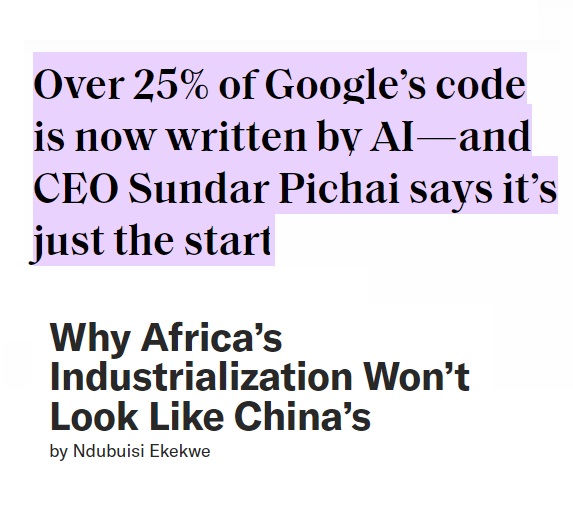
As Google Uses AI for 25% of Coding Activities, Africa Must Invent A New Industrialization Policy

0

In Harvard Business Review in an article titled “Why Africa’s Industrialization Won’t Look Like China’s“, I wrote: “In its attempts to industrialize, Africa has looked toward China’s success. China designed and executed a policy that shrank the industrialization process in a mere 25 years — something many economies took at least a century to do. That redesign has brought immense dislocation in global commerce and industry, enabling China to become one of the world’s leading economies. African leaders have been pursuing policies designed to mimic China’s path.

“But despite these efforts, Africa has yet to advance in its industrialization at the same speed China did. Put simply, the things that worked for China will not work for Africa. Africa must change its focus: It must encourage internal consumption and intra-trade, push forward the African Continental Free Trade Agreement, create a single African currency, improve infrastructure, and invest in education”.

Today, we are learning that “Over 25% of Google’s code is now written by AI—and CEO Sundar Pichai says it’s just the start”.

Expanding my hypothesis: America and Western Europe will not just keep their factory jobs, they will also keep their graphic design, coding and similar jobs because robots and AI will do those jobs in their lands. The implication is massive: the entry level mundane jobs US companies used to outsource to the developing world, are now being disintermediated by AI, and would be done at home.

So, as Google pushes 25% of its coding jobs to AI, most of those coding schools in the developing world which have relied on winning those roles will be gone. Google only needs experienced coders as AI will do what the entry level guys used to do. Now you get why those big techs are firing people every quarter: as AI gets better, it will replace some of those making it better!

This is why those building coding schools in Africa to farm coders and techies for US and European companies must rethink. We just need to push our governments to understand that we must develop our local markets because AI is now a huge competitor in those cross-border remote jobs and roles! (We have explained how to navigate this transition in Tekedia AI in Business Masterclass program ).


Artificial Intelligence (AI) in Business Masterclass | Immediate Access, $400 or ?200,000

Nigeria’s NEC Recommends Withdrawal of Tax Reforms Bill Seeking to Change VAT Distribution Model

0
FIRS signpost

The National Economic Council (NEC) has recommended the withdrawal of the Tax Reforms Bill currently under consideration in the National Assembly, which has been opposed by northern leaders.

Headed by Vice President Kashim Shettima and comprising governors from across the country, NEC’s recommendation comes amid heated debates and regional tensions surrounding proposed changes to the distribution model for Value Added Tax (VAT). The council has suggested that more engagement with stakeholders is needed to address these concerns before proceeding.

Oyo State Governor Seyi Makinde, speaking to journalists after an NEC meeting on Thursday, explained that the NEC decided to withdraw the bills due to the controversies they have sparked.

“We want stakeholders to be carried along,” he stated, emphasizing the need for more inclusive discussions around the proposed tax reforms.

Acknowledging the need to carry all stakeholders along, the Chairman of the Presidential Tax Reforms Committee, Taiwo Oyedele, said on Wednesday, “We share the sentiment expressed by the Northern Governors regarding the inequity inherent in the current model of derivation as a basis for distributing VAT revenue… We will collaborate with all stakeholders to address this concern with a view to finding a balanced solution that achieves a win-win outcome for all.”

This latest recommendation by NEC follows Sunday’s meeting of the Northern Governors’ Forum (NGF), chaired by Governor Inuwa Yahaya of Gombe State. The NGF openly rejected the derivation-based VAT model proposed in the bill, arguing that it would disproportionately disadvantage northern states. The north’s concerns about this model were further clarified by Nasarawa State Governor Abdullahi Sule, who explained that the proposed changes would place northern states at a significant disadvantage due to their comparatively low VAT revenues.

Sule, underscoring the unity among northern leaders, stated that their decision was not in opposition to President Bola Ahmed Tinubu, whose administration initiated the tax reforms.

“We can’t bring in President Tinubu and then oppose him,” he clarified. “If you look at the composition of the meeting, you’ll see people from different political backgrounds—some from APC, some from PDP, and others unaffiliated. We reached this decision collectively.”

Sule detailed the crux of the north’s concerns saying: “If we move forward with this derivation-based VAT model, states that generate little to no VAT will end up at a disadvantage. Northern states currently generate less VAT than the southern states, and altering the revenue-sharing model could reduce the already limited revenue flowing to these states.”

Drawing from his experience, Sule highlighted that VAT collection often takes place where products are processed or imported, such as ports in the south, rather than in the northern states that supply raw materials.

Earlier in the day, Bayo Onanuga, Special Adviser to the President on Information and Strategy, commented on the broader “misunderstandings and misgivings” surrounding the tax reforms. He reiterated that the changes outlined in the new VAT distribution model aim to promote a fairer system.

According to Onanuga, the current VAT system distributes revenue based on where the tax is remitted, not where goods and services are consumed or supplied. He argued that this model disadvantages states that supply goods consumed in other regions, as they do not receive a corresponding share of the VAT revenue.

“The reform seeks to correct this inequity,” Onanuga explained. “The new proposal considers the place of supply or consumption for relevant goods and services. Northern states that produce essential commodities, like food, should not lose out on VAT revenue simply because their products are VAT-exempt or consumed elsewhere. The model aims to create a balanced approach that reflects actual economic contributions across states.”

Concerns Over Derivation-Based VAT Model

The derivation-based VAT model has been a contentious issue, with stakeholders divided on its implications. Supporters of the new approach argue that it would allow states that generate more VAT to retain a larger share of the revenue, fostering economic accountability and encouraging self-sufficiency. This change could particularly benefit economically vibrant states like Lagos and Rivers, which generate substantial VAT from high levels of commercial activity and industrial output.

However, opponents contend that this model would create disparities among regions, exacerbating economic inequality across states with differing production capacities.

The VAT redistribution bill has been hailed as Nigeria’s closest step to fiscal federalism since the 1960s. However, the opposition from the northern states underscores a broader challenge in achieving a unified tax reform policy that equitably serves Nigeria’s diverse regions. Northern states rely heavily on federal allocations due to limited internally generated revenue, and a derivation-based VAT model could potentially shrink their revenue pool even further.

Under the current VAT model, all VAT collected across the country is pooled and redistributed according to a formula that allocates a higher percentage to states with higher populations, effectively subsidizing those with lower VAT revenues.

For the North, adopting a derivation model would mean sacrificing this redistribution advantage, potentially widening the fiscal gap between the regions. Many argue that this change would favor the southern states, as they host the country’s major economic centers where VAT collection is centralized.