DD
MM
YYYY

PAGES

DD
MM
YYYY

spot_img

PAGES

Home Blog Page 2894

How to Add Sei to Metamask: A Comprehensive Guide

0
How to Add Sei to Metamask

Sei Network is a high-performance Layer 1 blockchain designed for exceptional speed and efficiency. Its latest update, Sei V2, introduces parallelized EVM execution, significantly optimizing transaction processing. The network uses Delegated Proof of Stake to deliver fast, low-cost operations. Supporting both EVM and CosmWasm environments, Sei allows smooth integration and broad access to the Cosmos ecosystem. So, how can you add Sei Network? In this guide, we’ll walk through step-by-step instructions to add Sei to MetaMask manually, automatically, and more. Let’s dive in.

How to Add sei to Metamask Manually

You can add Sei to Metamask Manually through RPC. To add Sei RPC to MetaMask, follow these steps:

  • 1. Open your MetaMask extension or app.
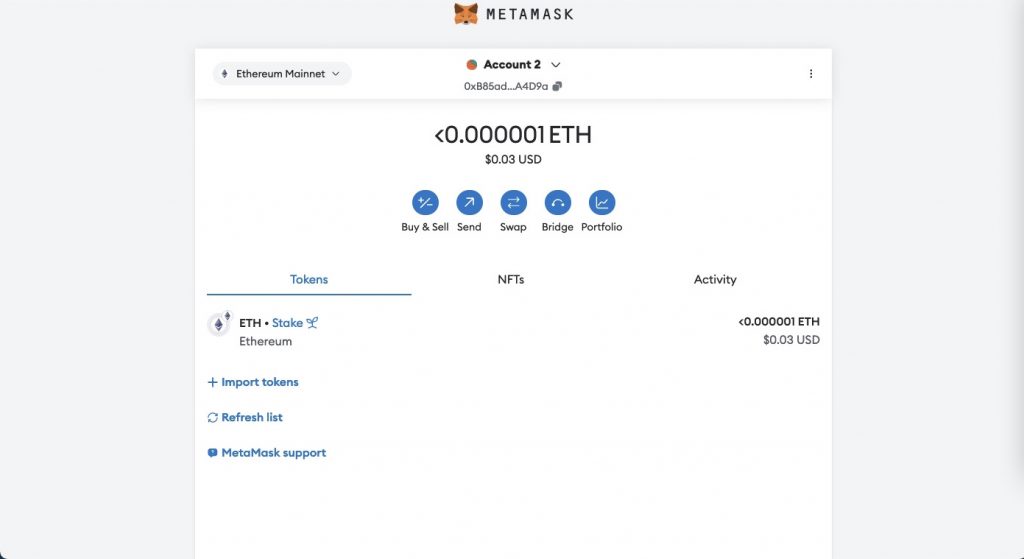
  • 2. Click on the network dropdown at the left corner of the MetaMask interface.
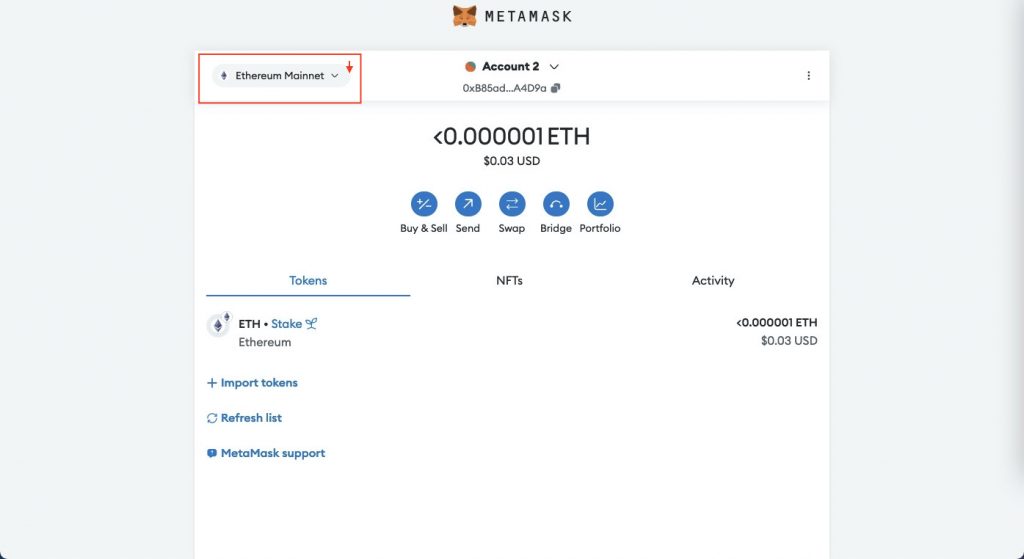
  • 3. Navigate down and select “Add Network.”
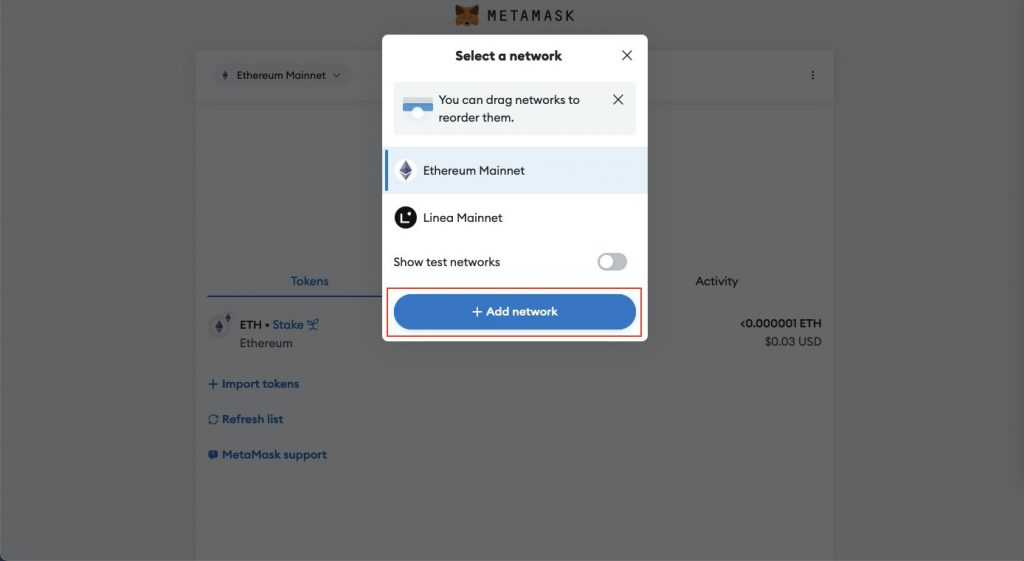
  • 4. Scroll down and select “Add a Network Manually.”
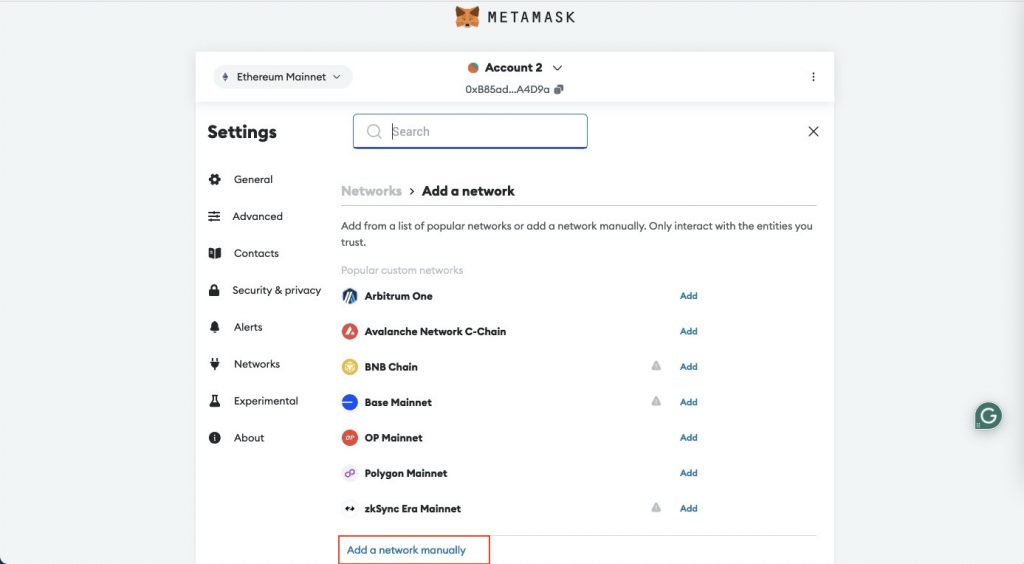
  • 5. Enter the following details in the required boxes:

Network Name: Sei

New RPC URL: https://evm-rpc.sei-apis.com

Chain ID: 1329

Currency Symbol: SEI

Block Explorer URL: https://seitrace.com
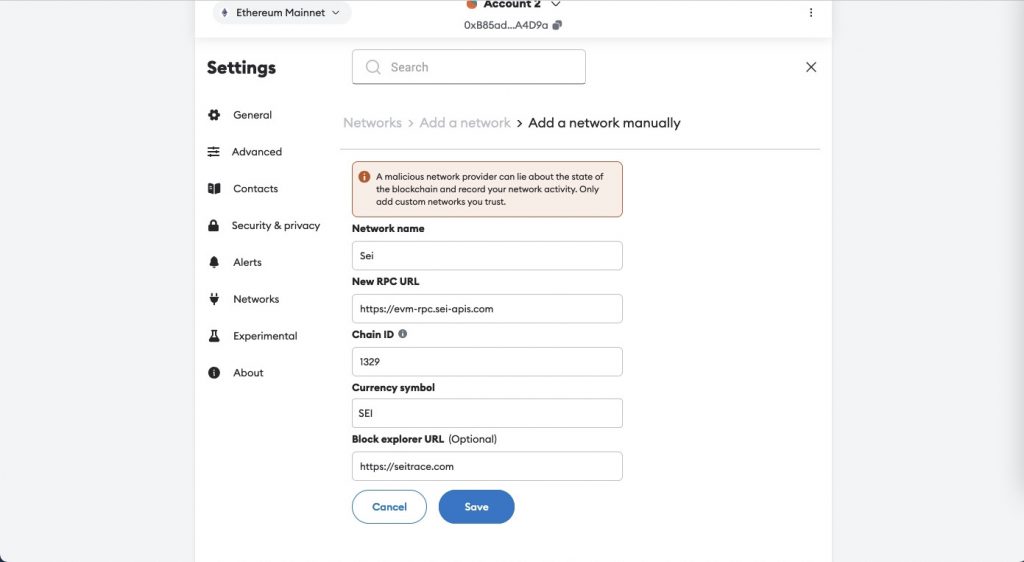
  • 6. Click “Save” to add the Sei Network to your MetaMask.

You can now manage Sei assets in your Metamask.

How to Add Sei to Metamask Automatically

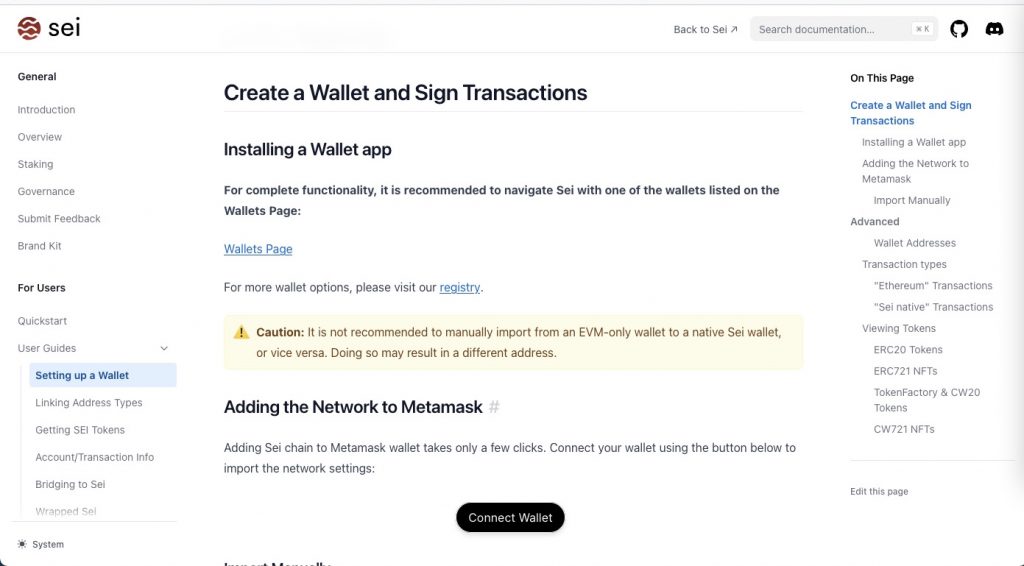
You can add the Sei network automatically from the Sei Docs or ChainList. To add the Sei network using Sei Docs, follow the steps below:

  • 1. Visit the link: https://www.docs.sei.io/user-guides/wallet-setup
  • 2. Navigate to “Adding the Network to Metamask.”
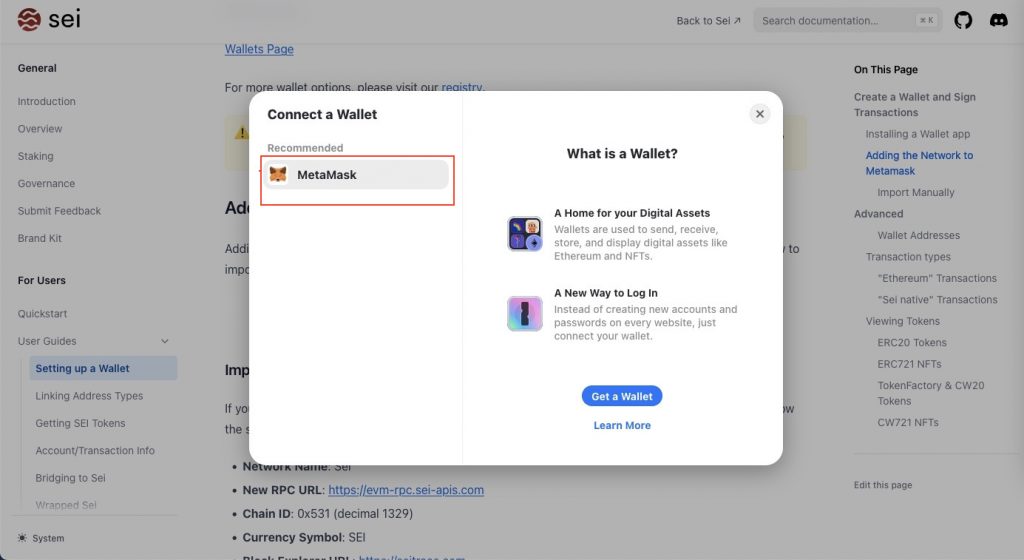
  • 3. Click on “Connect Wallet.”

  • 4. Select “Metamask.”

  • 5. Select the account you want to connect to Sei and click “Next.”
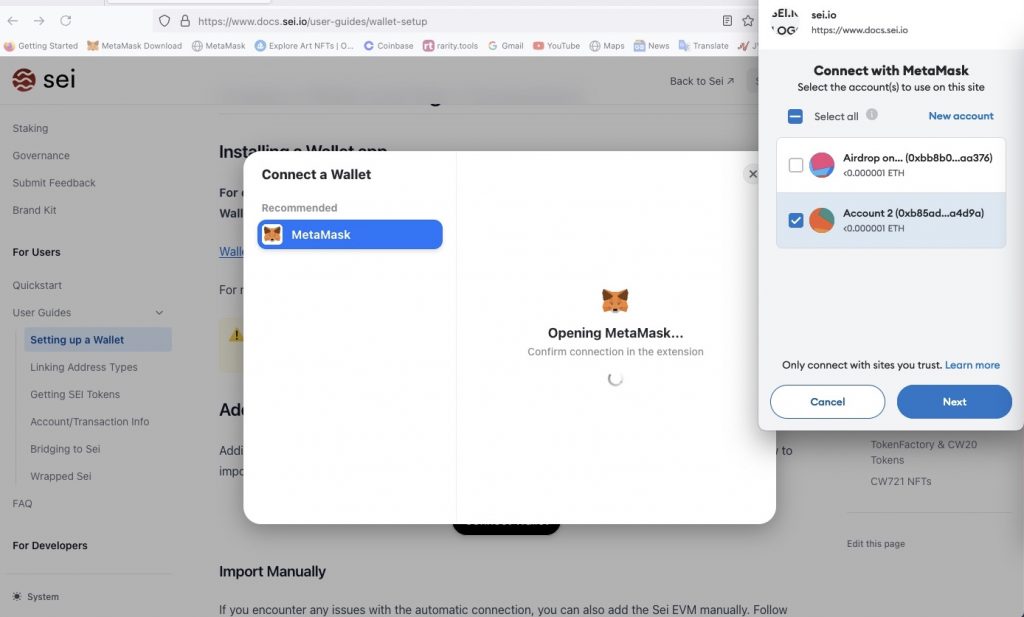
  • 6. Click on “Confirm” to grant permission.
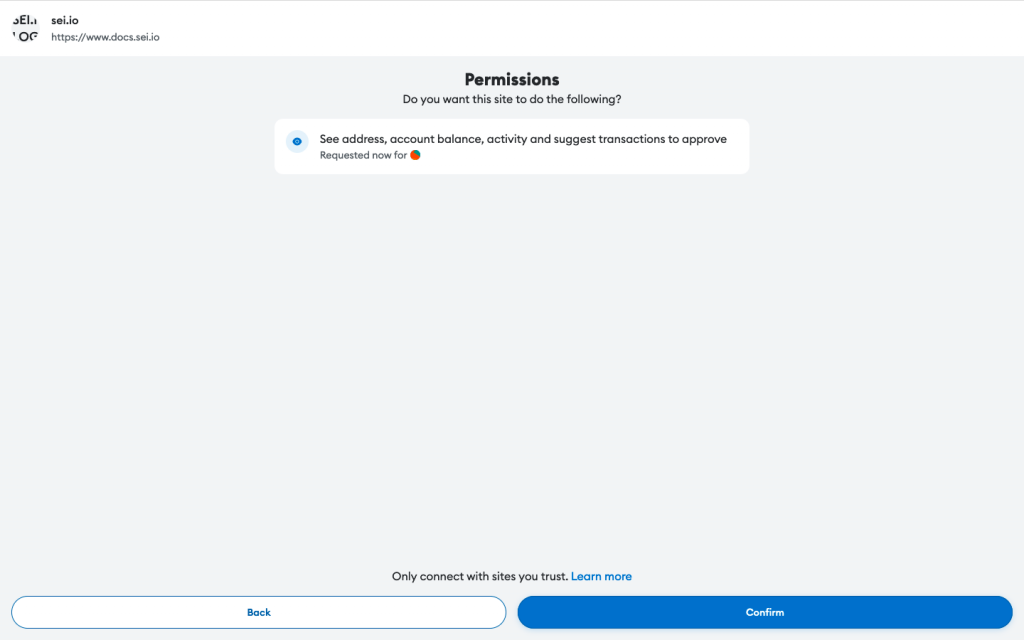
  • 7. Select “Approve” to grant website permission.
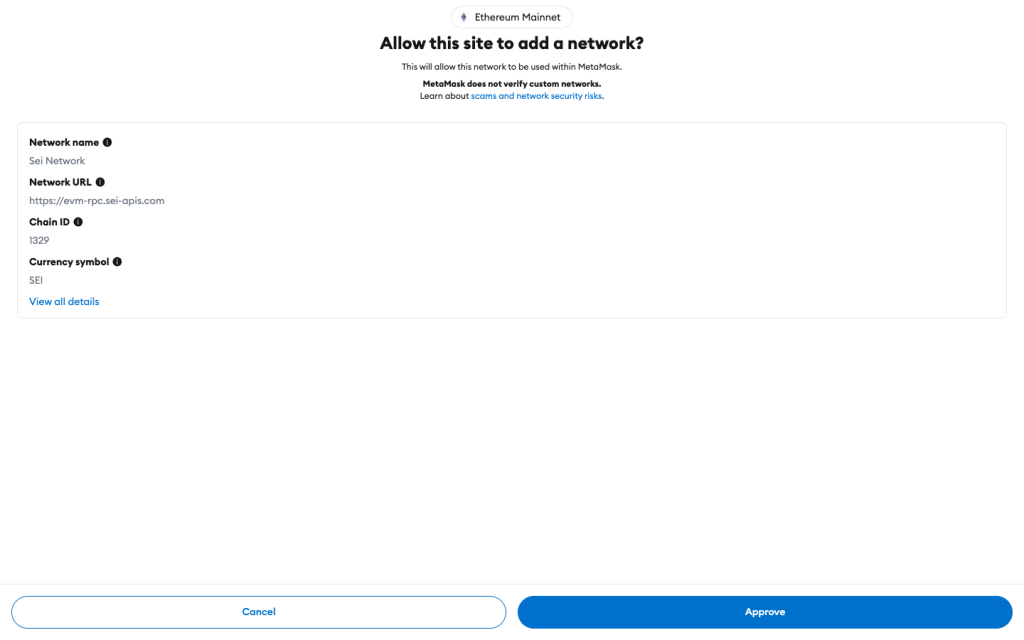
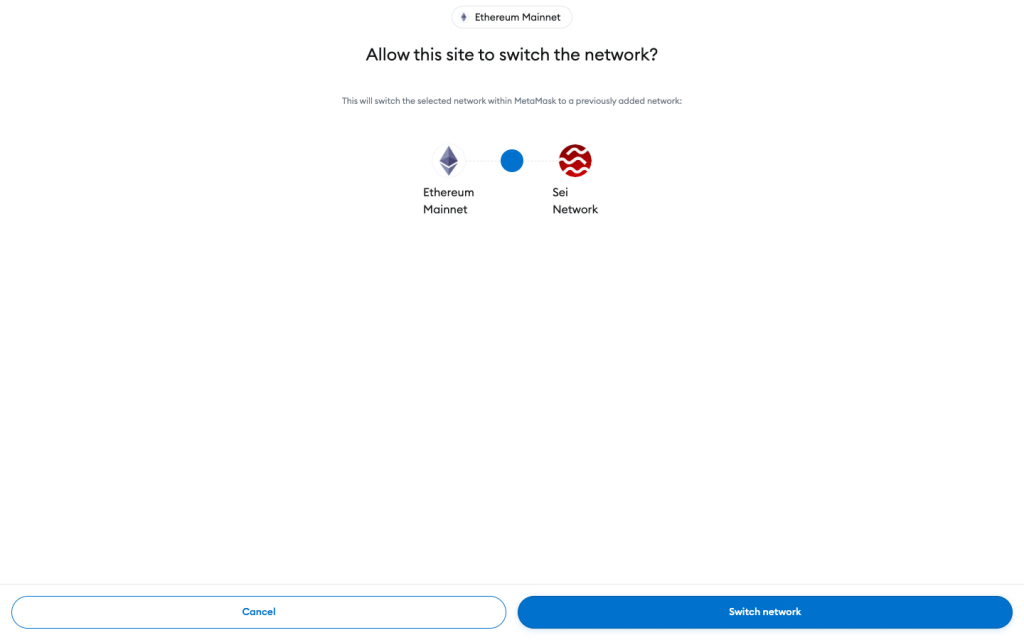
  • 8. Click on “Switch Network” to switch to Sei.
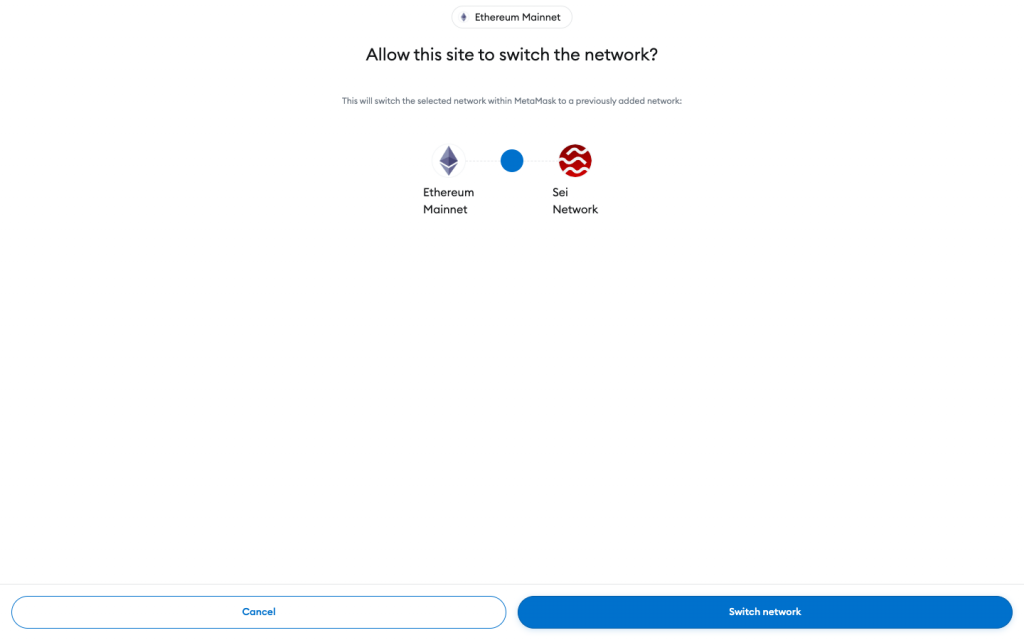
Your connected wallet address will appear on the Sei docs.
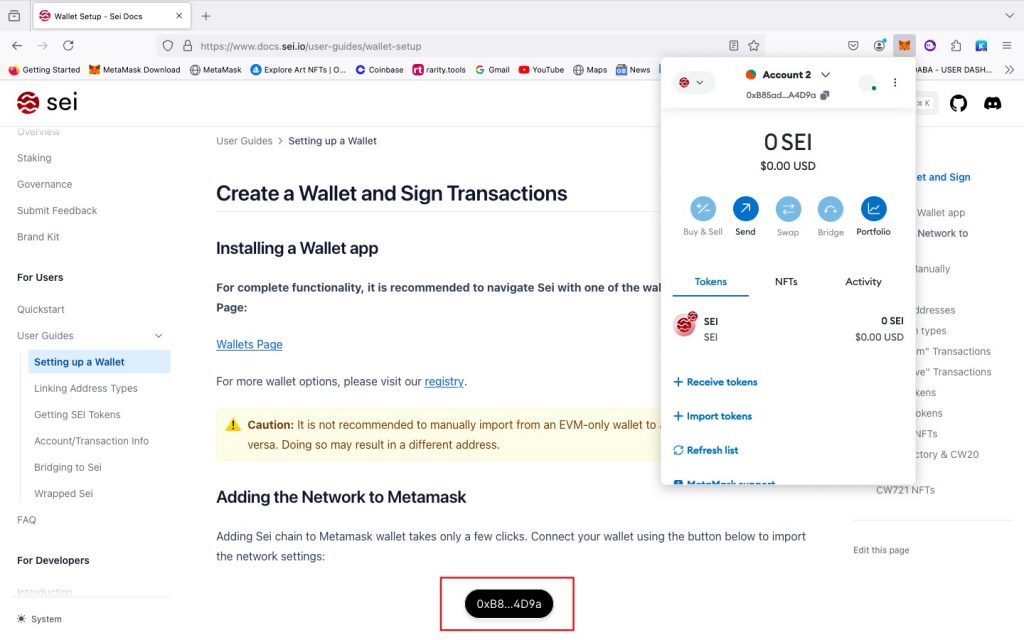
You can now manage Sei in your EVM-compatible wallet.

How to Add Sei to Metamask through ChainList

To add the Sei network to MetaMask using Chainlist, follow these steps:

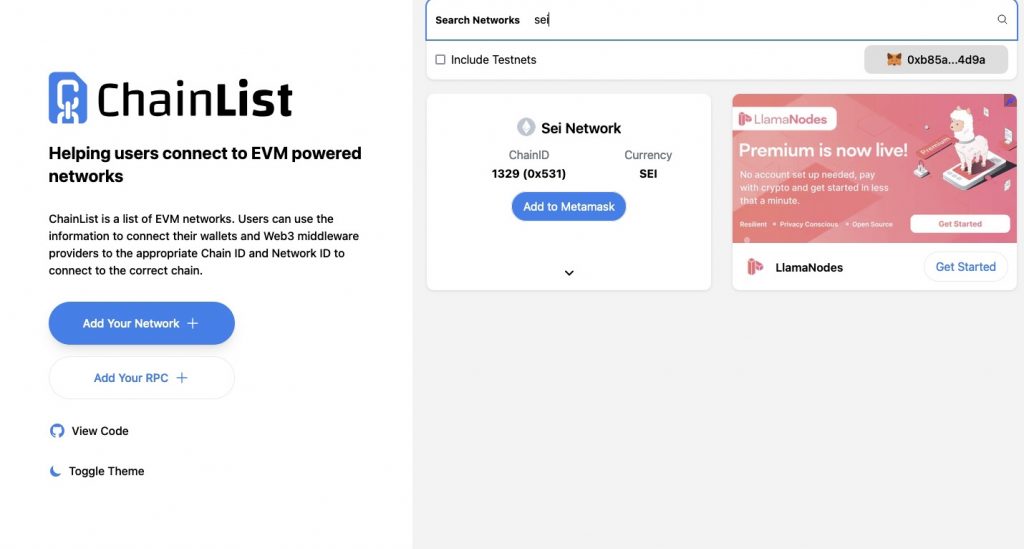
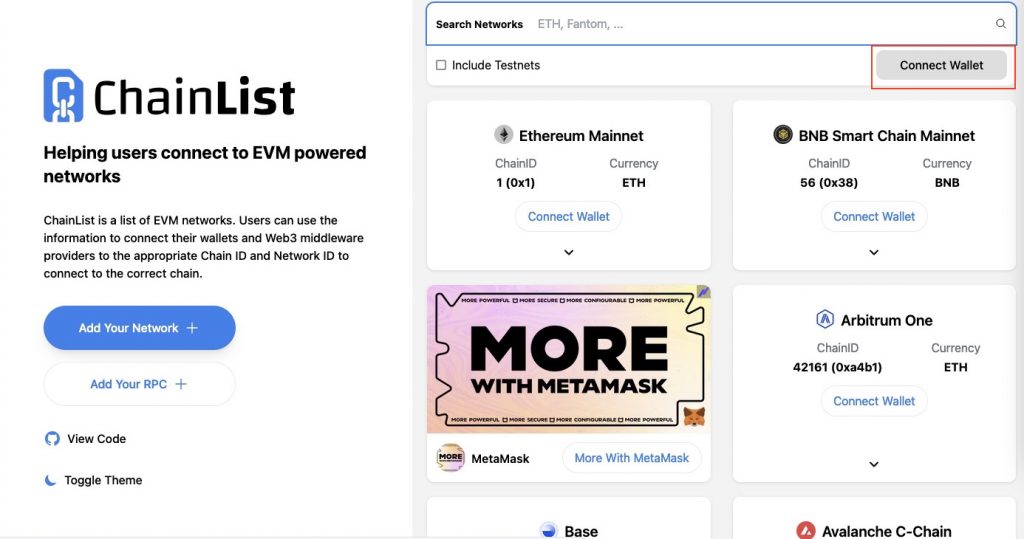
  • 1. Visit ChainList website: https://chainlist.org/
  • 2. Click on “Connect Wallet” at the top right corner.
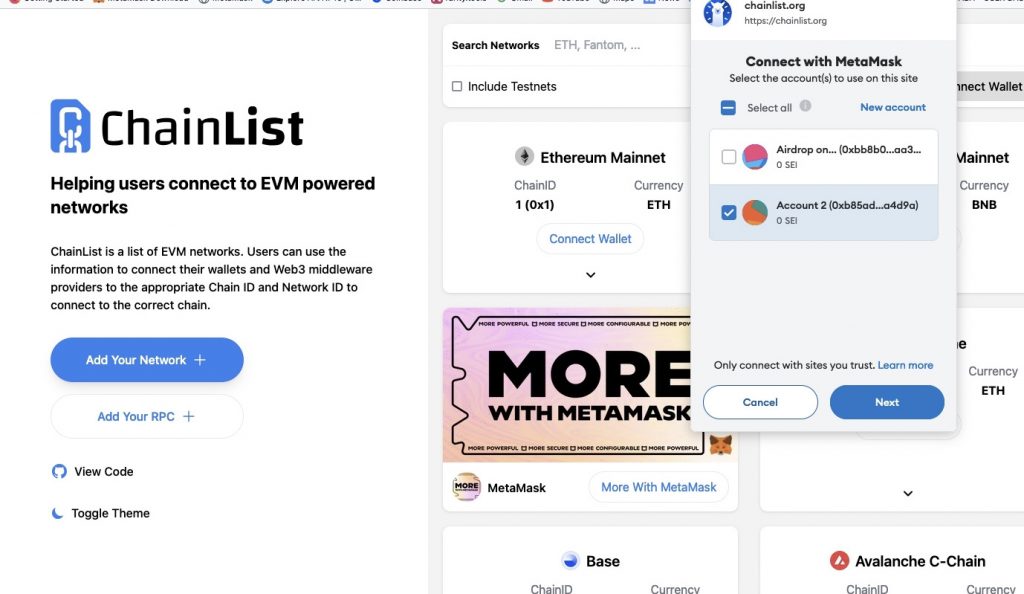
  • 3. Select the account you intend to connect and click on “Next.”
  • 4. Select “Confirm” to grant permission.
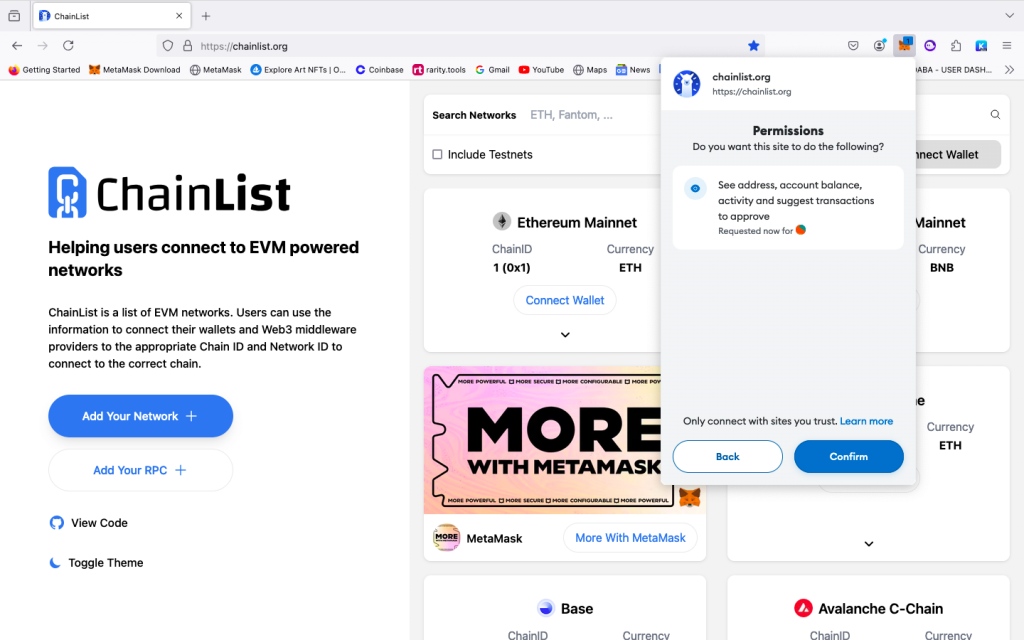
Your connected wallet address will appear on ChainList.
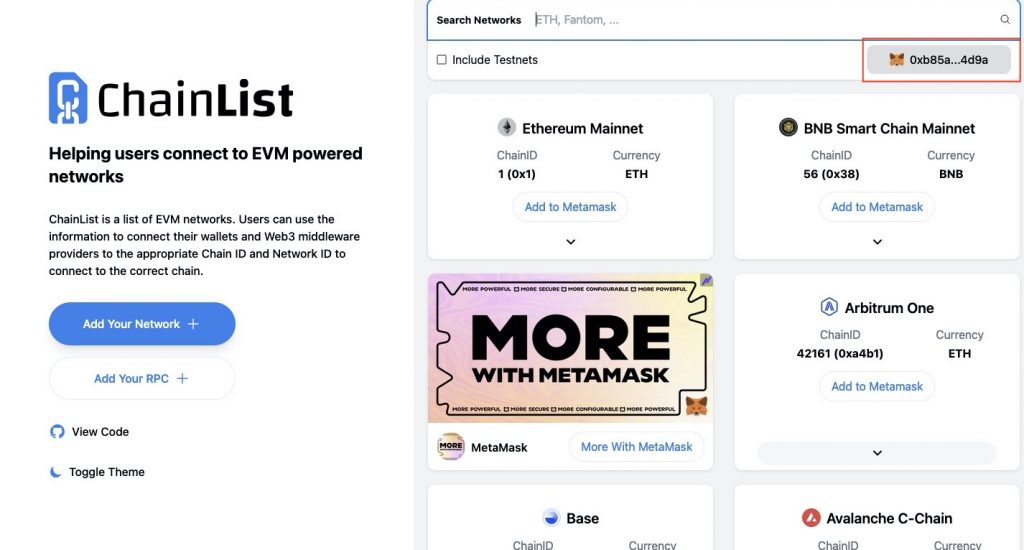
  • 5. Search for “Sei” using the search bar at the top of the page..
  • 6. Click on “Add to Metamask.”

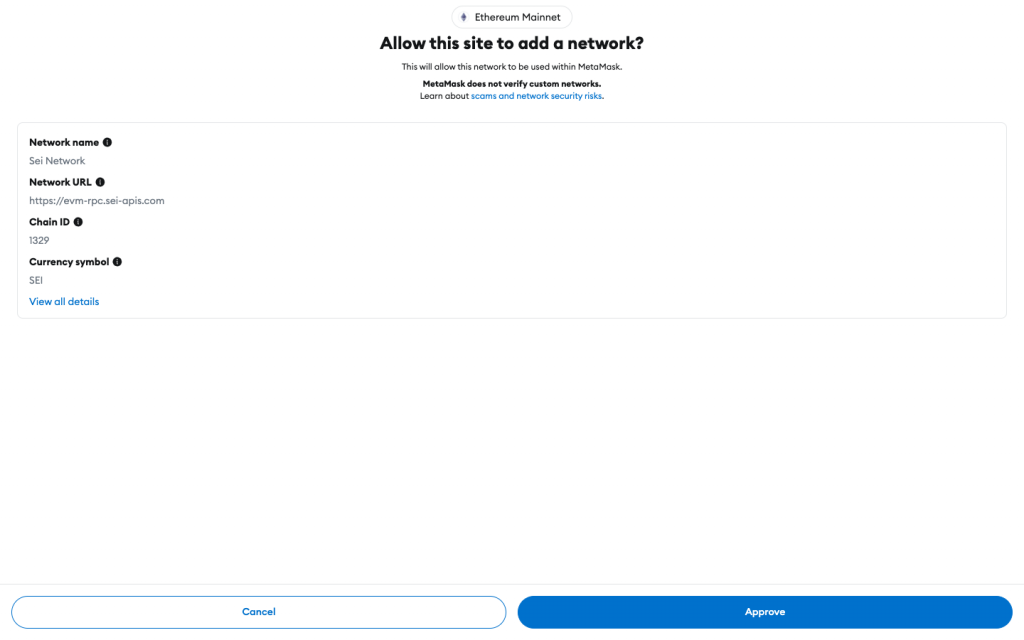
You will see a grant permission pop-up

  • 7. Select “Approve.”

  • 8. Select “Switch Network.”

Now, you’ve successfully added Sei with ChainList and can manage Sei in your EVM-compatible wallet.

How to Connect Sei to EVM Addresses Using Metamask

  • 1. Visit https://app.sei.io/
  • 2. Select “Connect Wallet” on the dashboard to view and manage your account.
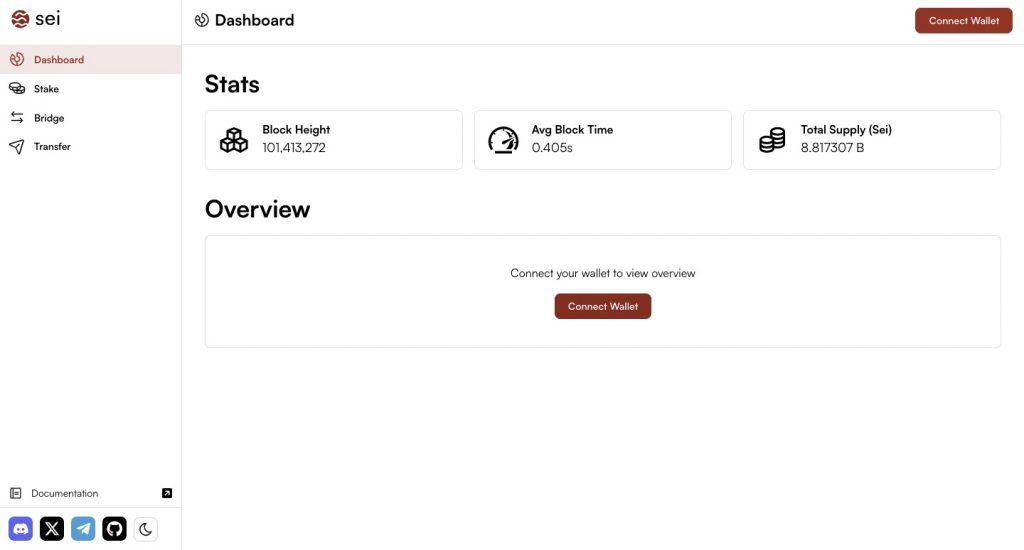
  • 3. Complete the captcha that pops up on your screen.
  • 4. Select “Link Addresses”  to connect your account on-chain.
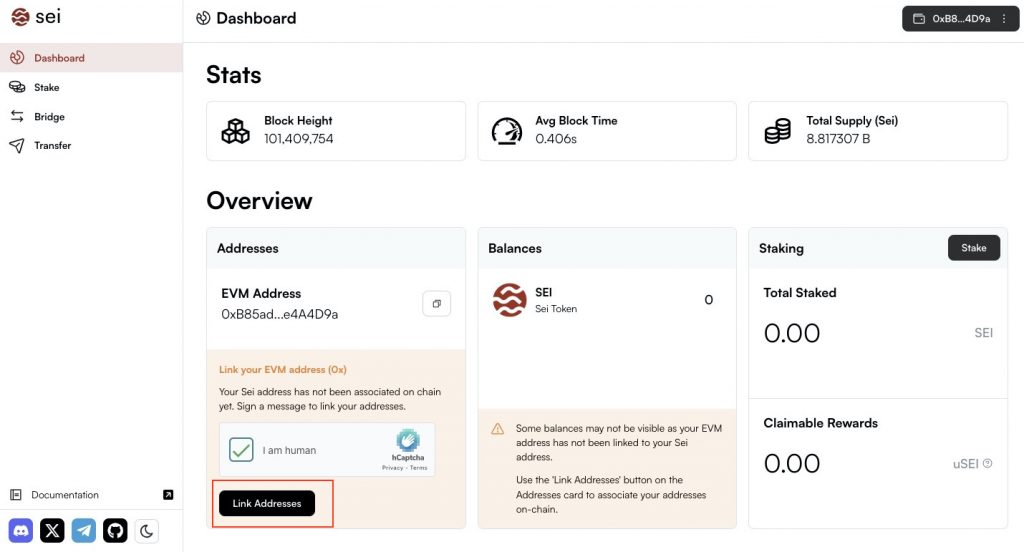
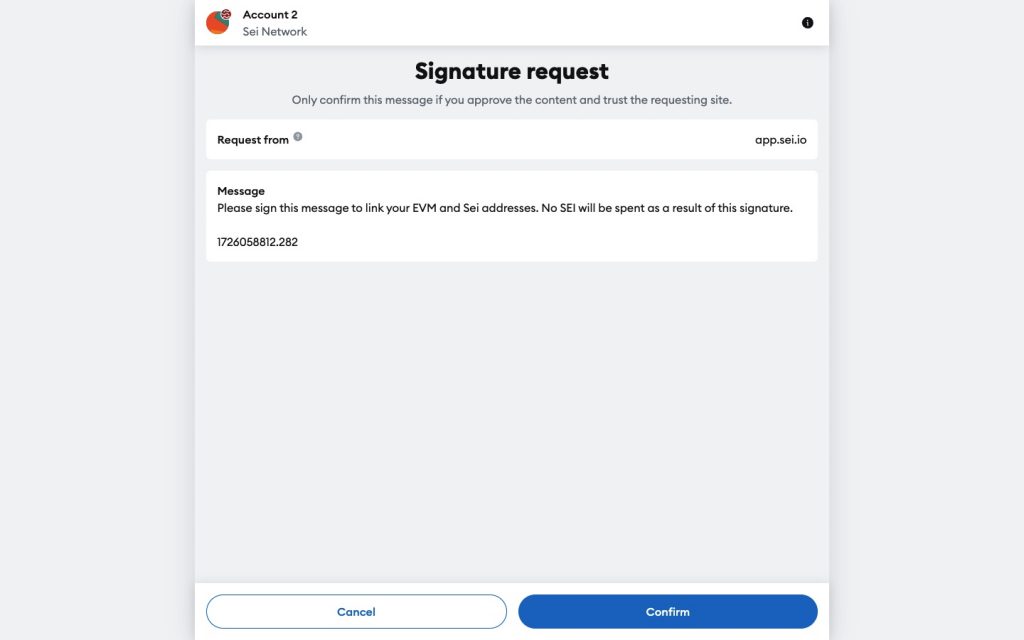
A signature request will pop up on your screen

  • 5. Click on “Confirm.”

Once your wallet is connected, you will see a Sei wallet address below your Metamask address.
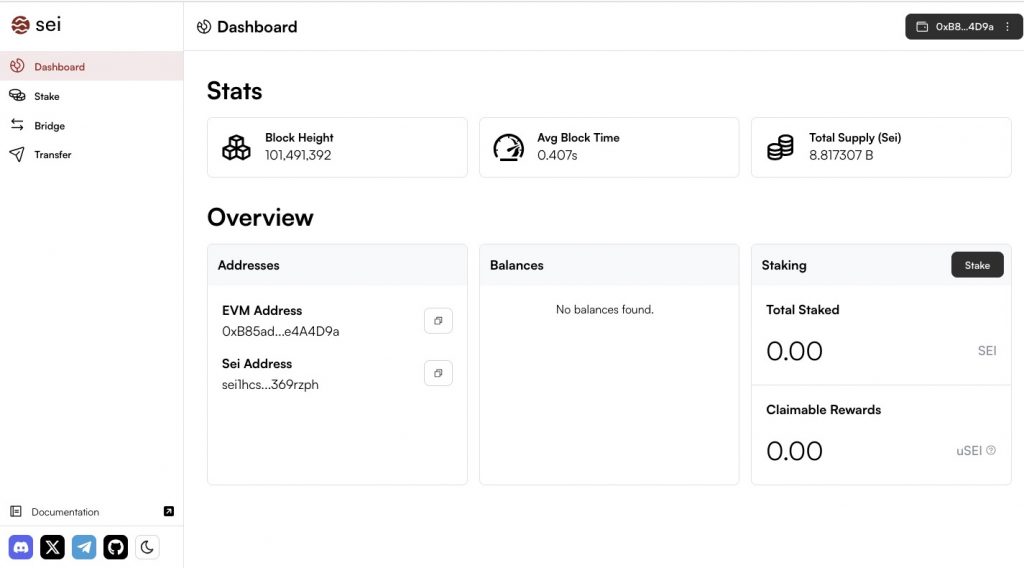
You can now use your wallet on decentralized platforms built on the Sei network.

How to Connect to Sei dApps Using Metamask

Once you’ve successfully connected your wallet to the Sei dashboard, you can access several DEX platforms on the Sei ecosystem. Let’s use DragonSwap as an example.

DragonSwap is a DeFi platform on the Sei Network, featuring an Automated Market Maker and a prediction market. It also offers liquid staking support. Users can stake, contribute to liquidity pools, and participate in yield farming within the Sei ecosystem. To connect Sei to DragonSwap using MetaMask, follow these steps:

  • 1. Visit https://dragonswap.app/

A pop-up will appear.
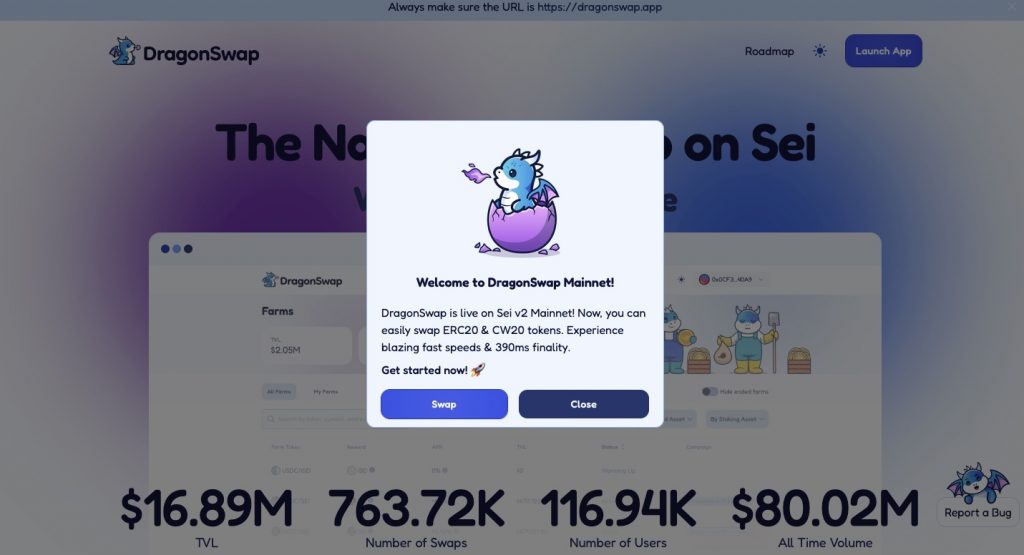
  • 2. Select “close” if you want to carry out other activities beyond swapping.
  • 3. Click on “Launch App” at the top right corner of the page.
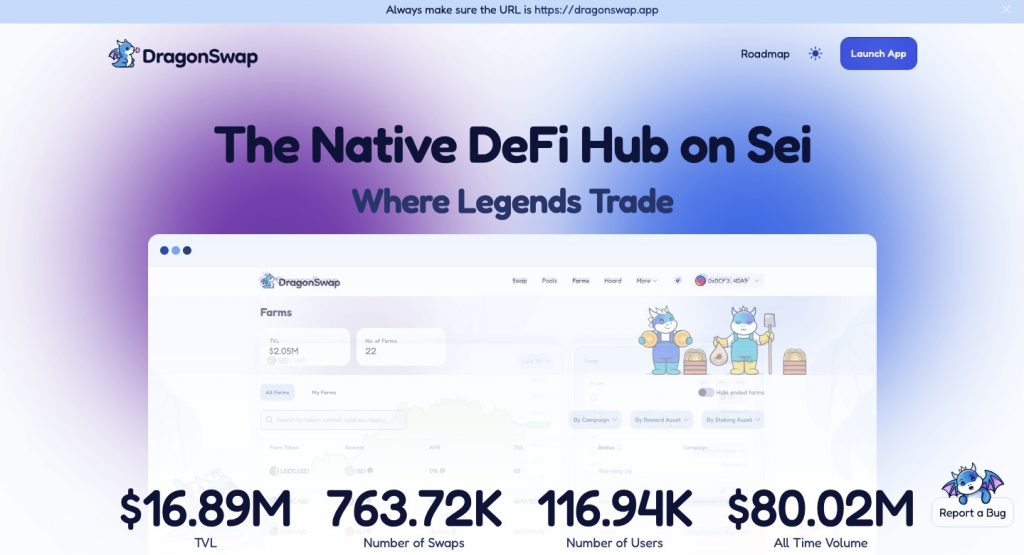
 

  • 4. Select “Connect Wallet” at the top right corner.

A pop-up will display

  • 5. Select “Metamask.”
  • 6. Click on the wallet address you want to connect and click on “Next.”
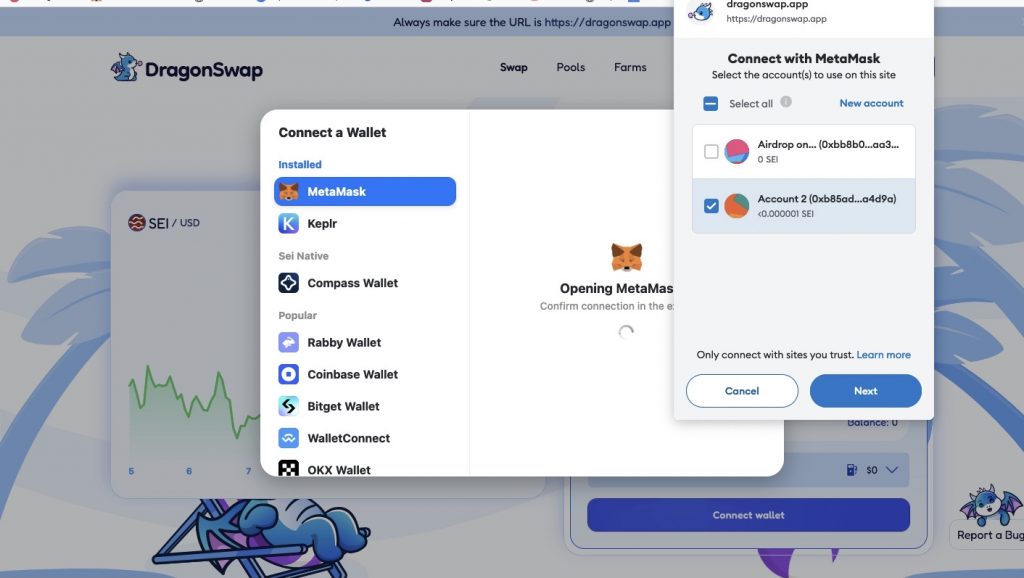
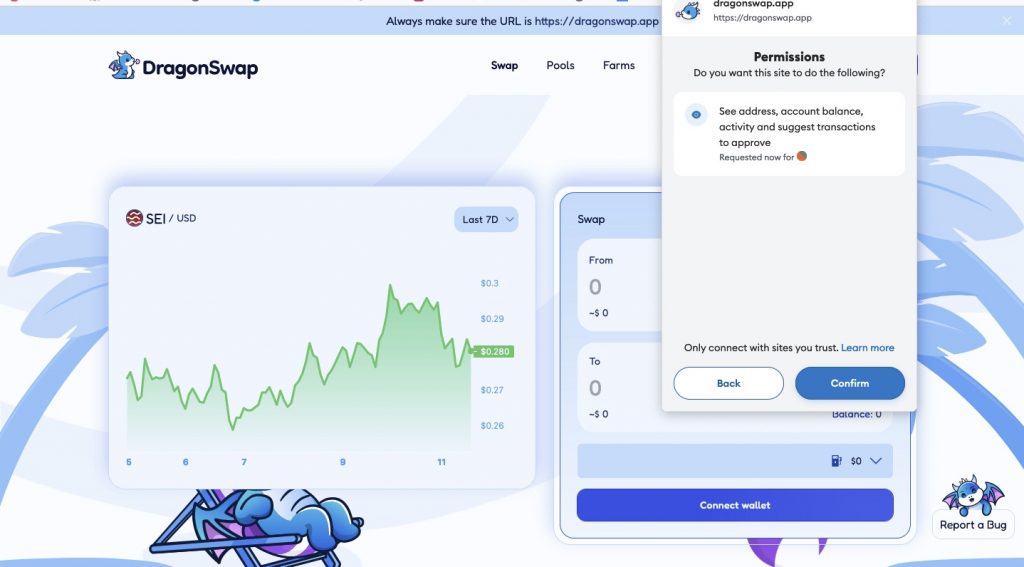
A grant permission request will pop up

  • 7. Click on “confirm.”

You can now swap tokens, provide liquidity into pools, and participate in yield farming.

FAQs

Can I Connect Metamask to Sei dApps Directly? 

Sei dApps require you to link your Metamask to the Sei dashboard to explore a variety of DeFi products and services. This will help you generate a Sei Native address alongside your EVM address for a smooth interaction.

What is the Difference Between the Sei Native Wallet and the EVM Wallet? 

On the Sei Network, linking your EVM wallet (0x address) generates a native Sei address (Sei1). Both addresses are connected and represent the same account. The Sei address is used for native Sei dApps, while the EVM address is used for EVM-compatible dApps. Balances and transactions are synced between the two, so you can send and receive funds using either address.

Does Sei Have a Native Wallet?

Yes. While you can access Sei’s native wallet using MetaMask, Sei also has its own native wallet called Compass. Compass facilitates fund transfers, NFT exploration, and connections across dApps on the Sei network.

Can I Bridge to Sei? 

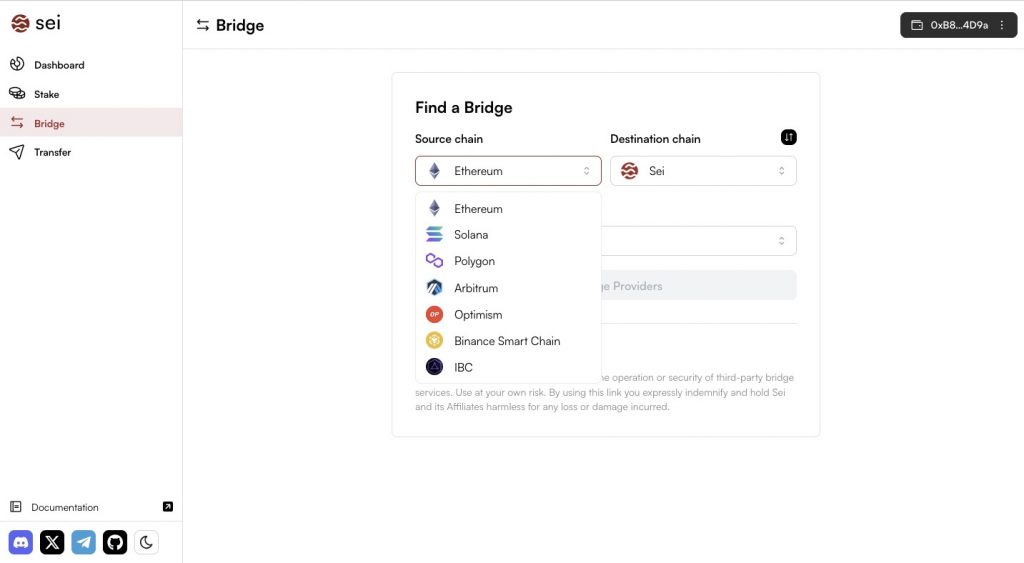
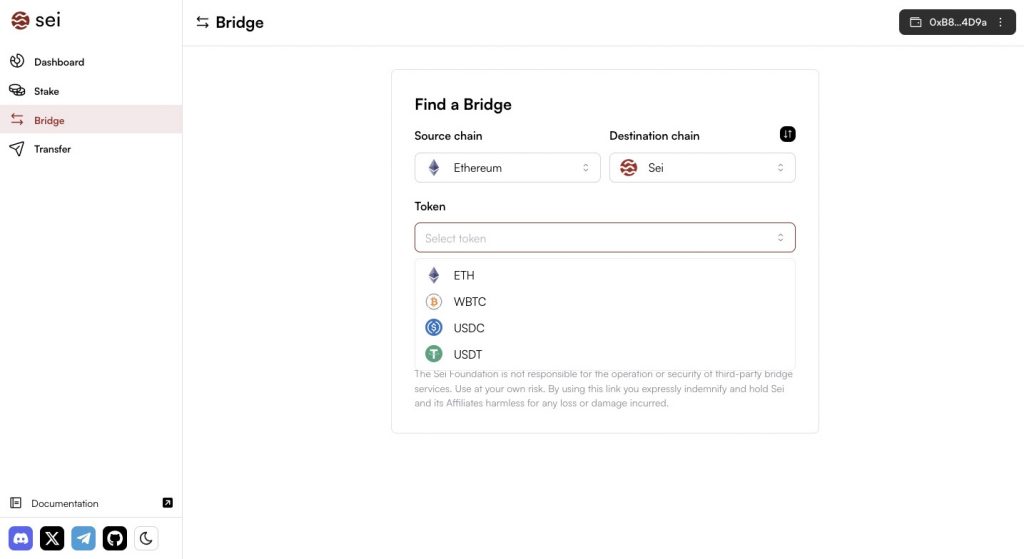
Yes, you can bridge to the Sei network. Although EVM-compatible wallets like MetaMask don’t support this feature, you can use cross-chain platforms like LiFi Protocol or Stargate Finance. Alternatively, you can use the Sei website, which works with Layer 1 and Layer 2 solutions such as Ethereum, Solana, Polygon, Arbitrum, Optimism, Binance Smart Chain, and IBC (Inter-Blockchain Communication). The website supports token assets like ETH, WBTC (Wrapped BTC), USDC, and USDT. Here’s how to bridge on the Sei’s website:

  • 1. Go to https://app.sei.io/bridge
  • 2. Select “Source Chain.”

  • 3. Click on “Select Token.”

  • 4. Choose your preferred token and select “Find Bridge Providers.”
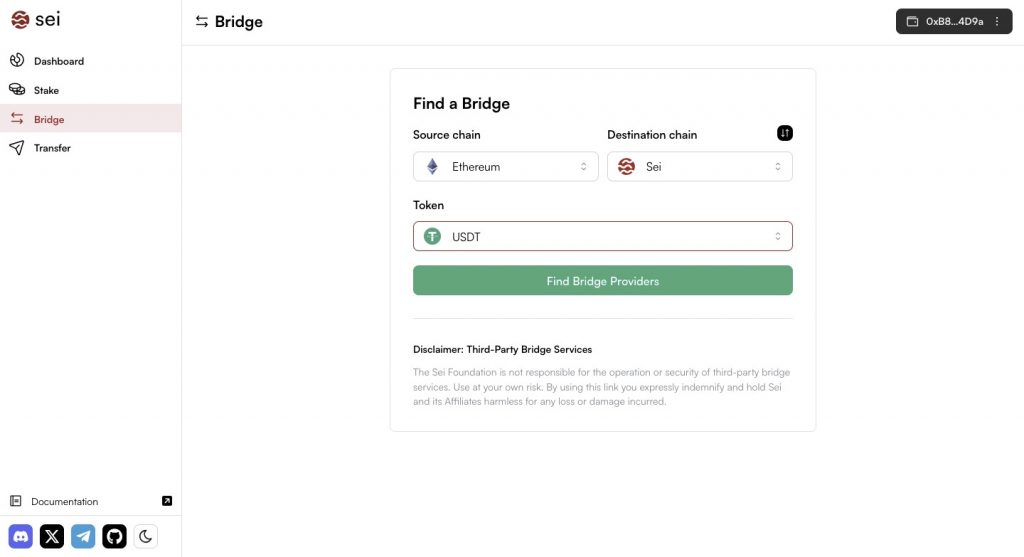
 

  • 5. Choose a preferred third-party bridge service from the available options, such as Squid, Symbiosis, Skip, Stargate, or TFM. The choice of bridge service depends on your source chain.
  • 6. Connect your wallet and bridge.

Final Thoughts

Adding the Sei Network to MetaMask is a straightforward process, whether done manually, automatically through Sei Docs, or using ChainList. Sei’s high-performance capabilities and integration with both EVM and CosmWasm environments make it efficient and flexible.

Following the provided steps allows you to properly manage your Sei assets and explore various decentralized applications on the Sei network. That way, you can fully tap into the benefits of Sei’s advanced features and extensive ecosystem.

Disclaimer!: This article is solely for educational purposes and should not be interpreted as a form of financial advice (NFA). Always conduct personal research before investing in any blockchain project.

NNPC’s Updated Shift Is The Right Playbook on Petrol Distribution in Nigeria Right Now

0

“In preparation for the Dangote Refinery’s scheduled petrol loading on Sunday, September 15, 2024, NNPC Ltd. has been mobilizing trucks to the refinery’s fuel loading gantry in Ibeju-Lekki. As of Saturday afternoon, NNPC Ltd. had deployed over 100 trucks, with hundreds more en route.” – NNPC Ltd.


A very good shift on policy: “The federal government of Nigeria has finalized a landmark agreement with Dangote Refinery, setting the commercial terms for the supply of crude oil to the refinery and the distribution of refined products, particularly petrol and diesel.”

Yes, the decision for Dangote Refinery to sell to NNPC is the right call, and I am happy the energy giant reversed its own policy where it noted that it would allow “market forces” to drive this distribution. In a piece titled “Nigeria’s Mistake of Market-Driven Distribution Pricing When Supply of Inelastic Product (Petrol) is Controlled”, I wrote “So, a village boy from Ovim posits that Nigeria cannot run a market-driven regime on petrol when its supply of petrol remains regulated, restricted and controlled, if we hope to attain parity, without welfare losses, in the market system.”.

Of course, over time, we can allow market forces to drive this. But right now, it makes no sense since Supply remains controlled and restricted.  Under NNPC, Nigeria can manage the vagaries of pricing oscillation better, over leaving the citizens to the mercies of marketers who under “market forces” can do havoc for an inelastic product under short supply.

Comment on Feed

Comment 1: The decision by Dangote Refinery to supply petrol to NNPC Ltd. is a necessary shift in Nigeria’s energy policy, given the inelastic nature of petrol demand. A fully market-driven pricing system would have led to price volatility and consumer harm, especially with restricted supply. By controlling distribution through NNPC, the government ensures price stability and protects consumers. While market forces can play a larger role in the future, this controlled approach is the right move for now to maintain economic stability.

Comment R1: Sir, a lot of people will not completely agree with you on this bcos 1.Controlling distribution through NNPC limits competition, this will hinder market efficiency. A competitive market with multiple suppliers would drive innovation, improve supply chains, and potentially lower prices.
2. By ensuring price stability through a government-controlled entity like NNPC, there’s a risk of artificially distorting prices, possibly reintroducing a form of indirect subsidy, by maintaining tight control, the government is missing an opportunity to liberalize the sector.
3.Relying heavily on a single refinery like Dangote’s and opaque pricing combined with government distribution control, increases systemic risk. If there are disruptions in Dangote’s supply chain or operational issues, the entire country’s fuel supply will be at risk. I stand to be corrected.

Comment R2: Your points are absolutely valid, and they highlight the complexities of balancing regulation with market liberalization in Nigeria’s energy sector.

  1. On competition and market efficiency: While it’s true that controlling distribution through NNPC could limit competition in the short term, the current market structure, where supply is restricted, doesn’t lend itself well to efficient competition. Allowing multiple players into a market with constrained supply could lead to price manipulation rather than true competition. Once supply stabilizes, transitioning to a more competitive, liberalized market will certainly drive innovation and efficiency.

  2. On price distortions and subsidies: The risk of price distortions and hidden subsidies is real. However, in the current economic environment, where petrol supply is heavily restricted, full liberalization might lead to sharp price increases that could burden consumers. The government’s role here is to manage that transition carefully. A phased liberalization plan, where subsidies are gradually reduced as supply grows and competition increases, would be a more sustainable approach.

  3. On systemic risk: Relying heavily on Dangote’s refinery does pose a risk, but this risk already exists in the market, given Nigeria’s heavy reliance on imports and outdated refineries. The short-term objective should be to stabilize local supply through Dangote while other refineries are revamped or new players are introduced. Diversification of suppliers, both local and foreign, remains critical to mitigate the systemic risks you mentioned.

In the long term, a competitive, well-supplied market is the goal, but we must address current supply limitations before fully embracing market-driven forces.

Nigeria And Dangote Refinery Agree on Crude Oil Supply in Naira, NNPC Becomes Sole Off-taker of Petrol As Supply Begins Sunday

0

The federal government of Nigeria has finalized a landmark agreement with Dangote Refinery, setting the commercial terms for the supply of crude oil to the refinery and the distribution of refined products, particularly petrol and diesel.

This agreement marks a critical step in addressing Nigeria’s fuel supply challenges, with the 650,000 barrels-per-day Lagos-Lekki Free Zone-based refinery poised to significantly alter the dynamics of the country’s downstream oil market.

Under the terms of the agreement, petrol distribution from the Dangote Refinery will officially commence on Sunday, September 15, 2024, with an initial supply of 25 million liters per day. The deal, which outlines the supply of crude oil in naira, will see the Nigerian National Petroleum Company Limited (NNPC) serving as the sole off-taker of petrol from the refinery, while diesel from the $20 billion facility will be available for sale to any interested marketers.

The Agreement’s Details

The Executive Chairman of the Federal Inland Revenue Service (FIRS), Dr. Zaccheus Adedeji, who represented Wale Edun, the Minister of Finance and Chairman of the Presidential Committee on the Sale of Crude Oil and Refined Products for Domestic Consumption in Naira, disclosed the development during a briefing in Abuja.

Adedeji revealed that all transactions involving the Dangote Refinery, from crude oil supply to the sale of refined products, would be conducted in naira. This decision is a strategic shift aimed at reducing Nigeria’s reliance on foreign exchange for oil transactions and ensuring that all financial activities tied to this agreement are conducted in the local currency.

“The supply of petrol will be handled exclusively by the Nigerian National Petroleum Company Limited (NNPCL), while diesel from the refinery will be available to any interested marketer. From October 1, 2024, NNPC will commence the supply of crude oil to Dangote Refinery, which will also be paid for in naira. In return, the refinery will supply petrol and diesel of equivalent value to the domestic market, also paid for in naira,” Adedeji stated.

The agreement is expected to stabilize Nigeria’s fuel supply, a sector long plagued by shortages and import dependency. By utilizing naira in all associated regulatory costs—such as fees to the Nigerian Ports Authority (NPA), Nigerian Maritime Administration and Safety Agency (NIMASA), and other federal regulatory bodies—the government aims to ease pressure on the country’s foreign exchange reserves.

Implications for Nigeria’s Fuel Market

For decades, Nigeria has depended heavily on importing refined petroleum products, despite being one of the largest oil producers in the world. The operational commencement of the Dangote Refinery offers a glimmer of hope that Nigeria can reverse this trend, as the facility’s massive refining capacity can meet the bulk of local demand for refined products, reducing the need for imports.

However, marketers have expressed concern over the NNPC’s role as the sole off-taker of petrol, which will likely give the company more control over the domestic fuel market. The role is expected to allow the state-owned company to streamline distribution and address the chronic supply issues that have frequently resulted in fuel shortages and long queues at petrol stations across the country.

However, diesel, another essential crude oil product, that was not subsidized along with petrol, will have a more liberalized distribution system. Dangote Refinery’s decision to sell diesel directly to any interested marketers opens the market to greater competition and ensures that industrial and commercial users have access to refined products without having to go through NNPC’s centralized distribution system.

Logistical Preparations for Distribution

As part of its preparations for the imminent loading of petrol from the Dangote Refinery, the NNPC has deployed over 300 trucks to the facility in Ibeju-Lekki, Lagos. These trucks will serve as the initial fleet to transport petrol to various parts of the country.

The Lagos State Government has also moved to address the expected surge in traffic along the Lekki-Ajah-Epe corridor by deploying additional traffic personnel to manage the influx of trucks and ease potential congestion.

The NNPC, in a statement via its X handle (formerly Twitter), confirmed the deployment of these trucks.

“In preparation for the Dangote Refinery’s scheduled petrol loading on Sunday, September 15, 2024, NNPC Ltd. has been mobilizing trucks to the refinery’s fuel loading gantry in Ibeju-Lekki. By the end of today, at least 300 trucks will be stationed at the refinery’s fuel loading gantry,” it said.

Economic Benefits of The Deal

This deal comes at a pivotal time for Nigeria’s economy. With inflation at elevated levels and foreign exchange pressures weighing on the country’s reserves, paying for crude oil in naira for local refining and distribution is expected to provide much-needed relief.

This move could significantly reduce the country’s foreign exchange exposure, especially given that fuel imports have been one of the primary drains on Nigeria’s reserves in recent years. Additionally, local refining can reduce shipping and import costs, which have contributed to the high cost of petrol and diesel in recent years.

The Dangote Refinery’s role in domestic fuel supply also aligns with the government’s broader efforts to revamp the downstream oil sector. The cessation of fuel subsidies earlier in 2023 was part of a broader strategy to deregulate the market and allow market forces to determine fuel prices.

However, the shift to market-driven pricing has come with challenges, including a sharp rise in fuel prices, which has fueled inflation and eroded consumer purchasing power.

While this agreement marks a positive step forward, the refinery’s pricing structure, particularly for petrol, remains a challenge that needs to be addressed. Market observers have speculated that Dangote Refinery’s products could be priced higher than imported products, especially given that the facility’s current stock was purchased in dollars.

Both NNPC and Dangote Refinery have yet to disclose prices for refined products.

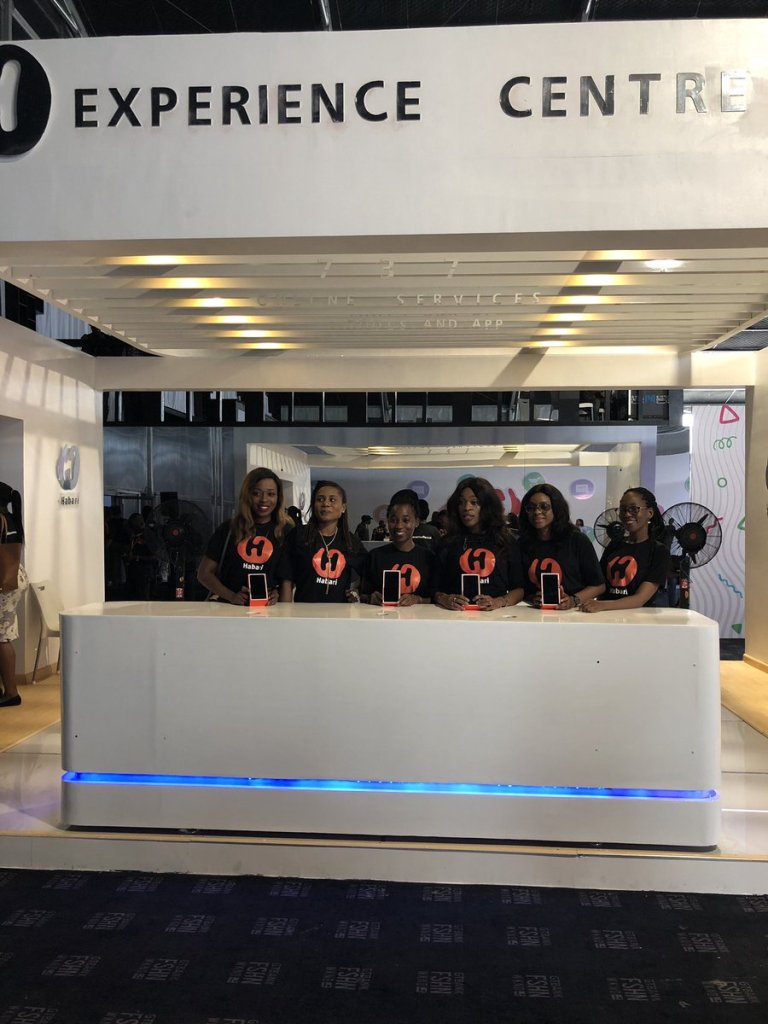
HabariPay, GTCO’s Fintech Subsidiary, Reports N1.7 Billion Profit in H1 2024

0

Habaripay, a fintech subsidiary of Guaranty Trust Holding Co Plc, that offers payment gateways, marketplace, and small business services, has announced a profit after tax of N1.7 billion in the first half (H1) of 2024.

This surge in profit represents a 30.7% increase compared to the N1.3 billion recorded during the same period in 2023. In its half-year 2024 financial presentation to investors, Habaripay reported a 21% rise in gross revenue, reaching N2.8 billion, up from N2.3 billion in the first half of 2023.

A key highlight of the report was the significant growth in Total Payment Value (TPV) of Naira transactions processed by the fintech. TPV surged by over 170% rising to N9.8 trillion in H1 2024 from N3.6 trillion in full-year 2023. The Fintech also saw an increase in the TPV of Dollar transactions, which grew to $1.2 million compared to $1.1 million in the same period last year.

GTCO noted that HabariPay’s revenue growth was also fueled by increased fee income from value-added service (VAS) and transaction processing for counterparties. GTCO initially launched Habari Pay in 2018, as a super-app that provides everything from streaming content to an e-commerce marketplace. The bank, with its ecosystem of Small business customers, wanted to create a marketplace hub to support vendors across different industries.

Fast forward to 2021, it transitioned into a holding company from its standalone commercial banking structure. The bank then made Habari Pay a standalone business offering payments, a marketplace, and small business services. Since the launch of Habaripay in 2022, the Fintech subsidiary has so far gained market acceptance, and has become a preferred payment solution for several individuals and businesses. In 2022, GTCO reported that HabariPay generated revenue of N1.52 billion and a pre-tax profit of N926 million, having operated for only 6 months.

Also, in the first quarter (Q1) of 2023, the fintech company reported a 300 percent rise in profit. Reports revealed that HabariPay recorded a profit after tax of N1.3 billion in H1, compared to N322.9 million in the same period of 2022. With a focus on providing innovative payment solutions, HabariPay leverages the strength of its parent company while offering diverse services such as bill payments, online shopping, and entertainment through its “Squad” platforms.

The fintech’s impressive financial performance, marked by strong revenue growth and increasing transaction volumes, underscores its ability to compete effectively with other major players in the Nigerian fintech industry. Notably, the platform’s significant growth shows promising adoption of the bank’s digital payments business as it looks to bolster its hold on the fintech sector. 

Guaranty Trust Holding Co PIc has disclosed that through the launch of its Fintech subsidiary, it wants to be at the forefront of delivering cutting-edge innovative solutions with its banking franchise, and would leverage its capacity to transform the evolving payment space.

Nigeria to Pay N180bn in Electricity Subsidies As NERC Fines DisCos N8.3bn for Overbilling

0

The Nigerian federal government is set to pay approximately N180.8 billion in electricity subsidies for power consumers in Bands B to E, whose tariffs have been frozen since December 2022.

This subsidy program comes in light of the heavy financial impact the Band A tariff is having on industries, with stakeholders and unions raising concerns that the current cost of electricity could drive businesses toward bankruptcy.

Nigeria’s power sector is at a critical juncture, as industrial players and other stakeholders expressed growing frustration over the high electricity tariffs under Band A. These businesses, which are often large power consumers, complain that the cost of energy is unsustainable and threatens the survival of many companies in the country.

This is more so as inflation continues to rise – shooting operating costs high.

Government’s Subsidy Program

The Nigerian Electricity Regulatory Commission (NERC) introduced a range of measures, including maintaining the frozen tariffs for Bands B to E, to cushion the effect of high energy costs for a significant portion of the population. The tariffs for these bands have remained unchanged since December 2022.

The federal government, by this means, sought to alleviate the financial pressure on lower-tier consumers, following a shift of the highest tariff to consumers and businesses operating under Band A.

NERC’s September 2024 Supplementary Order of the Multi-Year Tariff Order (MYTO), released by the Sanusi Garba-led regulatory body, underscores the need for continued government intervention in the electricity market. The order includes provisions for the disbursement of subsidies to various electricity distribution companies (Discos), ensuring that customers in Bands B to E are shielded from any price hikes.

“In line with the policy direction of the federal government on electricity subsidy, the allowed tariffs for Bands B-E customer categories shall remain frozen at the rates payable since December 2022 subject to further policy direction by the government,” NERC stated.

The federal government, through NERC, has allocated substantial funds for this initiative: Abuja Disco is expected to receive N26.4 billion, Ikeja Disco N23.76 billion, and Ibadan Disco N22.21 billion.

In addition, Enugu Disco will receive N14.61 billion; Port Harcourt will get N13.45 billion; Kaduna will get N13.14 billion; Kano has N12.96 billion; Jos Disco is entitled to a subsidy of N11.68 billion. The smallest allocation in the subsidy round will go to Yola Disco, which is slated to receive N8.06 billion.

NERC Fines DisCos for Overbilling

In line with its plan to reduce energy costs for lower-tier consumers, NERC has taken enforcement actions against the 11 Discos for overbilling customers. The regulator fined these Discos approximately N8.3 billion for their non-compliance with previous directives aimed at capping estimated billing practices. The fines are intended to hold Discos accountable for overcharging consumers who do not have prepaid meters and are subjected to estimated billing systems.

Among the affected Discos, Abuja Disco received the highest fine of N1.69 billion, followed closely by Eko Disco and Ikeja Disco, which were fined N1.41 billion each. Other Discos, such as Jos, Port Harcourt, and Benin, also faced significant penalties for billing violations, with fines ranging from N800 million to over N1 billion.

NERC’s order mandates that the Discos compensate affected customers and publish explanations for service failures on their websites.

NERC has been working to improve transparency and service delivery in the power sector by leveraging technology to monitor electricity supply in real-time. Under this shift, DisCos are now required to report the average daily hours of power supply for each Band A feeder on their websites and provide explanations for any service disruptions lasting more than two consecutive days. Failure to meet the required service levels can result in further penalties and potential downgrading of feeders, as outlined in NERC’s regulations.

Additionally, DisCos are required to maintain rapid response teams to address power outages and ensure efficient communication with customers regarding fault resolution and load management. These teams are tasked with providing timely updates on power restoration efforts and collaborating with the Transmission Company of Nigeria (TCN) to optimize electricity dispatch to respective feeders.

The Electricity Challenges Remain

While NERC’s actions have provided some relief to consumers and imposed accountability on the Discos, the broader challenges facing Nigeria’s power sector remain unresolved. The high cost of electricity for consumers under Band A, coupled with inconsistent supply, continues to threaten the viability of industries across the country.

The Manufacturers Association of Nigeria (MAN) has lamented the shutdown of over 300 companies and the loss of 380,000 jobs since the hike in power tariff in April 2024.

Analysts believe that without significant reforms and investment in infrastructure, the situation could worsen.

One of the core issues is that while the federal government is providing subsidies to ease the burden on lower-tier consumers, industries and large-scale businesses are bearing the brunt of the financial strain. This disparity is creating a situation where smaller consumers benefit from frozen tariffs, but the economic backbone of the country—its industries—faces an uncertain future due to high energy costs.

Moreover, there is a growing consensus that Nigeria’s power sector needs deeper reform, not just in terms of pricing but also in terms of infrastructure development and investment in renewable energy sources.