DD
MM
YYYY

PAGES

DD
MM
YYYY

spot_img

PAGES

Home Blog Page 2970

Moove Expands Into Mexico, Empowering Ride-Hailing Drivers And Promoting Sustainable Mobility

0

Moove, Nigerian mobility fintech startup, has officially launched its vehicle financing operations in Mexico, just a month after entering the U.S. market.

This expansion marks a major step in the company’s strategy to support gig workers and advance sustainable mobility solutions across North America.

Announcing this move, the company wrote,

“We’re excited to share that Moove has officially hit the streets of Mexico City! The first vehicles have been delivered to our drivers, marking a significant milestone in our LatAm expansion. With our Mexico team now fully onboard and operations underway, we’re driving towards a future of mobility that empowers drivers to achieve their goals and gain financial independence. This is just the beginning, and we’re proud to play a role in creating a positive impact across the region!”

Drivers in Mexico can now apply to join Moove, get verified, and start driving with one of its partner platforms. This initiative enables them to work toward vehicle ownership and financial independence while contributing to Moove’s mission of creating positive social and environmental impact across the region.

Moove’s expansion into Mexico is part of its broader goal to meet the rising demand for ride-hailing services in Latin America. The company’s business model allows gig workers to finance vehicles, with repayments automatically deducted from their weekly earnings. Moove has also emphasized its commitment to sustainability, with plans to shift toward electric vehicles (EVs) in many markets.

By partnering with global platforms like Uber, the company appeals to investors focused on environmental and social responsibility. This move into Mexico, Moove’s eighth market, follows successful launches in Nigeria, Ghana, South Africa, the UK, UAE, India, and the U.S.

In March 2024, the company raised $100 million in a series B funding round led by Uber, valuing the company at $750 million. Following the funds raised, Moove disclosed plans to enter additional markets by 2025, as part of its mission to empower ride-hailing drivers worldwide.

Founded in 2020 by Ladi Delano and Jose Odunsi, Moove provides customers with access to vehicle financing, as well as a range of financial services that were previously inaccessible to them and their families, helping them to be more productive and successful.

The mobility fintech startup is committed to building the largest and most productive hybrid and EV fleet in the world, empowering customers with greener options and positively contributing to a more sustainable world.

Since its launch, Moove has served over 20,000 customers and has positively impacted the lives of over 80,000 people globally. With its strong partnership, innovative business model, and dedication to green mobility, Moove is dedicated to democratizing access to financial services for mobility entrepreneurs.


Klasha Secures $2M in Additional Funding to Expand Cross-Border Payments Between Asia And Africa

0

Klasha, a leading global cross-border payments company, has raised an additional $2 million in funding to enhance its cross-border payment services for merchants in Asia and Africa.

The funding round saw participation from Klasha’s existing investors, including Alumni Ventures, Practical VC, Breega, Expert Dojo, My Asia VC, Resilience 17, and Magic Fund, all reaffirming their confidence in the company’s vision and ability to execute in a competitive market.

With this new round, the total funding raised now stands at $6.5 million. The new investment will fuel Klasha’s expansion into Asia, including a new office in Hangzhou, China, as the company continues to provide seamless B2B payment solutions across both continents.

Commenting on the funding round, Klasha CEO/founder Jess Anuna said,

“We’re thrilled to announce our latest funding round and investment into the Asian market. We already work with merchants at scale in the region and are looking forward to expanding our capabilities there, fostering more seamless B2B payments between the two continents. With this investment and the addition of Justin Fan, we are confident that we can tap into the immense B2B payment opportunities in the Asian market and drive sustainable growth for the company.”

Also speaking on the funding round, Brian Mac Mahon, Founder and CEO of Expert Dojo, expressed enthusiasm for Klasha’s rapid scaling efforts.

In his words,

“We’re excited to re-invest in Klasha as they expand their B2B payment services between emerging markets in Africa and Asia, providing faster and more seamless payment rails for their global merchants.”

Klasha is committed to addressing the growing demand for fast, efficient payment solutions between the two continents, offering terminations in multiple currencies at competitive rates. The company already works with numerous Asian PSPs and businesses such as Coda Pay, Fomo Pay, Easy Transfer, and the Chinese Chamber of Commerce in Yiwu.

Founded in 2021 by Jess Anuna, Klasha collects and sends over 120 currencies, saving merchants time and money. The company focuses on providing seamless cross-border B2B payment solutions between Asia and Africa through its virtual multi-currency accounts, collection, payout APls, and cross-border wire services. Klasha aims to address the evolving needs of sending and receiving payments between Asian and African markets while delivering fast terminations in a multitude of currencies at competitive prices. It has a global country and payment coverage in Nigeria, Kenya, Tanzania, South Africa, Sierra Leone, Uganda, Zambia, and the USA.

Currently, Klasha serves over 10,000 merchants and has processed more than 140 million transactions across emerging markets. The company is backed by renowned investors which include global ventures, Techstars, Greycroft, and Seedcamp, amongst others.

Cryptokeying – Best Cloud Mining Platform in 2024

0

With the birth of the first Bitcoin block in 2009, digital currency mining ushered in a prosperous development process, marking the official arrival of the mining era. However, the emergence of CryptoKeying has opened up new avenues for the development of AITD Pool, a new ecosystem for green energy mining.

AITD Pool relies on recycling renewable energy such as solar energy and wind energy to power its new energy cloud mining business, significantly reducing mining costs and integrating excess energy into the power grid. This means that you can use a lot of mining power without expensive hardware or the trouble of dealing with noise and heat at home. All you need is your computer or mobile phone to sign a mining contract and start reaping rewards.

The charm of new energy cloud mining

With the development and popularity of the blockchain industry, digital cryptocurrencies such as Bitcoin have entered the vision of many people. At this time, the concept of “cloud mining” was mentioned again by miners. In theory, cloud mining is a remote mining mode. Users purchase cloud mining contracts through the platform and earn income regularly.

The advantage is that users do not have to have a deep understanding of the principles of mining and various software and hardware, nor do they have to buy expensive mining machines, nor do they have to maintain them 24 hours a day. As long as you place an order to purchase a computing power contract, you can participate in mining with one click, which is similar to buying a product with income rights.

CryptoKeying: As simple as online shopping

In theory, the birth of CryptoKeying has brought beneficial results to the platform and investors. For investors, the process of participating in the power of cloud computing is as simple as online shopping. Investors only need to choose the corresponding cloud computing power contract and pay the fee during the active period of CryptoKeying cloud computing power to continuously obtain the corresponding digital cryptocurrency.

Unexpected profit model

In the process of digital transformation, the emergence of cloud computing platforms with lower mining thresholds, greater opportunities, and win-win operation models heralds the arrival of the “era of cloud mining for all people”. CryptoKeying mining was born out of the opportunity of the times and is committed to building a global consensus so that consensus can generate unlimited wealth. CryptoKeying provides the opportunity to earn $3,000 or more a day, allowing users to realize their dreams of getting rich online.

Safe and reliable

CryptoKeying adopts a bank-level fund supervision security system to ensure the safety of all user funds. In the world of cryptocurrency, trust and security are essential. CryptoKeying knows this well and puts user safety first. CryptoKeying is committed to transparency and legality, ensuring your investment is protected so you can focus on making a profit.

How to Get Rich

Starting your cloud mining journey with CryptoKeying is a simple process. Follow these simple steps to start earning passive income:

Sign Up: Create an account on the CryptoKeying platform.

Choose a contract: Select a mining contract that matches your goals.

CryptoKeying: Start mining immediately, with powerful hardware at your service.

Receive Daily Payouts: Enjoy the convenience of daily payouts, providing a steady stream of income.

Additional Prizes:

Signup Bonus: Get an immediate $10.00 bonus when you sign up and start mining.

Invitation Earnings: Increase your mining earnings by inviting friends. You will continuously receive a 3% mining reward.

VIP Bonus: Long-term investment can receive cumulative VIP bonuses up to $500,000.

Ad Bounty: CryptoKeying’s $50 million bounty is waiting for you. As long as you have enough resources, you can participate at any time.

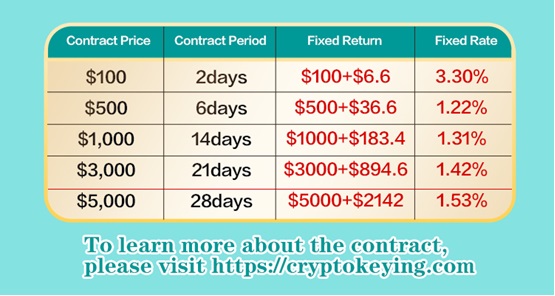
CryptoKeying Contracts: The contracts offered by CryptoKeying are not only simple but also diverse as they provide a variety of options to meet your investment needs. They provide stable, risk-free fixed income.

CryptoKeying Customized Cloud Mining Contracts: Explore Tailor-made Cloud Mining Options

Join the Lazy Way to Get Rich

As the cryptocurrency market continues to grow, CryptoKeying remains a pioneer in the industry, providing an easy path to profitability. Whether you are an experienced crypto enthusiast or a novice, CryptoKeying welcomes you to join the ranks of easy passive income.

Overall, CryptoKeying demonstrates the power of simplicity in the world of cryptocurrency. It emphasizes ease of use, security, and the potential for excess income every day, providing unique opportunities for beginners and experts. Join CryptoKeying now and embark on the easiest and most rewarding journey to online wealth.

In order to facilitate new and old users, CryptoKeying has launched the latest APP installation package. For more details, please visit the CryptoKeying official website: https://cryptokeying.com/

Netflix Faces Slower Subscriber Growth as Password Sharing Crackdown Shifts Focus to Ad Revenue

0
London, UK - August 01, 2018: The buttons of Spotify, Podcasts, Netflix, WhatsApp and Music on the screen of an iPhone.

Netflix, an American subscription video-on-demand streaming service, is expected to report its slowest subscriber growth in the last one and half years on Thursday, as the initial surge from its password-sharing crackdown begins to fade.

As part of a shakeup that began in mid-2022, Netflix has been blocking the previously widespread practice of sharing subscriber passwords with friends and family living in other households.

Since this implementation, Netflix has seen its subscriber and earnings growth accelerate in the last quarter, and has picked up nearly 55 million more paying customers, pushing its worldwide subscriber count to nearly 278 million through June this year.

Netflix added 8 million subscribers during the April-June period, marking a 37% increase over the same time last year. It was the sixth consecutive quarter, that Netflix’s subscriber gains have increased from the previous year.

The company’s profit in its latest quarter rose 44% from last year to $2.15 billion, or $4.88 per share, a figure that exceeded the estimates of analysts. Revenue climbed 17% from last year to $9.56 billion, also eclipsing analysts projections.

However, the company, subscribers gains from the password-sharing have begun to fade, prompting the company to sharpen its focus on selling more ads for its low-priced option, which the company said ended June with a 34% increase in total subscribers from March. It didn’t detail precisely how many of its worldwide subscribers have chosen to watch ads for the cheaper price.

Meanwhile, despite the widening audience for commercials, Netflix said it doesn’t expect advertising to be a major source of revenue growth until 2026 at the earliest. “Ads are going to be a bigger piece of the puzzle, but it won’t be in 2024 or 2025”, Spencer Neumann, Netflix’s chief financial officer, told analysts during a conference call.

As subscriber growth decelerates, Netflix is pivoting its focus to other key metrics, such as revenue growth and profit margins. Notably, the company plans to stop reporting subscriber data after 2025.

“Their focus is to continue growing subscribers at a healthy rate while also leveraging their scale to raise prices and boost advertising dollars,” said Pivotal Research analyst Jeff Wlodarczak.

Netflix’s ad-supported tier has shown growth, but the company has yet to disclose specific financial details. Analysts do not expect this tier to become a significant growth driver until 2026, raising concerns about the platform’s long-term trajectory. “They’re making less than a billion dollars a year on U.S. advertising, which doesn’t look impressive,” commented Ross Benes, an analyst at Marketer.

Some experts suggest that Netflix may need to raise prices and phase out more of its ad-free plans to steer customers toward its ad-supported tier, which tends to generate higher revenue per user. Notably, investors are now focusing on Netflix’s ability to leverage its advertising business for future growth.

The company, which operates in more than 190 countries, is expected to report ad revenue of $242.7 million in the third quarter, according to the average of estimates from three analysts compiled by LSEG. Overall revenue is expected to grow 14.3%, a slightly slower pace than the previous three months, to $9.76 billion.

Nigeria Can Use Purchase Agreement Framework To Revamp The Economy

1

Comment: “Commendable thought leadership on how you used the US postal service and Amtrak rail line to take a position that a government can actually subsidize, and lose money, and still achieve economic growth strategically. But what do you say about Nigeria’s excessive importation?”

My Response:  Thanks for the kind words. Yes, USPS has not made profit in more than two decades and the Amstrak line has not recorded a profit since 1971. The US government has not shut them down unlike how Nigeria took down NIPOST and Nigeria Railways. I am an apostle of efficient subsidies. Nigeria subsidized my university education and I think it was a great investment (lol).

On import, I do not think Nigeria imports a lot. So, I do not agree on that “excessive” importation mindset.  This is a TV pundit talking point with shallow understanding on critical enablers we need to rebuild Nigeria. And when we see the absolute size of the imports, we flip, triggering a mess in the FX regime. This has been happening for more than a decade in the nation.

Yes, the real focus should be “what are we importing?” and how we can use policies to change what we import and how we import. In Nigeria, for decades, we are not importing enough, and most especially, the little we import is the wrong category of imports. Unless we can discriminate at that category level at the policy level, we can put a policy that import is bad, and in the process stymie the ability of companies to actually import the right things.

Follow me: in 2022, South Korea’s total imports were $808.09 billion while Nigeria did about $60.35 billion for goods; South Korea is about 25% of Nigeria’s population. But if you check, South Korea imports were largely machinery, equipment, etc for production, while Nigeria’s were for finished goods. Also, in 2022, goods worth around $136.21 billion were imported into South Africa, with many of those industrial equipment. Check – more imports have not destroyed South Africa and South Korea’s currencies!

My position is this: if the economic team is afraid of subsidies, they should design a purchase agreement framework where the government commits to buy finished products from local companies. In other words, you can say, if you produce electric bulbs in Nigeria within a specified time, we commit to buy $500k worth. That will stimulate local capital formation as companies will use that document to look for capital knowing that a guaranteed customer is there. 

Once they supply to the government, the government resells to uptakers. Just like that  you can stimulate a virtuous circle, and depart from the scene, even as you increase tariff on imports of bulbs, and concurrently encourage purchase of equipment to make bulbs in Nigeria. Understand that under a purchase agreement regime, the government will not lose money to briefcase business people since it is only going to pay for finished products! This will stimulate the capital market, create local products and boost our balance of payment.

Wow – you may think. But that is what we are partially doing with Geregu Power and Transcorp Power and they are trillion Naira companies. They generate power and sell it to the government. You can do that in other sectors. Politically, no subsidies but the impact is the same. Nigeria must work!

Comment here

My ResponseI lived in Ovim and all the villages along Railway lines in Southeast were on average developing faster than others. Why? Many people used their markets because of access to transportation. People built houses, small hotels, etc around the railway station because some people, from far away areas with no railway, would have to sleep to catch the train early. The value of garri, yam, etc went up because buyers from Aba, Enugu, etc used the train to come and buy. When the station collapsed, many bad things happened because those opportunities froze.

If you are a government as the US does, someone could have modeled: we are losing $100k on this route on ticket, but this route is generating $1m economic activity. When VAT and all taxes are applied on that route, we are getting $150k. Route stays,

Since the railway and postal service collapsed, poverty has scaled in Nigeria’s rural areas because of a poor supply chain. The Ovim Oriendu Market has lost size as only the villagers attend it. The traders from Enugu, Aba, etc have stopped coming as there is no train to move the garri. My brother, I do not need an economist on this because my Raleigh bicycle was always on duty, moving bags of garri from the market to the train station. In short, every kid has a bike to move things: you could make small money doing that!