DD
MM
YYYY

PAGES

DD
MM
YYYY

spot_img

PAGES

Home Blog Page 2995

UN Announces $6 Million in Humanitarian Assistance to Borno, Nigerian Flood Victims

0

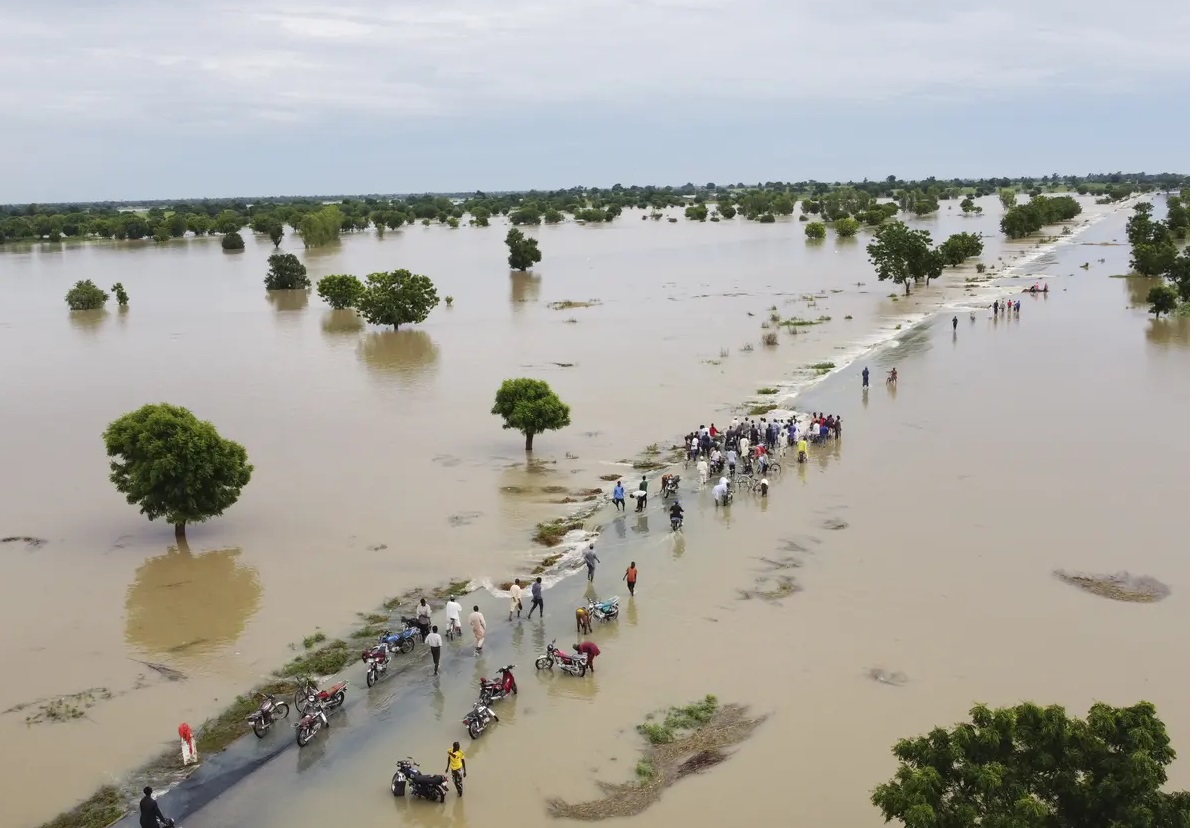
Mohammed Fall, the UN Humanitarian Coordinator in Nigeria, has announced that $6 million from the Nigeria Humanitarian Fund would be allocated to support flood victims in Borno State, as the humanitarian situation takes a critical turn.

The devastating flood was caused by the collapse of the Alau Dam, located just over 10 miles south of Maiduguri, the capital of Borno. The dam collapsed on September 10, 2024, killing at least 30 people and displacing nearly one million people, exacerbating the existing challenges faced by the region.

UN spokesperson Stephane Dujarric, in a press conference held on Monday in New York, shared details about the unfolding crisis and the joint mission to Maiduguri led by UN agencies, NGOs, and the Nigeria Red Cross Society. The mission was aimed at assessing the damage and coordinating relief efforts.

“We and our partners are providing them with hot meals, we are facilitating air drops of food in hard-to-reach areas cut off by floodwaters, and we are also trucking in water,” Dujarric said. “We are also providing water and sanitation hygiene services and water purification tablets to stem disease outbreaks. This is in addition to supplying hygiene and dignity kits to women and girls, as well as emergency health and shelter services.”

Dujarric further added that the UN Office of the Coordination of Humanitarian Affairs (OCHA) is working closely with donors to secure additional funding to ensure the continuous provision of aid.

The collapse of the dam and the resulting flood have had far-reaching consequences. More than 125,000 hectares of farmland have been damaged across Nigeria, and this happened just before the harvest season, at a time when 32 million people in the country are already facing severe food insecurity.

Emmanuel Bigenimana, head of the World Food Programme (WFP) office in Maiduguri, shared his firsthand experience, having conducted a rapid assessment of the damage.

“What I have seen is really heartbreaking,” he stated, describing submerged homes, schools, hospitals, and other essential infrastructure.

He highlighted that over 200,000 to 300,000 displaced people are overcrowded in several Internally Displaced Persons (IDP) camps and even on the streets.

The WFP confirmed that the dam collapse resulted in river water overrunning 50% of Maiduguri. In response, state authorities issued evacuation orders to residents in affected areas and appealed for international humanitarian support.

Bigenimana noted that WFP, in collaboration with local authorities and other partners, had managed to establish soup kitchens in three IDP camps: Teachers’ Village, Asheikh, and Yerwa. These kitchens aim to provide hot, nutritious meals to around 50,000 of the most affected children, women, and men who have lost their homes.

However, he stressed that the situation requires further assistance, noting, “This is really an additional burden to already existing crises. This region has been facing conflict for a decade.”

Borno state has been one of the regions most severely impacted by the Boko Haram insurgency. Although the conflict has been somewhat controlled, the recent flooding compounds pre-existing challenges. Bigenimana further elaborated on the difficulties the region faces, particularly in terms of rising food inflation and the skyrocketing prices that have worsened the food insecurity for millions in the region.

The WFP revealed that as of September 2024, some 800,000 people in 29 states across Nigeria have been affected by floods, while over 550,000 hectares of cropland have been inundated. Given that as of March 2024, 32 million Nigerians were already facing acute hunger, the current flooding presents an even greater challenge to the country’s food security.

The UN’s food agency estimates that $147.9 million is needed to support food-insecure people in Nigeria’s northeast over the coming six months. As for the flood-affected populations in Maiduguri, Bigenimana said, “recovery will take long.”

He concluded with a pressing call for more resources: “We need more resources to save lives and to put together efforts to respond to the crises – and also think of longer-term recovery and solutions.”

Heeding the call for help to boost the relief efforts, other players have also stepped in. The United Arab Emirates contributed five tonnes of food. Closer to home, business magnates Aliko Dangote and Abdulsamad Rabiu Dantata each pledged N1.5 billion in aid, while Senator Bala Mohammed donated N250 million. Former Vice President Atiku Abubakar and former Anambra State Governor Peter Obi also made contributions, with Atiku giving N100 million and Obi donating N50 million.

However, as the donations pour in, there are murmurs of doubt about whether the funds will reach the intended beneficiaries. In a country where corruption is systemic, the fear is that a significant portion of these donations will be siphoned off by unscrupulous middlemen, leaving those in desperate need with little to nothing. For the displaced in Maiduguri, who have already lost their homes and livelihoods, such theft would be another cruel blow.

Sui (SUI) Crosses $1; Kaspa (KAS) Launches KRC-20 Tokens – This New Hybrid Exchange Valued at $0.06 Captures Interest

0

Meta Description: Sui (SUI) targets $1.5 next, while Kaspa (KAS) launched KRC-20 tokens. DTX Exchange (DTX), a new hybrid exchange protocol, is priced at just $0.06.

The crypto market ended the week on a high note post-CPI, boosting sentiment and confidence. Sui (SUI), one of the top altcoins, crossed $1 amid a burst of momentum. In other news, Kaspa (KAS) rolled out its KRC-20 tokens, proving to be a bullish catalyst.

Also at the heart of the current market buzz is DTX Exchange (DTX), one of the latest new ICOs. The novel hybrid exchange protocol captures investors’ interest by combining the best elements of centralized and decentralized exchanges. By standing at the crossroads between TradFi and DeFi, it has been hailed as one of the best new cryptos to invest in.

DTX Exchange (DTX): A New Altcoin on Investors’ Radars

DTX Exchange (DTX), a new hybrid exchange protocol, stands out for several reasons. The crypto market has been buzzing given its blend of CEX and DEX—a shift from the norms. As it takes a different approach to trading and prepares to reshape the $10 billion global trading market, it is a new DeFi protocol to watch out for.

In just the third round of the ICO, over $2.6 million has been raised. Besides, it is heavily discounted and teeming with potential at its early stages, making it an investor favorite. A token costs only $0.06 and is tipped for a 55x jump after its debut. On its way to becoming one of this year’s breakout stars, investors have been betting on DTX ahead of Sui (SUI) and Kaspa (KAS).

Among its unique offerings, one distinguishing feature is its one-stop platform for all trading needs. Users can trade thousands of assets across TrardFi and Web3, including forex, stocks, equities and cryptocurrencies. By providing the best of both worlds, it is set for massive adoption.

Kaspa (KAS): KRC-20 Tokens Go Live

Kaspa (KAS), a proof-of-work (PoW) cryptocurrency that implements the GHOSTDAG protocol, is among the top crypto coins—a top 25. It plays a key role in the Layer-1 ecosystem, contributing to its rising demand and ascent. Talking about growth, KAS has been one of the year’s biggest highlights.

The Kaspa price increased over 200% on the yearly charts, making it one of the year’s best investments, outperforming the wider crypto market. Shorter time frames aren’t any different; there has been a 10% uptick in the past seven days in the Kaspa coin price.

Besides the overall market rally, the launch of KRC-20 tokens on the Kaspa protocol, which introduces smart contract functionality, can be linked to its upswing. In a viral post on X  by GHOSTDAG co-author, reposted by Kaspa, the KRC-20 launch on $KAS works great so far: “no reports of crashing nodes or anything like that.”

Sui (SUI): Eyes $1.5 Next

Sui (SUI), one of the top altcoins, also plays a key role in crypto. As a Layer-1 blockchain designed to be secure, powerful and scalable, it is among the most favorite destinations for developers and projects. Its performance in the past few weeks has been among the most explosive.

Reflecting bullish sentiment, the Sui token price surged over 15% on the weekly charts. This upswing extends to longer timeframes, up over 30% in the past month. The Sui (SUI) price trades over $1, with $1.5 the next key price level to watch out for.

With the new week starting strong, optimism can be barely contained. A weekly close above $1.3 is on the cards, as noted by top analysts. This will push it closer to its all-time high of $2.18, placing the Sui coin on the list of altcoins to watch out for.

Conclusion

As Sui (SUI) crosses $1 and targets the next resistance and Kaspa (KAS) launches KRC-20 tokens, DTX Exchange has become the latest DeFi protocol. Its combination of CEX and DEX, while offering the best of the worlds of DeFi and TradFi, makes it primed for massive adoption. To become an early adopter or investor, we suggest checking out the presale.

Learn more:

Buy Presale

Visit DTX Website

Join The DTX Community


African Analysis Gaps – Starlink (and phones).

0

Starlink (and phones)

I’ve seen a lot of articles hailing Starlink as a panacea for all Africa based communication links, and drama about it disrupting the business of companies like MTN. Here is why they are often wrong, or at least an incomplete perspective.

Starlink, as the name suggests, is a satellite service. Satellite services support long distance transfer of data of many different types, such as audio and video streams, phone calls, Enterprise CRM and ERP systems, interbank data, internet services, and App platform services.

Satellite is not the only solution for data transfer. Initially, it happened over old copper networks only used for phone calls. Modern networks include Fibre, and Terrestrial Microwave Radio.

Traditional satellites are high orbit. The journey from the ground to the satellite takes about 550 milliseconds (ms). This is a round trip of 1100 ms (up and back down again). This time is called the ‘latency’ (sometimes ‘ping time’).

Much content we access online are different even though they may appear to have similarities.

Remote Procedure Calls (RPCs)

RPCs are used by a device like a laptop or phone, to ask for remote content. If a streaming service is a single stream, the device asks once, and the stream is initiated. The ‘latency’ of the connection is hardly noticed.

Modern Websites and Social Media however, are not single content entities. What may appear as one block has many sections in it, and each must receive a request separately. Many RPCs must happen to call up what may appear to be one single piece of content. While 1100 ms may not seem like a lot of time, when the use of RPCs scale to call up complex content, the type of content matters. Using transport media with lower latency matters hugely with complex content.

Tier 1 providers (aka internet ‘mirrors’) and ‘silos’.

Tier 1 providers (aka internet ‘mirrors’) are at the top of the food chain for sourcing internet content. They are all over the world, with the U.S. having more of them than any other country. They maintain copies of the internet in real time.

They have a peer arrangement between each other.

  • They don’t pay to have their traffic delivered between them as they constantly update.
  • Their peering relationship provides internet downstream through other providers and eventually to individual users.
  • They peer on multiple continents. An RPC initiated by a device will pick the shortest route their providers service plan can offer.
  • There is no Tier 1 on the continent of Africa.

Examples: AT&T, Arelion, NTT, Verizon, Tata, Telestra, Colt, Deutsche Telekom, CenturyLink, GTT, Orange Open Transit and Zayo.

‘Silos’ are separate datacentre content reservoirs owned by large social media or other operators that have closed systems with a lot of content relative to their services. They include Meta, Amazon, Google, Apple, Microsoft, and X (fka Twitter).

An RPC initiated by a device will pick content held by a ‘silo’ at a regional location if it is the shortest route to getting it. There is some silo content at various locations on the African continent.

Connectivity types and what Starlink is:

Traditional Geostationary Satellites have a roundtrip latency of 1100 ms as said. Fibre is much faster, and from an ‘average’ African location will complete roundtrip service with the nearest Tier 1 in about 300 ms. Microwave Radios are often used for extension across terrain where fibre is not workable for a variety of reasons. It’s also often used as a last mile solution. Microwave Radio will add an extra 20-40 ms roundtrip to the solution.

Starlink is a LEO (Low Earth Orbit) satellite.

Starlink’s satellites orbit about 550km above Earth. With much less distance to cover when sending and receiving signals, the latency is drastically reduced.

Negative considerations of LEO:

One geostationary satellite can cover up to 1/3rd of the earths surface. This depends on the band frequency. Examples are Ku band, Ka band, C band and L band. LEO low height means the footprint is tiny, and many satellites are needed for global coverage. As of August 2024, there are 6,350 Starlink satellites in orbit, of which 6,290 are working. LEO satellites are ‘point to multipoint’ in a ‘mesh’ network. This means information packets can travel from a satellite to closest available one(s), in addition to travel across connections with the ground. Starlink calls these ‘Inter-Satellite Link’ (ISL).

With none of the Tier 1’s (think Internet Mirrors) in Africa, the latency would be still better than geostationary satellite doing multiple ISL hops, but nowhere near fibre. Starlinks ideal environment to scale adoption,  is where vast open spaces with no fibre exist, Tier 1’s are regionally available, and disposable income of citizenry is above global averages.

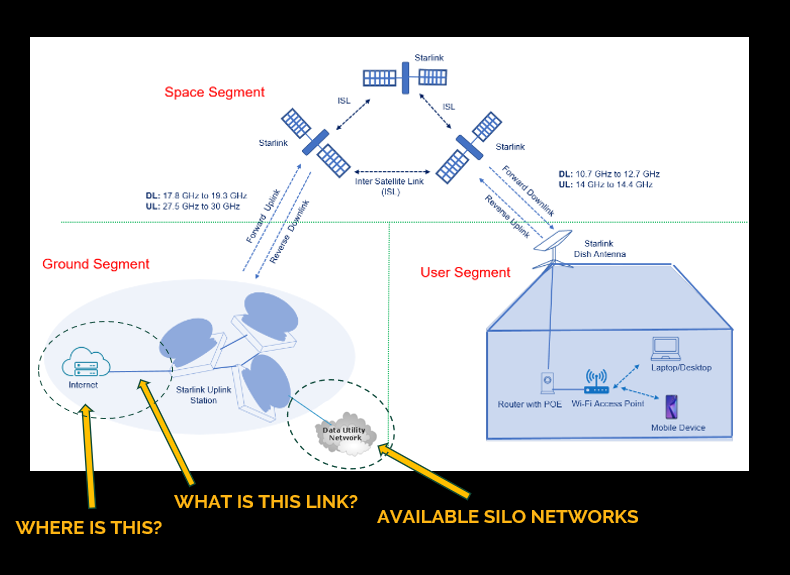
Generic Starlink Architecture – Segment Links

Securing BACKHAUL services from other data transport infrastructure owners.

In the generic architecture above, the Ground Segment is misleading. We have no idea what the link to the ‘internet’ is, and what is represented by the ‘internet’ cloud. In an African country, with no regional Tier 1, and variable access to ‘Silo Networks’ it’s unclear if performance will be anything like those broadly bantered about.

It’s quite possible in some climbs, the backhaul includes the same submarine cable services chosen by regional customer-end networks, and Telcos, and layering Starlink on top. When you examine that model, it can’t pay for Starlink.

Pricing seems to be focused on growth and market capture rather than profit.

Facing competition from Hughesnet and Viasat in one geography Starlink recently temporarily lowered its equipment prices from a steep $599 to $299. That’s lower than equipment costs from Hughesnet ($400 to $550) and essentially the same costs as equipment from Viasat ($300).

Equipment is proprietary.

I previously ‘owned’ a small project to refit an earth station at AUN (American University of Nigeria) in Yola. The project also needed to reposition the earth station, and provision it with a different (geostationary) satellite service provider. Starlink equipment will only work with Starlink. If the provider is changed the hardware is worthless. This would also be true of a phone service.

High Provision and maintenance cost.

While Starlink sattelites are relatively cheap, there are a lot of them there, and they cost a lot to launch. Being lower, they are subject to stratospheric and atmospheric elements. Having a very finite footprint, with thousands spread globally,  they can’t all be launched from a single ‘best balance’ launch point and moved into position.

Community Gateways 

Community Gateways are for large shared groups but they are a product alternative at the user segment end, and don’t mitigate where the other segments bring challenges for some climbs.

Starlink Community Gateway

Future Starlink Phones

Phones represent an alternative device solution at the User Segment end. They do not impact on the nature of the Space Segment or the Ground Segment in how they impact on both performance and cost of sales in different Geos.

If the service was in Lagos, it will either achieve ISL multi-hops or backhaul over submarine fibre – nearest Tier 1 for peering – Portugal. If the service was in Nairobi, it would either achieve ISL multi-hops or backhaul first over regional fibre backbone to Mombasa, and then over submarine fibre – nearest Tier 1 for peering – India.

Availability of Silo Networks may be different at both locations.

While the performance and cost of sales would be different, they are unlikely to offer users something better, unless again, they are focused on growth and market capture rather than profit.

Again if the provider is changed the phone is worthless. It cannot work as the way a handset using MTN can also be used for Airtel or Globacom.

A user in the US, Europe, Canada, Australia or India for example would have higher performance, and lower cost of sales, because a Tier 1 internet mirror would be located locally or regionally, within fibre backbone reach.

Other articles and posts about Starlink.  

Many third party articles appear from time to time brining their own technical opinion fused with those of technojournalists, and the Starlink site. Most of them fail to expose granular data on the Ground Segment, which can have a huge impact on performance, and cost of sales, and can massively vary from one location to another, most especially across different African geos.

This situation would work equally for phones as it would for premises services.

It’s important to understand any market prices kept artificially uniform by Starlink, cannot do so indefinitely and at some point will have to become a function of cost of sales.

No nitty gritty geo contrasts on ‘cost of sales’ appear in articles.

Parallels with Bouquet Content Services (example Multichoice DSTv) in Africa and Netflix

As an aside, articles comparing these similar services for the market, frequently focus only on the relationship between the cost of content to providers and the charge to users.

This is also an incomplete comparison. Why?

The cost of internet is metred in Africa and shows high variances. Though there are some exceptions there is a general trend for East Africa to be cheaper to source internet than the West.

A user with Netflix will additionally have to pay for internet, and may even have such poor bandwidth it severely impacts the user experience. Services like DSTv however have their own carrier media bundled in the subscription price. This is rarely highlighted in comparisons, and on the rare occasions it is, it lacks sufficient detail for the comparison to be valid.

Conclusion

Dig very deep on costs and comparisons. Ask for a trial if possible. Seek price continuity information on Starlink, and explore hardware buy-back options you may be able to persuade a vendor to undertake. Ensure you get full contractual terms agreed in writing.

Investor Activity in Africa Declines in H1 2024

0

According to a recent report from Africa: The Big Deal, investor activity in Africa has seen a significant decline this year. The report reveals that 5 investors have done at least a deal a month on average in H1 2024, not far from H1 2023 (7) but much behind H1 2022 (33).

Nearly 300 investors were involved in at least one deal worth $100,000 or more during H1 2024. This represents a 27% decrease from the same period in 2023, which saw around 400 investors, and is less than half the number of active investors in H1 2022, which reached approximately 700.

One notable trend is the decrease in repeat investments. In H1 2024, just under 18% of investors participated in more than $100k+ deals, a drop from previous years. In 2023 23%, in H1 2022 29%, and in H1 2021 25%. This suggests that investors are taking a more cautious approach amid changing market conditions.

However, despite the overall slowdown, a few firms have maintained strong activity in Africa. At the top of the list is Launch Africa, which signed a deal almost every other week during H1 2024. After a brief slowdown in 2023 due to the transition between their Seed Fund I and Seed Fund I1, launch Africa is back on track and is poised to surpass their 2023 total of 19 deals if they maintain their current pace.

Techstars followed as the second-most active investor in H1 2024, though its activity has notably slowed compared to last year. In 2023, the venture capital firm completed an impressive 56 deals- more than one per week on average. However, they only announced 9 deals in H1 2024, a significant drop from the 28 deals made in H1 2023. It remains to be seen whether they will match their previous performance by the end of the year.

Notably, three firms, 54 Collective (formerly Founders Factory Africa), Catalyst Fund, and Renew Capital each completed 7 deals in H1 2024. Both 54 Collective and Catalyst Fund are on track to meet their 2023 totals of 16 and 13 deals, respectively. Renew Capital has already outperformed its 2023 numbers, completing 7 deals in H1 2024 compared to 5 throughout last year. Meanwhile, two firms- DFC and Baobab Network completed 5 deals each in H1 2024, already surpassing their 2023 totals. Y Combinator, another active player in the African market, has also made progress and may match its 12 deals from 2023.

However, several venture capital firms that were highly active in 2023 have slowed their deal-making pace this year. Ventures Platform and Norrsken, both of which averaged more than a deal per month last year, completed fewer than 5 deals in H1 2024. Additionally, Flat6Labs and Loftylnc–both known for their previous serial investments- have been relatively quiet but are actively raising new funds, hinting at a potential resurgence in activity.

The decline in investor activity in Africa for H1 2024, is coming after August marked the lowest funding month of the year, despite a record-breaking $443 million raised in July.

As the African investment landscape continues to evolve, the second half of 2024 will be crucial in determining whether investor confidence and activity will rebound or if the cautious trend will persist across the continent. With some investors already outperforming their 2023 benchmarks, there may still be room for optimism in the African startup ecosystem.

Dow Jones Predictions for Q4 2024

0

As of September 2024, the Dow Jones has been navigating a complex economic landscape marked by several significant trends. In the early part of the year, the Dow Jones index saw considerable volatility, driven largely by a combination of geopolitical tensions, inflationary pressures, and the U.S. Federal Reserve’s monetary policy adjustments. After the Federal Reserve hiked interest rates to combat persistent inflation throughout 2022 and 2023, the Dow experienced short-term sell-offs as investors grappled with the rising cost of capital and its potential dampening effect on economic growth.

In recent months, however, the DJI has hovered around the 35,000 to 35,500 point range, reflecting investor optimism that the U.S. economy will be able to avoid a full-blown recession.

Several key factors are likely to influence the trajectory of the index in the coming months:

  1. Monetary Policy: The Federal Reserve’s interest rate policy will remain one of the most critical determinants for market movement. Investors are particularly keen on interpreting signals from Fed officials regarding potential rate cuts in 2024, which would likely boost the index.
  1. Corporate Earnings: As companies continue to report quarterly earnings, the strength of corporate profits will play a crucial role. With mixed results in different sectors, some analysts expect tech giants like Apple, Microsoft, and Google to continue driving the index upwards.
  1. Geopolitical Tensions: Global uncertainties, such as the war in Ukraine, China-U.S. relations, and the ongoing energy crisis in Europe, will also weigh on market sentiment and, most of all, its volatility.
  1. Consumer Sentiment and Spending: The U.S. economy is heavily reliant on consumer spending, so signs of a weakening consumer base could spell trouble for the Dow. Rising credit card debt, higher borrowing costs, and the potential for a cooling labour market are risk factors to watch closely.

Forecast for the Next Few Months

Analysts are cautiously optimistic about the Dow’s performance in the final quarter of 2024. Many predict that the index could maintain its current levels or even see modest gains if inflation continues to decline and the Federal Reserve signals an eventual pivot toward rate cuts. The consensus among market experts suggests that the Dow could finish the year in the 36,000–37,000 range if economic conditions remain stable and corporate earnings hold up.

However, the possibility of a mild recession still lingers, and any unexpected shocks — such as a sudden rise in oil prices or worsening geopolitical conflicts — could have a downward impact. Obviously, you might say…