DD
MM
YYYY

PAGES

DD
MM
YYYY

spot_img

PAGES

Home Blog Page 3

Meta, Microsoft Job Cuts Compound Tech Layoffs, Deepening Fears Over AI-induced Job Losses

0

A fresh wave of layoffs across major U.S. technology firms is reinforcing a shift that has been building for months: the same companies driving the artificial intelligence boom are now cutting thousands of jobs, accelerating concerns about long-term job security in the sector.

The latest announcements from Meta and Microsoft, alongside earlier reductions at Amazon, bring the scale of workforce cuts into sharper focus. Collectively, these firms are part of the so-called Magnificent Seven, whose dominance in global markets has been underpinned by aggressive investment in AI.

Yet that same investment cycle is now coinciding with a significant contraction in headcount. More than 92,000 tech workers have been laid off in 2026 alone, according to Layoffs.fyi, pushing total job losses in the sector since 2020 to nearly 900,000.

At Meta, the company plans to cut 10% of its workforce, around 8,000 jobs, while also eliminating 6,000 open roles. It said the move is “all part of our continued effort to run the company more efficiently and to allow us to offset the other investments we’re making.”

Microsoft confirmed it will offer voluntary buyouts to about 7% of its U.S. workforce, potentially affecting up to 8,750 employees. Amazon has already cut at least 30,000 roles since October, equivalent to roughly 10% of its corporate and technology staff.

These reductions form part of a broader recalibration across the largest technology firms, many of which are redirecting resources toward AI infrastructure. Alphabet, Microsoft, Meta, and Amazon are expected to spend close to $700 billion combined this year on data centers, chips, and software systems to support AI services.

The contrast is record capital expenditure alongside shrinking workforces.

Analysts believe the trend confirms that AI is not only creating new opportunities but also accelerating workforce restructuring among the industry’s most powerful players. The job cuts within the Magnificent Seven, in particular, are being closely watched because of their outsized influence on hiring trends, wages, and broader labor market sentiment in the technology sector.

Anthony Tuggle, an executive coach with experience in AI, described the shift as structural.

“This represents a fundamental structural shift rather than a temporary market correction,” he said. “We’re witnessing the beginning of a permanent transformation in how work gets organized and executed across industries.”

The underlying driver is efficiency. As AI systems become capable of handling coding, customer support, data analysis, and other routine tasks, companies are reassessing how much human labor is required to sustain growth. In many cases, the result is a leaner operating model.

The effects are already visible beyond core tech firms. Nike announced 1,400 layoffs, largely in its technology division, highlighting how AI-driven restructuring is spreading into other sectors. Chief operating officer Venkatesh Alagirisamy acknowledged the impact, telling employees: “These reductions are very hard for the teammates directly affected and for the teams around them, too.”

At the same time, companies are becoming more aggressive in managing workforce size. Daniel Zhao, chief economist at Glassdoor, said declining voluntary turnover is forcing employers to take direct action.

“Because natural attrition isn’t happening as much, companies are being more aggressive about pushing people out of the door,” he said. “Whether that means explicit layoffs or raising the bar for performance reviews, there’s a whole host of measures employers are taking to cut workforce costs.”

The anxiety among workers has been building since the launch of ChatGPT in 2022, which demonstrated the expanding capabilities of generative AI. It intensified as tools from firms such as Anthropic began performing tasks that previously required entire teams, raising questions about the future of many roles across software, operations, and support functions.

Data suggests the labor market is already diverging. A 2026 Motion Recruitment study found hiring is slowing for entry-level and general IT roles, while demand for specialized AI talent remains strong. Salaries have largely stagnated, with gains concentrated in high-skill areas such as machine learning engineering.

In some corners of the industry, the shift is producing a new operating model. Startups are scaling revenue with significantly smaller teams, aided by automation and AI tools. Venture investors report that companies can now reach tens of millions of dollars in revenue with a fraction of the workforce previously required, reshaping expectations around productivity and headcount.

The implications are broader than the technology sector alone. As large employers within the Magnificent Seven reduce hiring and cut roles, the ripple effects extend to suppliers, contractors, and adjacent industries that depend on tech-driven growth.

Glassdoor’s Employee Confidence Index reflects the change in sentiment. Confidence in the tech sector has fallen sharply, dropping 6.8 percentage points year-on-year to 47.2% in March — the steepest decline among major industries. Zhao said the shift is affecting worker behavior, with fewer employees willing to leave their jobs despite declining satisfaction.

“This is a bit of an unusual technological boom in which the people who are participating in it are feeling pretty anxious about what’s going on,” he said. “Many workers do feel stuck right now.”

For now, the trajectory shows the companies leading the AI boom are also leading a restructuring of the workforce, prioritizing efficiency and automation over headcount growth. The involvement of the Magnificent Seven, firms that set the tone for the global technology industry, is seen as an indication that the shift is not cyclical but foundational.

What remains uncertain is the pace at which new roles will emerge to offset the losses. While history suggests technological change eventually creates jobs, the current transition appears to be moving faster than the labor market’s ability to adapt, leaving a widening gap between displacement and opportunity.

Sanusi Questions Tinubu’s Borrowing Drive Despite Subsidy Removal as Nigeria’s Debt Nears N160tn, Debt Servicing Strains Public Finances

0

The Emir of Kano, Muhammadu Sanusi II, has intensified scrutiny of Nigeria’s fiscal direction, questioning why the federal government continues to accumulate debt despite removing fuel subsidies, a reform widely expected to ease pressure on public finances.

In a public address posted on social media, the former central bank governor restated his opposition to the subsidy regime, calling it unsustainable.

“I have always said the subsidy regime was unsustainable. We cannot continue supporting foreign refineries when we are an oil-producing country, keeping refineries open abroad while we’re not running our own,” he said.

Yet Sanusi’s central concern lies in what has followed the policy shift. “Secondly, the subsidy has been removed, but what is being done with the savings? We should be seeing fiscal consolidation. You cannot eliminate wastage and still continue borrowing,” he said. “People need to see the benefits. If subsidy payments have stopped and funds are available, why are we still borrowing repeatedly? What exactly are we borrowing for?”

His remarks come against the backdrop of a rapidly expanding debt profile under President Bola Tinubu. Nigeria’s total public debt stood at roughly N159 trillion (about $110 billion) as of December 2025, one of the highest levels in the country’s history. A significant portion of that accumulation has occurred during Tinubu’s tenure, driven by aggressive external borrowing, approval of multi-billion-dollar loan packages, and continued reliance on multilateral financing to plug budget deficits and fund infrastructure.

Within months, the administration has secured approvals for over $6 billion in fresh external borrowing, alongside a broader borrowing plan exceeding $20 billion. Additional World Bank loans, estimated at over $6 billion in the first 16 months of the administration, have further added to the debt stock. The latest request, a $516 million facility for the Sokoto–Badagry Superhighway, underscores the pace at which new obligations are being taken on.

The rising debt burden is increasingly intersecting with Nigeria’s weak revenue position. A substantial share of government income is now absorbed by debt servicing, leaving limited fiscal space for capital investment and social spending.

“It’s not enough to simply say subsidy was removed. When you get to a point where 100% of your revenue goes into debt servicing, you cannot continue. Where will the money come from?” Sanusi said.

That dynamic has become a central concern among economists. While subsidy removal was expected to reduce recurrent expenditure and free up resources, the anticipated fiscal relief has been diluted by continued borrowing and rising debt obligations. In effect, savings from subsidy reforms risk being offset by higher interest payments and debt repayments.

Sanusi also questioned the sequencing of reforms, warning that policy timing has compounded macroeconomic pressures.

“For me, removing subsidy or liberalizing exchange rates are good interventions. But were they done at the right time? That’s a key question,” he said.

He cautioned that implementing such measures in a loose monetary environment could destabilize the currency.

“However, if you remove subsidy and liberalize exchange rates in an environment of very loose monetary conditions, before tightening money supply, the naira can fall sharply,” he said.

Concerns over fiscal management extend to how borrowed funds are deployed. The federal government’s push to finance large-scale infrastructure projects, including the Sokoto–Badagry Superhighway and the Lagos-Calabar Coastal Highway, has drawn criticism over prioritization and transparency.

Economist Ndubisi Nwokoma described the borrowing strategy as “fiscal rascality,” arguing that existing infrastructure should take precedence.

“I recently travelled to the East, and the roads are in terrible condition. Why not focus on maintaining them? Even if we must borrow, Nigerians should see tangible improvements in major expressways. If that happens, people will not complain as much,” he told Daily Trust.

He warned that some projects risk becoming “white elephants,” adding, “Why not fix what we have before embarking on new roads? … There was no transparent tendering process. This points to fiscal recklessness.”

Procurement concerns have further amplified criticism. Both flagship road projects have been linked to Hitech Construction, part of the Chagoury Group, raising questions about competitive bidding and value for money, particularly when financed through debt.

Former Vice President Atiku Abubakar echoed those concerns, warning that borrowing without transparency could deepen fiscal vulnerabilities.

“At a time when Nigeria is already groaning under the weight of unsustainable debt, the resort to yet another foreign loan, without transparent terms, clear cost-benefit analysis, and a credible repayment framework, raises profound questions about prudence and accountability,” he said.

He added, “What Nigerians expect is not just ambitious projects, but responsible financing. Development must not become a euphemism for deepening debt traps that generations yet unborn will be forced to repay.”

Atiku also questioned the procurement process, warning against what he described as a pattern of insider contracting. He called on the National Assembly, led by Godswill Akpabio, to subject the loan request to rigorous scrutiny.

The broader economic picture reveals a structural imbalance. Nigeria’s revenue-to-GDP ratio remains among the lowest globally, limiting the government’s ability to fund expenditure without resorting to debt. At the same time, rising interest costs, both domestic and external, are increasing the burden of servicing existing obligations.

Sanusi pointed to the contradiction at the heart of current policy. “Today, we have a situation where we have a domestic refinery, we’re not importing petroleum products, and we’re even exporting to Europe. This is very good for the economy,” he said.

However, he maintained that such gains must translate into fiscal improvement, not continued borrowing.

The tension between reform and outcomes is becoming more pronounced. Subsidy removal and exchange rate liberalization were intended to stabilize the economy and restore investor confidence. So far, there are little or no visible improvements in fiscal discipline, infrastructure delivery, or cost of living. That has fueled public skepticism.

Bitcoin Eyes Breakout Above $80K as Institutional Inflows Fuel Momentum

0

Bitcoin has climbed more than 30% from its February lows and is pressing toward $80,000, turning sentiment sharply bullish across trading communities.

The crypto asset surged past the $79,000 zone, trading as high as $79,425 on Friday, amid bullish optimism.

Data from TradingView and CoinGlass confirms that at 14.3%, BTCUSD is on track for its best performance in nearly 18 months.

In what has been a remarkable turnaround through April, despite geopolitical and macroeconomic uncertainty, Bitcoin is now attempting to break above its multi-month trading range.

Recall that when Bitcoin was at February lows, most traders were loudly calling for further crashes. Now that resistance is being approached, the same crowd has turned bullish.

CoinGlass data shows that if the monthly close matches current levels, the crypto asset will seal its most bullish month since November 2024. Currently, this year’s April gains are marginally above those of 2025, when Bitcoin finished 14.1% higher.

Amid BTC bullish price action, data from CoinmarketCap reveals that the sentiment in cryptocurrency trading had slid back to neutral from extreme fear.

As Cointelegraph continues to report, Bitcoin bulls still face a ladder of resistance levels around the $80,000 mark. Traders see a lengthy battle to regain control, while the Bitcoin bear market, by historical standards, should still be far from over.

“BTC Has been in an up trend during April. But it is coming up to some important high timeframe levels. Especially above the $80K area is where the bulls would need to push through to turn this around on the high timeframe,” Trader Daan Crypto Trades summarized on Thursday.

Despite the rebound, crypto analysts continue to flag critical resistance zones. Bitcoin is now pressing against the upper end of its multi-month range, with $80,000 emerging as a decisive level for the next move.

“On the downside, the immediate supports are that ~$72,000 region and $65,000 below that,” he added.

However, the path to a new all-time high remains narrow. Persistent energy-driven inflation continues to threaten the timeline for Federal Reserve rate cuts in late 2026.

For bulls to maintain control, Bitcoin must convincingly break and hold the $80,000 threshold, otherwise, a rejection at this multi-month resistance could see the price drift back toward immediate support in the $72,000 region.

Notably,  data from SoSoValue, reveals that US-listed spot Bitcoin ETFs have extended their inflow streak to eight straight sessions, pulling in $223.21 million on Thursday alone and pushing the cumulative total to around $2.4 billion since April.

The latest run has already overtaken the previous seven-day streak in March, which brought in roughly $1.2 billion.

BlackRock’s iShares Bitcoin Trust (IBIT) has accounted for more than 73% of the latest inflows, drawing about $1.4 billion during the streak. The fund now holds 809,870 BTC, representing 62% of total assets under management across US spot Bitcoin ETFs.

Outlook

Bitcoin’s near-term direction will likely be defined by its interaction with the $80,000 resistance level. A decisive breakout and sustained hold above this threshold could open the door to a rally toward the $90,000 region and potentially new highs.

However, rejection at this level may reinforce the current range-bound structure, with price consolidating or retracing toward lower support zones.

Market sentiment, ETF flows, and macroeconomic developments will remain critical drivers in determining whether the current bullish momentum can evolve into a broader, sustained uptrend

China’s Robotaxi Push Accelerates as Geely’s Caocao Targets Global Fleet Amid Intense Competition

0

Caocao Inc, the mobility arm of Geely Holding Group, plans to deploy thousands of robotaxis globally from next year, intensifying competition in a market increasingly defined by autonomous vehicle ambitions, according to its chief executive.

Chief executive Gong Xin told Reuters at the Beijing auto show that the company is positioning itself for large-scale autonomous deployment across multiple regions, including Abu Dhabi, Hong Kong, and five mainland Chinese cities, beginning in 2027.

The expansion sets up a direct competitive track with Tesla, led by Elon Musk, which is also developing a purpose-built autonomous vehicle, the Cybercab. Both firms are converging on the same concept: dedicated robotaxi fleets designed from the ground up rather than modified consumer vehicles.

Caocao’s long-term roadmap is more explicit on scale. The company expects large-scale delivery of its Geely-built Eva Cab robotaxi in 2028, with fleet expansion reaching 100,000 vehicles by 2030. Gong said production, delivery, and deployment will be closely aligned, suggesting a compressed rollout cycle once regulatory and operational conditions are in place.

The Eva Cab is seen as a different design philosophy from most current autonomous test fleets. Unlike retrofitted passenger vehicles, it is purpose-built for ride-hailing, with a simplified cabin layout, reduced storage compartments, and no enclosed door pockets. The design aims to lower costs and improve durability while reducing passenger misuse and maintenance complexity.

Gong said the stripped-down configuration allows the vehicle to be priced below traditional private cars, although he did not disclose exact figures. The focus on cost control is central to Caocao’s approach, which treats robotaxis less as premium technology showcases and more as scalable transport infrastructure.

This contrasts with many existing robotaxi programmes, which rely on modified versions of mass-market vehicles. Those systems often face constraints in interior optimization, energy efficiency, and cost scaling, limiting their ability to reach high-volume deployment without significant redesign.

Caocao’s ambition is underpinned by its parent company’s industrial footprint. Backed by Geely, the company benefits from access to manufacturing capacity and global automotive supply chains, which executives argue will be critical in scaling autonomous fleets competitively.

Gong described the group’s positioning as a structural advantage in the emerging robotaxi market. He said Caocao is aligned with Geely’s international expansion strategy and suggested the company could emerge as one of only a few dominant players in China’s autonomous mobility sector by 2030.

The timeline indicates growing confidence in the commercial viability of driverless transport in China, where regulators have been more open to large-scale autonomous testing than many Western jurisdictions. However, the market is also becoming more crowded, with multiple automakers and tech firms accelerating their own programmes.

Xpeng is also advancing its robotaxi ambitions, with plans to produce hundreds to thousands of autonomous vehicles over the next 12 to 18 months, according to its president, Brian Gu. The company is expected to begin early deployments while still seeking operational partners for global expansion.

The parallel efforts by Caocao and Xpeng come amid a shift among Chinese automakers: a transition from vehicle manufacturing toward integrated mobility services. This evolution reflects both competitive pressure in China’s domestic EV market and the search for higher-margin, recurring revenue models. It also signals a broader global race that is increasingly converging on a shared endpoint. Both Chinese firms and U.S. competitors are now focusing on purpose-built autonomous vehicles rather than retrofitted platforms, suggesting the industry is moving into a second phase of robotaxi development.

On the U.S. side, Tesla’s Cybercab programme remains one of the most visible efforts, with Musk indicating that production will scale gradually before ramping up significantly. The company’s long-term goal is to deploy fully autonomous vehicles at scale, replacing human-driven ride-hailing networks with software-managed fleets.

The emergence of Caocao’s plan introduces a parallel trajectory with different structural advantages. While Tesla is building vertically integrated hardware-software systems, Chinese players like Caocao are leveraging established manufacturing ecosystems and state-backed industrial capacity to reduce costs and accelerate deployment timelines.

The competitive overlap is becoming clearer. Both sides are targeting similar use cases, urban mobility networks operating at high utilization rates with minimal human intervention, but are approaching them through different industrial models.

Investors and industry participants now face a market that is no longer speculative in concept but increasingly defined by execution timelines, regulatory readiness, and fleet economics.

Caocao’s announcement adds another layer to that race as it does not just signal entry into autonomous mobility, but an attempt to define one of its most critical variables: cost per kilometer at scale. Industry experts say that metric, more than technological capability alone, is likely to determine which players ultimately dominate the global robotaxi market.

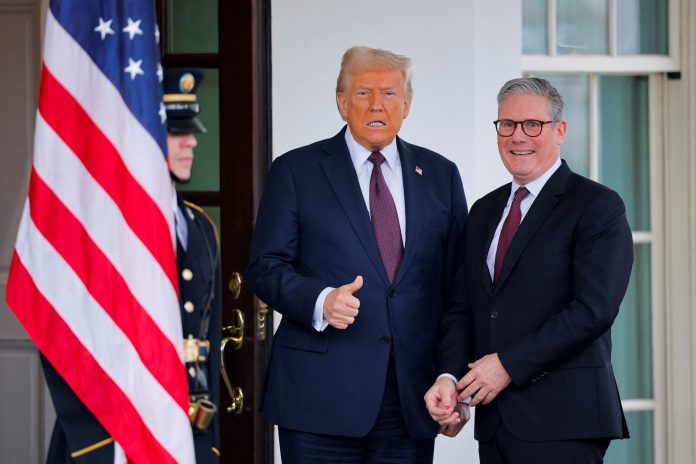
Trump Threatens Tariffs Over U.K. Digital Tax, Raising Fresh Risk of Transatlantic Trade Clash

0
CREATOR: gd-jpeg v1.0 (using IJG JPEG v80), quality = 82

U.S. President Donald Trump has escalated tensions with Britain, warning that Washington could impose sweeping tariffs if London refuses to scrap its digital services tax, a policy long viewed in the United States as disproportionately targeting American technology firms.

“If they don’t drop the tax, we’ll probably put a big tariff on the UK,” Trump said at a White House event, signaling a readiness to translate longstanding policy objections into direct trade retaliation.

The dispute centers on the United Kingdom’s 2% digital services tax, introduced in 2020 to capture revenue from large technology companies generating income from British users. The levy applies primarily to U.S.-based firms such as Apple, Alphabet, the parent of Google, and Meta, which dominate global digital advertising and platform ecosystems.

Washington’s opposition is rooted in both commercial and strategic concerns. U.S. policymakers believe that unilateral digital taxes discriminate against American firms, effectively exporting tax burdens onto companies that are central to U.S. economic strength and technological leadership. The Trump administration’s latest threat suggests a shift from diplomatic pressure toward coercive trade policy, using tariffs as leverage to force policy alignment.

Trump’s remarks come ahead of a planned visit by King Charles III, which the president indicated could help ease strains.

“I think the King could help repair the relationship,” Trump said, underscoring how economic disagreements are increasingly intersecting with high-level diplomacy.

At a structural level, the dispute exposes unresolved tensions in the global tax system. Digital companies can generate significant revenues in markets where they have limited physical presence, creating gaps in traditional tax frameworks. The U.K.’s levy was introduced as an interim solution while negotiations continue at multilateral levels to establish a coordinated approach to taxing multinational corporations.

However, progress on a global framework has been uneven, prompting countries to act independently. That fragmentation is precisely what Washington is seeking to prevent, arguing that a patchwork of national taxes risks creating overlapping obligations, higher compliance costs, and potential double taxation for firms operating across jurisdictions.

The threat of tariffs introduces a more immediate economic risk. The United States is one of the United Kingdom’s largest trading partners, and any escalation could affect a wide range of sectors beyond technology. While Trump did not specify targets, a broad-based tariff could hit British exports in areas such as automotive manufacturing, pharmaceuticals, and financial services, sectors deeply integrated into transatlantic trade flows.

For the U.K., the digital tax represents both a fiscal tool and a political signal. It is seen as a domestic pressure to ensure that large technology companies contribute more equitably to public finances, particularly as digital services play an increasingly central role in the economy. Rolling it back under external pressure could carry political costs, complicating negotiations.

The dispute has also added to a broader shift in trade policy under Trump, where tariffs are increasingly used as instruments of negotiation rather than purely protective measures. This approach raises the risk of retaliatory cycles, particularly if Britain responds with countermeasures or seeks to align with other jurisdictions pursuing similar taxes.

Markets are likely to view the situation through a wider lens of geopolitical risk. The combination of trade tensions, ongoing conflicts in the Middle East, and fragile global supply chains creates an environment where policy shocks can have amplified effects on investor sentiment and cross-border investment flows.

There is also a corporate dimension. Companies such as Apple, Alphabet, and Meta face growing regulatory and tax pressures across multiple jurisdictions, forcing them to navigate an increasingly complex global market. A tariff escalation tied to digital taxation would add a fresh challenge, potentially affecting pricing strategies, investment decisions, and market access.

However, the path forward remains uncertain as diplomatic engagement could still produce a compromise, particularly if broader international tax negotiations regain momentum. Alternatively, the dispute could harden into a test case for how far the United States is willing to go in defending its technology sector through trade policy.