DD
MM
YYYY

PAGES

DD
MM
YYYY

spot_img

PAGES

Home Blog Page 3

Next Tekedia Capital Portfolio Business Update – Feb 28, 2026

0

Hello,
Greetings. Our next portfolio business update is scheduled as follows:
Date: Saturday, Feb 28, 2026
Time: 4-6pm WAT
Zoom link will be sent later.

If you are not in the WhatsApp Group, please read this note published here for context ahead of the session. Note that you can schedule anytime with the provided Zoom for update; no need to wait for the Group scheduled session.

Tekedia Team


Best Crypto to Buy Now: Ripple (XRP), Cardano (ADA), Ethereum (ETH) Bulls Buy New Coin Under $0.0025 Before a $1 Run

0

As markets swell with optimism, seasoned bulls are looking at three stalwarts, Ripple (XRP), Cardano (ADA), and Ethereum (ETH), as solid anchors.  But beyond the blue-chips, an emerging presale star, Little Pepe (LILPEPE), is capturing attention for its parabolic potential. With a current presale price of just $0.0022, LILPEPE is being framed by some as the meme-powered underdog that could run toward $1, and bulls are not shy about calling it their moonshot bet.

Ripple (XRP): The Regulatory Milestone and Payments Powerhouse

Ripple’s native token, XRP, has entered a new chapter. In a landmark change, legal battle with U.S. regulators over high fees has ended with Ripple paying a fine of $125 million, which has wiped out one of its biggest overhangs. This resolution prepares the way for new institutional trust and a more obvious mainstream way. When paired with the growing sentiment around tokenization, especially in real-world assets, XRP could become a deep liquidity rail for global finance. Analysts from Standard Chartered have even projected it reaching $5 by 2025, citing both payment use-cases and a strategic push into tokenized finance. On the technical front, some 6-month outlooks place XRP’s bullish target in the $3.20–$4.00 zone, driven by ETF speculation, institutional inflows, and favorable macro trends.  Taken together, XRP’s recent regulatory clarity, real-world utility, and bullish price forecasts make it a strong contender for the next leg up.

Cardano (ADA): PoS Sustainability Meets Long-Term Vision

Bulls still have an interest in Cardano because of its slow, research-oriented strategy. Its PoS consensus is energy-efficient by design and scales in a manner that is sustainable to adopt Web3. Academic rigor combined with peer-reviewed developmental model Layer 1 competition provides an interesting alternative to more rapid, yet less rigorous ecosystems. Although the gains of Cardano in the short term are not as epic as those of meme coins, its long-term runaway is substantial. ADA is starting to be framed as the base standard of a decentralized application, governance, and real-life solutions. For investors who believe in measured, principled growth rather than speculative mania, ADA remains a favorite.

Ethereum (ETH): Programmability and Institutional Reawakening

Ethereum is the foundation of innovation in smart contracts. It is used to run most DeFi, NFTs, and decentralized applications, and its discourse is supported with institutional inertia. In 2025, ETH surpassed its 2021 all-time high, with a market cap approaching $600 billion, a clear sign that capital is returning in force.  Beyond price action, Ethereum’s ecosystem benefits from research on scalability. New models for parallel transaction execution are being explored, which could dramatically increase throughput and lower costs. For bulls, ETH stands as the programmable backplane for Web3, powerful, battle-tested, and primed for the next wave of global adoption.

Little Pepe (LILPEPE): The Sub-$0.0025 Underdog with Meme Energy and Utility

While XRP, ADA, and ETH anchor the core, speculative bulls are zeroing in on a different kind of bet: Little Pepe. Currently in stage 13 of its presale, LILPEPE is priced at $0.0022 and has reportedly raised over $27.5 million so far. The presale has been blazing, with more than 16.7 billion tokens sold.  What makes LILPEPE stand out is not just its cheap entry, but its foundation: rather than being a purely speculative meme token, it is built on its own EVM-compatible Layer 2 blockchain designed for high throughput and near-zero trading fees.  Presale mechanics amplify the bullish case. Since Stage 12 sold out early at $0.0021, Stage 13’s $0.0022 price already reflects strong demand. With a confirmed listing price of $0.003, early buyers are eyeing a 30% return even before secondary trading begins. Given the rapid adoption, the community-driven launch structure, and the meme-native utility, many bulls believe LILPEPE could orbit far beyond its initial valuation.

Conclusion

For those who believe this bull market is not just about speculative noise but a return to serious infrastructure plays, combining these assets could capture both reliability and upside.  Little Pepe, in particular, represents an asymmetric bet: a low-cost presale entry with high-leverage potential, underpinned by a technical roadmap and community energy.

For more information about Little Pepe (LILPEPE) visit the links below:

Website: https://littlepepe.com 

Whitepaper: https://littlepepe.com/whitepaper.pdf

Telegram: https://t.me/littlepepetoken

Twitter/X: https://x.com/littlepepetoken

$777k Giveaway: https://littlepepe.com/777k-giveaway/

Cramer Warns Oracle Could Become the Brake on Big Tech’s AI Spending Spree as Wall Street Loses Patience

0

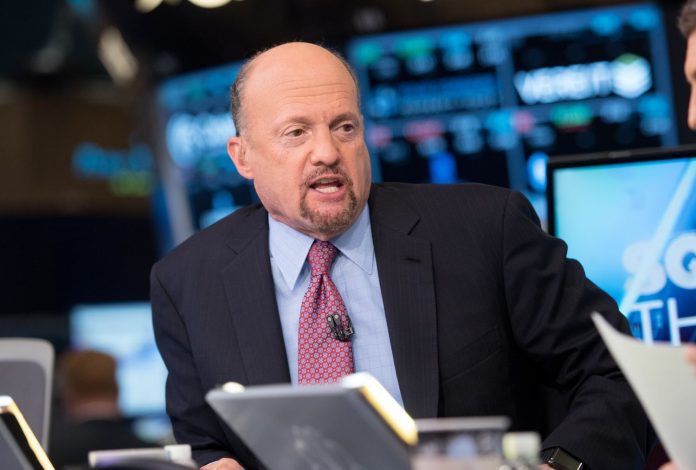
CNBC’s Jim Cramer on Tuesday argued that Oracle may be nearing a financial and market-imposed limit in the artificial intelligence arms race, positioning the software giant as a potential catalyst for a broader slowdown in hyperscalers’ spending.

His comments come as Oracle’s stock and credit profile have become focal points for growing investor unease about whether today’s AI investments can realistically pay for themselves.

Cramer said Oracle’s balance sheet is now under sharper scrutiny after the company committed to an unprecedented expansion of its data center footprint to support AI workloads, particularly for OpenAI. While Oracle has leaned heavily into AI infrastructure as a growth engine, Wall Street’s reaction suggests investors are increasingly concerned about leverage, execution risk, and the long wait before returns materialize.

“Oracle already has a huge amount of debt. Their balance sheet’s not that good,” Cramer said on CNBC. “At some point, they’ll heed the warning of the bond market and slow things down. These data centers cost a fortune and even the best builders stumble. Oracle can’t risk blowing up its balance sheet for Sam Altman.”

Those warnings intensified after Oracle’s recent earnings report, which, like Broadcom’s, showed strong demand for AI services but failed to reassure investors about financing and profitability. Oracle beat earnings expectations but missed on revenue, and management offered limited clarity on how it plans to fund its rapidly expanding AI commitments without further stretching its balance sheet.

Since early September, Oracle’s stock has been under sustained pressure, losing nearly half its value from a peak triggered by optimism over a massive AI backlog. Over just a few trading days last week, the shares fell sharply again, reflecting a broader reassessment of AI-linked infrastructure stocks. Investors who once rewarded aggressive expansion are now questioning whether the pace of spending has outstripped realistic cash flow generation.

The pressure is not confined to equities. Oracle’s growing reliance on debt markets has amplified concerns. The company recently issued $18 billion in bonds, a move that drew intense scrutiny from credit investors. According to Cramer, demand for credit default swaps tied to Oracle surged after the issuance, a signal that bondholders are increasingly hedging against the risk that the company’s leverage could become problematic if AI economics disappoint.

Oracle has also disclosed massive long-term obligations tied to its cloud and data center strategy. As of late November, the company reported hundreds of billions of dollars in lease commitments for data centers and cloud capacity, many stretching 15 to 19 years into the future. That scale of fixed obligation has unsettled investors at a time when pricing, utilization rates, and long-term demand for AI services remain uncertain.

Cramer argued that Oracle’s position makes it the weakest link in what he described as a spending standoff among five major players: Amazon, Microsoft, Google, Meta, and OpenAI, which relies heavily on Oracle as a core infrastructure partner. These companies, he said, are locked in a race to outspend one another, building data centers wherever power and land are available, while trying to prevent rivals from encroaching on their core businesses.

“This reckless, imprudent data center spending has crushed these stocks,” Cramer said, adding that OpenAI’s spending posture is particularly aggressive.

He described the ChatGPT maker as venture-funded and unusually willing to absorb losses in pursuit of scale, committing more than $300 billion over five years to Oracle’s technology alone, with total commitments across partners approaching $1.4 trillion.

In that context, Oracle’s market performance has become a warning sign. Equity investors have punished the stock, while credit markets are demanding higher compensation for risk. Cramer suggested that if Oracle responds by slowing its AI buildout, it could give other hyperscalers political and financial cover to do the same.

“If Oracle pumps the brakes on spending, competitors could follow suit and see their stocks climb,” he said, arguing that restraint could ease fears of runaway capital expenditure and restore confidence in valuations.

He also said a slowdown would force OpenAI to prioritize its ambitions rather than trying to dominate every segment of the AI economy simultaneously.

“This way Oracle stays alive, and OpenAI is forced to choose which businesses it truly wants to target,” Cramer said. “Because he who defends everything defends nothing.”

Oracle’s recent market performance has become emblematic of a broader shift in sentiment for Wall Street. The AI trade is no longer being judged solely on growth narratives and demand projections. Investors are now focused on debt levels, long-term obligations, and the credibility of returns.

Shares of Broadcom, CoreWeave, and Oracle Tank Following Wall Street AI Infrastructure Selloff

0

In a corner of the artificial intelligence market that once seemed immune to doubt, investor sentiment has shifted sharply, exposing growing anxiety about whether the vast sums being poured into AI infrastructure will generate commensurate returns.

Broadcom, CoreWeave, and Oracle — three companies central to the global AI buildout — extended their recent selloff on Monday, deepening losses from last week. The declines have come even as all three firms continue to post strong year-to-date gains, underscoring that the market’s unease is not about the relevance of AI, but about the sustainability of its economics.

The recent weakness reflects a broader reassessment underway on Wall Street. After years of enthusiasm driven by explosive demand for computing power, chips, and data centers, investors are increasingly focused on balance sheets, profit margins, and funding risks. The question now being asked is less about growth and more about how long companies can keep spending at this pace before returns begin to materially justify the investment.

“It definitely requires the ROI to be there to keep funding this AI investment,” Matt Witheiler, head of late-stage growth at Wellington Management, said on CNBC’s “Money Movers” on Monday. He added that, based on what he has seen so far, “that ROI is there.”

Witheiler also outlined the optimistic case still underpinning much of the sector.

“Every single AI company on the planet is saying if you give me more compute I can make more revenue,” he said, a sentiment that has fueled unprecedented capital expenditure across the technology industry.

Yet the market’s reaction to recent earnings suggests that patience may be wearing thin. Both Broadcom and Oracle reported quarterly results last week that beat revenue expectations and reinforced the message that demand for AI-related products and services remains strong. Investors, however, focused less on top-line growth and more on the cost of delivering it.

Oracle’s situation has drawn particular scrutiny. The company has become increasingly reliant on debt markets to finance its aggressive expansion in cloud and data center infrastructure. Management said capital expenditure in the current fiscal year will rise to $50 billion, up from a previous forecast of $35 billion, following new long-term contracts with customers, including Meta and Nvidia.

At the same time, Oracle’s lease obligations have ballooned. As of Nov. 30, the company disclosed $248 billion in lease commitments related to data centers and cloud capacity, with terms stretching between 15 and 19 years. That figure represents a 148% increase from the end of August, highlighting the scale and speed of its expansion. Investors have been left searching for more clarity on how those commitments will be financed and what they mean for future cash flows.

Broadcom’s challenges are rooted less in leverage and more in profitability. Chief executive Hock Tan said AI chip sales are expected to double this quarter from a year earlier to $8.2 billion, driven by demand for both custom AI accelerators and networking semiconductors used in large-scale data centers.

However, producing complete AI server systems requires significant upfront spending. Broadcom’s chief financial officer, Kirsten Spears, cautioned investors that “gross margins will be lower” for certain AI chip systems as the company ramps up production and absorbs higher component costs. That warning reinforced concerns that earnings growth may lag revenue growth in the near term.

The market reaction has been unforgiving. Broadcom shares fell 5.6% on Monday after tumbling 11% on Friday, leaving the stock roughly 18% below the record high it reached just days earlier. Oracle slid another 2.7% on Monday and is now down 17% over the past three trading sessions. The stock has lost about 46% of its value since Sept. 10, when it surged after the company disclosed a massive AI backlog.

Concerns about leverage have further intensified the selloff. Venture capitalist Tomasz Tunguz, founder of Theory Ventures, wrote in a blog post on Monday that Oracle’s recent fundraising has pushed its debt-to-equity ratio to about 500%, a level far above those of its major cloud rivals. He noted that Amazon, Microsoft, Meta, and Google all maintain ratios between 7% and 23%.

CoreWeave, a cloud infrastructure provider built largely around Nvidia’s graphics processing units, is also under pressure. Tunguz pointed out that CoreWeave’s debt-to-equity ratio stands at roughly 120%, making it one of the most highly leveraged players in the AI infrastructure space.

CoreWeave’s stock performance reflects that unease. Shares fell about 8% on Monday after dropping 11% last week, and the company has now lost more than 60% of its value since peaking in June. The decline has occurred even as demand for GPU-powered cloud services remains strong, highlighting how sensitive investors have become to capital intensity and financial risk.

Taken together, the latest market moves suggest the AI trade is entering a more demanding phase. Enthusiasm for the technology itself remains intact, but the tolerance for mounting debt, margin compression, and open-ended spending is fading.

For companies racing to build the backbone of the AI economy, the challenge is no longer just scaling faster than competitors, but proving convincingly that the scale will eventually translate into durable profits.

Thank You For Year 2025 – Ndubuisi Ekekwe

0

As we close the chapter of 2025, I want to thank you for making this feed super-amazing. My prayer for you, your families and your friends, is that 2026 brings abundance in every dimension. Like the baobab tree, may your abundance be vast and unconstrained in health, in wealth, and in wisdom. May the works of your hands be blessed.

This has been my prayer since my early days in secondary school: Oh Lord, as you send your angels to bless men and women, our hands are always lifted up to be noticed, not because we merit anything, but because Your grace has qualified us.  When were done in the Scripture Union, we would affirm: “The next praise will be better, because new songs will be discovered.”

In 2026, you will discover new songs. My name is Ndu-bu-isi-uwa [life is first in all things in the universe] and I pray that you will experience life in abundance. As you reflect on 2025, identify areas for growth and renewal.

Let us enter 2026 with the crisp energy of the harmattan (or winter), unlocking new vistas in our careers, our businesses, and our personal economies.

In our business, the year 2025 has been our best year ever. And in 2026, we will launch a new company that will employ about 100 people in Nigeria, unlocking massive opportunities while fixing critical market frictions. We will share here for those who would like to join in our journey via jobs once our license is out. I look ahead with deep optimism because Nigeria’s greatest companies have not yet been founded, and the promise of what lies ahead remains vast.

From Oriendu Market Ovim to the banking halls of Victoria Island Lagos, those who dream and take actions will always win the future. Take action with a journey into 2026. And make it a journey into abundance.

  • Udo diri unu.
  • Salama alaykum.
  • Alaafia fun yin.
  • Gracias infinita.

I wish everyone who encounters this message an amazing 2026 ahead. You have all made me better, and for that, I am deeply grateful. Thank you for making this feed amazing.