DD
MM
YYYY

PAGES

DD
MM
YYYY

spot_img

PAGES

Home Blog Page 3

DeepSnitch AI Bonus: Hong Kong Announces Stablecoin Licenses Amid Crypto Downturn As SOL Hovers Around $100 While DeepSnitch AI Attracts ADA Whales With Impressive 300x Bonus Offers

0

Hong Kong is taking a decisive step toward regulated digital assets as the Hong Kong Monetary Authority (HKMA) prepares to issue its first stablecoin issuer licenses in March, according to a Reuters report.

The announcement arrives during a turbulent period for the crypto market, where declining prices and uncertainty have pushed major assets like Solana below the $100 mark, intensifying investor caution.

Despite this, attention is shifting toward high upside opportunities positioned ahead of the next cycle. One project gaining traction is DeepSnitch AI, whose DeepSnitch AI bonus structure and early-stage incentives are attracting Cardano whales.

With the Deepsnitch AI presale bonus explained clearly, the platform is emerging as a standout narrative amid today’s shifting crypto landscape.

Hong Kong moves closer to approving its first regulated stablecoin issuers

Hong Kong’s financial regulator is nearing a major milestone in its digital asset framework, as the Hong Kong Monetary Authority (HKMA) prepares to issue its first stablecoin-related licenses as early as March.

Speaking during a Legislative Council session, HKMA Chief Executive Eddie Yue indicated that the authority’s evaluation process for stablecoin applicants is close to completion. He noted that the initial rollout will be highly selective, with only a limited number of licenses expected to be granted in the first phase.

DeepSnitch AI bonus: Traders rush to DeepSnitch AI for attractive bonus offers amid crypto bear market

As crypto markets grind through uncertainty, traders are moving toward tools that actually work in real time. That shift explains why DeepSnitch AI is seeing a surge in attention right now. While most projects are stalled by volatility, DeepSnitch AI is already live and offering an impressive bonus structure that has attracted traders and investors alike.

This growing urgency around its bonus is one of the factors driving interest in the DeepSnitch AI bonus narrative as the presale enters its final stretch.

DeepSnitch AI is a live intelligence platform built specifically for traders who need clarity during chaos. Instead of speculation or future promises, it offers immediate utility through a single dashboard that connects four active AI agents: SnitchFeed, SnitchScan, SnitchGPT, and AuditSnitch.

One of these agents, SnitchFeed, continuously scans on-chain activity and social momentum to reveal real-time alerts when attention, dominance, or behavior shifts across tokens. Rather than chasing noise or reacting late, traders see signals forming as they happen, turning market confusion into actionable insight.

DeepSnitch AI is currently in the 4th stage of its presale, priced at $0.03830, already up by 150%  from its initial $0.01510 entry point, showing the growing demand around the project.

While the project has briefly delayed its launch, it has only strengthened the position of users. Instead of rushing a public release, holders retain exclusive access while the system continues to mature,  creating access, learning, and enjoying DSNT allocation perks that cannot be replicated later.

Solana investors grow concerned as SOL hovers around $100

Solana’s native token has recently felt more pressure than momentum. In the week from January 27 to February 2, 2026, SOL slid from about $122.34 to approximately $103.05, marking a decline of roughly 15% as it trades near the critical psychological $100 level.

Adding to the unease, blockchain chartist Alicharts identified that if SOL fails to hold around current levels, the next meaningful support zone could be near $63, suggesting thinner bids under the market and more downside risk if selling accelerates.

ADA whales unimpressed as Cardano sees 15% weekly drop

ADA has struggled to find a footing this week, sliding roughly 15% between January 27 and February 2, 2026. ADA opened the period near $0.346 and is now trading around $0.293. Despite occasional surges in recent sessions, the overall tone of the asset has been bearish.
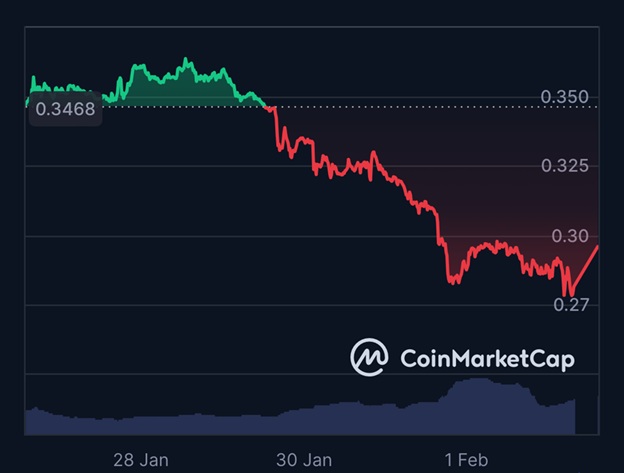
Interestingly, while price action looks weak, on-chain data shows significant whale accumulation even amid the pullback, large holders have been adding tens of millions of ADA to their positions as the price dips, a behavior that some analysts interpret as strategic accumulation rather than panic selling.

Conclusion

While the broader crypto market wrestles with volatility, traders are increasingly gravitating toward projects that already deliver value. This is where the DeepSnitch AI bonus continues to stand out. With live tools, a working dashboard, and a presale still in progress, DeepSnitch AI offers early buyer benefits that go beyond speculation.

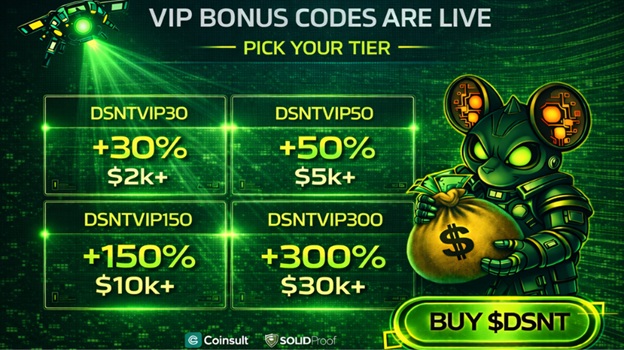
While timing remains everything in crypto, the DeepSnitch AI bonus structure amplifies that advantage. At the current price of $0.03755, a $5,000 purchase delivers roughly 133,000 DSNT tokens but applying a 50% bonus increases that allocation to about 200,000 DSNT.

This is why the DeepSnitch AI bonus conversation keeps coming up among traders looking for huge growth

Visit the official website for priority access and check out X and Telegram for their latest community updates.
FAQs

What token is being coined as the next big crypto in 2026?

Several analysts are watching AI driven utility tokens closely, and DeepSnitch AI is increasingly mentioned due to its live products and early stage pricing.

Is the DeepSnitch AI bonus window still open?

Yes, the DeepSnitch AI bonus window remains available during the current presale stage, allowing early participants to secure additional DSNT tokens before launch.

Can investors benefit from the DeepSnitch AI bonus offers?

Investors can benefit significantly from the DeepSnitch AI bonus by increasing their token allocation at the current presale prices. The project enables buyers to gain more DSNT upfront, which can dramatically improve long term returns if the project performs as expected after launch.


Bitcoin Stages Modest Rebound After Weekend Tumble Below $80K, Erasing $200B in Value

0

Bitcoin, the world’s leading cryptocurrency, clawed back modest gains on Monday, February 2, 2026, trading around $77,926 at 8:37 a.m. ET—up about 1% on the day per CoinMetrics data—following a sharp weekend plunge that saw it dip below $80,000 for the first time since April 2025.

The asset bottomed at $74,876 amid thin liquidity, capping a 12% weekly decline that wiped over $200 billion from its market capitalization, according to CoinMarketCap figures. The sell-off, which accelerated over the weekend, aligned with a broader risk-off wave sweeping global markets, as noted by Dessislava Ianeva, research analyst at crypto exchange Nexo.

She told CNBC the drawdown was “amplified by structurally thin weekend liquidity, rather than by crypto-specific developments or signs of fundamental stress,” pointing to correlations with traditional risk assets. U.S. stocks tumbled Friday, dragged by a 10% drop in Microsoft shares after disappointing earnings, with negativity spilling into European and Asian indexes on Monday.

Precious metals extended their historic rout, with silver suffering a 30% plunge Friday—its worst day since March 1980—and gold deepening losses amid expectations of sustained or higher interest rates. This safe-haven breakdown, coupled with Bitcoin’s sensitivity to macro shifts, exacerbated the decline.

Yuya Hasegawa, analyst at Japanese crypto firm Bitbank, attributed the move to “rising geopolitical risk, a decline in tech equities triggered by Microsoft, and a breakdown in precious metals—one of the few remaining safe-haven outlets for investor capital in recent weeks.” Forced liquidations played a pivotal role in the cascade. CoinGlass data revealed over $2 billion in Bitcoin long and short positions liquidated since Thursday, with total crypto liquidations hitting $2.56 billion on Saturday—the 10th-largest single-day event on record.

These automatic sales, triggered when leveraged positions hit price thresholds, amplified downward pressure in volatile markets. The nomination of Kevin Warsh as Federal Reserve chair by President Donald Trump added to the uncertainty. Warsh’s hawkish stance—emphasizing monetary discipline and a smaller Fed balance sheet—has been interpreted as bearish for risk assets, including crypto, potentially delaying rate cuts and strengthening the dollar.

While Bitcoin has sometimes been positioned as an inflation hedge or “digital gold,” its 22% drop over the past year underscores its vulnerability during volatility. Investor sentiment has cooled markedly. CoinShares reported $1.73 billion in outflows from digital asset investment products for the week ended January 30—the second consecutive week of heavy redemptions—pushing year-to-date outflows to $1 billion.

James Butterfill, head of research at CoinShares, described this as “a marked deterioration in investor sentiment towards the asset class,” citing waning rate-cut expectations, negative price momentum, and disappointment over crypto’s exclusion from the “debasement trade.” Other major cryptocurrencies mirrored the downturn, with Ether and XRP posting losses after multi-day sell-offs. The broader crypto market cap contracted by about 10% over the week, reflecting synchronized pressure.

Analysts offer varied outlooks on Bitcoin’s trajectory. Hasegawa suggested a “short-term bottom” may be approaching around $70,000, a key psychological and technical level; a sustained break below could signal deeper resets. Technical indicators show Bitcoin decisively below its 100-week simple moving average around $85,000, confirming seller control after two months of support, with the next major zone at $75,000—where buyers intervened in April 2025.

More bearish views include John Blank, chief equity strategist at Zacks Investment Research, who warned on CNBC’s “Squawk Box Europe” that Bitcoin could slide to $40,000 in 2026. Blank based this on historical cycle patterns, noting past “crypto winters” featured 70% to 80% drawdowns from peaks. From Bitcoin’s all-time high of $126,000 in October 2025, $40,000 would represent a roughly 70% plunge, potentially unfolding “very quickly or more likely over the next six to eight months.”

On-chain metrics provide some counterbalance. Despite the price weakness, 335,000 new Bitcoin wallets were created during the dip, signaling rising adoption and potential accumulation by fresh buyers. Quantitative models suggest Bitcoin is 35% undervalued relative to its 15-year trend, with projections for rebounds to $113,000 by mid-2026 and beyond $160,000 by early 2027.

The episode highlights Bitcoin’s maturation as an asset class, increasingly intertwined with macro narratives like Fed policy and equity trends. As liquidity returns post-weekend and key U.S. labor data looms, including JOLTS and ADP reports, Bitcoin’s ability to hold above $75,000 will be crucial in determining whether this correction deepens or reverses.

Currently, the market’s fragility amid thin trading and cascading liquidations is telling of crypto’s volatility, even as long-term adoption metrics trend positive.

Dangote Major Subsidiaries Deepen Gas Ties with NNPC as Nigeria Bets on Execution to Unlock Industrial Growth

0

Three major subsidiaries of the Dangote Group have moved to strengthen long-term gas supply arrangements with units of the Nigerian National Petroleum Company Ltd, marking how central gas has become to Nigeria’s industrial and energy transition ambitions.

The agreements, disclosed at the launch of the Nigeria Gas Master Plan 2026 in Abuja on Friday, involve the Dangote Petroleum Refinery, Dangote Fertilizer Plant and Dangote Cement Plc. On the supply side are Nigerian Gas Marketing Limited and NNPC Gas Infrastructure Company, both subsidiaries of NNPC Ltd. While the exact volumes covered by the contracts were not made public, officials described the deals as critical to supporting Dangote’s expansion plans across refining, petrochemicals, fertilizer production, and cement manufacturing.

The move comes when Nigeria is seeking to reposition natural gas as the backbone of its industrialization drive, while also using it as a transition fuel in the shift away from heavier, more polluting hydrocarbons. The Dangote–NNPC agreements sit squarely within that policy direction, linking the country’s largest industrial conglomerate with its national oil company at a moment when government rhetoric is shifting from ambition to delivery.

Speaking at the event, the Minister of State for Petroleum Resources (Gas), Rt. Hon. Ekperikpe Ekpo framed the Gas Master Plan 2026 as a turning point. He said the launch marked a move away from repeated policy articulation toward an execution-focused framework designed to translate Nigeria’s vast gas reserves into tangible economic outcomes.

Ekpo stressed that Nigeria’s challenge has never been the size of its gas endowment, but the ability to convert that potential into sustained industrial output, infrastructure development, and jobs. His remarks echoed a long-standing frustration within the sector: despite decades of gas discovery, domestic utilization has lagged due to weak infrastructure, inconsistent pricing frameworks, and limited offtake certainty.

NNPC Ltd Group Chief Executive Officer, Bashir Bayo Ojulari, placed the Dangote agreements within the broader objectives of the new plan. He said the Gas Master Plan is designed not only to meet, but to exceed, the presidential mandate of raising national gas production to 10 billion cubic feet per day by 2027 and 12 billion cubic feet per day by 2030. Achieving those targets, he added, is expected to catalyze more than $60 billion in new investments across the oil and gas value chain by the end of the decade.

For Dangote Group, reliable gas supply is more than an energy issue; it is a core input for its business model. Gas powers the massive 650,000 barrels-per-day Dangote Refinery, feeds the fertilizer plant that has positioned Nigeria as a net exporter of urea, and supports cement production across multiple plants. Securing stronger contracts with NNPC units reduces exposure to supply disruptions, price volatility, and infrastructure bottlenecks, all of which have historically undermined large-scale industrial operations in Nigeria.

The agreements also highlight the strategic role of NNPC’s gas subsidiaries as the government attempts to build a more integrated domestic gas market. Nigerian Gas Marketing Limited plays a key role in commercializing gas supply, while NNPC Gas Infrastructure Company is central to pipeline development and network expansion. Their involvement suggests an effort to align supply, transportation, and industrial demand under a more coordinated framework.

The backdrop to these deals is the evolution of Nigeria’s gas policy itself. The Nigeria Gas Master Plan was first introduced in 2008 as a blueprint to stimulate domestic gas utilization and reduce the dominance of crude oil in the economy. Over time, however, shifting market dynamics, persistent infrastructure gaps, and regulatory uncertainty limited its impact. The passage of the Petroleum Industry Act and the launch of the Decade of Gas Initiative reshaped the sector’s operating environment, making a revised and more practical framework necessary.

Under the updated plan, national gas output is expected to rise from about 8 billion cubic feet per day currently to 10 billion cubic feet per day by 2027 and 12 billion cubic feet per day by 2030. Officials say the focus is not only on production, but also on expanding processing facilities, pipelines, and distribution networks to ensure gas can be delivered reliably to industrial users such as Dangote.

Recent policy steps are meant to reinforce this push. In December 2025, Nigeria launched its first online gas trading, clearing, and settlement platform, designed to improve transparency, efficiency, and price discovery in the domestic gas market. Regulators argue that such mechanisms are essential if large contracts, including those signed by Dangote, are to contribute meaningfully to national supply growth rather than remain isolated bilateral arrangements.

Data from the Nigerian Upstream Petroleum Regulatory Commission show that total gas production in 2025 stood at about 2.71 trillion standard cubic feet, highlighting both progress and the scale of the challenge ahead. Moving from current output levels to the ambitious targets set in the Gas Master Plan will require sustained investment, policy consistency, and the resolution of long-standing infrastructure constraints.

In that sense, the Dangote–NNPC gas contracts are both symbolic and practical. They signal confidence from the country’s largest private industrial player in Nigeria’s gas agenda, while also testing whether the new emphasis on execution can finally close the gap between policy intent and industrial reality. If the agreements translate into steady supply, expanded capacity, and measurable economic spillovers, they could become a template for how gas is used to anchor Nigeria’s long-promised industrial transformation.

Alibaba Raises the Stakes in China’s AI Battle With 3 Billion Yuan Lunar New Year Campaign Push

0

Alibaba has escalated competition in China’s fast-heating artificial intelligence market, pledging 3 billion yuan ($431 million) to drive user adoption of its Qwen AI app during the Lunar New Year holiday, a period long regarded as the country’s most intense digital marketing battleground.

The spending commitment, announced on Monday, dwarfs similar efforts by rivals Tencent and Baidu and is set to begin on February 6. Alibaba said the campaign will roll out incentives tied to dining, drinks, entertainment, and leisure, with what it described as “large red envelopes distributed continuously,” signaling a broad-based push to embed its AI product into everyday consumer activity during the festive period.

The move comes just weeks after Tencent and Baidu disclosed their own Lunar New Year campaigns. Tencent said it would spend 1 billion yuan promoting its Yuanbao chatbot app, while Baidu committed 500 million yuan to attract users to its AI services. Alibaba’s pledge is three times Tencent’s and six times Baidu’s, underscoring how aggressively China’s tech giants are now competing for early dominance in consumer-facing AI.

Lunar New Year has historically been a decisive moment for user acquisition in China’s digital economy. Hundreds of millions of people travel home, spend extended time with family and friends, and increase online consumption, making the holiday a prime window for apps seeking mass adoption. Tech firms have repeatedly used the period to lock in users who often remain loyal long after the festivities end.

The most striking precedent dates back to 2015, when Tencent turned its WeChat messaging app into a viral distribution channel for digital red envelopes, a modern twist on a traditional Lunar New Year gift. That campaign helped WeChat Pay rapidly close the gap with, and eventually challenge, Alipay’s dominance in mobile payments, reshaping China’s financial technology landscape. Industry observers now see echoes of that moment in the current AI race.

This year’s public holiday, which begins on February 15 and runs for nine days, is longer than in most previous years, giving companies a wider window to engage users. Alibaba’s strategy appears designed to take full advantage of that extended break, although the company did not clarify whether its incentives would be distributed as cash red envelopes or as discount coupons redeemable across its sprawling ecosystem, including Taobao and other consumer platforms.

Tencent, by contrast, has provided more detail about its approach. Its Yuanbao campaign, which starts on Sunday, requires users to upgrade to the latest version of the app to claim digital red envelopes. These rewards can be withdrawn directly into WeChat wallets, and users are encouraged to share links with others, earning additional cash incentives in the process. The mechanics closely mirror earlier viral payment campaigns that proved effective in driving rapid adoption.

The surge in promotional spending reflects how quickly competition in China’s AI sector has intensified. The launch of DeepSeek’s R1 model in January last year rattled global AI markets and acted as a catalyst for faster adoption and sharper rivalry at home. Since then, Chinese firms have accelerated product releases, model upgrades, and consumer outreach in a bid to avoid being left behind in what is increasingly seen as a winner-takes-most market.

Alibaba’s heavy investment in Qwen during such a critical period suggests it views consumer mindshare as just as important as technical capability. While Chinese tech companies have made significant progress in developing large language models, the battle is now shifting toward distribution, daily use cases, and ecosystem integration, areas where cash incentives can quickly tilt the balance.

The race is not limited to the three biggest players. Several other Chinese AI firms have been rolling out upgrades ahead of the holiday. DeepSeek, whose earlier model sharpened competitive pressures across the industry, is expected to release its next-generation V4 model in mid-February, according to a report by The Information. The new version is said to feature stronger coding capabilities, raising the stakes further for incumbents trying to retain developer and enterprise interest alongside consumer users.

The Lunar New Year campaigns highlight a familiar pattern in China’s tech sector – when a strategic technology reaches an inflection point, competition quickly spills into massive marketing spend, platform incentives, and ecosystem plays. Alibaba’s 3 billion yuan bet signals that the company sees the current AI moment as one of those defining junctures, where early user capture could shape market leadership for years to come.

Purch Endorsed by Jeremy Allaire Via X Post Leading to Exponential Growth

0

Circle, the company behind the USDC stablecoin, has effectively endorsed a new AI-driven payments project called Purch through a post from its co-founder and CEO, Jeremy Allaire.

Purch is designed as a payments interface that enables AI agents to autonomously purchase real-world goods online—such as from Amazon or other e-commerce platforms—using USDC for settlement.

The system works by having AI agents send natural language requests to Purch, which then searches over 1 billion product listings, curates matches, handles checkout, and arranges physical delivery to the agent’s owner without requiring KYC.

The project integrates with platforms like Moltbook (a social network for AI agents) and OpenClaw, allowing agent-to-agent transactions for tasks like searching, selecting, paying, and delivering items. This ties into broader trends in decentralized AI and crypto payments, where USDC provides stable, on-chain settlement for automated commerce.

Following Allaire’s post on X highlighting the feature, Purch’s associated Solana-based token, $PURCH launched via Pump.fun, experienced a rapid surge. It reportedly peaked at around $11M to $18M in market cap due to the legitimacy boost from Circle’s involvement, before retracing sharply by about 75% amid volatility typical of memecoin-style launches.

As of recent discussions, the token’s market cap has stabilized around $6M, with concerns raised about team control over 50-60% of the supply potentially enabling dumps. The token offers utility like early access to the platform requiring 1M $PURCH holdings, roughly $8K, lower fees, and cashback on purchases, flights, hotels, and other services.

This event highlights how established players like Circle are bridging traditional finance with AI agent economies, but it also underscores the risks in speculative tokens—high initial hype often leads to corrections. The project’s dev has enterprise experience from SAP and IBM, and the official Purch X account lists the token contract address, adding some credibility.

However, as with any crypto project, thorough due diligence is essential, especially given the supply concentration and lack of long-term locks on team tokens. The Purch ($PURCH) token and its associated AI payments interface represent an early, speculative example of the broader shift toward agentic commerce—where autonomous AI agents handle discovery, selection, payment, and delivery of real-world goods and services.

The project’s brief surge to around $18-19M market cap peaking near $19M before retracing sharply to ~$7-7.5M as of early February 2026 after Circle CEO Jeremy Allaire’s endorsement, followed by a ~75% pullback, illustrates several key implications across technology, crypto markets, finance, and society.

Circle’s indirect spotlight via Allaire highlighting Purch’s use of USDC for no-KYC, agent-driven e-commerce purchases from platforms like Amazon and Shopify underscores growing institutional interest in bridging AI autonomy with stablecoins.

USDC serves as a low-volatility, programmable settlement layer for machine-to-machine or agent-to-human transactions—ideal for avoiding crypto price swings in practical use cases like automated shopping.

This aligns with 2025-2026 trends: protocols like x402 (Coinbase-led for crypto web payments), Google’s Agent Payments Protocol (AP2), OpenAI/Stripe’s Agentic Commerce Protocol, and Mastercard/Visa’s agentic token systems are enabling AI agents to transact securely.

Purch combines these with Solana’s speed and USDC to enable real-world delivery without traditional fraud-prone rails. As AI agents proliferate via platforms like Moltbook or OpenClaw, stablecoins like USDC could become the default “money” for an emerging machine economy—agents paying for compute, energy, services, or goods autonomously.

Circle’s 2026 roadmap emphasizes expanding USDC adoption through infrastructure like Circle Payments Network (CPN) and Arc blockchain, potentially accelerating such integrations. The rapid hype-to-correction cycle is classic for Solana-based tokens launched via Pump.fun: Endorsement pump ? Allaire’s post provided legitimacy, driving FOMO and a short-term 10x+ move.

75% drop reflects profit-taking, concentrated supply (team reportedly controls significant portions without long locks), and volatility in low-liquidity memecoin-style projects. Current stats show ~$7M FDV/market cap proxy, high 24h volume ($28M+ at peaks), but thin liquidity.

Highlights risks in “narrative tokens” tied to AI/crypto intersections—hype from credible figures can create explosive but unsustainable gains. Utility features offer some stickiness, but concentrated control raises dump concerns. Always DYOR; these remain high-risk speculative assets.

By 2026, forecasts suggest AI agents could drive 25%+ of e-commerce ~$10-12T annually by 2030. Purch is an early crypto-native experiment, but traditional players (Visa Intelligent Commerce, Mastercard Agent Pay, Google AP2) are rolling out similar systems with fiat rails, tokenization for security, and consent-based mandates.

Crypto’s edge: feeless/fast settlement via Solana/USDC for micro/agent transactions. Friction reduction in digital economy ? No-KYC, instant USDC checkout for 1B+ products lowers barriers for AI-driven purchases, potentially enabling new models like autonomous supply chains, robot economies, or agent labor markets.

As agents gain spending power, issues like verifiable consent, fraud prevention, chargeback resistance, and compliance grow. Stablecoin frameworks support this, but concentration in few issuers like Circle raises centralization concerns. Many “AI agent” projects face hype inflation, exploits or faked demos.

Purch competes with established protocols and fiat-backed agent systems; long-term success depends on actual adoption beyond token speculation. If AI agents become primary shoppers/payers, it reshapes consumer control, privacy, and jobs in commerce/logistics.

The Purch episode is a microcosm of 2026’s converging trends: AI autonomy meets programmable money, fueled by stablecoins like USDC. While the token’s pump-and-dump highlights crypto’s speculative nature, the underlying tech points to real disruption in payments and e-commerce—where agents could soon act as independent economic actors.

This space evolves rapidly; watch Circle’s infrastructure pushes and protocol wars for the next catalysts. NFA—thorough research essential.