Shares of Dutch semiconductor equipment giant ASML fell on Tuesday after reports that a Chinese company has begun manufacturing a key chipmaking tool that the company has long dominated, fueling concerns that Beijing is making meaningful progress toward semiconductor self-sufficiency.
The stock declined 1.8% as part of a broader sell-off in global chip stocks, although ASML shares remain up more than 123% this year, reflecting continued investor optimism over surging artificial intelligence-driven semiconductor demand.
The decline followed a report by The Information that an unnamed Chinese company has started producing immersion deep ultraviolet (DUV) lithography machines, with the first systems expected to be delivered this year to major domestic chipmakers including Semiconductor Manufacturing International Corporation and ChangXin Memory Technologies.
The report comes as China accelerates efforts to reduce its dependence on Western semiconductor technology in response to increasingly stringent U.S.-led export restrictions. While the development marks an important milestone for China’s domestic chip industry, industry analysts who spoke to CNBC caution that it is unlikely to threaten ASML’s technological leadership in the foreseeable future.
“This should be taken with a pinch of salt because what China is producing is likely limited to the lower end of the market,” Stephane Houri, Head of Equity Research at ODDO BHF, told CNBC.
A Milestone for China
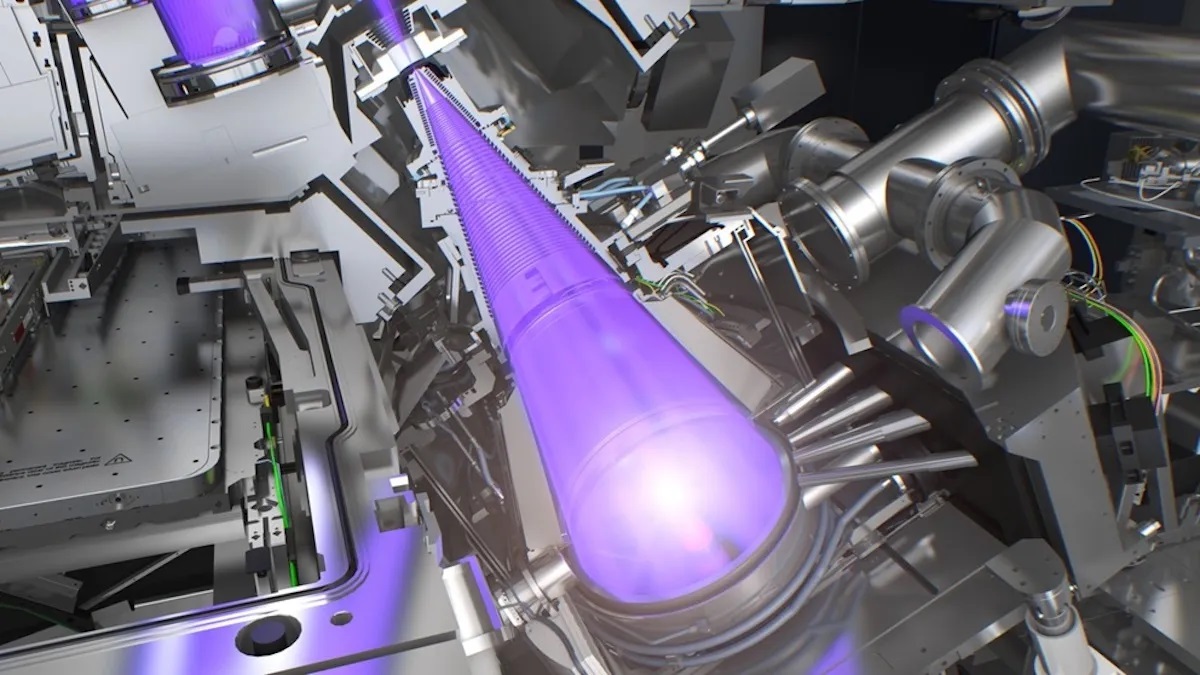
Immersion DUV lithography systems are among the most sophisticated manufacturing tools required to produce advanced semiconductors. They project intricate circuit patterns onto silicon wafers. They are widely used to manufacture mature and mid-range chips deployed in automobiles, industrial equipment, consumer electronics and many AI-related components.
Although DUV technology remains essential, it is not the most advanced lithography platform available.
For cutting-edge processors powering artificial intelligence applications, premium smartphones and high-performance computing systems, manufacturers rely on extreme ultraviolet (EUV) lithography, a technology in which ASML remains the world’s only commercial supplier.
That distinction is critical.
While China may now be capable of producing certain DUV systems domestically, analysts say replicating ASML’s EUV technology remains vastly more challenging and is unlikely to happen anytime soon.
However, industry experts stress that merely producing a functioning lithography machine is only the first step.
The more important metric is manufacturing yield, or the percentage of usable chips produced during fabrication. Even small differences in yield can determine whether a semiconductor factory operates profitably.
“They need to get to at least yield parity, not just have a working tool,” Nick Patience, AI Lead at Futurum Group, told CNBC.
Current yields at Chinese foundries already trail global leaders such as Taiwan Semiconductor Manufacturing Company, even when using imported ASML equipment. Machines developed by an inexperienced domestic supplier will likely require years of refinement before achieving comparable levels of reliability, uptime and production efficiency.
Patience noted that reliability is built through years of deployment across multiple fabrication plants, giving ASML a significant advantage that cannot easily be replicated.
Scaling Production Remains Another Major Hurdle
Even if China’s first-generation DUV systems prove functional, manufacturing them at commercial scale presents another challenge. According to The Information, the Chinese manufacturer plans to build only five machines this year and approximately 20 units in 2027.
By comparison, ASML expects to manufacture around 130 immersion DUV systems in 2026 and plans to increase production capacity by another 30% in 2027.
Analysts at SemiAnalysis note that production scale, ecosystem support and long-term servicing capabilities remain among ASML’s strongest competitive advantages.
“Tool performance, scaling production of the machine itself, fleet performance, surrounding ecosystem and poor economics against fully depreciated ASML machines all stack up against China DUV,” the research firm said.
Servicing hundreds of machines worldwide, ensuring software updates, supplying replacement parts and maintaining consistent performance over many years represent barriers that extend well beyond building an initial prototype.
Limited Financial Impact on ASML
The market reaction may also overstate the commercial implications for ASML. China accounted for 14% of ASML’s €6.6 billion in second-quarter system sales, equivalent to roughly €924 million.
However, analysts note that export controls already prevent ASML from selling many of its most advanced immersion DUV systems to Chinese customers. As a result, domestically produced Chinese equipment would largely replace sales ASML is already prohibited from making rather than eroding existing revenue.
“A tool ASML cannot legally or physically supply being built locally does not subtract from a sold-out order book,” SemiAnalysis said.
Demand outside China also remains exceptionally strong, driven by the global AI infrastructure boom, with major foundries continuing to expand capacity using ASML’s equipment.
Paul Triolo, a partner at DGA Albright Stonebridge Group, said producing a handful of domestic machines is fundamentally different from competing with ASML globally.
“Providing a small number of even minimally capable DUV machines domestically is one thing. Supporting a global fleet that would provide real competition for ASML is quite another,” he said.
EUV Remains China’s Biggest Technological Challenge
The latest development has also renewed speculation about whether China could eventually develop an indigenous EUV lithography system. Reuters reported last year that China had completed a working EUV prototype, but analysts caution that commercial success remains a far more difficult objective.
ASML spent roughly two decades developing EUV technology and invested around $10 billion in research and development alongside strategic partners including Intel Corporation, Taiwan Semiconductor Manufacturing Company and Samsung Electronics before the technology became commercially viable. Beyond generating EUV light, the technology depends on ultra-precise mirrors, complex optics, sophisticated software and an extensive global supplier ecosystem that took decades to establish.
While some advances in DUV engineering may contribute to future EUV development, analysts say the technological leap remains enormous.
“Some breakthroughs in DUV immersion lithography are applicable to more advanced EUV technologies, but many are not. EUV light source and optics technology are much more advanced and complex,” Triolo said.
Houri echoed that assessment.
“I think EUV is out of reach. Never say never, especially with the Chinese, but it’s a completely different technology.”
Talking long-term, the emergence of a domestic Chinese DUV supplier nevertheless represents another step in Beijing’s long-term strategy to localize critical semiconductor technologies amid escalating geopolitical tensions and tightening export controls.
Success is expected to reduce reliance on foreign suppliers for mature-node manufacturing and strengthen the resilience of its semiconductor supply chain. For ASML, however, the immediate competitive threat appears limited. The company’s technological leadership, manufacturing scale, service network and monopoly in EUV lithography continue to create formidable barriers to entry.
While China’s progress deserves close attention, analysts broadly agree that producing a limited number of domestic DUV machines is far from displacing the Dutch company at the forefront of global semiconductor manufacturing equipment.