DD
MM
YYYY

PAGES

DD
MM
YYYY

spot_img

PAGES

Home Blog Page 30

US Shifts Stance on North Korea, Signaling Openness to Talks with Kim Jong Un

0
North Korean leader Kim Jong Un and his daughter Kim Ju Ae visit the Ministry of National Defense on the occasion of the 76th anniversary of the founding of the Korean People's Army in Pyongyang, North Korea in this picture released on February 9, 2024 by the Korean Central News Agency. KCNA via REUTERS

The Trump administration released its updated global security roadmap, a key policy document outlining national defense priorities for the coming years.

Notably absent from this document is any explicit reference to the “complete, verifiable, and irreversible denuclearization” (CVID) of North Korea—a cornerstone of US policy toward Pyongyang since the 2018 Singapore summit between Donald Trump and Kim Jong Un.

This omission has sparked widespread speculation that Washington is deprioritizing the long-stalled denuclearization goal in favor of pragmatic diplomacy, potentially paving the way for renewed high-level talks as early as 2026.

During Trump’s first term (2017–2021), the US pursued an aggressive “maximum pressure” campaign, combining sanctions, military exercises with South Korea, and personal diplomacy with Kim.

The three Trump-Kim summits produced vague commitments to denuclearization but collapsed over demands for sanctions relief versus verifiable steps from North Korea. The Biden administration maintained CVID as the baseline but saw no progress, with North Korea conducting over 100 missile tests since 2022, advancing its ICBM and submarine-launched capabilities.

The New Roadmap

Released amid escalating US-China tensions and Russia’s deepened ties with North Korea including arms transfers for Ukraine war support, the document emphasizes threats from China, Iran, and non-state actors while redirecting focus to “extended deterrence” alliances with allies like South Korea and Japan.

North Korea’s nuclear program—now estimated to include 50–60 warheads and missiles capable of reaching the US mainland—is not addressed, marking a departure from the 2017 National Security Strategy, which labeled it a “second-tier” existential threat.

Both the US and South Korean governments quickly clarified on December 8 that no formal policy shift has occurred and denuclearization “remains the ultimate goal.” However, analysts interpret the silence as deliberate, reflecting Trump’s personal affinity for Kim and a desire to avoid provoking Pyongyang while testing waters for “peaceful coexistence” without preconditions.

Hong Min, a senior researcher at South Korea’s Korea Institute for National Unification, described it as a “conscious intent” to revive dialogue by sidelining the divisive CVID demand. Trump’s Hints at Renewed TalksTrump has long touted his “special relationship” with Kim, once claiming they “fell in love” over letters exchanged post-2019.

In recent months, he’s amplified signals of openness :September 2025 Overture from Kim: During a Supreme People’s Assembly speech, Kim Jong Un explicitly invited talks, stating: “If the US drops its hollow obsession with denuclearization and wants to pursue peaceful coexistence… there is no reason for us not to sit down.”

He added fond personal memories of Trump, contrasting this with rejection of dialogue with South Korea, which he views as a “foreign enemy.” Trump’s Response interviews and social media posts since his January 2025 inauguration, Trump has echoed this, saying he’s “proactive” about meeting Kim again “to get something done” and floated ideas like economic incentives without tying them to disarmament.

At the October 2025 APEC summit in South Korea, Trump reportedly raised North Korea in side talks with Xi Jinping, though no breakthroughs emerged. SSome analysts ramed it as a pragmatic win for de-escalation, while critics called it a concession to a “nuclear rogue state.”

Experts like Yang Moo-jin of the University of North Korean Studies see it as lowering hostility to enable 2026 summits, possibly focusing on arms control (e.g., missile test freezes) or confidence-building measures rather than full disarmament.

Kim views such talks as regime validation, especially with North Korea’s arsenal now “irreversible” in his words. Dropping CVID might erode US credibility with allies South Korea fears abandonment; Japan worries about missile threats and embolden proliferators globally.

North Korea’s ties with Russia and China give it leverage, but Trump could counter with sanctions relief tied to verifiable limits on long-range strikes. With US-China rivalry dominating the roadmap, North Korea becomes a secondary lever—potentially traded for concessions on Taiwan or trade.

If talks materialize, they could echo the “freeze-for-freeze” proposals floated by China/Russia in 2017, halting tests in exchange for scaled-back US-South Korea drills. While official channels downplay the change, the roadmap’s silence speaks volumes.

Trump appears willing to meet Kim on equal footing, betting his rapport can yield stability without the “absurd obsession” of total disarmament. Whether this leads to de-escalation or a nuclear fait accompli remains the trillion-dollar question—literally, given the economic carrots Trump has dangled.

Bitcoin Mining Profitability Hits Record Lows in Late 2025

0

Bitcoin mining profitability has plummeted to unprecedented lows in recent months, driven by a perfect storm of declining cryptocurrency prices, surging network difficulty, and subdued transaction fees.

As of early December 2025, key metrics like hashprice—a measure of daily revenue per terahash of computing power—have dipped below $35 per petahash per second (PH/s), marking the lowest levels in Bitcoin’s history.

This has pushed many miners into “survival mode,” with equipment payback periods stretching beyond 1,200 days and operational costs averaging $44–$45 per PH/s, leaving slim-to-negative margins for all but the most efficient operators.

Key Factors Behind the Downturn

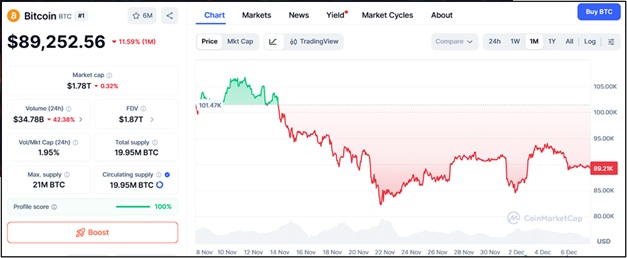
Several interconnected pressures are squeezing miners: BTC has fallen around 20% from its 2025 peaks near $110,000, trading in the $80,000–$90,000 range. This directly erodes revenue from block rewards currently 3.125 BTC per block post-2024 halving.

The network hashrate hit a new high of 1.16 zettahashes per second (ZH/s) in October, pushing mining difficulty to an all-time high of 156 trillion. The next adjustment on December 11 is forecast to rise further to 149.8 trillion, intensifying competition.

Average fees are at multi-year lows ~$0.58 per high-priority transaction, reducing ancillary revenue as on-chain activity cools. Electricity, hardware depreciation, and financing expenses have climbed, with all-in mining costs for one BTC reaching $137,800 cash costs at $74,600.

Public miners’ market caps dropped 16% in November alone. These conditions mark the fourth consecutive month of declining profitability, per JPMorgan analysis, with daily block rewards averaging $41,400 per exahash—down 14% from October and 20% year-over-year.

Faced with breakeven or losses, 70% of top public miners like Marathon Digital, Riot Platforms, CleanSpark are diversifying into AI/high-performance computing (HPC). They’ve raised $6 billion for GPU infrastructure and secured $15.5 billion in contracts, including IREN’s $9.7 billion five-year deal with Microsoft.

However, AI revenue remains too nascent to fully offset mining losses, leading to predictions of a “shakeout” where inefficient operators capitulate and sell BTC holdings—potentially creating short-term supply pressure but long-term network stabilization.

Despite the gloom, some optimism persists: JPMorgan recently upgraded stocks like CleanSpark and Cipher Mining, sparking a rally in miner equities. Miners are also stockpiling BTC like MARA holds 53,250 BTC worth $5.6 billion, betting on a price rebound.

For a typical modern ASIC miner (e.g., 390 TH/s hashrate, 7,215W power draw at $0.05/kWh electricity): Daily gross revenue: ~$0.015–$0.02 per TH/s. Daily net profit: As low as $6.27 after costs for a full rig—barely covering expenses.

~$90,000+ for most setups; below that, operations turn unprofitable. While Bitcoin’s network security is at peak strength, miner economics are in crisis—echoing past cycle bottoms. Survival hinges on BTC climbing above $90,000 or successful AI transitions.

For individual miners, now’s the time to audit costs or consider hosting in low-energy regions; for investors, this could signal a contrarian entry if capitulation accelerates.

As of December 2025, Ethereum mining as we knew it—GPU-intensive proof-of-work (PoW) operations—has been obsolete for over three years, thanks to “The Merge” upgrade in September 2022.

This shift to proof-of-stake (PoS) ended traditional mining on the mainnet, redirecting the ecosystem toward staking and validator nodes. While this made Ethereum 99.95% more energy-efficient and scalable, it left former miners grappling with sunk costs in hardware and disrupted revenue streams.

ETC mining uses similar hardware but yields ~$0.01-0.02/TH/s daily—viable only with cheap electricity <$0.05/kWh. Broader altcoin shifts like Monero or Ravencoin face ASIC resistance but volatile rewards.

Post-Merge, ~37% of blocks remain OFAC-compliant censoring sanctioned txs, down from 78%, but MEV-Boost relays centralize block building. Validators often large pools exploit sequencing, creating bottlenecks akin to pre-Merge mining pools.

In 2025, small miners dominate Reddit threads lamenting “get-rich-quick” failures, while firms like BitMine report $4B losses on ETH exposure. Miners aren’t standing still—70%+ have diversified: Staking as the New “Mining”: Lock ETH to validate blocks and earn ~3-5% APY.

Pools like Lido lower barriers min. ~0.01 ETH, but centralization risks persist. ETC leads for GPU reuse, followed by Ravencoin and Monero. Cloud mining platforms like HashJ or IeByte offer ETH-payout proxies without hardware, using GPU scheduling for 10-20% returns.

Ex-miners like CoreWeave repurpose rigs for AI cloud services, securing $15B+ contracts. Cysic’s ComputeFi turns GPUs into liquid resources for ZK-proofs and Ethereum block proving. Protocols like Lithos (on Ergo) introduce decentralized PoW with fraud proofs, slashing invalid work for trustless pools.

Public firms blend BTC mining with ETH staking, while cloud/community models emerge to sidestep hardware woes. Ethereum’s PoS era prioritizes accessibility over raw compute, but challenges like L1 revenue erosion (vs. L2s) and ETH’s SoV competition from stablecoins persist.

In essence, Ethereum “mining” challenges are now staking and adaptation hurdles—echoing Bitcoin’s 2025 lows but with greener upside. If BTC rebounds to $120K, ETH could hit $10K, buoying yields. Stay lean, diversify, and watch L2s: they’re the real profitability frontier.

Bank of Japan Views A Resilient Japan’s Economy Amid Trump’s Tariffs

0

Bank of Japan (BOJ) Governor Kazuo Ueda stated that Japan’s economy has weathered the impact of U.S. President Donald Trump’s tariffs, signaling resilience despite ongoing trade pressures.

This positive outlook comes after a period of volatility, including a brief economic contraction earlier in the year, and is expected to influence the BOJ’s potential decision to raise interest rates at its upcoming policy meeting.

The BOJ held its key policy rate steady at 0.5% amid “high uncertainties” from Trump’s protectionist policies, including reciprocal tariffs and a 25% levy on imported cars. Officials noted moderate recovery but acknowledged weaknesses in exports, particularly to the U.S. and via manufacturing hubs like Mexico.

Business sentiment among large manufacturers improved slightly, with the BOJ’s Tankan survey showing a modest uptick in confidence index rising to +13. Exports held steady, contributing to better-than-expected GDP growth of 1% annualized in Q2, boosted by pre-tariff front-loading of shipments.

The economy contracted 1.8% year-over-year in Q3—the first downturn in six quarters—primarily due to a sharp drop in automobile exports after tariffs fully took effect. However, economists viewed this as a temporary setback rather than a recession signal.

Ueda’s comments mark a shift toward optimism, emphasizing that the economy has stabilized and inflation remains above the BOJ’s 2% target for over three years. This “weathering” of tariffs is attributed to: Successful negotiations reducing some levies from 25% to 15% on select goods.

Diversified export strategies and domestic wage-price dynamics supporting growth. Broader global adjustments, though risks from U.S. consumer slowdowns persist. Markets are pricing in a likely rate hike next week, potentially the third since ending negative rates in 2024, to normalize policy amid sustained inflation.

Analysts from firms like Citi and Nomura caution that while short-term growth is intact, prolonged tariffs could still pressure long-term trajectories, especially if extended to allies like Japan. This assessment aligns with the BOJ’s mandate to balance growth and price stability, but it underscores the tariffs’ role in complicating Japan’s export-dependent recovery.

This optimism contrasts with earlier 2025 volatility, where tariff uncertainties repeatedly pressured the currency lower. Following Ueda’s Nagoya speech, the yen strengthened by 0.4% against the U.S. dollar, reaching a session high of ¥155.49 in intraday trading on December 1.

This marked a reversal from late-November levels around ¥156–157, where the currency had weakened amid lingering tariff fears and a stronger dollar buoyed by U.S. Federal Reserve signals. Japanese 10-year government bond yields rose by about 3 basis points to 0.85%, reflecting expectations of a rate hike at the BOJ’s December 18–19 meeting.

Higher yields typically attract foreign capital, supporting yen strength. Ueda’s comments downgraded the perceived severity of tariffs, the effective hit on exports like autos was smaller than feared, thanks to partial negotiations reducing levies from 25% to 15% on some goods.

This eased “high uncertainties” cited in prior BOJ outlooks, boosting confidence in sustained inflation above 2% and economic rebound from Q3’s 1.8% contraction. Trump’s tariffs, implemented progressively from March 2025, initially exacerbated yen weakness through several channels.

Tariffs slowed Japanese exports to the U.S. down 12% YoY in Q3, hurting corporate profits and prompting BOJ growth forecast cuts from 1.2% to 0.8% for FY2025 in April. This fueled safe-haven dollar demand, pushing USD/JPY to multi-month highs:March: ¥149.46 little changed post-BOJ hold.

Peaked near ¥152 amid “unprecedented” tariff announcements in April. May: Slid to ¥150+ after BOJ slashed forecasts, with yen dropping further on delayed rate-hike bets. July: Touched ¥150 again post a partial U.S.-Japan tariff deal, but uncertainty lingered. October: Hit ¥153.56 despite hawkish BOJ signals, as U.S. labor weakness and tariff ripple effects weighed.

A weaker yen raised import costs like energy and food, supporting BOJ’s 2%+ inflation but also importing volatility. Ueda noted in April that tariffs could “heighten uncertainty over the economic outlook,” indirectly pressuring the yen via reduced business sentiment.

Low BOJ rates steady at 0.5% since January encouraged yen-funded carry trades into higher-yield assets. Tariff-induced growth worries amplified unwind pressures, as seen in October’s slump. Recent X discussions highlight fears of a BOJ hike “obliterating” these trades, potentially amplifying yen gains.

Markets now price in an 85% chance of a 25-basis-point hike to 0.75% on December 19, per Bloomberg data, which could propel the yen toward ¥150–152 by year-end. Ueda emphasized wage momentum and tariff “receding” pressures as key, with core inflation at 2.2% for FY2025 supporting this path.

Persistent U.S. policy uncertainty could cap gains, potentially revisiting ¥157 if Q4 exports disappoint. A weak yen also aids exporters but risks overheating inflation via imports. Analysts at Reuters and Citi note that while Japan’s resilience reduces yen downside, prolonged tariffs could still shave 0.5% off GDP, indirectly via U.S. slowdowns.

Overall, Ueda’s assessment has stabilized the yen in the short term by dialing back tariff doomsday scenarios, but its trajectory hinges on the December BOJ decision and U.S. trade developments.

Argentina’s Central Bank to Permit Banks to Offer Crypto Services Starting in 2026

0
TOPSHOT - Argentine presidential candidate for the La Libertad Avanza alliance Javier Milei waves to supporters after winning the presidential election runoff at his party headquarters in Buenos Aires on November 19, 2023. Libertarian outsider Javier Milei pulled off a massive upset Sunday with a resounding win in Argentina's presidential election, a stinging rebuke of the traditional parties that have overseen decades of economic decline. (Photo by Luis ROBAYO / AFP) (Photo by LUIS ROBAYO/AFP via Getty Images)

Argentina’s Central Bank— Banco Central de la República Argentina, or BCRA is actively drafting new regulations to lift a three-year ban on banks providing cryptocurrency services, with implementation targeted for as early as April 2026.

This move represents a significant policy shift toward greater integration of digital assets into the traditional banking system, driven by the country’s ongoing economic challenges, including hyperinflation exceeding 270% and strict capital controls.

Under President Javier Milei, who assumed office in late 2023 and has publicly advocated for crypto-friendly reforms, regulators have pivoted from prohibition to structured oversight. Banks would be authorized to offer trading, custody, and related services for major cryptocurrencies such as Bitcoin (BTC), Ethereum (ETH), Tether (USDT), and XRP.

These services could be integrated directly into banking apps, making crypto more accessible to everyday users. To mitigate risks, banks must operate crypto services through separate legal units with enhanced capital reserves, liquidity requirements, and security protocols.

All activities will adhere to strict Know Your Customer (KYC) and Anti-Money Laundering (AML) standards, aligned with guidelines from Argentina’s National Securities Commission (CNV). While not yet officially confirmed, sources close to the BCRA indicate that the rules could be finalized and take effect by April 2026.

Internal planning is already underway, building on 2024 regulations that required Virtual Asset Service Providers (VASPs) like exchanges to register with the CNV. Argentina ranks as a global leader in grassroots crypto adoption, processing $93.9 billion in transaction volume from July 2024 to June 2025 second in Latin America per Chainalysis.

Citizens have turned to crypto as a hedge against peso devaluation and inflation, often via informal channels. Formalizing bank involvement aims to enhance safety, improve tax compliance, reduce reliance on unregulated platforms, and boost liquidity.

This development positions Argentina as a potential model for other inflation-plagued economies blending traditional finance with digital assets. Local banks like BBVA Argentina, Banco Macro, and Grupo Financiero Galicia have expressed interest, potentially accelerating adoption among the country’s 20+ million banking customers.

However, challenges remain, including ensuring fair competition with existing crypto exchanges via equitable tax policies and finalizing technical integrations. Industry voices, such as those from local exchange Lemon, hail it as a “key driver for mass adoption,” while experts caution that success hinges on balanced taxation and risk management.

For comparison, Brazil already has comprehensive bank-crypto laws, and similar expansions are underway in the U.S. and Europe. The BCRA has not issued an official announcement, so timelines could shift, but the momentum reflects a clear pro-innovation stance under the current administration.

Argentina stands out as a global leader in cryptocurrency adoption, particularly in Latin America, where economic instability—marked by hyperinflation (around 85% annually in 2025), peso devaluation, and strict capital controls—has driven citizens to digital assets as a hedge and alternative to traditional finance.

Unlike wealthier nations where crypto is often speculative, in Argentina, it’s a practical tool for savings, remittances, and daily transactions. This grassroots momentum has positioned the country as a model for emerging markets, with adoption rates far exceeding global averages.

Approximately 19.8% of the population about 9.1 million people out of 46 million owns cryptocurrencies, making Argentina the top in Latin America ahead of Brazil (18.6%). Some surveys report up to 29.4% ownership in high-inflation contexts, though 19.8-22.8% is the consensus for active holders.

Around 10 million active crypto wallet users, ranking Argentina 15th globally. Daily users are estimated at 5 million, reflecting high engagement for remittances and payments. $93.9 billion in on-chain value received from July 2024 to June 2025, second in Latin America and contributing to the region’s $1.5 trillion total over three years.

This marks a 40% regional increase in transactions, with Argentina’s stable at high levels despite volatility. Earlier data showed $91 billion, indicating steady growth. 20th on Chainalysis’ 2025 Global Crypto Adoption Index, which weights grassroots usage by population and purchasing power parity. This reflects broad retail participation rather than institutional dominance.

61.8% of transactions involve stablecoins (e.g., USDT, USDC), far above the global 44.7% average, used for hedging inflation and cross-border payments. Over half of exchange purchases in Argentina are stablecoins, with retail-sized transfers (<$10,000) growing fastest.

With inflation eroding savings and capital controls limiting USD access, crypto offers dollar-pegged stability and borderless transfers. Remittances and freelance payments are key use cases, with platforms like Ripio and Lemon Cash enabling peso-crypto conversions at 6,000+ informal outlets.

Younger demographics and rising digital literacy amplify this, alongside President Milei’s pro-crypto stance, which has spurred regulatory easing like VASP registration under the CNV.

Barriers include regulatory uncertainty (e.g., potential 30% tax on undeclared assets) and security risks from informal channels, but 2025’s VASP rules align with FATF standards for AML/CFT. Trends point to institutional integration: Banks may offer services by April 2026, potentially onboarding 20M+ customers.

Latin America’s 15.2% average adoption up from prior years underscores Argentina’s influence, with stablecoins powering 70% of bot-driven transfers in AI/e-commerce. Overall, these stats highlight crypto’s role in financial inclusion, with projections for sustained 18-20% quarterly growth in ownership.

Plume Network Secures ADGM Commercial License, Unlocking RWA Growth in the Middle East

0

Plume Network, a modular Layer 2 blockchain specialized in real-world asset (RWA) tokenization, has obtained a commercial license from the Abu Dhabi Global Market (ADGM) Registration Authority.

This approval, announced today, enables Plume to legally originate, distribute, and scale tokenized RWAs—such as real estate, bonds, and commodities—across the Middle East, Africa, and other emerging markets.

The move positions Plume as a key player in one of the world’s most RWA-friendly regulatory environments, where institutions like BlackRock, Deutsche Bank, and sovereign wealth funds via the $1 trillion+ Abu Dhabi Investment Authority are increasingly exploring digital assets.

ADGM, a UAE-based international financial center, provides a progressive, English common law-based system for digital finance. The license allows Plume to operate compliantly under ADGM’s oversight, focusing on tokenized securities and asset finance.

Plume intends to open a permanent office in Abu Dhabi by the end of 2025, with initial commercial launches and partnerships with regional banks and fintechs slated for early 2026. This includes local hiring to build ties with Middle Eastern institutions.

The UAE’s ambition to diversify beyond oil—through initiatives like free zones and blockchain sandboxes—aligns perfectly with Plume’s RWA focus. As CEO Chris Yin noted, “The Middle East is not just a market, but a strategic partner in shaping compliant real-world tokenization.”

This development comes amid surging interest in RWAs, with Plume already leading by RWA holder count on blockchains. Recent catalysts include a 31% token surge following U.S. SEC transfer agent registration in October 2025 and a Coinbase listing today, which could boost liquidity.

On-chain metrics show a 318% increase in Ethereum transaction volume for Plume over the past week, signaling growing adoption. The Middle East’s RWA ecosystem is booming: Dubai and Abu Dhabi have piloted tokenized real estate and funds, with regulators like the SCA and DFSA providing clear guidelines for fractional ownership and AML compliance.

Dubai has emerged as a global epicenter for real-world asset (RWA) tokenization, blending its thriving real estate market, progressive regulations, and strategic position as a financial hub.

By converting physical or traditional assets—like properties, commodities, bonds, and funds—into blockchain-based digital tokens, RWA tokenization enables fractional ownership, 24/7 liquidity, and borderless access.

As of December 2025, the UAE’s on-chain RWA value stands at approximately $17 billion, with Dubai leading the charge through government-backed pilots and a supportive ecosystem. This positions the emirate not just as a market, but as a blueprint for compliant, scalable tokenization worldwide.

Dubai’s regulatory environment is designed to foster growth while ensuring investor protection. In May 2025, VARA updated its Rulebook to classify tokenized RWAs as “Asset-Referenced Virtual Assets” (ARVA), providing end-to-end guidelines for issuance, custody, trading, and secondary markets. This framework emphasizes additive benefits like transparency and efficiency, with real estate as a priority sector.

Dubai Financial Services Authority (DFSA): Operating in the Dubai International Financial Centre (DIFC), the DFSA approved the region’s first tokenized money market fund in July 2025—the QCD Money Market Fund by Qatar National Bank and DMZ Finance—targeting institutional applications and projecting global RWA growth to $18.9 trillion by 2033.

Dubai Land Department (DLD): Collaborating with VARA, the Dubai Future Foundation, and the Central Bank of the UAE, DLD launched a pilot real estate tokenization platform in May 2025 via Prypco Mint. It uses the XRP Ledger to digitize property deeds, enabling fractional shares starting at AED 2,000 (~$545) for UAE ID holders, with global expansion planned.

These initiatives align with Dubai’s D33 economic agenda, aiming to double the economy by 2033 through digital finance, and have attracted institutions like BlackRock and sovereign funds. A tokenized apartment in Dubai sold out in under 2 minutes in June 2025, drawing 149 investors from 35 countries. Platforms like OneAsset and Fasset are tokenizing warehouses and skyscrapers, unlocking cross-border access.

Beyond property, tokenized bonds and commodities are rising, with RWA Labs providing full-stack infrastructure for SMEs and institutions. Events like Blockchain Life 2025 and the RWA Summit highlighted over $32 billion in global tokenized assets, with Dubai pilots showcasing Arbitrum and VeChain integrations.

Unlike the 2019 security token hype, Dubai’s clear rules prevent liquidity pitfalls, with platforms like DigiShares offering white-label solutions. Experts forecast Dubai leading Middle Eastern RWA growth, with initiatives like World Liberty Financial’s 2026 launches.

Dubai’s momentum is accelerating—evidenced by recent forums like DAOS Connect’s RWA Strategy Session and Binance’s full ADGM licensing. With events like the World Token Summit in June 2026 on the horizon, expect more partnerships in CBDCs, DeFi, and AI-blockchain hybrids.

For builders, VARA’s framework makes launching straightforward: structure legally, secure licensing, and leverage free zones like DIFC. Dubai isn’t just tokenizing assets—it’s redefining finance. Stay tuned for pilot expansions and institutional inflows.

Plume’s entry could accelerate this, potentially unlocking billions in tokenized assets from the region’s $3+ trillion in sovereign wealth. This is a bullish step for RWA innovation—watch for partnership announcements soon.