DD
MM
YYYY

PAGES

DD
MM
YYYY

spot_img

PAGES

Home Blog Page 3014

Exploring Potentials of ETF for TON Blockchain, and Dogecoin Beyond a Meme

0

The TON Blockchain, also known as The Open Network, is a rapidly evolving platform that has garnered significant attention in the cryptocurrency and blockchain communities. With its decentralized layer 1 proof-of-stake blockchain, TON offers a range of services including decentralized storage, payments, and an integrated wallet within messaging apps like WeChat, endorsed by Telegram.

Blockchain ETFs are funds that invest in companies involved with the transformation of business applications through the development and use of blockchain technology. They offer a diversified portfolio of blockchain investments, which can include companies that provide hardware, software, and services that are integral to the blockchain ecosystem. For those interested in the TON Blockchain, identifying ETFs that invest in companies developing or utilizing this technology could be a strategic move.

The investment landscape is taking note of TON’s potential, with the introduction of products like the 21Shares Toncoin Staking ETP (TONN), listed on the SIX Swiss Exchange. This particular exchange-traded product (ETP) not only provides exposure to toncoin, TON’s native currency, but also offers staking rewards, which could be an attractive proposition for investors looking for passive income streams from their crypto investments.

For those new to the concept, staking involves holding funds in a cryptocurrency wallet to support the operations of a blockchain network. In return, stakers receive rewards, similar to interest payouts, which can enhance the overall yield of their investment. The TONN ETP’s total expense ratio of 2.50% reflects the costs associated with this innovative investment vehicle.

The emergence of blockchain ETFs and ETPs signifies a maturing market that is increasingly integrating traditional financial structures with the novel mechanisms of the blockchain world. These investment vehicles offer a bridge for conventional investors to participate in the blockchain space without the need to directly engage with the complexities of cryptocurrency ownership and management.

Blockchain ETFs, in general, aim to invest in companies that are actively involved in the development and use of blockchain technology or in financial products tied to the performance of cryptocurrencies. They represent a diversified approach to blockchain investment, potentially mitigating the risks associated with direct cryptocurrency investments.

The tokenization of ETFs on the blockchain is another intriguing development, blending the traditional ETF structure with the benefits of blockchain technology. This could lead to increased efficiency, transparency, and security in asset trading.

As the blockchain sector continues to evolve, it is likely that we will see more innovative products like the TONN ETP, offering investors new ways to engage with and benefit from the growth of blockchain technologies. The 21Shares Toncoin Staking ETP is a testament to the dynamic nature of this space and the potential for blockchain to transform not just the world of finance, but a multitude of industries across the globe.

For investors considering blockchain ETFs, it’s essential to conduct thorough research and understand the underlying assets and strategies of these funds. With the blockchain industry still in its relative infancy, these investments carry a unique set of risks and opportunities that should be carefully evaluated.

The TON Blockchain, originally envisioned by the creators of the messaging app Telegram, has garnered significant attention in the cryptocurrency and blockchain communities. Its promise of high-speed transactions and scalability has made it a subject of interest for investors and technologists alike. With the growing interest in blockchain technologies, Exchange-Traded Funds (ETFs) that focus on blockchain have become a popular way for investors to gain exposure to this innovative sector.

The TON Blockchain and its associated investment products represent a fascinating intersection of technology and finance. As the blockchain ecosystem expands, it offers a wealth of possibilities for investors willing to explore this new frontier. The key to navigating this space is staying informed and approaching investments with a clear understanding of the risks and rewards involved.

Exploring the Potential of Dogecoin Beyond a Meme

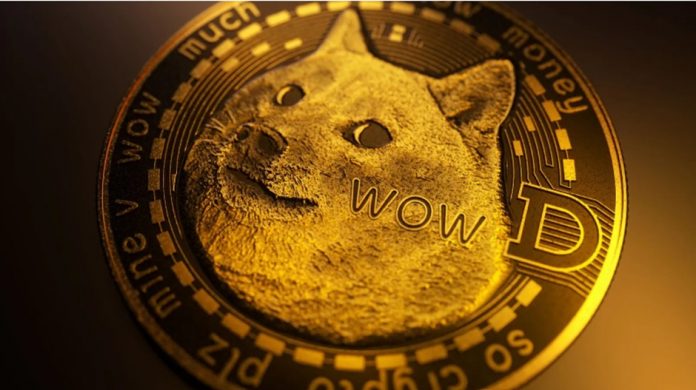
The world of cryptocurrency is ever evolving, with various digital currencies vying for attention in a highly volatile market. Among these, Dogecoin has carved out a unique niche for itself. Initially started as a joke in 2013, Dogecoin has amassed a significant following and has become a notable player in the crypto space.

As of late, Dogecoin has experienced a substantial drop in value, which has been a cause for concern among investors and enthusiasts alike. However, recent trends have shown that Dogecoin has stabilized above the $0.1 mark, indicating a potential “safe zone” for the cryptocurrency. This stabilization has sparked a renewed interest in the future prospects of Dogecoin, with some analysts, such as Alan Santana, projecting an optimistic outlook.

Alan Santana, a noted figure in the cryptocurrency analysis sphere, has made a bold prediction regarding Dogecoin’s trajectory. He anticipates a staggering 25,000% rally for Dogecoin in the year 2024. While this forecast may seem overly ambitious to some, it is not without its basis. Predictions in the crypto market are often derived from a combination of technical analysis, market sentiment, and emerging trends within the industry.

Several factors could contribute to such a rally. The increasing adoption of cryptocurrencies in mainstream Economy and commerce, the growing interest in digital currencies as a hedge against traditional financial market fluctuations, and the potential for technological advancements within the Dogecoin network all play a role in shaping its future.

The foundational economic principle of supply and demand is a significant driver of Dogecoin’s price. While Dogecoin has an unlimited supply, which differentiates it from cryptocurrencies like Bitcoin, its price can still be affected by changes in demand. The most fundamental economic principle also applies to Dogecoin. The availability of Dogecoin and the market’s demand for it can cause price fluctuations.

The overall sentiment of the market, which can be swayed by news, social media, and public figures, plays a crucial role in the valuation of Dogecoin. Updates and improvements to the Dogecoin network can impact its usability and security, thereby influencing investor confidence and price. Changes in regulatory frameworks for cryptocurrencies in different countries can affect Dogecoin’s accessibility and attractiveness to investors.

It’s important to note that the cryptocurrency market is notoriously unpredictable, and investments can be subject to extreme fluctuations. The sentiment in the market can shift rapidly, influenced by global economic events, regulatory changes, and technological breakthroughs. As such, while predictions like Santana’s provide a glimpse into potential futures, they should be approached with caution and due diligence.

Investors and enthusiasts are advised to keep a close eye on market trends, news, and analyses to make informed decisions. The potential for growth in Dogecoin, as with any investment, comes with its risks. It is essential for individuals to research thoroughly, understand the market dynamics, and consider their risk tolerance before making investment choices.

As we look towards the rest part of 2024, the conversation around Dogecoin and its place in the cryptocurrency market continues. Whether it will achieve the heights predicted by analysts like Santana remains to be seen. However, the journey of Dogecoin—from a meme to a market mover—serves as a testament to the unpredictable and exciting nature of the crypto world.
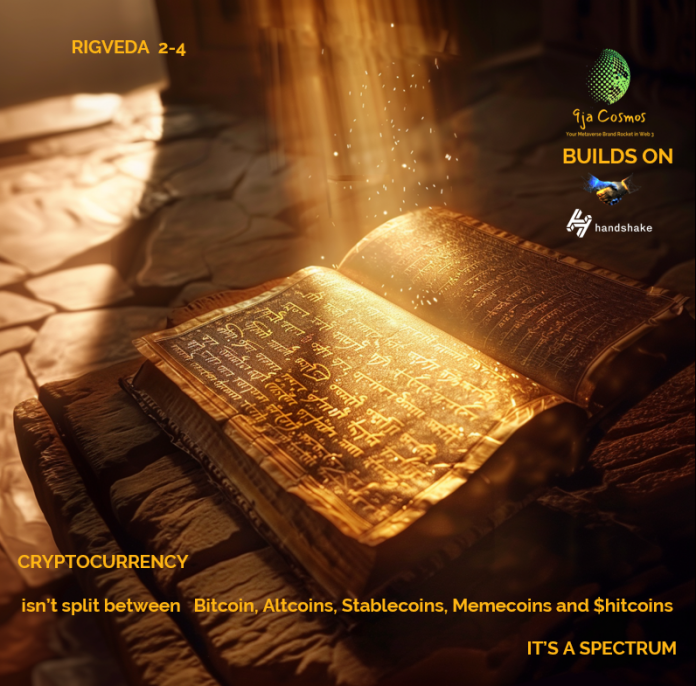

Rigveda 2-4 ‘Cryptocurrency isn’t split between Bitcoin, Altcoins, Stablecoins, Memecoins and $hitcoins – It’s a spectrum

0

PRELUDE:

There are many misconceptions in the world of Cryptocurrency, which generally breaks down into two groups – Coins and Tokens.

Most of these misconceptions come from ‘Pop Talk’ in Web 3. Rigveda 2-4 acts to sort this out.

CATEGORIES OF MISCONCEPTION:

Bitcoin: Bitcoin is the oldest well known blockchain. The coin is generated through a process called ‘mining’. It uses a very specific PoW (Proof of Work) mechanism incorporating ‘Nakamoto Consensus’ named after the suspected creator, Satoshi Nakamoto.

The design is public information, and so, other blockchains have been created which are almost identical. Loyal proponents seem to dismiss that these variations or similes are what they are.

Altcoins: ‘Altcoin’ is a subjective word that means different things to different people depending on who you ask. The broadest possible interpretation is that any cryptocurrency not Bitcoin is an ‘Altcoin’.

This does not make sense, as some cryptocurrency labelled ‘altcoins’ exhibit Bitcoin properties, including ‘Nakamoto Consensus’

Some Bitcoin supporters’ conflict themselves by making technical arguments when comparing Bitcoin to a ‘FIAT’ such as the US Dollar, and then failing to confine themselves to similar technical arguments, when claiming other cryptocurrency holds no value.

There has never been an invention or innovation in human history which successfully argued (rather subjectively) that it is the only one that ‘deserves’ to exist. It didn’t work for Coca Cola, it didn’t work for Ford, it didn’t work for IBM Computers, and it won’t work for Bitcoin.

As STEM (Science, Technology, Engineering and Mathematics) ideological arguments were made to differentiate Bitcoin from a FIAT, so STEM ideological arguments need to be made to distinguish between individual cryptocurrencies, one of which may be Bitcoin.

Collectively naming many cryptocurrencies ‘Altcoin’ simply because they are not Bitcoin, is not rational.

Stablecoins:

Stablecoins are often anything but ‘stable’. They began as a bridge between cryptocurrency and FIAT when there was more reluctance in the market.

Web3 began to expand, and new CEXs (Centralized Exchanges) struggled to secure a geo-diverse licence portfolio, and keep up with an explosion of currencies, particularly project tokens.

Stablecoin providers jumped into a ready market, being a go between for FIAT currency and an obscure world of ‘virtual value’.

Bitcoin visibility was significantly lower than it is today, and viewed as part of that obscure world.

Stable coins offered the strongest ‘notion’ of security in an unsure space. They claim to ‘peg’ to a familiar and accepted value unit, such as $USD or gold.

The peg concept is indeed ‘notional’. Convoluted wizardery often exists in how this ‘peg’ is interpreted. They come from a commercial company, not an autonomous decentralized source, there may be structures that resemble ‘quantitative easing’, and there are redemption caveats that shield them from a ‘run’ faced with declining demand in an ‘over-supply’ challenge.

This story of Tether (USDT) should be taken as an anchor narrative to understand Stablecoin Risk.

<VIEW>

Again, that something is called a stablecoin does not define how it is technically structured. The criteria is purely about the presence of the ‘peg’. Some things can be called ‘Stablecoins’ with no ‘STEM narrative’ to prove they are similar.

Stablecoins are probably ok as a transaction tool in a small holding window. Ticking time bombs should never be used as a store of value.

‘In practice, … stablecoin issuers have yet to be proven to maintain adequate reserves to support a stable value, and there have been a number of failures with investors losing the entirety of the (fiat currency) value of their holdings.’ – Wikipedia

Memecoins:  Memecoins are a genre of cryptocurrency that originated from internet memes, often featuring animated characters or animal images. It’s a commonly stated distinction – ‘All coins are tokens but most tokens are not coins. ‘

Coin issue is a function of the core activities of a blockchain. The blockchain type and tokenomics has a significant impact on the value of a coin. Currency Tokens [not coins], are on the other hand created through various off-chain architectures using ‘smart contracts’, for example, those using ERC 20 in the ‘EVM Compatible’ space.

The problem with the term ‘memecoin’ is it doesn’t make clear if it’s a coin or a token. It doesn’t define whether it has utility, use cases or simply nothing.

Being a ‘memecoin’ doesn’t preclude the crypto from having other attributes. On it’s own, the ‘meme’ phenomenon will only attract ‘impulse investors’ in a tight window. With other attributes it may endure.

The Memecoin Genre, is probably the most ill-defined of cryptocurrency labels in ‘Pop Talk’.

$hitcoins:  $hitcoins again, are a very ill-defined genre.

$hitcoins can be cryptocurrencies created for no real reason or purpose, often with little to no value. They typically have low market capitalization and are prone to crashing and burning. Some common features of shitcoins include:

  • Speculative and volatile: Shitcoins are often created to speculate on market trends, leading to rapid price fluctuations.
  • Lack of real-world use: Shitcoins rarely have a clear purpose or practical application, making them less valuable. They lack utility and use case.
  • Unserioius from the start: Many shitcoins are created as jokes or parodies, with names and branding that poke fun at the crypto market. Most memecoins are also considered $hitcoins.

$hitcoins are generally off-chain tokens rather than coins which are the function of a blockchain core. The origin of the name ‘$hitcoin’ comes from the investing experience of the token reaching an ATH (ALL TIME HIGH) price rapidly after issue, and then abruptly going to zero  ($hit).

Coins which are the function of a blockchain core, are expected to have an enduring value, and while they can become severely depressed, they don’t head to zero. Most have an architecture that can be used to build.

‘Bitcoin Maxis’ sometimes muddy the water by dismissing many cryptocurrencies as ‘$hitcoins’ in a similar way they perceive ‘altcoins’.

$hitcoins can also be tokens released to exit Founders and/or VCs from (poorly conceived) projects. ‘Rug Pulls’ happen when open market token purchases provide the opportunity for Founders and/or VCs to bail, and then token price plumets.

The PopTalk –‘$hitcoin’ has no clear technical criteria, so a deep dive is needed on any opportunity that stimulates interest.

Rigveda 2-4 and ‘The 9ja Cosmos Way’:

We ignore the PoP Talk and the hype, and call Cryptocurrency as we see it. We say what STEM principles say they are.

You can talk about different types of food, but what are the classifications? You will probably get different answers whether you choose to ask a Wholefood consumer, Dietician, Additives critic, Food Toxicologist, Nutritionist, or a Vegan !

Is Bitcoin a ‘store of value’? Well not if the person you ask is solely interested in Ordinals!

Nothing created by humans is ever perfect, but some creations are just built better, and endure better than others and the world of Cryptocurrency is no different.

What efforts have creators done to make a coin issuance impregnable once it’s put in place, free from vulnerabilities of human actions of some sort later?

How limited is the issue?

What durability qualities does it have?

How safe is your ‘value’?

Bitcoin is just a ‘brand’, and clarifying you hold  ‘Altcoins’, ‘Stablecoins’, ‘Memecoins’ or ‘$hitcoins’ answers none of these questions.

Cryptocurrency types:

Autonomous – Limited Issuance

Here, the coin is issued by a self-sufficient blockchain on ‘auto-pilot’.  It is completely independent – not controlled by others or by outside forces. The tokenomics design enforces a pre-programmed pace at which coins are issued into circulation, which will stop at a finite and limited maxiumum.

So far, only a ‘Nakamoto Consensus’ PoW (Proof of Work) Blockchain can achieve this type of coin. The most famous example is Bitcoin. There are others, such as Litecoin, Handshake and Ravencoin.

Autonomous – (Inflationary) Controllable Issuance

Here, the coin is issued by a self-sufficient blockchain on ‘auto-pilot’.  The design may offer limited control to trusted entities defined by design policy and tokenomics . The tokenomics design enforces a pre-programmed pace at which coins are issued into circulation. Supply is not always limited, but issue tokenomics are cemented to architecture and supply growth is predetermined and predictable. Supply alteration by custodians can be difficult. Inflationary components are rigidly mathematically contrived to provide liquidity support for ecosystem growth, but are not arbitrary, in, for example, how a nation may respond with ‘money printing’ to a Debt Ceiling scenario.

Several PoW and PoS (Proof of Stake) blockchains can produce variations on these types of coins.

Variable Issuance

Here, the cryptocurrency may be issued by a self-sufficient blockchain (coin), or may be native to an off-chain architecture, though not a smart contract token.  The design offers considerable control to trusted entities defined by design policy and tokenomics. The tokenomics design allows coin issuance in response to custodian led triggers . Supply is not limited, though bound by a function of the architecture and not arbitrarily issued through smart contracts.

A mix of non-PoW blockchains and other cryptographic architectures are capable of this coin.

Off-chain and non-native tokens.

There are many different types of tokens. They are created according to a prescriptive method called a protocol. Tokens are not an integral result of a blockchains’ ‘ordinary’ functioning.

A protocol method is created through a group of people creating and completing an IP (Improvement Proposal) for a blockchain. Tokens have been used for many things including NFTs, Gaming Assets, deeds to mass data, event ticketing, RWAs (real world assets, and more).

In this case we concern ourselves with token protocols used to carry out transactions, or value retention. The protocol ‘ERC 20’ is in use for this purpose in architecture extensions and networks operating with or compatible to Ethereum, known as EVM Compatible. Token volume and any asset base it may represent are entirely in the hands of commercial network owners.

In some cases, the network the token is driving may be deemed to have or be developing valuable virtual products, but in some other cases, it may have just a notion, idea, or simply nothing. They loosely resemble equities, though network owners token management specifically is not answerable to any stock exchange, issuance governance, shareholder authority or corporation compliance. They can dilute the issuance with ease, and without consultation.

In cases where ‘Memcoins’ or ‘$hitcoins’ are being discussed, it is invariably these types of Off-chain and non-native tokens rather than (blockchain) coins at all.

This group, represents the most misleading of all of such assets, to be homogenized under the heading ‘cryptocurrency’.

also: 

Rigveda 2 – 1 : Web 3 is as an ‘End-to-End Decentralized UX’ [user experience]

Rigveda 2 – 2 : ‘There isn’t, wasn’t and won’t be a Web2’

Rigveda 2- 3 : ‘Whether a token in Web3 is an ‘NFT’, does not depend on the asset it has title to. It depends on the token protocol leveraged to create it.’

9ja Cosmos is here…

Get your .9jacom and .9javerse Web 3 domains  for $4 at:

.9jacom Domains

.9javerse Domains

.det0x Domains

Preview our Sino Amazon/Sinosignia releases (Ente)

Preview our Sino Amazon/Sinosignia releases (Pinterest)

Visit 9ja Cosmos LinkedIn Page

Visit 9ja Cosmos Website


Why Hunger Remains in Africa, and the Solution Goes Beyond Producing More Food

1

Question: How can Nigeria deepen its food security considering the level of hunger in the land?

My response: We need to go to the root cause of why we have hunger in the community of farmers. This paralysis is centuries-old, and let me use a case study from the Igbo Nation. Across the Igbo Nation, new yams are celebrated because the new harvest ends  the “unwu” [a period of scarcity or seasonal famine] period. 

That “unwu” period is when yams have been planted but they are not yet ready to be harvested. Due to lack of storage facilities, there is always this scarcity because yam, the king of crops, in Igbo mythology, is severely intermittently scarce.

But as August arrives, and the new yams are ready for harvest, communities celebrate because the “unwu” is going to be over. That is the heart of the new yam festival which you might have read in Chinua Achebe’s books. The festival honours the earth goddess of wealth for bringing her fertility and increasing the wealth of the village! As yams are celebrated during the festival, abundance returns to the land!

Unfortunately, as soon as the next farming period begins around March/April, the “unwu” period returns, and intensifies around June and July. Check your village, there is one crop which goes through this cycle – massive periods of abundance followed by scarcity because there are limited storage and preservation facilities.

Sure – this is not to argue that ancestral Africa did not try to invent how to store and preserve crops. The point is that the methods are not efficient, and not many new methods were discovered on how to consume most of the crops. I have visited George Washington Carver Museum, in Tuskegee University, and his miracle for food security: “A genius in botany and agricultural experimentation, Dr. George Washington Carver discovered more than 100 uses for the sweet potato and a variety of Southern plants. “ 

Simply, Nigeria’s hunger problem now is not really about low production, but also lack of new ways to preserve and consume whatever is produced. We lose about 37% of whatever that is produced to food waste. It is unfortunate: during the yam festival, yam is everywhere and people celebrate, only for the same people to endure scarcity in a few months.

According to the Food and Agriculture Organization (FAO), sub-Saharan Africa (SSA) loses or wastes around 37% of the food it produces, which is about 120–170 kilograms per person per year. This is a higher rate than the global average of about one-third, and is primarily due to losses that occur at the farmer producer stage of the supply chain. For example, in Kenya, pests destroy up to 30% of the maize that is harvested.

That means that preservation and storage management must deepen even more than over-fixation; producing more is the holy grail for food security! Yes, our governors and political leaders must put the same level of effort they put during the planting season with free fertilizers and seeds, on initiatives that will preserve the little that is produced.

If farmers can feed themselves via better storage, hunger will disappear in Nigeria at scale because more than 70% of workers work in agriculture!

The Middle East remains a Place of Uncertainty

0
Benjamin Netanyahu and Joe Biden in Jerusalem, on March 9, 2010.

The Middle East, a region that has long been synonymous with geopolitical complexity, continues to navigate a path fraught with uncertainty. Recent developments suggest a cautious avoidance of direct conflict between Israel and Iran, two regional powers whose enmity has often threatened to escalate into open confrontation. This momentary respite, however, does not alleviate the underlying tensions that pervade the region.

The avoidance of conflict is a testament to the intricate balance of power and the delicate diplomatic engagements that characterize the Middle East. It is a region where historical grievances, strategic alliances, and the quest for influence converge, creating a tapestry of relations that is as rich as it is volatile.

Israel’s security concerns, particularly regarding its unacknowledged nuclear capabilities, are central to its defense strategy, especially in the face of perceived threats from Iran. Iran, on the other hand, asserts its right to respond to what it views as aggression, as evidenced by the Iranian President’s remarks following the assassination of Ismail Haniyeh on Iranian soil. These incidents highlight the ever-present potential for escalation, even as both nations navigate the complex waters of regional politics.

The broader Middle East remains a place where the specter of conflict looms large. The assassination of a Hamas political leader, attributed to Israel, and the subsequent vows of retaliation by Iran and its allies, underscore the fragility of peace in the region. The United States and other international actors have been actively involved in trying to prevent a wider regional conflict, reflecting the global implications of Middle Eastern stability.

Despite the potential for conflict, there have been periods where outright confrontation has been avoided. Such moments of restraint are significant, not only for the nations directly involved but also for the broader stability of the Middle East. However, avoidance of conflict does not equate to the absence of uncertainty. The region remains a complex puzzle, with each piece – from territorial disputes to ideological differences – contributing to the overall picture of unpredictability.

The recent news cycle has brought to light several developments that underscore the fragility of peace in the Middle East. Reports of heightened alertness from Hezbollah, the Lebanon-based militant group, suggest an atmosphere of preparedness for potential conflict. Furthermore, the acknowledgment of Israel’s formidable nuclear deterrent, particularly its fleet of Dolphins.

The strategic maneuvers and diplomatic engagements are indicative of the careful navigation required by the nations involved. It is a testament to the resilience and adaptability of the states in the Middle East that they continue to seek pathways to coexistence amidst the challenges.

The international community watches with a keen eye, understanding that the implications of these interactions extend far beyond the borders of the region. The pursuit of stability and peace is not only a regional concern but a global one, as the ripple effects of Middle Eastern politics can be felt worldwide.

The Middle East remains a place where unpredictability is a constant yet hope for a harmonious future persists. It is a region that demands attention, respect, and a nuanced understanding of its complexities. The world hopes for a day when the Middle East will find a lasting peace that honors the rich tapestry of its lands and peoples.

Navigating Bitcoin’s Price Volatility and Investor Sentiment

0

In the ever-evolving landscape of cryptocurrencies, Bitcoin has long stood as the flagship digital asset, capturing the attention of investors worldwide. However, the inherent volatility of Bitcoin’s price can often lead to a rollercoaster of emotions and market sentiment. As of late, the crypto community has witnessed a noticeable decline in Bitcoin’s value, with the current price hovering around $60,676. This downturn has cast a shadow over investor sentiment, plunging it to a state of extreme caution.

The recent dip in Bitcoin’s price is not an isolated event but part of the broader ebb and flow that characterizes the cryptocurrency market. Factors contributing to this volatility range from regulatory news, technological advancements, market manipulation, to macroeconomic trends. Such unpredictability is a double-edged sword; it presents opportunities for high returns while posing significant risks.

Investor sentiment, a key driver of market dynamics, currently reflects a pervasive sense of apprehension. The Crypto Fear & Greed Index, a barometer for investor mood, indicates a shift towards fear, suggesting that investors are exercising more caution in their trading decisions. This cautious approach is often a reaction to the fear of further price drops, leading to a sell-off that exacerbates the decline.

Despite the current sentiment, history has shown that the crypto market is resilient. Bitcoin, in particular, has rebounded from several downturns to reach new heights. This resilience is partly due to the growing recognition of Bitcoin as a ‘digital gold,’ a potential hedge against inflation and currency devaluation. Moreover, the finite supply of Bitcoin, capped at 21 million coins, adds to its appeal as a store of value over the long term.

Here are some strategies that can help in navigating the complex world of crypto investments:

Liquidity refers to how quickly and easily an asset can be converted into cash without affecting its market price. In the realm of cryptocurrencies, prioritizing assets with higher liquidity, like Bitcoin and Ethereum, can be a wise move. These assets are generally easier to sell in the market, especially during volatile periods.

The crypto market is known for its volatility, which can often lead to emotional trading. To conquer emotions, investors should adhere to a disciplined investment strategy and avoid making impulsive decisions based on short-term market movements. Given the speculative nature of cryptocurrencies, it’s prudent to invest only the amount of money that one can afford to lose without affecting their financial stability.

Diversification is key in any investment strategy. By spreading investments across different cryptocurrencies and blockchain projects, investors can mitigate the risk of loss if one asset underperforms. DCA involves investing a fixed amount of money at regular intervals, regardless of the asset’s price. This strategy can help in reducing the impact of volatility and lower the average cost of investment over time.

For investors, the key to navigating this volatility is a well-informed strategy that considers both the risks and the long-term potential of cryptocurrencies. Diversification, risk management, and a clear understanding of one’s investment horizon are crucial. Additionally, staying abreast of market trends and sentiment indicators can provide valuable insights into the timing of investment decisions.

While the current decline in Bitcoin’s price and the low investor sentiment present challenges, they also offer a moment for reflection and strategic planning. Investors who can weather the storm and make informed decisions may find opportunities even in a bearish market. As the crypto market continues to mature, it will likely become more stable, but for now, volatility remains an integral part of the cryptocurrency experience.