DD
MM
YYYY

PAGES

DD
MM
YYYY

spot_img

PAGES

Home Blog Page 3018

Nigeria Should Do This To Fix State-Level Elections

1

Nigeria is wasting time asking states to organize elections. I have never supported that thesis because in the next 30 years, Nigeria will likely not mature to the level where governors could be trusted to organize free and fair elections for local government chairmanships. That is also the reason why I am not in support of state police since if you do that, the state police will become an extension of the governor’s political infrastructure.

I had written: I am not in full support of State Police as our democracy is still immature to allow some governors to have full control of the Police. If that should happen, forget any opposition at the state level. Rather, I support Regional Police, like Southeast Police Force, under the control of the 5 governors with quarterly rotating chairmanship.”


Extending that thesis, I call the National Assembly to update the constitution so that we can have a Southeast Independent Electoral Commission (SEIEC), Southwest Independent Electoral Commission (SWIEC), etc if we do think INEC cannot handle these state-level elections. For each of these state-level commissions, no governor will have the exclusive control and apparatus to run the show. But if we ignore this position, we will be wasting time thinking that state capitals can be different from local government headquarters!

Anambra State just returned APGA to all local governments in the state. In Imo State, APC cleared the chairmanship positions in all local governments. Across the nation, the governor’s party runs the tables. You may say it does not matter but remember: the absence of evidence is not an evidence of absence. Simply, these results are not typical when you remember that every state has opposition strongholds, so when one party wins 100%, you will understand that a special apparatus is at work.

But putting these systems at geopolitical level, you dilute the influence of state governors. Of course, you may ask: why not ask the INEC to run this show? A better question except that INEC seems to bill like expatriates, and most regions will like local rates!

As Nigeria Expands Borrowing, Recent Policies May Not Be Delivering Projected Revenues

0

Nigeria don collect again from World Bank: “The World Bank has approved three significant projects for Nigeria, providing a total of $1.57 billion in financing. This latest funding, announced in a statement by World Bank Nigeria on Monday, September 26, 2024, is aimed at addressing challenges in education, healthcare, and climate resilience while enhancing critical infrastructure for irrigation and dam safety.”

With this, one can posit that recent reforms could not generate the revenue needed to deal with some of these sundry issues. Recall that when the floating of Naira was announced, the plan was to save $billions. And when the petrol subsidies followed, more $billions were to follow on the saving column. So, for the government to take this path, it does mean that the modeled revenue expectation did not come as planned.

If that is the case, the government needs to re-evaluate its model, to see if in the mid-term, there could be a reversal, or if this will be a hopeless expectation, even in the long-term for these policy anchors.

As always, debt is not necessarily bad in business or nation building. The real issue is what you are borrowing for. I preach borrowing to build capacity to produce tomorrow, and not to consume. Good luck, Nigeria.

World Bank Approves $1.57bn in New Financing for Nigeria to Address Governance, Healthcare, and Climate Resilience

0

The World Bank has approved three significant projects for Nigeria, providing a total of $1.57 billion in financing. This latest funding, announced in a statement by World Bank Nigeria on Monday, September 26, 2024, is aimed at addressing challenges in education, healthcare, and climate resilience while enhancing critical infrastructure for irrigation and dam safety.

The package includes a $1.5 billion loan and a $70 million grant and is part of the World Bank’s broader strategy to improve key sectors in Nigeria, including human capital development, governance, and water management. The move highlights the bank’s ongoing commitment to help Nigeria navigate its social and environmental challenges while driving improvements in productivity and reducing poverty.

Project Breakdown

The $1.57 billion will be allocated across three major initiatives, each targeting critical areas of Nigeria’s development:

HOPE-GOV Program: $500 Million for Governance in Health and Education

This program will receive $500 million to address governance challenges in the education and healthcare sectors. By improving financial and human resource management systems, the program aims to enhance transparency and accountability in these sectors, ensuring that essential services reach vulnerable populations.

Poor governance has long plagued Nigeria’s education and health services, where resource mismanagement and corruption have hindered service delivery. The HOPE-GOV program is designed to address these issues head-on by reforming management structures and making services more accessible, particularly to low-income families who have been historically marginalized.

HOPE-PHC Program: $570 Million for Primary Healthcare Strengthening

The Primary Healthcare Provision Strengthening Program (HOPE-PHC) is set to receive $570 million to revamp Nigeria’s primary healthcare services, focusing on improving outcomes for women, children, and adolescents. With Nigeria grappling with some of the highest maternal and under-five mortality rates in the world, the program will provide much-needed support in reproductive, maternal, newborn, child, and adolescent health services.

A combination of $500 million in International Development Association (IDA) credit and a $70 million grant from the Global Financing Facility (GFF) will fund the program. Contributions from organizations like the UK Foreign, Commonwealth & Development Office (FCDO) and the Children’s Investment Foundation Fund (CIFF) will help finance sustainable healthcare initiatives, particularly in underserved areas where quality health services are often inaccessible.

The World Bank estimates that this project will benefit over 40 million Nigerians, helping to reduce mortality rates and improve the overall resilience of the healthcare system.

SPIN Program: $500 Million for Sustainable Power and Irrigation

The third major project, known as the Sustainable Power and Irrigation for Nigeria (SPIN) program, will receive $500 million to enhance Nigeria’s climate resilience through improved dam safety and irrigation infrastructure. This initiative aims to protect Nigeria from climate-induced disasters, such as floods and droughts, which have negatively impacted agriculture and rural livelihoods in recent years.

The project will also expand Nigeria’s irrigation systems, benefiting farmers and livestock breeders across the country. With around 950,000 people expected to benefit directly, the SPIN project will not only boost agricultural productivity but also support Nigeria’s long-term energy strategy by developing a hydropower generation master plan. This plan will facilitate the public-private partnerships needed to increase energy production and enhance national energy security.

Tackling Nigeria’s Governance and Human Capital Challenges

In the announcement, Dr. Ndiamé Diop, the World Bank’s Country Director for Nigeria, underscored the importance of investing in Nigeria’s human capital, emphasizing the need to address governance weaknesses in critical sectors such as healthcare and education.

“Effective investment in the health and education of Nigerians today is central to increasing their future employment opportunities, productivity, and earnings, while reducing poverty among the most vulnerable,” Diop said.

He highlighted the need to improve access to high-quality services for women and girls, who face the greatest barriers to healthcare and education in Nigeria.

The SPIN program, Diop added, will play a crucial role in protecting Nigerians from the effects of climate change while boosting hydropower generation, contributing to the nation’s long-term sustainability.

Concerns Over Debt and Project Implementation

While this financing marks a critical step in addressing Nigeria’s developmental challenges, it also raises concerns about the country’s rising external debt. Under the administration of President Bola Tinubu, Nigeria has secured a total of $6.52 billion in new financing from the World Bank. However, there are concerns about how effectively these funds are being utilized, as Nigeria continues to struggle with external debt servicing.

As of July 31, 2024, Nigeria had received only 16% of the loans earlier approved by the World Bank under Tinubu’s administration. Out of the $4.95 billion initially approved, just $774.99 million had been disbursed.

Additionally, data from Nigeria’s Debt Management Office (DMO) shows that the country owed the World Bank $15.59 billion as of March 31, 2024. This growing debt burden has led to increased scrutiny over the government’s borrowing practices, with critics warning that the high cost of debt servicing could undermine Nigeria’s long-term economic stability.

Debt service costs gulped a staggering 74% of the federal government’s retained revenue in the first quarter of the year, according to data from the Central Bank of Nigeria.

This situation has created concern over every government’s attempt to borrow, especially as oil production, Nigeria’s major source of revenue, has been in decline. Critics have noted that the government has been borrowing for consumption for about a decade now – creating a debt crisis that will likely jeopardize the economy in the future.

Against this backdrop, the World Bank has been urged to prioritize effective implementation to ensure that the benefits of this funding reach the intended populations.

EssayService Homework Planner Review: Your New Study Buddy

1

We all know that feeling: a new semester starts, and suddenly, you’re drowning in a sea of syllabi, due dates, and exams. But fear not! EssayService, a trusted name in academic support, is here to help you stay afloat.

They’re expanding their horizons beyond just essays, offering students a whole toolkit to help them navigate the challenges of school and come out on top.

And with the new school year upon us, Essay Service has unveiled its latest innovation: the Homework Planner. This nifty tool promises to be your ultimate organization sidekick.

It’s basically your digital sidekick for staying organized, helping you keep tabs on assignments, due dates, and those all-important exams. This way, you can ditch the stress and focus on what’s truly important: learning and getting those A’s!

So, is the Homework Planner the key to a stress-free semester? Let’s dive into this EssayService review and find out!

We’ll explore its features, its ease of use, and its overall impact on your academic life. Get ready to learn if this tool is truly worth adding to your study arsenal.

Homework Planner: Your Key to a Stress-Free Semester

Let’s face it: juggling multiple classes, assignments, and extracurriculars can feel like a circus act. Keeping track of everything can be a nightmare, leading to missed deadlines, forgotten readings, and a whole lot of stress. That’s where EssayService’s Homework Planner swoops in to save the day.

We put this new tool to the test, and we were seriously impressed. It’s like having a personal assistant for your academic life, keeping everything organized and reminding you when things are due.

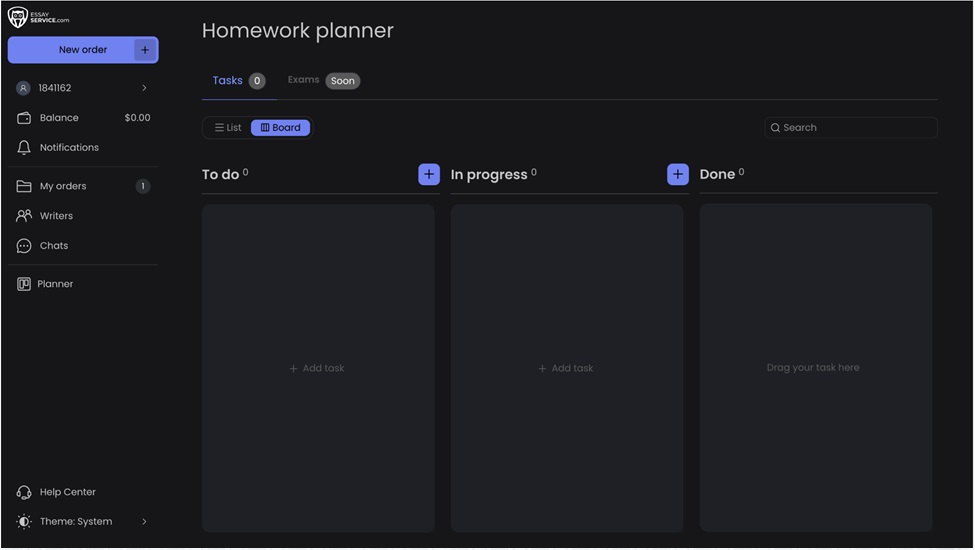
The Homework Planner lets you create a personalized calendar where you can input all your assignments, exams, and other important dates. It becomes super easy to visualize your workload at a glance.

But it’s not just a fancy calendar. The Homework Planner also has some clever features to help you stay on top of things. You can set reminders for upcoming deadlines, break down large tasks into smaller steps, and even track your progress as you complete each assignment.

We found that using the Homework Planner reduced our stress levels. It’s reassuring to know that everything is organized in one place, and we no longer have to worry about forgetting important deadlines or scrambling to finish assignments at the last minute.

EssayService’s Homework Planner is a fantastic tool for any student who wants to stay organized, boost their productivity, and achieve academic success.

Whether you’re a chronic procrastinator or a natural planner, this tool can help you take control of your workload and make the most of your time.
From Planning to Problem-Solving: Customer Support

After exploring the impressive Homework Planner, we turned our attention to another crucial aspect of the EssayService experience: their customer support. After all, even with the best tools, questions and issues can arise.

We’re pleased to report that our interactions with EssayService’s support team were overwhelmingly positive. They were consistently helpful, knowledgeable, and eager to assist us with any queries we had. No matter if we used live chat or email, they always got back to us quickly with helpful answers.

However, we did notice a slight delay in response times during peak hours, which is understandable given the high demand for their services. While this wasn’t a major issue for us, it’s worth noting for those who require immediate assistance.

Even though it took a little longer sometimes, the support team was always super helpful and patient. They even offered helpful tips and suggestions beyond our initial inquiries.

We have to admit EssayService’s customer support team is a valuable asset to the platform. While there might be slight delays during peak times, their dedication to assisting customers and resolving issues is commendable.
Quality: Delivering on the Promise of Excellence

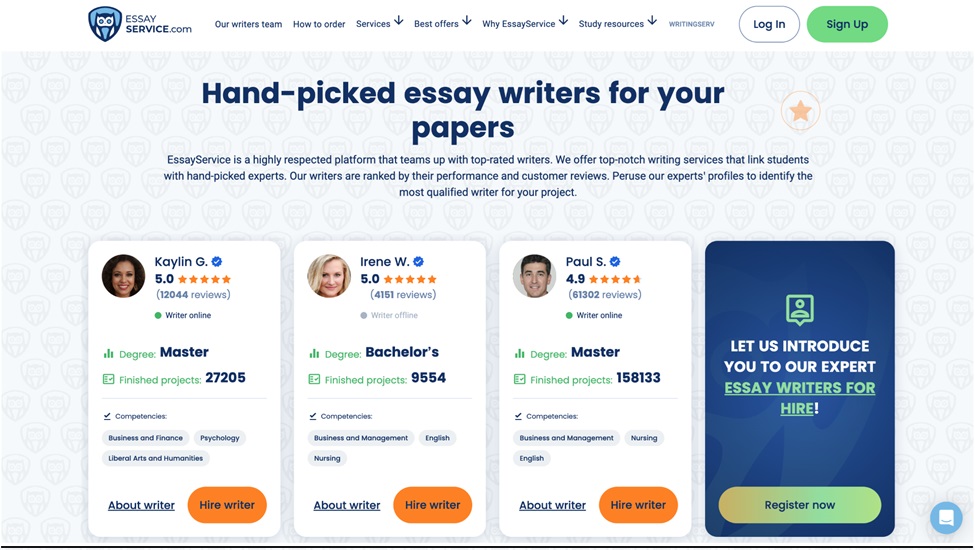
Now, let’s get to the heart of the matter: the quality of the work itself. We’re pleased to report that EssayService exceeded our expectations.

The essay we received was well-researched and meticulously written. It was clear that the writer had a deep understanding of the topic and a knack for crafting compelling arguments.

We also ran the essay through plagiarism and AI detection checks, and it came back clean. This commitment to originality and academic integrity is a major plus for any student worried about getting caught using a writing service.

Yet, there were a couple of minor areas where we saw room for improvement. The writing style, while grammatically sound, could have been a bit more polished and engaging. Additionally, incorporating a few more sources could have added further depth and nuance to the arguments.

However, despite these minor suggestions, the essay was still top-notch, demonstrating the expertise and professionalism of EssayService’s writers.

User Experience: Streamlined and Efficient, as Expected

EssayService’s platform is a testament to user-centric design. From the moment you land on their website, you’re greeted with a clean, intuitive layout that makes navigation effortless. Ordering is a piece of cake, with easy-to-follow instructions and helpful hints along the way.

During our evaluation, the platform performed flawlessly, with no technical glitches or downtime. This reliability ensures a smooth and uninterrupted user experience.

Several key features further enhance the impression. The real-time order tracking system keeps you informed about the progress of your essay, while direct communication with your writer fosters collaboration and ensures your expectations are met.

EssayService prioritizes user convenience, providing a streamlined and efficient platform that caters to students’ needs. From placing an order to receiving the final draft, the entire process is designed to be hassle-free and supportive.
Pricing: A Relief for Budget-Conscious People

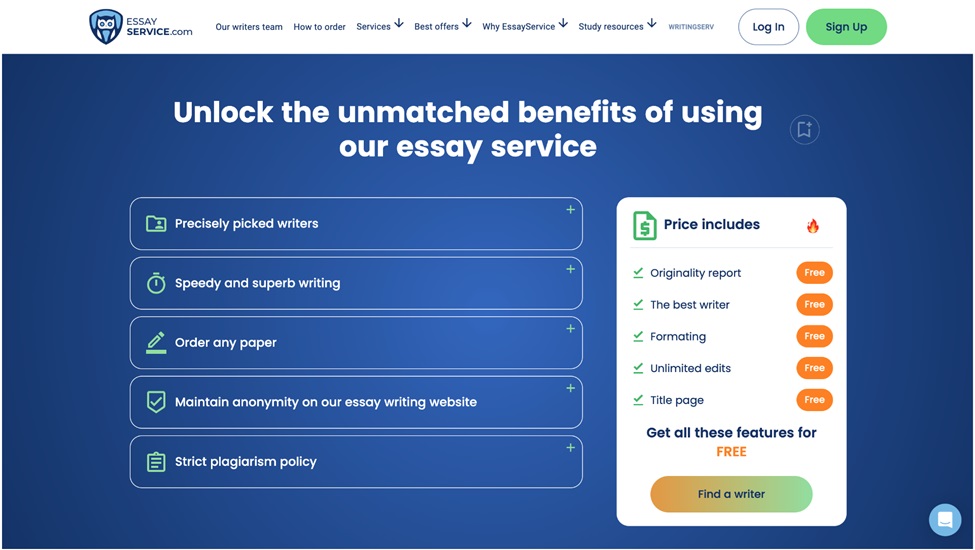
When it comes to pricing, EssayService pleasantly surprised us. For our evaluation, we ordered a 4-page research paper with a 7-day deadline, and we opted for the additional plagiarism and AI detection checks.

The final price (after applying our 15% discount) was a mere $41.99. That’s a steal, especially considering the exceptional quality of the work we received!

We did our research and compared EssayService’s prices to those of other services in the market. We found that their rates are consistently lower than those of many competitors.

This affordability, combined with high-quality work and reliable service, makes EssayService an excellent value for money. You get top-notch help with your schoolwork without having to skip meals or give up your Netflix subscription.
Let’s Wrap It Up

Our exploration of EssayService has left us thoroughly impressed. It’s a reliable and comprehensive platform that caters to students’ needs. All because it provides high-quality academic assistance at affordable prices.

The Homework Planner feature provides a practical and effective solution for managing the chaos of the school year. It’s a valuable tool for any student striving for organization and success.

While there’s always room for minor tweaks, like improving website navigation and ensuring even faster support during peak hours, these drawbacks are overshadowed by the platform’s numerous strengths. From their responsive customer support to their top-notch essay quality and commitment to originality, EssayService consistently delivers.

Start with their Homework Planner and experience the difference it can make in your studies. You won’t be disappointed!

Key Elements of Technical Analysis

0

We cannot ignore analysis while discussing trading and investing. Like a soldier’s armament before entering the war, analysis is a vital process for both traders and investors. An analysis is helpful not just for attacking (profit-seeking) but also for reducing risk, defending against battlefield threats, and even preventing death (margin call).

In trading and investing, we generally distinguish between two forms of analysis: technical analysis and fundamental analysis. But in this article, we’ll concentrate more on technical analysis.

Technical analysis is the process of examining price changes by using historical data, usually represented by charts. These historical price changes are shown in the chart.

Why do charts need to be used?

Price charts are always the main focus of technical analysis. Why is this important? The rationale is that each price movement depicted on a chart sums up the activities of all market participants. The chart gives data that may be evaluated in the future and reflects the actions of buyers and sellers in every price rally and decline.

Three aspects of technical analysis that require our attention

  1. Trend

The trend is the overall direction of price movement over a specific time period, typically seen in a daily timeframe. Trends can be categorized into three types:

  • Uptrend (Bullish): This occurs when the price of a financial instrument increases over a set period. The XAUUSD chart below illustrates an example of a bullish trend:
  • Downtrend (Bearish): A downtrend, or bearish trend, occurs when the price of a financial instrument declines over time. This is illustrated in the GBPUSD chart below:
  • Sideways Trend: In this case, the price of a financial instrument moves within a limited range without a clear direction. This can be seen as follows:
  1. Support and Resistance

Another essential aspect of technical analysis, along with trends, is support and resistance.

  • Support: Support is a lower price level that prevents further declines. It often forms based on historical data and serves as a future support level.
  • Resistance: Resistance, on the other hand, is the opposite of support, acting as a barrier that limits further price increases. Like support, resistance levels are shaped by previous price action, and prices may revisit them in the future.

These levels are important because they highlight key areas where significant market activity occurs, potentially signaling either a trend continuation or a trend reversal.

  1. Indicators

Tracking indicators is an important part of technical analysis, in addition to observing candlestick patterns. Indicators provide an additional tool to help make trading decisions. Popular indicators include trend indicators (such as moving averages and Bollinger Bands), oscillators (such as stochastic and the relative strength index), and volume indicators (such as volume and accumulation/distribution).

By monitoring and understanding these technical factors, investors and traders can gain deeper insights into the market, allowing them to make more informed adjustments to their trading and investment strategies. Technical analysis also confirms an asset’s fundamental outlook, offering extra support to the overall analysis.