DD
MM
YYYY

PAGES

DD
MM
YYYY

spot_img

PAGES

Home Blog Page 3025

Tekedia General Scholarship Fund Grows with Donations

0

Join me to thank Chinedu Chidolue of The Chidolue Law Firm for funding the future through a generous donation to Tekedia Institute General Scholarship Fund. Our slogan is “our product is knowledge” and our mission is to scale knowledge. Thank you for your generosity.

As always, our non-profit partner, IWB Africa (Ideas Worth Billions), a community of amazing young Africans, will handle the selection of Chinedu Chidolue Scholars. This is the working requirement: “Please kindly apply my little donation towards the brightest applicants that can’t afford the tuition. I once walked in their shoes”.

Every year, hundreds of learners attend our programs FREE through general scholarships funded by citizens and organizations. We thank them and wish them more wins. For Mr. Chidolue, we wish The Chidolue Law Firm, an immigration law firm in the United States, to grow from strength to strength.

Jumia Reports Q2 2024 Financial Results: Revenue Declines Amid Currency Devaluation, But Operational Metrics Improve

0

Jumia, a leading e-commerce platform in Africa, has released its financial results for the second quarter of Q2 2024, showing a 17% decline in revenue to $36.5 million, down from $44 million recorded in the same period last year.

Jumia attributed the decline to regional currency devaluations that impacted both Gross Merchandise Value (GMV) and Total Payment Volume (TPV). Despite these challenges, the company reported significant improvements in operational and financial metrics under the leadership of CEO Francis Dufay.

It reported a $20.2 million operating loss a decline, compared to $22.1 million in Q2 of 2023, down 8% year-over-year, and down 5% in constant currency. Adjusted EBITDA loss was $16.3 million, compared to a loss of $18.2 million in the second quarter of 2023, down 10% year-over-year, and down 11% in constant currency. Loss before income tax from continuing operations was $22.5 million in the second quarter of 2024, down 27% year-over-year.

Jumia reported a liquidity position of $92.8 million, a decrease of $8.7 million in the second quarter of 2024 as compared to a decrease of $39.1 million in the second quarter of 2023. Net cash flows used in operating activities was $8.4 million compared to net cash flows user in operating activities of $19.5 million in the second quarter of 2023.

Commenting on the report, the company wrote,

“Jumia delivered another quarter of acceleration in its usage trends along with improved cash efficiency. Continued execution against our strategic priorities drove a 7% year-over-year increase in Orders, while Orders per Customer, excluding JumiaPay app Orders, which do not incur logistics costs, climbed to 2.1 Orders in the second quarter of 2024. GMV improved 35% year-over-year in constant currency and we delivered GMV growth in reported currency in six of our countries in the second quarter, up from five in the first quarter of 2024, a sign that the Jumia’s value proposition continues to resonate with the African consumer.”

Also speaking, Jumia’s CEO Francis Dufay, said the company’s performance this quarter reinforces the belief that its strategy is working. He further noted that the deep understanding of the African e-commerce market as well as its unique asset base and strategy, positions Jumia for growth as the company progresses on its path towards profitability.

Moving forward, Jumia continues to take a disciplined and targeted approach to marketing spend focused on targeting more efficient marketing channels, such as search engine optimization (“SEO”), customer relationship management (“CRM”) and relevant offline local channels while also leveraging its Force network.

As a result of these efforts, Jumia is attracting a stickier and higher quality customer base as evidenced by a 262 basis point year-over-year improvement in repurchase rates in the first quarter of 2024. The company’s cohort analysis indicates that 36% of new customers, who placed an order for a product or a service on our platform in the first quarter of 2024, completed a second purchase within 90 days. This represents an improvement compared to 33% of new customers from the first quarter of 2023, who reordered within 90 days.

Its Fintech arm JumiaPay, recorded significant progress, after it saw its transactions reach 1.9 million, an increase of 31% year-over-year mainly driven by increased penetration of JumiaPay on delivery as well as the implementation of cashback campaigns and incentives conducted in the second quarter of 2024.

On the outlook for the remaining year, Jumia remains committed to reducing its losses and accelerating its progress towards cash efficiency and profitable growth. Based on the positive impact of its growth strategy, it projects an increase in both prefers and GMV in 2024.

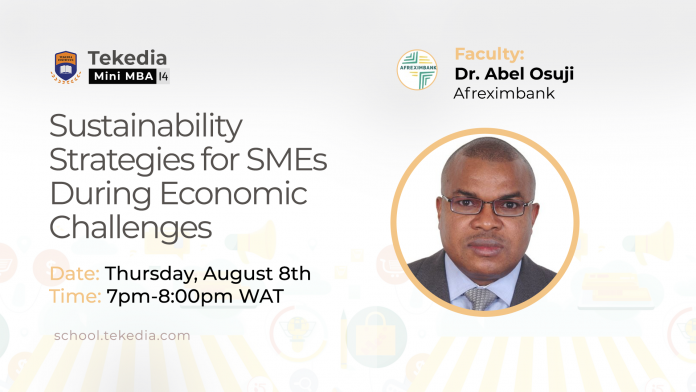
Sustainability Strategies for SMEs During Economic Challenges | Tekedia Mini-MBA

0

Across Africa, there are many economic perturbations. In Nigeria, recently, we have seen how rising energy costs, forex paralysis, and other vectors, are affecting the abilities of small and medium scale enterprises (SMEs) to pursue their strategic missions in the market. 

According to the nation’s tax agency, FIRS, more than N1.7 trillion revenue disappeared in 2023, and thousands of companies faded in the broad manufacturing  industry. Within those manufacturers, some are at the small and medium phases of their growth.

The implications of these economic turbulence are huge, not just to the state’s revenue, but also to the companies. Tomorrow, at Tekedia Mini-MBA, our Faculty, Dr Abel Osuji, from Afreximbank, Africa’s bank of this decade, in our opinion, will be teaching on “Sustainability Strategies for SMEs During Economic Challenges”.

We will webcast it on this page for non-Tekedia Mini-MBA community members. For current learners, the Zoom link is in the class board.

Tekedia Mini-MBA >> our product is Knowledge 

Winning The Future As Team Nigeria

0

Good People, thank you for the kind words for my piece which challenged our leaders to understand that what happens in one region is affecting all of us. If you visit any village where family clans have the notion that for a clan to thrive, the other must diminish, you will see a lost village. But if you visit one where all clans work together, you get a prosperous and healthy community. 

So, Mr. President, as you work to fix the nationwide protest, do not forget the sit-at-home protest. I challenge you to solve that problem because since that protest started, Nigeria’s economic position has deteriorated. I can provide you hard numbers to show how we are losing 4% of national economic output for more than half a decade!

I am compelled to comment because in your speech this morning, you omitted that sit-at-home protest. But you cannot fix the nationwide one sustainably without fixing that, as Nigeria cannot attain economic equilibrium without SE operating at full capacity!

So, if Northeast Nigeria is under the challenges of insurgency, all Nigerians should feel the pulse because if the root cause is not resolved, sooner or later, food inflation will become the norm – and everyone will pay the price. So, the re-orientation that our challenges cannot be regionalized is fundamental and important.

 And our national leaders must see the regional challenges as national. Indeed, fixing the current national protests must also include fixing the sit-at-home protests in the Southeast!

Finally, my post was NEVER to seek any sympathy for any region. I am simply telling Nigeria that when your past seems more memorable than the present, it means there is a problem. And fixing that problem does mean working as ONE PEOPLE because Nigeria’s challenges are huge when you look at our population and economic opportunities. So, optimizing every inch in the nation and making sure everyone is working should be the playbook. 

Nigeria Must Solve Southeast Sit-At-Home And Nationwide Protests To Advance Opportunities

Revolutionizing Intimacy: How Emerging Tech is Shaping Personal Connections

0

Technology’s impact on personal connections in an age where digital interactions often replace face-to-face meetings is profound and complicated. As we navigate through the digital era, new forms of technology enhance methods of connecting and fundamentally alter the emotional landscape of relationships. This article explores how emerging technologies revolutionize how we experience intimacy and build connections in modern society.

Virtual Reality for Deepening Emotional Connections

Virtual Reality (VR) has evolved beyond mere gaming experiences to deepen emotional bonds between people. By creating shared virtual spaces, individuals can experience closer connections even when far apart.

  • Empathy and Experience Sharing: VR allows people to step into each other’s shoes, giving couples in long-distance relationships an immersive experience that feels as real as face-to-face meetings. Couples can enjoy virtual dates that feel nearly as realistic as meeting in person: exploring new cities, watching sunsets, or just sitting together in simulated reality- this can strengthen emotional ties drastically!
  • Therapeutic Uses: Therapists have begun using VR to assist couples in cultivating empathy and better understand each other. 
  • Enhanced Realism: On cam-to-cam websites, VR can transport users to fully immersive environments where they can interact in real time, improving the depth of their communication and emotional engagement. Whether a virtual coffee shop or a scenic park, these platforms make virtual meetups increasingly lifelike and meaningful.

By experiencing another’s viewpoint in an immersive virtual reality setting, individuals can fully see their partner’s experiences and emotions, leading to deeper emotional intimacy.

Wearable Technology: Building Connection Through Physical Touch 

Wearable tech is revolutionizing our relationships by simulating physical sensations despite geographical distance. Devices like intelligent wristbands and connected garments can simulate feelings such as touch, squeeze, and heartbeat to bridge digital and physical presence.

  • Haptic Feedback Devices: These gadgets utilize haptic feedback to simulate physical touch. When one person taps their bracelet, its counterpart device vibrates or heats up – providing the sensation of physical contact without actually experiencing physical touch!
  • Emotion Transmission: Some cutting-edge wearables can transmit heartbeat rhythms or mimic muscle movements to transmit emotions nonverbally and increase feelings of closeness between wearers.

Artificial Intelligence: Customizing Emotional Interactions

Artificial Intelligence (AI) is at the forefront of customizing emotional interactions online. AI algorithms can analyze communication patterns to suggest times to talk, recommend activities to enhance relationships, or even anticipate emotional needs before they are expressed directly.

  • Communication Enhancement: AI can aid partners by analyzing text messages and voice communications to gain insight into emotional states and relationship dynamics.
  • Predictive Personalization: By learning from interactions, AI technologies can suggest small acts of kindness or thoughtful gestures at just the right moments – further strengthening bonds between people.

Blockchain Technology and Trust: Building Privacy

In personal relationships, blockchain provides an unrivaled advantage by offering a decentralized, secure, and private communication platform.

  • Secure Messaging: Blockchain technology enables secure messaging apps where only participants in an exchange have access, maintaining privacy for your conversations.
  • Trust in Digital Interactions: Using blockchain, platforms can verify identities without disclosing personal information to users, creating a safer online interaction experience and increasing confidence.

As technology progresses, its effect on personal relationships cannot be denied. From VR and wearables to AI and blockchain technologies, each innovation brings more immersive, personalized, and secure forms of intimacy than ever before. Technology cannot replace human touch entirely, but it unquestionably enhances how we connect, understand, and relate in digital environments.

Conclusion 

In summary, the future of personal relationships lies within technology innovators and users who use these tools to enhance their relationships. As we explore more possibilities, it becomes evident that technological development will redefine intimacy as more accessible, meaningful, and secure for all parties involved. This shift is visible across many modern services — you can learn more about Lauradate as one example of a platform built around these evolving expectations.