DD
MM
YYYY

PAGES

DD
MM
YYYY

spot_img

PAGES

Home Blog Page 3035

Zachxbt Exposes a Network of Developers, as Banca Sella to offer Bitcoin Trading

0

In a startling revelation, the blockchain investigator known as ZachXBT has brought to light a sophisticated network of North Korean developers allegedly involved in the crypto industry. According to recent findings, this group comprises 21 individuals who have been working on over 25 cryptocurrency projects, generating up to $500,000 a month. This discovery not only highlights the intricate connections between technology and international relations but also raises significant concerns regarding cybersecurity and the potential misuse of cryptocurrency for geopolitical ends.

The investigation, spearheaded by ZachXBT, indicates that these developers, using fake identities, have been deeply embedded within the crypto ecosystem. The ramifications of this are manifold, with implications for the security of crypto assets and the integrity of the projects involved. It is reported that a substantial amount of money, estimated at $1.3 million, was siphoned off from a project’s treasury due to malicious code introduced by these developers. This incident underscores the vulnerabilities that exist within the digital asset space and the need for rigorous security protocols.

The funds accrued by this network are believed to be funneled back to support North Korea’s sanctioned activities, including its weapons programs. This linkage is particularly concerning as it suggests a methodical approach to leveraging the anonymity and fluidity of cryptocurrencies for funding state-level agendas. The Office of Foreign Assets Control (OFAC) has sanctioned individuals such as Sim Hyon Sop and Sang Man Kim, who are allegedly connected to these operations, further indicating the gravity of the situation.

The exposure of this network also sheds light on the broader issue of the use of cryptocurrencies in international sanctions evasion. Cryptocurrencies, by their very nature, offer a degree of anonymity and can be transferred across borders with ease, making them an attractive tool for entities looking to bypass economic sanctions. This case exemplifies the challenges that regulators and law enforcement agencies face in tracking and curbing illicit financial flows in the digital age.

Moreover, the overlap of Russian Telecom IP addresses among developers claiming to be based in the United States and Malaysia points to a complex web of deceit and international collaboration. Such findings highlight the global nature of the crypto industry and the difficulties in establishing clear jurisdictional oversight.

As the crypto industry continues to evolve, it becomes increasingly important for projects to conduct thorough due diligence on their team members and collaborators. The ZachXBT investigation serves as a cautionary tale for the crypto community, emphasizing the need for heightened vigilance and robust security measures. It also calls for greater cooperation between the crypto industry and regulatory bodies to ensure the integrity of the digital economy and to prevent the misuse of technology for unauthorized activities.

The unfolding of this story is a stark reminder of the intersection between technology and geopolitics. It illustrates how the decentralized and borderless realm of cryptocurrencies can become entangled with the strategic objectives of nation-states. As the world grapples with the implications of this revelation, it is clear that the conversation around cryptocurrency regulation and security is more pertinent than ever.

Banca Sella to offer Bitcoin Trading to over 1.3M Customers in Italy

Banca Sella, Italy’s second oldest bank, has taken a significant leap into the future of finance by offering Bitcoin trading to its 1.3 million customers. This move is not just a milestone for Banca Sella but a monumental moment for the cryptocurrency world and its growing acceptance in mainstream banking.

Founded in 1886, Banca Sella has been at the forefront of banking innovation in Italy. The bank’s decision to integrate Bitcoin trading into its services is a response to the increasing demand for digital currency solutions and the growing interest in cryptocurrency investments among the general public.

The service will be available through Banca Sella’s mobile banking platform, Hype, which was developed in collaboration with Illimity Bank in 2021. Hype is designed to facilitate Bitcoin transactions without the need for traditional cryptocurrency exchanges, providing a seamless and secure trading experience for users. To ensure the safety of transactions and manage risks, Banca Sella has implemented restrictions on yearly Bitcoin trades for its customers, with varying limits based on the type of account they hold.

Firstly, the Banca Sella bank has introduced a tiered system for Bitcoin trading limits, which varies depending on the type of account held by the customer. For instance, “Hype Start” account holders can transact up to $2,700 annually in Bitcoin, while “Plus” and “Premium” members have higher limits set at approximately $54,000 per year. This not only provides flexibility for users but also helps manage the bank’s risk exposure.

Moreover, Banca Sella’s mobile banking platform, Hype, developed in collaboration with Illimity Bank, allows users to trade Bitcoin directly without the need for traditional cryptocurrency exchanges. This direct trading capability reduces the layers of transaction processes, thereby minimizing the potential security risks associated with third-party exchanges.

The Hype platform also incorporates a sophisticated three-key system of integrated technology, which ensures that customers hold the custody and therefore the ownership of their currency. This system is a significant safeguard against hacker attacks, identity theft, or loss.

Additionally, Hype enables users to send Bitcoin to contacts in their address book and make purchases wherever cryptocurrency is accepted. The ease of use and the removal of complexities in trading Bitcoin directly through the Hype service provide a secure and user-friendly experience.

Banca Sella’s proactive measures reflect its commitment to providing a secure and innovative trading environment for its customers, aligning with the bank’s legacy of pioneering banking solutions. As the financial world continues to evolve with the integration of cryptocurrency, Banca Sella stands at the forefront, offering a secure bridge between traditional banking and the future of digital transactions.

This strategic initiative by Banca Sella arrives at a time when institutional investors are showing a heightened interest in Bitcoin. Major financial players such as Goldman Sachs and Morgan Stanley have recently acknowledged Spot Bitcoin ETFs, indicating a bullish outlook for the cryptocurrency market.

Despite the volatile nature of Bitcoin, with prices fluctuating between $58,000 and $60,000, the market is showing signs of consolidation. The daily average token transfer volumes have seen an increase, suggesting a mix of panic selling and resilient demand for the asset. This indicates that investors are actively engaging with Bitcoin, even amidst uncertain market conditions.

Banca Sella’s move to offer Bitcoin trading is not only a testament to the bank’s innovative spirit but also reflects the changing landscape of financial services. As traditional banking intersects with the burgeoning crypto ecosystem, Banca Sella is positioning itself as a forward-thinking institution ready to embrace the future of finance.
Nigeria Buy Now Pay Later Market Experiences Remarkable Growth, Projected to Reach $2.4 Billion by 2029

0

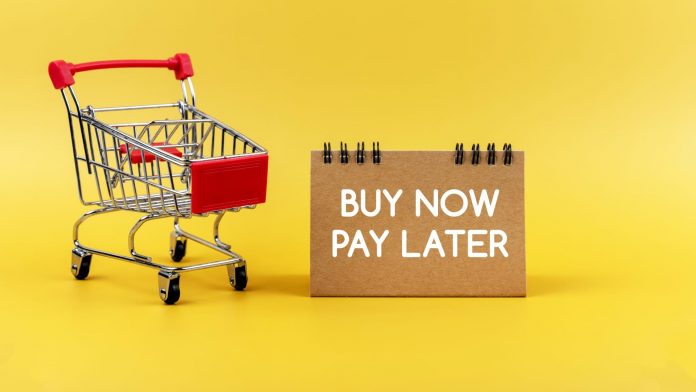
In a report by Research and Markets, Nigeria’s Buy Now Pay Later (BNPL) is poised for significant growth, with growth merchandise value (GMV) predicted to increase from $1.22 billion in 2023 to an impressive $2.4 billion by 2029.

This forecast underscores the rapid adoption of BNPL services in Nigeria, driven by a growing demand for flexible payment options among consumers and the expansion of digital financial services.

The report revealed that the BNPL payment industry in Nigeria, currently has an estimated market value of $1.4 billion, which has recorded strong growth over the last four quarters, supported by increased e-commerce penetration.

It is worth noting the BNPL model, which allows consumers to make purchases and pay for them in installments, has quickly gained traction in Nigeria. This payment option is particularly appealing, due to the country’s current economic climate, as it enables consumers to maintain their standard of living despite the financial pressures caused by inflation. By offering a way to defer payments without incurring high interest rates, BNPL services are helping Nigerians manage their finances more effectively.

As the cost of goods and services continues to climb, many Nigerians are finding it increasingly difficult to make upfront payments for essential items. This financial strain has led to a surge in demand for alternative payment options, with BNPL emerging as a particularly attractive solution. This has led to a shift in consumer behavior, with more people seeking flexible payment options that allow them to spread the cost of purchases over time.

Africa’s leading e-commerce platform Jumia is at the forefront in this regard, after it announced two new Buy Now, Pay Later (BNPL) partnerships in Nigeria with Newedge (Easybuy), an innovative finance company in Nigeria, and CredPal, a leading Nigerian fintech company.

These partnerships are expected to expand Nigerian consumers’ access to Jumia’s marketplace, conveniently allowing them to make purchases and spread their payments over a set period while removing the barrier of immediate payment. Notably, the addition of the BNPL option is an exciting and innovative way to drive e-commerce adoption and accessibility while expanding the purchasing power of our customers.

Also, several fintech companies which include Carbon, PayFlexi, and CredPal, amongst others, have recognized the potential of the BNPL market in Nigeria and are rapidly expanding their services to meet growing demand. These companies are partnering with merchants across various sectors, to offer consumers more choices and greater flexibility in how they pay for their purchases.

For merchants, the BNPL model presents an opportunity to attract and retain customers who might otherwise be unable to afford their products. By offering installment payment options, businesses can increase their sales and improve customer satisfaction. At the same time, consumers benefit from the ability to make necessary purchases without the immediate financial burden.

The BNPL market’s growth in Nigeria is also supported by the increasing adoption of digital payment solutions. As more Nigerians turn to online shopping and digital transactions, BNPL providers are well-positioned to capture a larger share of the market.

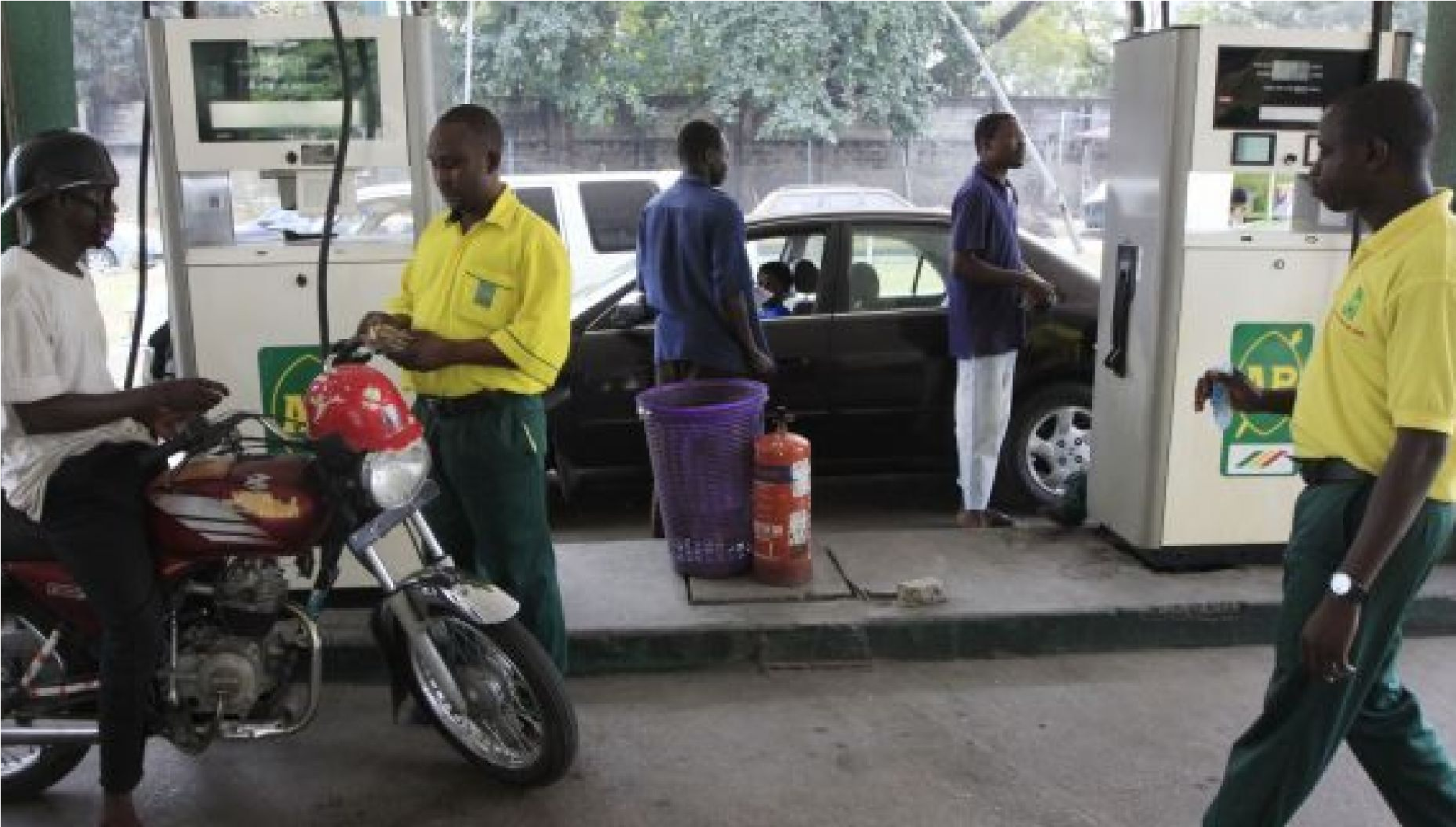
Nigeria Has Spent N9.3tn on Petrol Subsidy in 19 Months Despite Government Denials

0

In a startling revelation, recent data has shown that Nigeria’s government has spent a staggering N9.31 trillion on petrol subsidies in just 19 months, covering the final five months of former President Muhammadu Buhari’s administration and the first seven months under President Bola Tinubu.

This enormous expenditure, which surpasses the N8.15trn spent on subsidy in 16 years, has occurred despite repeated official claims that the petrol subsidy was abolished, exposing the heavy financial burden it continues to place on the nation’s economy.

When President Tinubu took office on May 29, 2023, he declared the end of the petrol subsidy in his inaugural speech, marking what was supposed to be a turning point in Nigeria’s economic policy. However, despite this public commitment, the government has continued to spend massively on what it now refers to as “shortfalls” rather than subsidies. NNPCL said the government now requires it to sell PMS at half the landing cost, with the difference being reconciled between NNPCL and the federation.

This rebranding effort was aimed at maintaining the narrative that the subsidy had been removed, but the financial implications tell a different story.

According to data compiled by Agora Policy and supported by sources such as FAAC communiqués, NEITI reports, and the NNPC Limited’s 2023 Annual Financial Statements (AFS), Nigeria spent N5.10 trillion on petrol subsidies in 2023 and an additional N4.21 trillion in the first seven months of 2024. This spending, far from decreasing, has escalated significantly compared to previous years, largely due to economic factors such as the devaluation of the naira.

Recently, Tinubu reportedly asked the NNPC to use the 2023 final dividends owed to the federation to pay for petrol subsidies. Additionally, the president agreed to suspend the 2024 interim dividend payments to the federation, allowing NNPC to bolster its cash flow amidst the mounting financial pressure.

This decision is part of a broader effort by the government to manage the subsidy payments discreetly, even as public discourse continues to focus on the supposed end of the subsidy regime. The NNPC has forecasted that the cumulative petrol subsidy bill from August 2023 to December 2024 will reach N6.884 trillion, highlighting the ongoing financial challenges posed by these “shortfalls.”

Impact of Naira Devaluation

The government’s narrative is further complicated by the significant devaluation of the naira following the liberalization of the foreign exchange market in 2023. Since this policy shift, the naira has lost over 60% of its value, with the exchange rate soaring from N740 per dollar in June 2023 to N1,600 per dollar recently. This depreciation has had a profound impact on the cost of petrol imports, leading to a sharp increase in the subsidy bill.

Analysts have noted that although Tinubu’s initial announcement of the subsidy removal in May 2023 saved the government N400 billion by June, the benefits were quickly eroded by the adverse effects of the naira’s devaluation.

Analysis from Agora Policy shows that Nigeria’s subsidy as a percentage of GDP rose to 2.2% in 2023, the highest level since 2011, despite the government’s claims of subsidy removal. This increase underscores the disconnect between the official narrative and the economic realities that continue to place a heavy burden on Nigeria’s finances.

The Lingering Petrol Subsidy Story

Nigeria’s struggles with petrol subsidies are not new. From 2006 to 2021, the country spent N8.15 trillion on subsidies. When including the period up to mid-2024, total expenditure balloons to N20.37 trillion. The year 2022 alone saw a subsidy bill of N2.911 trillion under Buhari’s administration, demonstrating the persistent financial strain these subsidies have placed on the country.

In August 2023, the NNPC’s fuel importation costs shifted from a surplus to a negative balance, resulting in a subsidy bill of N52.73 billion. The situation worsened over the following months, with the subsidy bill peaking at N833.68 billion in April 2024. In 2023, the NNPC raised alarms, stating that the subsidy payments were severely impacting its cash flow and threatening its viability as a “going concern.”

The NNPC also expressed concerns about its ability to sustain petrol imports, attributing its difficulties to “forex pressure.” Although the subsidy bill slightly decreased to N537.66 billion in December, it surged again to N693.67 billion in January 2024.

The ongoing payments, despite being labeled as “shortfalls,” have exposed the government’s difficulty in transitioning away from the subsidy regime. The economic strain has been compounded by the naira’s devaluation, leading to a situation where the supposed savings from ending the subsidy have been more than offset by rising costs.

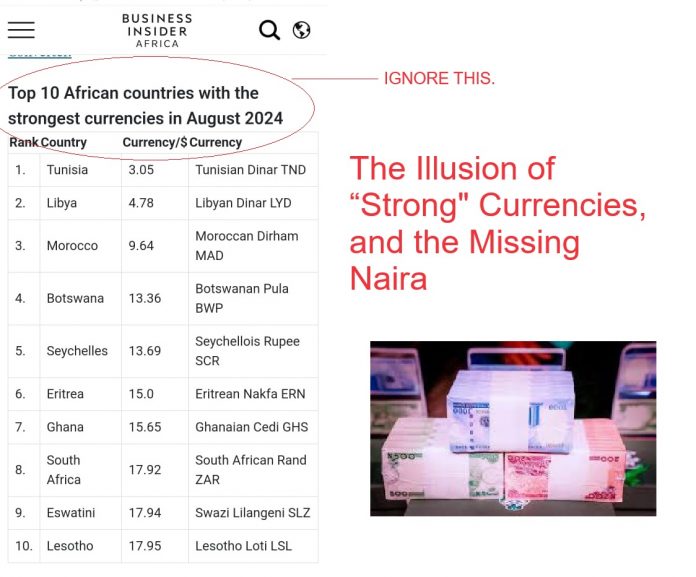
The Illusion of “Strong” Currencies, and the Missing Naira

1

You might have seen the Business Insider article where it ranked the “strongest” currencies in Africa, and our Naira was missing.  Let me help here because BI was totally wrong.

In 2007, when Ghana pegged $1 = 1Cedi (days before that translation, it was $1 = 10,000 old Cedis), Naira was trading around $1= N125. Today, both are about $1 = 15Cedi and $1 = N1600 which means Naira is still ahead.

Nigeria can decide to cut-out two digits in the exchange value with USD (you need to spend money on that as every contract in Nigeria will be off by two digits). Seriously, the strengths of currencies are not defined by pure exchange rate values. This BI article is fundamentally defective and should be ignored. That is not how to rank currencies. 

Note: I USD = 144 Japanese Yen. Does it mean those currencies are “stronger” than Yen? Also, 1USD = 1,325 South Korean won. Does it also mean that Ghana’s Cedi is stronger than South Korea’s Won?

Here is the deal: Central banks work to stabilize national currencies by managing inflation (and some others like the US Federal Reserve add the additional role of boosting employment/economic output via interest rate management). The absolute number is marginal provided that number is stable. So, it is the STABILITY (yes, volatility) that matters. 

If Naira is N3,000 and stays within a range of N2990 – N3010 over 6 months, you are better off there than Naira which is oscillating around N1000 to N1600 over the same period.

But if you have to measure by “strong”, consider purchasing power parity. Purchasing power parity (PPP) is a currency conversion rate that compares the purchasing power of different currencies by adjusting for price level differences between countries. It’s calculated by dividing the price of a basket of goods in one location by the price of the same basket in another location. The basket of goods includes those that are part of final expenditures, such as household and government consumption, fixed capital formation, and net exports. PPP is measured in national currency per US dollar.

The Chinese Continue to Collect Over Failed Ogun State Deal – Confiscates Nigerian Jet in Canada

1

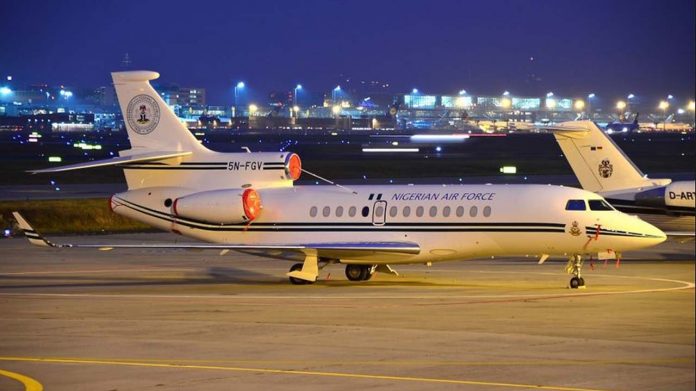
The Chinese continue to collect: “The escalating legal confrontation between Nigeria and Zhongshan Fucheng Industrial Investment Ltd, a Chinese firm, has turned a new leaf, as Zhongshan confiscates another luxury jet owned by Nigeria in Canada. This move is part of a broader campaign by Zhongshan to recover assets as compensation for an unresolved arbitration award.”

This paralysis is coming from Ogun State but nobody knows Ogun or any state outside Nigeria. If the Nigerian government signed a sovereign guarantee on the transactions, Nigeria should step forward, and take over all elements of this arbitration from Ogun State.

Simply, no one cares about what Ogun State is saying now. What matters now is how Nigeria will get itself out of this maze. If you look carefully, it was not only the Chinese company that was affected (yes, Nigerian companies could have been harmed also). However, the difference here is that it was only the Chinese firm which might have received a sovereign guarantee from Nigeria.

It is a lesson for Nigerian leaders: you do not just abandon projects recklessly. Sure, I am not passing any judgment on this particular case; I am simply saying we need to do better. In Imo State a few years ago, a new governor came and froze a real estate project started by his predecessor, with no feeling that ordinary citizens took loans to invest in that project. In Kano, a governor bulldozed a fully developed project. They did those things and got away, but here, we are learning how it could look when the victims are not Nigerians and Nigerian companies.

Chinese Firm, Zhongshan Fucheng, Seizes Another Nigeria’s Jet in Canada