DD
MM
YYYY

PAGES

DD
MM
YYYY

spot_img

PAGES

Home Blog Page 3053

Meta Unveils Llama 3.1 Impact Grants to Empower AI-Driven Organizations Across Africa, Others, With $2 Million

0

Meta has announced the launch of the Llama 3.1 impact Grants, to empower AI-Driven organizations across Africa, the Middle East, and Turkey.

The tech giant is continuing its commitment to supporting innovative use cases of open-source AI to address critical global challenges. Building on the success of previous grant programs, the Llama 3.1 Impact Grants will provide up to $2 million USD in funding to organisations worldwide.

The Llama 3.1 Impact Grants program invites proposals from organisations with ideas for using Llama 3.1 to address social challenges in their communities. Applications in areas such as economic development, science and innovation, public service and more will be given special consideration. Selected recipients will receive up to $500,000 USD and winners will be announced early next year.

Speaking about the grant, Kojo Boakye, Meta Vice President, Public Policy, Africa, the Middle East, and Turkiye, Kojo Boakye said,

“We’re inspired by the diverse projects we’ve seen developers undertake around the world to positively impact their communities by building with Llama. We believe AI has more potential than any other modern technology to increase human productivity, creativity, and quality of life and to accelerate economic growth while unlocking progress in medical and scientific research. The Llama 3.1 Impact Grants program presents an opportunity to further empower organizations to leverage AI for social good and to drive meaningful change.”

To support prospective applicants, Meta will host a series of regional events, including virtual events, in-person hackathons, workshops, and training sessions in Egypt, Hong Kong, India, Indonesia, Japan, the Kingdom of Saudi Arabia, Korea, Latin America, North America, Pakistan, Singapore, Sub-Saharan Africa, Taiwan, Thailand, Turkey, the United Arab Emirates and Vietnam.

These events will provide technical guidance and mentorship, fostering the development of impactful applications of Llama 3.1 in local contexts. Organisations participating in these events will be eligible for additional specialised awards of up to $100,000 USD.

The inaugural Llama Impact Grants, announced in October 2023, received over 800 applications from 90+ countries. The 20 finalists have submitted their final proposals, and the grant recipients will be announced in September, alongside the recipients of the Llama Impact Innovation Awards.

All proposals will be evaluated using the selection criteria which are as follows;

  • Must not be an individual, a sole proprietor, or sole-owner entity in the jurisdiction where it is formed; 
  • Be an entity that is duly formed prior to August 5, 2023, and in good standing under the laws of the jurisdiction in which the Organization was formed; 
  • Have the legal right to participate in this Award Program and its participation will not violate any agreement or obligation between the organization and any third-party; 
  • Must appoint and authorize one individual (the “Applicant”) to represent, act, and submit a Proposal on behalf of the Organization; 
  • The Applicant must be an employee of or affiliated with the organization and must be at least eighteen (18) years of age and the age of majority in the Applicant’s jurisdiction of residence. 

According to Meta, the application window for the Llama 3.1 Impact Grants is open from Monday, August 5, 2024, to Friday, November 22, 2024. Interested organizations are advised to apply here. Meta encourages eligible organizations to submit their proposals and take advantage of this opportunity to drive social impact through AI. 

US Judge Rules Google “A Monopolist” – Potentially Breaking Its Dominance, with Wider Impact on Apple and Mozilla  

0

In a groundbreaking decision that could dramatically alter the digital landscape, U.S. District Judge Amit Mehta declared that Google had violated U.S. antitrust laws with its search business. This pivotal ruling marks a substantial challenge to Google’s market dominance and opens the door to significant changes in how internet users access information.

“After having carefully considered and weighed the witness testimony and evidence, the court reaches the following conclusion: Google is a monopolist, and it has acted as one to maintain its monopoly,” Judge Mehta stated. “It has violated Section 2 of the Sherman Act.”

The ruling’s implications are profound, not only for Google but also for its partners who benefit from the tech giant’s market position. Speculation quickly arose regarding the impact on Apple, which reportedly receives up to $20 billion annually from Google to prioritize its search engine on iPhones through the Apple Safari web browser.

While Apple might feel the pinch, the company’s vast and diversified revenue streams provide some cushion against the financial blow.

However, the scenario is starkly different for Mozilla, the non-profit organization behind the Firefox web browser. Mozilla relies heavily on its search deal with Google, which directs user queries to Google’s search engine. According to Mozilla’s latest financial statement, Google’s payments constituted a staggering $510 million out of the foundation’s $593 million revenue. The potential loss of this revenue poses an existential threat to Mozilla.

In response to the ruling, Mozilla struck a resolute tone.

“Mozilla has always championed competition and choice online, particularly in search,” a spokesperson told Fortune. “We’re closely reviewing the court’s decision, considering its potential impact on Mozilla and how we can positively influence the next steps…Firefox continues to offer a range of search options, and we remain committed to serving our users’ preferences while fostering a competitive market.”

Mozilla’s predicament underscores the broader consequences of the ruling. Originally rising to prominence in the late 1990s as a community-driven project to challenge Microsoft’s Internet Explorer, Mozilla now struggles to stay relevant in a market dominated by Big Tech. The organization has already faced significant challenges this year, including layoffs of about 60 staffers and the resignation of its CEO.

Critics of the judge’s ruling are likely to highlight Mozilla’s potential downfall as an unintended consequence of the antitrust decision, arguing that it could harm smaller tech players more than the giants it aims to regulate. Some might contend that Mozilla has not sufficiently leveraged its financial support from Google to innovate and differentiate its Firefox browser and could potentially seek alternative partnerships, such as with Microsoft’s Bing.

The ruling’s immediate future involves Google’s expected appeal, indicating a protracted legal battle. Moreover, the judge’s upcoming decision on the remedies to impose on Google will be crucial. These remedies could range from forbidding Google’s payments to partners altogether, capping the fees for distribution agreements, pushing for the implementation of a “choice screen” on devices, or other measures.

According to Evercore ISI research analyst Mark Mahoney, it could take another six months to a year, or even longer if the judge decides to stay the remedies phase pending Google’s appeal, before the exact penalties are determined.

“This victory against Google is a historic win for the American people,” Attorney General Merrick Garland said, emphasizing the ruling’s significance. “No company — no matter how large or influential — is above the law.”

White House Press Secretary Karine Jean-Pierre echoed this sentiment, stating, “As President Biden and Vice President Harris have long said, Americans deserve an internet that is free, fair, and open for competition.”

The decision also touches on broader antitrust efforts targeting Big Tech, with potential implications for other giants like Apple and Amazon, both of whom are embroiled in their own antitrust battles. Additionally, the ruling could influence the Justice Department’s case against Live Nation, given the centrality of exclusivity deals in that lawsuit.

Moreover, the ruling raises critical considerations regarding the future of artificial intelligence (AI). Critics argue that Google’s search monopoly, driven by its exclusive agreements, provides it with an unparalleled data advantage, which is crucial for developing superior AI models. Microsoft CEO Satya Nadella highlighted this concern during the trial, suggesting that Google’s dominance in search could translate into a formidable lead in AI, potentially stifling innovation from other tech firms.

However, the ruling against Google is more than a legal rebuke; it signals a potential seismic shift in the tech industry, challenging the established order and aiming to foster a more competitive digital marketplace.

Fitch Ratings Downgrades Dangote Industries Limited

2

Unbelievable for Aliko Dangote and his business:

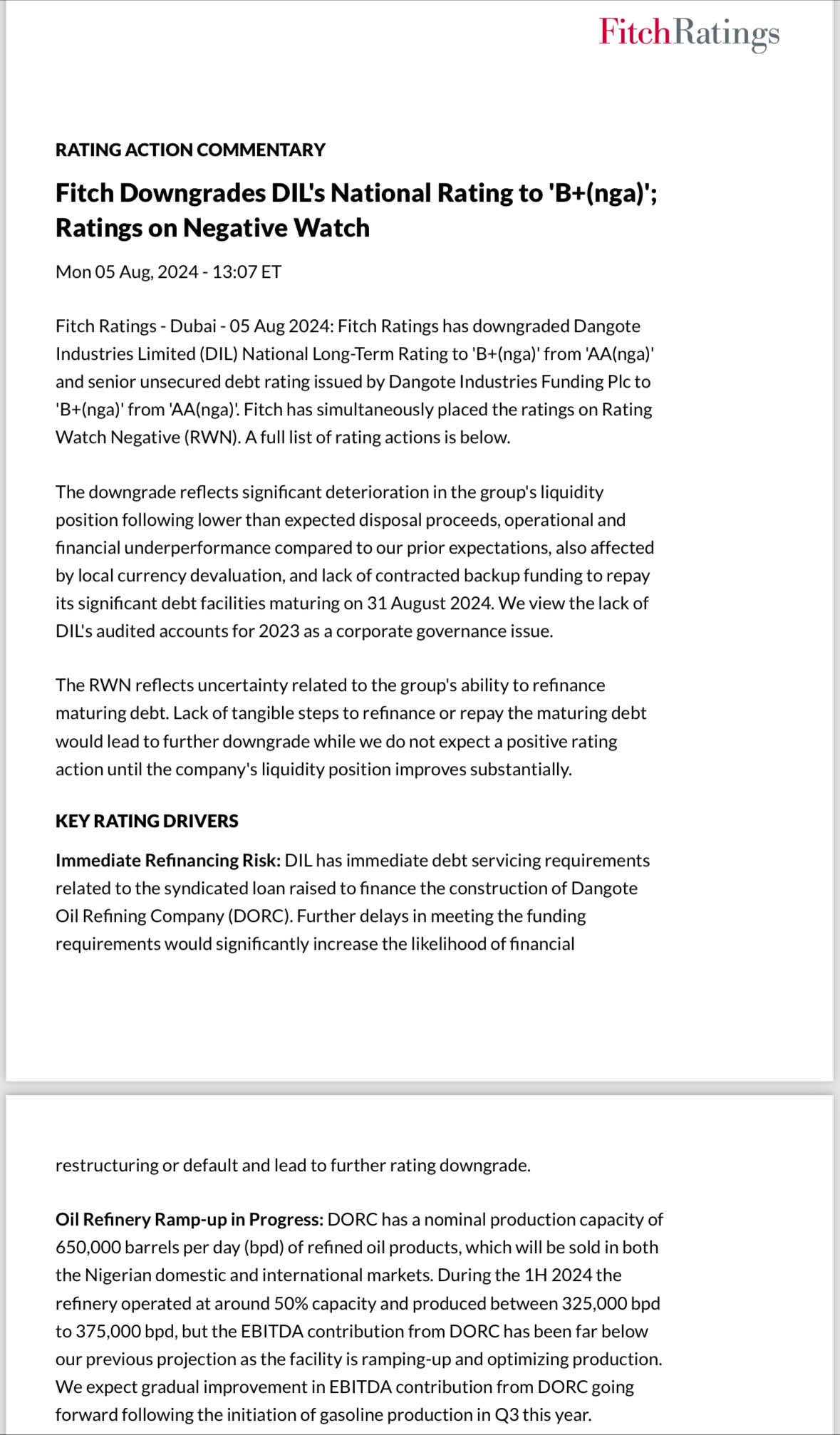
“Fitch Ratings has downgraded Dangote Industries Limited’s (DIL) credit rating to B+ and placed it on ratings watch negative, citing concerns about its liquidity and ability to raise money. The downgrade reflects significant deterioration in the group’s liquidity position following lower than expected disposal proceeds, operational and financial underperformance compared to prior expectations. This development is particularly concerning given that DIL operates what will be Africa’s largest oil refinery once fully operational, a 650,000 barrel per day facility in Nigeria. The downgrade has sparked discussions about the broader implications for Nigeria’s business environment and the challenges faced by the country’s oil industry.” – X summary.

According to  Fitch Ratings, Dangote Group plans to divest 12.75% stake in Dangote Petroleum Refinery over liquidity concerns. In a statement on Monday, Fitch said Dangote Group plans to use the proceeds from the stake sold to service a sizable syndicated loan that matures on August 31, 2024.

Good People, this is a partial downgrade of Nigeria’s manufacturing sector. Do not imagine the possibility of Dangote Industries defaulting on these loans. That will mean your salt, your cement, your … will now be made by your village native doctor (he can turn the sand in the village square to salt, etc), as many have wished for ages. But for most of us, it would be REALLY bad.

Someone needs to help Dangote, not because he is a businessman, but because if the world abandons him, because  Nigeria is throwing him under the bus, most things will crash.

Jumia Has A Future in JumiaPay

1

Jumia has done well and the new CEO has executed a solid business playbook, exiting markets and focusing on areas of potential growth.  Within quarters, they have reduced operating loss from about $50 million to $22.1 million per quarter. 

However, by cutting out some units like Jumia Foods, revenue has dropped, from $44m (in Q2 2023) to now $36.5 million. The GMV also dropped, 5% year-over-year to $170.1 million.

But interestingly, Jumia has a great future and that future is in JumiaPay. Yes, Jumia needs to execute the double play strategy where Jumia ecommerce will be used to feed customers to JumiaPay, and if that happens, JumiaPay becomes the core product, while Jumia ecommerce is a supporting component. B2C commerce is challenging in Africa due to lack of postal systems, increasing marginal cost with growth.

JumiaPay has solid numbers, and if that company was the one being reported, the business would have done better at least on the valuation: “JumiaPay Transactions reached 1.9 million, an increase of 31% year-over-year mainly driven by increased penetration of JumiaPay on delivery as well as the implementation of cashback campaigns and incentives conducted in the second quarter of 2024. Ongoing efforts to streamline the user experience and the continued rollout of JumiaPay on delivery to increase cashless orders positions JumiaPay as a strong enabler of the Company’s e-commerce platform.”

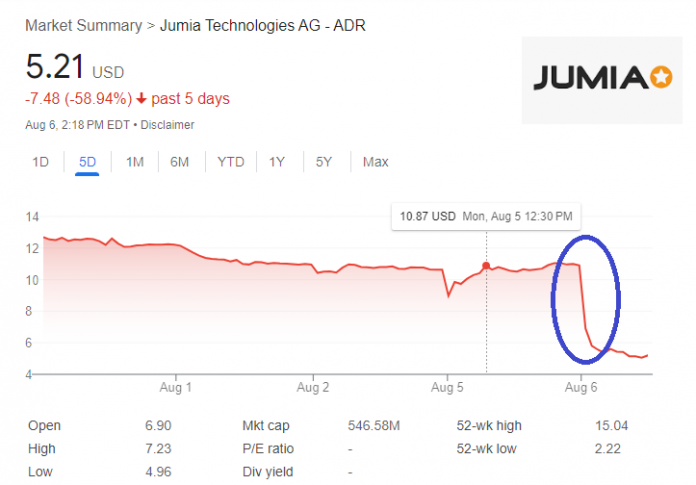
In other words, if the focus is JumiaPay and it is open for all ecosystems, the market cap of JumiaPay should be more than about $530 million Jumia is trading today.

China Launches First Batch of Satellite Internet Constellation, A New Rival to Musk SpaceX

0

China has successfully launched the first batch of its satellite internet constellation as it aims to deploy a vast network of satellites to enhance global communications.

The satellite internet which was launched on Tuesday, at the Taiyuan Satellite Launch Centre, by Shangai Spacecom Satellite Technology (SSST), a state-owned company in China, deployed 18 low Earth orbit (LEO) satellites, is poised to become a major competitor to SpaceX’s Starlink.

Known as “Thousand Sails”, the constellation is a low-Earth orbit set of more than 15,000 satellites that China has said will create global Internet coverage. Domestic media have widely described the project as the Chinese version of Starlink which runs about 6,000 satellites.

By 2025, China is aiming to deploy 648 satellites in the first phase of the constellation’s buildout, in order to create an internet network with global coverage, according to state media CCTV.

China’s recent launch of a Satellite Internet Constellation represents a significant milestone in its initiative to establish a satellite broadband network similar to that of Starlink, enhancing China’s capabilities in space communications.

The network currently comprises approximately 5,500 satellites in orbit and serves the needs of consumers, businesses, and government entities. While Starlink aims to provide comprehensive global internet coverage through its respective satellite networks, with Musk stating to send up to 42,000 satellites into space, China’s satellite could offer similar, if not enhanced coverage and capacity compared to Starlink.

This could impact Starlink’s market dominance, especially in regions where China’s constellation establishes a strong presence. Notably, the deployment of a large satellite network by China could significantly bolster its geopolitical influence. The “Thousand Sails Constellation” may provide internet access in underserved or strategically important regions, potentially challenging Starlink’s current market position and expanding China’s global reach.

In a bid to shake off SpaceX market dominance, cost and pricing strategies will be crucial in determining the impact of China’s satellite network on the market. Competitive pricing and improved accessibility could lure customers away from Starlink, particularly in regions where China’s constellation offers a more attractive alternative.

The launch of China’s Internet constellation highlights the nation’s ambitious space goals and Beijing’s efforts to challenge the U.S. dominance in the sector. China which often seeks to develop its technology and infrastructure hopes to reduce dependence on foreign technology, in a bid to make its industries self-reliant and hedge against possible foreign influence or pressure.

Also, developing its technologies enables the Asian country to exert greater influence globally, enabling the country to set standards, expand geopolitical reach, and most importantly control data.