
DD
MM
YYYY

PAGES

DD
MM
YYYY

spot_img

PAGES

Home Blog Page 3064

Nigerian Senate Passes 2023 Finance Act Amendment Bill, Raises Windfall Tax to 70%

0

The Nigerian Senate has on Tuesday, passed the amendment bill to the 2023 Finance Act, significantly raising the windfall tax on banks’ foreign exchange revaluation gains from 50% to 70%.

This adjustment, originally proposed by President Bola Tinubu, has sparked considerable debate among economic experts and stakeholders, with many noting that it can potentially undermine investors’ confidence.

The Chairman of the Senate Committee on Finance, Sen. Sani Musa, presented the committee’s report, which included the revised windfall tax rate and other key changes. One notable amendment involved the commencement date of the revised act.

Originally set retroactively to January 1, 2023, the date was changed to coincide with the implementation of the Central Bank of Nigeria’s (CBN) new foreign exchange policy, which began on June 14, 2023. This change was prompted by objections from Sen. Aminu Waziri Tambuwal, who argued against the retroactive nature of the amendment.

In addition to these changes, the Senate extended the timeline for the windfall levy. Initially intended to cover only the 2023 financial year, the levy will now apply to all profits from foreign exchange transactions from the start of the new forex policy until the end of the 2025 financial year, as specified in clause 2 of the amendment. This extended period aims to capture more of the foreign exchange revaluation gains banks may accrue.

The Senate also addressed fiscal matters by passing an amendment to the 2024 Appropriation Act. This amendment adds N6.2 trillion to the 2024 budget for recurrent expenditures, including payments for the new N70,000 minimum wage and infrastructure projects under the “Renewed Hope” initiative.

Background of The Windfall Tax

Tinubu’s administration initially proposed the windfall tax as part of a broader strategy to increase government revenue. The tax targets the foreign exchange revaluation gains banks reported in the 2023 financial year, aiming to redistribute these profits through a one-time levy.

The amendment stipulates that banks failing to remit the required amount will face a 10% penalty on the withheld tax and interest at the CBN’s minimum discount rate, with key officials potentially facing imprisonment.

The Move Has Sparked Concerns

The proposal has stirred significant debate among economic and legal experts, as well as major tax advisory bodies. Critics argue that the unpredictability and retroactive application of the windfall tax could deter future investments in Nigeria, both domestic and foreign. They contend that such a policy could undermine investor confidence, which is crucial for economic stability and growth.

KPMG Nigeria has been particularly vocal, criticizing the initial 50% rate and suggesting that the tax could lead to legal disputes. The firm pointed out that Nigeria’s tax policy does not traditionally support retroactive taxes, raising concerns about the legal standing of the amendment.

PwC Nigeria echoed these concerns, emphasizing that the tax’s unpredictability, applied to already reported profits, could discourage future investment. The firm highlighted the potential negative implications for the financial sector and the broader economy, especially given Nigeria’s current economic challenges.

Prominent lawyer Dr. Olisa Agbakoba also voiced his concern about the amendment, describing it as an ill-thought-out policy. He argued that the proposal was beyond the scope of the National Assembly and warned that the burden of the tax would ultimately be passed on to banks’ customers, potentially increasing the cost of banking services and financial products.

The debate over the windfall tax occurs against a backdrop of significant economic challenges in Nigeria. The country’s economy has been battered by declining oil revenues, high inflation, and rising unemployment rates. As an oil-dependent nation, Nigeria has struggled with the volatility of global oil prices, which has reduced foreign exchange earnings and strained public finances.

Given these challenges, economic experts have cautioned the government against implementing policies that could further erode investor confidence. They argue that the economy, already weakened, cannot afford additional shocks from policies perceived as punitive or unpredictable.

The consensus among experts is that maintaining a stable and predictable policy environment is crucial for attracting the investment needed to spur economic growth and development.

Thus, the increased windfall levy on banks’ foreign exchange revaluation gains, while intended to bolster government revenue, may have unintended consequences. If not carefully managed, the policy could exacerbate the country’s economic woes, further deterring investment and slowing economic recovery.

The Senate’s passage of the Finance Act amendment bill marks a significant policy shift, raising critical questions about the viability of Nigeria’s economic policies.

The government faces the dual challenge of addressing fiscal shortfalls while ensuring that its policies do not undermine the broader economic stability. However, the windfall tax has tested the government’s ability to balance raising revenue and fostering a conducive environment for economic growth. To many, it has failed on the latter.

Ethereum Spot ETF is Expected to hit US Market

0

The investment landscape is witnessing a significant shift with the introduction of spot Exchange-Traded Funds (ETFs) in the United States market. After much anticipation and a lengthy approval process, the U.S. Securities and Exchange Commission (SEC) has finally given the green light to spot Bitcoin ETFs, marking a historic moment for both the cryptocurrency sector and traditional investment avenues.

Spot ETFs are investment funds traded on stock exchanges, much like stocks. They are designed to track the current, or “spot,” price of an asset, allowing investors to buy shares in the fund and, by extension, gain exposure to the real-time value of the underlying asset. This is in stark contrast to futures ETFs, which are based on contracts predicting the future price of an asset.

The financial world will be abuzz with the approval of Ethereum Spot Exchange-Traded Funds (ETFs) by the United States Securities and Exchange Commission (SEC). This decision will mark a significant milestone for the cryptocurrency industry, potentially paving the way for a surge in mainstream adoption of Ethereum.

Ethereum, the second-largest cryptocurrency by market capitalization, has been a topic of interest for investors looking to diversify their portfolios with digital assets. The approval of Ethereum Spot ETFs means that investors can now gain exposure to Ethereum without the complexities of direct cryptocurrency ownership, such as wallet management and security concerns.

The SEC’s green light for these ETFs is expected to attract billions of dollars into the ecosystem, with major financial institutions like BlackRock, Fidelity, and Grayscale among the approved spot Ether ETF applicants. This move could also lead to a boost in Ethereum’s price, as similar approvals have done for other cryptocurrencies in the past.

The introduction of Ethereum Spot ETFs is a testament to the growing recognition of cryptocurrencies as a legitimate asset class. It also reflects the SEC’s evolving stance on digital assets, following the approval of Bitcoin ETFs earlier this year. With the ease of trading through traditional brokerage accounts, Ethereum ETFs are likely to appeal to a broader range of investors, including those who are new to the crypto space.

As the Ethereum Spot ETFs begin trading, all eyes will be on the market’s response and the potential impact on the broader cryptocurrency landscape. This development could herald a new era of investment opportunities and further democratize access to cutting-edge financial technologies.

The approval of spot Bitcoin ETFs is particularly noteworthy. These funds offer investors a more direct correlation with the actual price movements of Bitcoin, minus the complexities and risks associated with futures contracts. With spot ETFs, investors can expect a more accurate reflection of Bitcoin’s market value, providing a straightforward and potentially less volatile investment option.

One of the most compelling advantages of Ethereum spot ETFs is the ease of access they provide to investors. By simplifying the process of investing in assets like Bitcoin, which traditionally required navigating cryptocurrency exchanges, digital wallets, and security concerns, spot ETFs make it possible for a broader range of investors to participate in the market.

Moreover, the competitive fee structure emerging from the SEC’s simultaneous approval of multiple spot Bitcoin ETFs is a boon for investors. Lower fees are a critical factor in attracting new assets, and spot ETFs have positioned themselves as a cost-effective alternative to existing crypto funds and futures ETFs.

The introduction of Ethereum spot ETFs is expected to bring a new level of maturity to the cryptocurrency market, potentially leading to increased institutional investment and mainstream acceptance. Additionally, the SEC’s decision could pave the way for other asset classes to be represented through spot ETFs, further expanding the investment universe for individuals and institutions alike.

As Ethereum spot ETFs will begin trading, all eyes will be on their performance and the impact they will have on the market. With the potential to democratize access to various assets and provide a more stable investment vehicle, spot ETFs could indeed be the game changer that many have been waiting for.

The arrival of Ethereum spot ETFs in the US market is a transformative development for investors looking to diversify their portfolios with cryptocurrency and other assets. As the market adapts to this new offering, it will be fascinating to observe how spot ETFs influence investment strategies and the broader financial ecosystem.

Markets Shift And Products Must Evolve: Lesson from US Presidential Politics

1

We have a live business case in the United States presidential politics where Donald Trump has built his product (campaign), and designed everything to win against an opponent (Biden). He was well ahead, and was on the path to coronation as the dominant market leader, with superior market positioning.

As he mounted a national pitch event (the Republican national convention) to sell his product vision to Americans, he focused on that competitor (Biden). To a large extent, most Americans bought the product, and he added extra 13% of the market share. Looking at the trajectory, I called the  election for him!

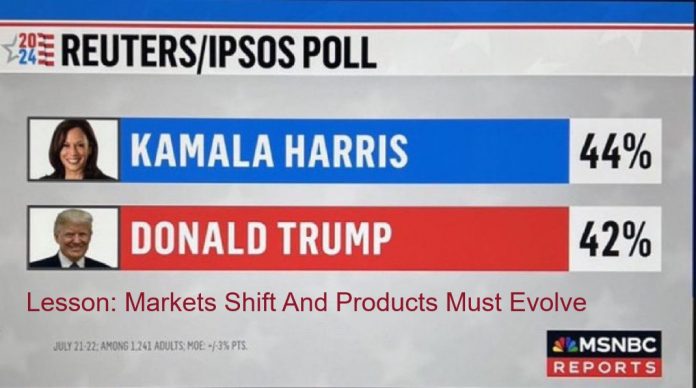
Then, the competitor evolved, and morphed into another “product”. Yes, Biden dropped out and his party has a new product (Kamala Harris). Magically, the perceptions of the customers (voters) have shifted and in a very dynamic market, Trump has lost market share leadership:

“In a recent Reuters/Ipsos poll* conducted after President Biden’s decision to step down from the presidential race, Vice President Kamala Harris has taken a slight lead over former President Donald Trump, with 44% support compared to Trump’s 42%. This marks a significant shift in the race, with Harris gaining momentum following her campaign launch. The poll also indicates that in a hypothetical three-way race including Robert F. Kennedy Jr., Harris maintains a four-point lead over Trump. Harris has launched her campaign with a rally, criticizing Trump and promising to unite her party.”

In business, the past is largely gone. Your product may have been viable yesterday, but is it still viable today? For Trump, he needs to evolve, as a new product has been unveiled by the other party. Otherwise, that will be it for him

*polls mean nothing; they will move and shift. Some polls show that Trump is ahead. The best poll is the one on election day. But we will be using this topic to draw lessons on business as we always do here.

ENS and LayerZero In Green Amid Market Slump, 8000 Unique Holders Celebrate DTX Exchange $1 Million Presale

0

In a surprising turn, Ethereum Name Service (ENS) and LayerZero (ZRO) have shown stunning resistance, standing out amid a broader market slump. Their performances, combined with the milestone achievement of the DTX Exchange reaching a $1 million presale milestone with 8,000 unique holders, bring excitement for investors and enthusiasts seeking 25x gains in crypto.

Ethereum Name Service (ENS) Faces the Bearish Market Heat

The Ethereum Name Service (ENS), a distributed naming system on the Ethereum blockchain, has recently gained attention. Despite being consistently close to a major resistance zone since the start of 2024, ENS has been unable to surpass this barrier. However, recent price actions suggest that Ethereum Name Service (ENS) might soon rebound and reclaim its position.

The Ethereum Name Service (ENS) price has recently entered a pivotal resistance zone between $27.54 and $29.26, an area it has struggled to break through since the beginning. Technical indicators reveal a growing strength among the bulls. The (RSI) has rebounded from its average levels, while the Bollinger Bands are poised to expand from their current contraction.

These signs suggest that the bulls are preparing for a significant event, which could propel the Ethereum Name Service (ENS) price upward by 20%, potentially reaching the $35 mark. Investors and traders should closely watch these technical signals as they indicate a favorable shift in market dynamics for Ethereum Name Service (ENS).

LayerZero (ZRO) Price Analysis: Will ZRO Hit $10 Soon?

LayerZero (ZRO) has recently experienced a notable surge in market value, currently priced at $5.02. This represents a substantial gain of 28.19% over the past seven days, reflecting bullish market conditions and potential shifts in investor sentiment for LayerZero (ZRO). It is also clear that certain external market influences have highly pumped the token.

During the same period, ZRO’s market capitalization and trading volume also fluctuated. The market cap dropped by 3.53% to $552,096,375, reducing investors’ overall LayerZero (ZRO) value. Despite high activity, the trading volume of $324,783,485 over the last 24 hours represents a 41.83% decrease for LayerZero (ZRO).

Investors Add DTX Exchange To Watchlist After $1M Presale

Amid the fluctuating fortunes of Ethereum Name Service (ENS) and LayerZero (ZRO), the DTX Exchange (DTX) has set the bar high through its incomparable stability and growth. DTX Exchange is a cutting-edge crypto trading platform that allows users to trade cryptocurrencies, forex, equities, and contract-for-differences (CFDs).

Its advanced infrastructure and robust trading features provide lucrative opportunities for traders. With key features like 1000X leverage, distributed liquidity pools, a non-custodial wallet, and no KYC requirements, DTX Exchange is redefining trading standards in the market.

The DTX Exchange has successfully raised over $2 million in its private seed round and over $100,000 in the public presale so far. Its ongoing presale has already raised over $1,098,553, with more than 10 million tokens sold. This rapid success reflects investors’ growing confidence and interest, highlighting DTX’s upswing potential to lead the market.

DTX Exchange’s 8,000 Holder Community Attracts Crypto Lovers

DTX platform rewards active participants with loyalty incentives through DTX Tokens, encouraging continued engagement. DTX Token holders can stake their tokens to participate in the platform’s governance, gaining voting power in key decision-making processes. This reward model empowers users and ensures the platform evolves with the community’s needs.

DTX Exchange is outperforming its competitors with cutting-edge features and a promising growth trajectory. Investors looking for a platform combining innovation, community engagement, and strong growth potential will find DTX an ideal investment opportunity. The upcoming token rounds are expected to increase, driving further interest and investment.

While Ethereum Name Service (ENS) and LayerZero (ZRO) deal with their respective market challenges and opportunities, DTX Exchange’s impressive presale success and advanced platform features position it as a standout competitor. DTX’s jaw-dropping achievements amidst a market slump show its potential to outperform and offer substantial returns to its investors.


Learn more:

Visit DTX Presale

Read Whitepaper

Join The DTX Community

Tesla Misses Wall Street Estimates, as The Automaker Revenue Declines by 7% in Q2 2024

0

Tesla, a leading company in sustainable energy with electric cars, solar panels, roofs, and batteries, has reported a weaker-than-expected earnings report for the second quarter (Q2 of 2024).

After a rocky first half of the year that saw Tesla cut more than 10% of its headcount, the company reported better-than-expected deliveries for the second quarter earlier this month. However, deliveries were still down from a year earlier for a second straight period.

The company’s automotive sales dropped for a second straight period, after its revenue dropped by 7%, missing Wall Street estimate. Analysts had projected stronger financial results based on Tesla’s previous performance and market expansion efforts.

Revenue increased 2% from $24.93 billion a year earlier, but automotive revenue dropped to $19.9 billion from $21.27 billion in the same quarter a year ago.  Also, operating income decreased YoY to $1.6B in Q2, resulting in a 6.3% operating margin. YoY, operating income was primarily impacted.

Following the unimpressive second-quarter report, Tesla shares fell more in premarket trading in the U.S. on Tuesday, after the electric carmaker missed expectations, as its auto business continued to face pressure.

The shortfall in Tesla’s Q2 2024 revenue has been attributed to higher-than-expected costs related to production and logistics, as well as pricing adjustments in response to competitive pressures. Meanwhile, recall that on July 2, 2024, Tesla’s deliveries beat Wall Street estimates, after the company reported that it produced 410,831 vehicles, and delivered 443,956, but the total number was down 4.8% from a year earlier.

During the quarter, Tesla offered discounts and other incentives, including subsidized financing deals, in China and the U.S. to spur demand. Those deals hit the company’s profitability, with its adjusted earnings margin falling to 14.4% from 18.7% in the second quarter of 2023.

Net income at Tesla declined 45% to $1.48 billion, or 42 cents a share, in the second quarter from $2.7 billion, or 78 cents a share, a year earlier. This has spurred the company to slash prices globally and offer discounts and incentives amid slowing sales and rising competition, especially in China one of its key markets.

As of 2023, there are about 123 automakers actively selling electric vehicles in China, many of which are fueled by generous subsidies from Beijing. In the domestic market, automakers are struggling through a price war led by BYD, Tesla’s biggest rival, and slowed EV sales growth.

CEO Elon Musk said, in opening remarks on Tuesday’s earnings call that Tesla will host a robotaxi unveiling event on Oct. 10, 2024. Originally, he had stated that the event would take place on Aug. 8.

It is however worth noting that Robotaxis was a huge focus on the earnings call. Musk envisions a world in which owners can authorize their Tesla vehicle to be used as part of an Uber-style ride-hailing service and where the cars would drive autonomously. The Tesla robotaxi and the “unsupervised” full self-driving software that Musk says will run them is at the center of the company’s future.

In Q2, the company in its report disclosed that it focused on reducing interventions with FSD (Supervised)1, while improving driving comfort. Notably, it rolled out a version of FSD (Supervised) that primarily relies on eye-tracking software to monitor driver attentiveness. Looking ahead to future autonomous driving and robotaxi service, Tesla has continued progress on software and hardware.