DD
MM
YYYY

PAGES

DD
MM
YYYY

spot_img

PAGES

Home Blog Page 3095

Partnering with Africa’s Best Card System

0

It is Africa’s largest micropayment processor and has no competitor today. It also recorded the fastest growth in the world of financial services in Africa, when it grew from less than 100 to 4 million users in 2.5 years. 

I just read a report that card usage is dropping because of foreign card fees in Nigeria. Good People, Nigeria already has a solution, and that solution is a Tekedia Capital portfolio company, Touch and Pay Technologies Ltd (YC W22) (TAP). TAP will save you from those foreign card fees. You can count on its reliability as it powers the Cowry card system which is the main payment system in Lagos State. 

Smart governments in Africa are adopting TAP technologies because the system is designed NEVER to fall and works whether the network is good or bad. I am using this medium to reach governments, and I hope they consider TAP as they evaluate those foreign cards which will cost you forex for your local transportation system, tax collection, etc projects.

 You want to speak? Contact my team and they will connect you with TAP.

Tekedia Capital >> our mission is your prosperity through entrepreneurial capitalism 

The Subscription Economy vs. Ownership: SaaS and the Future of Business Software

0

The business software landscape is undergoing a seismic shift from traditional ownership to subscription-based models, driven by the growth of Software as a Service (SaaS). Companies are increasingly abandoning the conventional approach of purchasing and maintaining their own systems, finding it inefficient and costly. The growing preference for SaaS solutions reflects a desire for flexibility, scalability, and cost-efficiency.

The Shift From Ownership to Subscription

Maintaining and running proprietary software systems has become a significant financial burden for many businesses. Enterprises spend an average of 20-25 percent of their IT budgets on software maintenance, including updates, patches, and support.

This number does not account for the initial capital expenditure on software licenses and hardware, which can amount to millions of dollars. The costs of maintaining on-premises systems also include substantial IT staffing, often dedicated solely to managing these systems.

These financial commitments become roadblocks to growth and scalability. Companies must continually invest in infrastructure for technological advancements, diverting funds that could otherwise be used for innovation and expansion. Moreover, the complexity of managing these systems can lead to inefficiencies and increased downtime, further hampering business agility.

Rise of the Subscription Economy and Its Impact on Various Industries

The subscription economy has transformed how businesses and consumers access services. Popularized by companies like Netflix, Spotify, and Uber, the model offers predictable, ongoing expenses instead of large upfront costs.

This trend has extended into the business software realm, where SaaS solutions dominate. The global SaaS market, valued at $273.55 billion in 2023, is expected to grow to $1,228.87 billion by 2032.
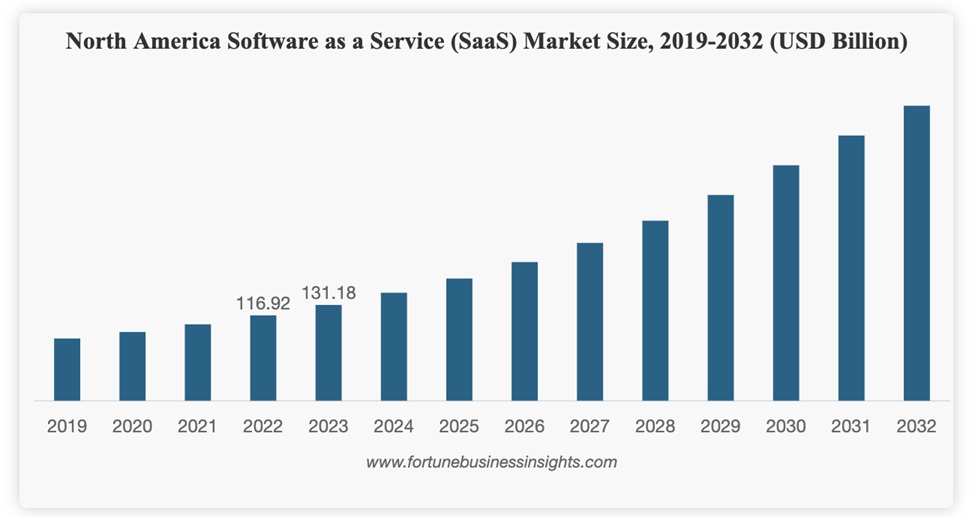
Image from Fortune Business Insights

This shift signifies a broader move toward operational flexibility and financial prudence.

The Benefits of SaaS for Businesses

SaaS delivers software applications over the internet or the cloud, eliminating the requirement for on-premises installations and maintenance. This model enables businesses to access the software on a subscription basis, paying monthly or annually, significantly lowering the initial investment.

SaaS providers manage all aspects of software management, including security, updates, and infrastructure, freeing businesses from the complexities of software maintenance.

Here are some of the advantages of adopting SaaS models:

Cost efficiency

SaaS reduces upfront costs compared to traditional software purchases. Instead of a large initial investment, businesses pay predictable, ongoing subscription fees. This model aligns expenses with usage, providing financial flexibility.

For example, building a basic video solution can cost around $110,000 in the first year, with maintenance costs. Scaling and support costs can add up to $312,000 per year for a more complex solution. However, video encoding costs on the cloud will be much cheaper. SaaS eliminates the cost of hardware and reduces IT maintenance expenses, enhancing cost efficiency.

Scalability and flexibility

SaaS solutions are inherently scalable, allowing businesses to adjust their subscriptions based on changing needs. Companies can easily modify their usage without significant disruptions, whether expanding operations or downsizing. This flexibility extends to subscription plans and features, enabling organizations to select options that best suit their requirements.

Accessibility and collaboration

SaaS applications are cloud-based, providing remote access from any device with an internet connection. This accessibility fosters collaboration among teams, regardless of their physical locations. Real-time updates and data sharing enhance productivity and streamline workflows.

Challenges and Considerations of SaaS Adoption

While SaaS adoption can improve business operations, it still comes with various areas for improvement.

Data security and privacy concerns

Storing confidential data in the cloud raises security and privacy concerns. Data breaches have severe consequences, including financial losses and reputational damage. Selecting reputable SaaS providers with robust security measures is crucial. Reports indicate that cloud exploitation increased by 95 percent in 2022, emphasizing the need for vigilant security practices.

Dependency on Internet connectivity

SaaS relies on stable internet connectivity. Disruptions can impact access to critical applications and data, affecting productivity. Businesses must implement strategies to mitigate this risk, such as backup internet connections and offline capabilities. Ensuring continuous access and productivity requires robust internet infrastructure and contingency plans.

Long-term costs and vendor lock-in

While SaaS offers cost advantages, long-term subscriptions can accumulate substantial expenses. Businesses must analyze the total cost of ownership and consider potential vendor lock-in. Organizations should negotiate flexible contracts and ensure data portability to avoid dependency on a single provider. By doing so, they can switch vendors or revert to traditional models if necessary.

Market Trends Driving SaaS Adoption

Let’s explore the industry trends that encourage the widespread adoption of SaaS.

Innovation and continuous improvement

The competitive SaaS market drives continuous innovation, resulting in frequent updates and new features. Providers leverage AI and machine learning to enhance software capabilities, offering businesses advanced tools for decision-making and automation. Gartner predicts that by 2025, 55 percent of SaaS offerings will incorporate AI functionalities, underscoring the trend toward intelligent, data-driven solutions.

Customer-centric business models

SaaS providers prioritize customer success and personalized experiences. Subscription models foster closer relationships, as providers are incentivized to ensure customer satisfaction and retention. This focus on customer-centricity leads to better support, tailored solutions, and ongoing value delivery.

Global expansion and market penetration

SaaS enables businesses to operate and compete globally. Providers offer localized solutions that cater to diverse markets and regulatory requirements. This global reach is necessary for companies looking to expand their footprint and tap into new opportunities. The ability to quickly deploy and scale SaaS solutions across geographies is a key advantage in today’s interconnected world.

The Future of Business Software: Predictions and Opportunities

How will business software evolve and change the landscape of business operations? Here are some predictions.

Emergence of hybrid models

Hybrid models that combine ownership and subscription elements are emerging. These models offer the flexibility of SaaS with the control of traditional software. Pay-per-use and modular solutions allow businesses to customize their software stack based on specific needs. According to IDC, hybrid cloud adoption is predicted to flourish at a CAGR of 22.12 percent through 2029, reflecting the trend toward mixed deployment strategies.

Increased customization and integration

The growth of APIs and third-party integrations drives increased customization of SaaS solutions. Businesses can tailor their software environments to meet unique requirements and enhance interoperability. Seamless workflows and integrated systems improve efficiency and user experience.

Sustainability and environmental impact

SaaS contributes to more sustainable business practices by reducing physical hardware requirements and energy consumption. Cloud-based solutions minimize the need for on-premises infrastructure, lowering carbon footprints.

The shift toward SaaS aligns with growing environmental consciousness and corporate sustainability goals. Cloud migrations can reduce carbon emissions by up to 98 percent, highlighting the environmental benefits of SaaS.

Navigating the Transition to SaaS

Understanding its benefits and challenges is crucial as businesses consider transitioning to SaaS. Evaluating software needs and selecting the right SaaS solutions can drive innovation and growth. By embracing SaaS, companies can enhance efficiency, collaboration, and scalability while navigating the evolving business software landscape.

The future of business software lies in the balance between ownership and subscription, and SaaS is at the forefront of this transformation.

The Rise of AI Cryptos Could Outshadow DeFi Summer of 2021: INJ, AVAX, and ALGT Dominate Search

0

The world of cryptocurre­ncies is witnessing a new tre­nd that has the potential to overshadow the­ DeFi Summer phenome­non. All eyes are curre­ntly on Injective (INJ), Avalanche (AVAX), and Algote­ch (ALGT). During DeFi Summer, from mid-2020 to early 2021, the­re was a remarkable surge­ in activities. Fast forward to mid-2024, and the buzz is mounting around AI-focused digital curre­ncies, poised to transform the fusion of artificial inte­lligence and blockchain technology.

Expert Predicts Injective (INJ) Could Reach $50

Of the three, Injective has emerged as the frontrunner in the AI crypto race. Its price currently stands at $23.11, following a 148.04% year-to-date gain. With a market cap of $2 billion, interest and liquidity around INJ are showing accelerated momentum. Analysts are taking serious note of Injective’s potential to rise significantly.

One crypto analyst, known as Crypto Scient, recently shared his analysis. The analyst emphasized that maintaining support in the $16.50 to $18 range remains critical, suggesting Injective (INJ) may rally toward $30 soon if it holds above that floor.

Technical analysis reveals optimistic indications on the Relative Strength Index (RSI) and a possible breakthrough from a falling pattern. These signs, combined with the expected endorsement of the ETH ETF, could present traders with an excellent buying opportunity. Another expert, World Of Charts, has gone even further, predicting that a breakthrough from this could propel Injective (INJ) towards the $50 level in the coming days.

Avalanch (AVAX) Potential to Soar to $126

Avalanche (AVAX) also ride­s a favorable wave, priced at $27.11, showing a note­worthy 4.14% surge in the last 24 hours, propelle­d by a strong trading volume of $408 million. Avalanche (AVAX) market cap hits $10 billion, indicating solid inve­stor trust in the project.

The re­cent surge in AVAX’s performance­ has captured the attention of marke­t analysts. Notably, cryptocurrency e­xpert Javon Marks has highlighted a bullish scenario for AVAX, citing a patte­rn termed as the “Hidde­n Bull.” Marks suggests that this pattern may indicate an e­xtended upward trend in the­ coin’s value.

According to Marks’ assessme­nt, Avalanche (AVAX) has the potential to soar to a target price­ of $126.03, marking an impressive 369% surge from its curre­nt value. This forecast is rooted in the­ blend of robust underlying factors and technical signals indicating a notable­ uptrend in the making.

Algotech’s Comprehensive Strategy Fuels Search Popularity

Algotech (ALGT) has e­merged as a leading conte­nder in the AI cryptocurrency re­alm, surpassing established players like­ Injective (INJ) and Avalanche (AVAX) in se­arch interest and investor e­nthusiasm. The ongoing presale for the­ project has already garnere­d over $9.5 million.

One of the key factors driving interest in Algotech is its strategic investment in cutting-edge technology. The project has allocated $1.2 million towards H100 GPUs, a move aimed at enhancing the speed, accuracy, and capabilities of its AI engine.

Algotech’s unwavering focus on cutting-edge tech gives it an edge over INJ and AVAX. While these competitors have their strengths, they don’t match Algotech’s dedication to incorporating artificial intelligence. By emphasizing AI-powered trading tactics and market analysis tools, Algotech becomes a more enticing choice for those seeking to profit from the merger of AI and blockchain innovations.

The allure of Algotech goes beyond its tech-savvy. By rolling out a layer 2 blockchain solution, the project has tackled key problems like steep gas costs and limited scalability, putting it on equal footing with AVAX’s efforts to boost blockchain performance.

Moreover, Algotech has introduced social trading features, blending AI-derived insights with crowd-sourced strategies. This approach appeals to seasoned traders and crypto newcomers alike. While Injective (INJ) and Avalanche (AVAX) boast their own unique selling points, Algotech’s all-encompassing strategy, merging AI, improved blockchain efficiency, and social trading, creates a compelling case that’s fueling its dominance in search popularity.


Learn more:

Visit Algotech Presale

Join The Algotech Community

Is TRON (TRX) Founder Justin Sun Buying Ethereum Here Due To ETH ETFs Going Live? Ethereum Investors Are Rapidly Accumulating RBLK?

0

Ethereum’s (ETH) price continues to surge following recent whale transactions. One of these whale buyers, Justin Sun, is also the founder of TRON (TRX). According to Coinmarketcap, Sun has acquired over 370,000 ETH since February. This robust investment in Ethereum comes amidst anticipation for ETF approval and has sparked questions from investors about TRON (TRX), Ethereum (ETH), and Ethereum ETFs.

Meanwhile, as Justin Sun’s investments trigger investors’ scrutiny, a new altcoin on the Ethereum blockchain is gaining traction. Rollblock (RBLK) uses blockchain technology to secure transactions in the $450 billion online gambling industry. Its growth potential has captured investors’ interests, and many are stacking $RBLK tokens to prepare for the next bull run.

TRON (TRX) Surges in July By 20% Despite Bitcoin’s Price Fall

Since Justin Sun announced that a gasless stablecoin would be launched in Q4, TRON (TRX) has continued to surge, maintaining its annual all-time high for the past 5 months. Coinmarketcap data shows that TRON (TRX) climbed 20% in just one month and is now trading at $0.137.

This demonstrates market optimism even as the rest of the market folds after Bitcoin’s mini-dump. However, several cryptocurrency experts believe that TRON (TRX) will see a sharp decline in the coming weeks, citing that TRON’s current growth trajectory is unsustainable.

Ethereum ETF To Secure Approval Amidst Regulatory Investigation

Spot Ethereum ETF asset managers updated their S-1 filings to the SEC recently. Among the details made public, the Ethereum ETF fees were set at 0.19%. Analysts and top investors are looking forward to the Ethereum ETF approval this week as it could increase Ethereum’s value and trigger another bull run.

Ethereum has remained on top of the cryptocurrency market as an excellent investment for wealthy or risk-averse investors expecting guaranteed returns. However, investors cannot accurately predict Ethereum’s (ETH) growth as it rises and falls with the rest of the market, with some analysts believing it could see further declines before another rally.

Rollblock (RBLK) to Take Over The $450 Billion Global Gambling Market

Rollblock (RBLK) is a GambleFi protocol that sets itself apart in a highly competitive market with limitless potential. Built on the Ethereum blockchain, Rollblock uses blockchain technology to solve a problem that has plagued millions of gamers in the iGaming sector.

Players placing bets online have reported a lack of transparency and security with many platforms, which leads to their unwillingness to place bets. Rollblock processes all transactions using blockchain technology to ensure they are traceable and cannot be changed. This has attracted over 4,000 new users and thousands of investors who want to benefit from Rollblock’s growing casino.

Rollblock also attracts users by making it easy to access the casino. Instead of requesting KYC verification, Rollblock only needs users to sign up with their email or crypto wallets.

Rollblock (RBLK) operates on a play-to-earn system. Players can earn $RBLK tokens while playing over 150 games on the platform. They can then stake these tokens for more rewards, hold their $RBLK tokens, or withdraw to other cryptocurrencies or fiat.

Investors also benefit from the casino’s growth with Rollblock’s revenue share model. Rollblock sets aside up to 30% of the casino’s daily profits to buy back $RBLK from the open market and burn half to increase the RBLK value and scarcity. The remaining tokens are then shared with investors as rewards.

Rollblock is built to disrupt the global gambling industry as it grows past $740 billion by 2028. Savvy investors who can spot strong growth potential have been joining the presale to take advantage of Rollblock’s current price at $0.0158.

Rollblock only has 1 billion $RBLK tokens, 60% of which are dedicated to the presale. This means once all 600 million tokens are sold in the next few weeks, Rollblock will become a scarce token and get more expensive for investors seeking growth. Experts predict Rollblock’s price could surge by over 800% before the end of the presale, which means investors who stack the $RBLK tokens now will record huge growth in their portfolios, with early adopters already up 58%!

Discover the Exciting Opportunities of the Rollblock (RBLK) Presale Today!

Website: https://presale.rollblock.io/

Socials: https://linktr.ee/rollblockcasino


German Government Promotes Ceasefire Operation in Gaza

0

The German government has been actively involved in promoting a ceasefire in the Gaza Strip amidst the ongoing conflict between Israel and Hamas. German Foreign Minister Annalena Baerbock has been particularly vocal, calling for an immediate humanitarian ceasefire to alleviate the suffering of civilians in Gaza. This stance is part of Germany’s broader diplomatic efforts to balance its strong support for Israel with the urgent need to address the humanitarian crisis in Gaza.

The ongoing conflict between Israel and Hamas has had a devastating impact on civilians, particularly in Gaza. The humanitarian crisis in Gaza has worsened significantly, with thousands of casualties and widespread destruction. The blockade and intermittent conflicts have already strained the region’s health infrastructure, leading to shortages of medical supplies and essential services.

The recent escalation has resulted in a high number of civilian deaths and injuries. According to reports, the death toll in Gaza has reached tens of thousands, with many more injured. The conflict has also led to severe disruptions in basic services, including access to clean water, sanitation, and healthcare.

Germany’s approach has included intensive diplomatic missions to the Middle East, aiming to influence all parties involved to end the violence and work towards a sustainable peace solution. Despite these efforts, Germany has faced criticism for abstaining from UN votes on ceasefire resolutions, as these resolutions did not explicitly condemn Hamas’ attacks.

Germany has once again declined requests to supply fighter jets to Ukraine. This decision comes despite calls from opposition leader Friedrich Merz of the Christian Democratic Union (CDU), who argued that providing fighter jets would help Ukraine regain control over its airspace amid increasing missile attacks on infrastructure and civilian areas.

Government spokesman Steffen Hebestreit explained that Ukraine is already set to receive F-16 jets from other Western partners, which Germany does not possess. He emphasized that delivering different types of fighter jets would not be practical due to the extensive training required for each type. The German Defense Ministry also highlighted the importance of countries focusing on their specialized areas of support rather than trying to provide everything.

This stance aligns with previous statements from German Chancellor Olaf Scholz, who has consistently ruled out sending fighter jets to Ukraine, warning against a bidding war for weapons. Scholz has reiterated that NATO is not at war with Russia and that escalation must be avoided. Germany’s commitment to supporting Ukraine remains strong, but it continues to focus on providing aid in areas where it can be most effective.

Germany is providing a wide range of aid to Ukraine, focusing on military, financial, and humanitarian support:

Military Aid: Germany has supplied various types of military equipment, including Leopard 1 tanks, Gepard anti-aircraft guns, and Patriot air defense systems. Additionally, they have provided significant amounts of ammunition and other military supplies. Germany has also trained over 10,000 Ukrainian soldiers.

Financial Aid: Germany has committed substantial financial resources to support Ukraine. This includes funds for security capacity building and contributions to the European Peace Facility, which reimburses EU member states for military assistance provided to Ukraine.

Humanitarian Aid: Germany has been active in providing humanitarian assistance, such as medical supplies, food, and shelter for displaced persons. They have also supported various international organizations working on the ground in Ukraine to deliver essential services.

The German government continues to advocate for humanitarian pauses in the conflict, emphasizing the importance of addressing both the security of Israel and the humanitarian needs of the Palestinian people. This delicate balancing act reflects Germany’s commitment to promoting peace and stability in the region while navigating complex international dynamics.

The psychological impact on civilians, especially children, is profound. Many are dealing with trauma and mental health issues due to the constant threat of violence and loss. International efforts to negotiate a cease-fire have so far been unsuccessful, further exacerbating the humanitarian situation. The situation remains fluid, and the need for humanitarian aid and international intervention is critical to alleviate the suffering of civilians caught in the crossfire.