DD
MM
YYYY

PAGES

DD
MM
YYYY

spot_img

PAGES

Home Blog Page 31

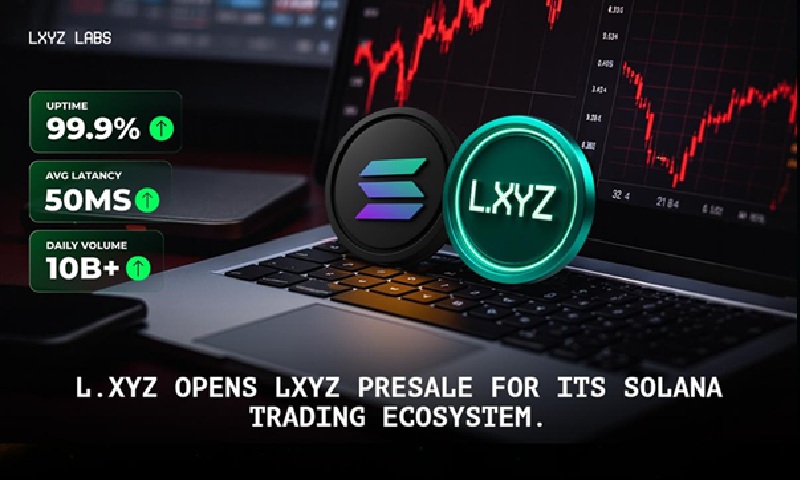
L.xyz Reveals LXYZ Token Presale for Its Hybrid AMM + Order Book Trading Ecosystem on Solana

0

L.xyz has officially revealed the presale for its native token LXYZ, a key milestone in the construction of its advanced trading ecosystem built on the Solana blockchain. The platform is introducing a hybrid model that combines Automated Market Maker liquidity with a centralized style order book. This approach aims to improve precision, reduce slippage, and deliver fast execution for a wide range of traders.

The L.xyz team is focused on creating an exchange where speed, stability, and flexibility come together. Solana provides the foundation for this vision, offering high throughput, low transaction fees, and rapid finality. Traders using L.xyz will have access to spot markets, futures markets, and high leverage tools that reach up to 100x on select pairs.

A Dual Engine Designed for Better Trading

The hybrid AMM and order book model allows L.xyz to offer liquidity depth similar to centralized venues while keeping the entire system non-custodial. Liquidity pools ensure that users can execute trades at any time, even during volatile conditions. At the same time, the order book provides more control for traders who prefer structured entries, limit orders, and stop orders.

This structure is designed to support professional strategies and fast reactions to market changes. With Solana handling transaction processing in milliseconds, traders can engage with the market more efficiently than on traditional blockchain based DEXs.

LXYZ Token Presale Opens Access to Core Ecosystem Features

The LXYZ token is central to how users will participate in governance, staking, liquidity programs, and future cross-chain utilities. The presale includes 40 percent of the total supply, equal to 200 million tokens, divided into ten structured phases. Each phase offers 20 million tokens with a price increase of 0.05 USD from the previous phase.

This phased model gives early supporters access to the token at transparent and predictable prices. Presale tokens include a lock-up period and vesting structure to maintain long term stability within the ecosystem.

Tools Created for Both Active Traders and Liquidity Providers

L.xyz offers a set of features intended to support traders who need speed and accuracy as well as users who prefer passive income opportunities.

Key features include:

  • Spot, margin, and futures markets
    • Risk management tools including stop loss and liquidation monitoring
    • Liquidity mining programs that reward users with LXYZ tokens
    • Staking options for long term participants
    • Real time charting and analytics for market analysis

The platform will continue expanding with AI based tools, automated strategies, cross chain swap functionality, and multi chain liquidity pools. These future capabilities are outlined in the L.xyz roadmap and position the exchange for broader ecosystem growth.

Governance Led by the Community

L.xyz is structured as a fully non custodial exchange. Users keep full control of their assets through Solana compatible wallets. Governance decisions will be made by LXYZ token holders who can vote on listings, fee adjustments, feature upgrades, and proposals submitted through the DAO.

This governance model ensures that the direction of L.xyz reflects the interests of its community rather than a centralized authority.

Building Toward a High Performance Trading Future

With its hybrid trading engine, focus on low latency execution, and long term roadmap, L.xyz is working to create a high performance environment for both retail and institutional level traders. The presale provides the first opportunity for users to engage with the ecosystem and contribute to its development.

As adoption grows, the platform is designed to evolve into a comprehensive, fast, and reliable trading hub powered by the Solana blockchain.

Telegram: T.me/ldotxyz

X: X.com/ldotxyz

Aware Super’s new CIO warns of “orange lights” in AI financing

0

Australia’s Aware Super has entered the new year with a guarded but confident view of the global artificial intelligence boom, as its newly appointed chief investment officer, Simon Warner, flags emerging fragilities in the way some AI ventures are now being financed.

Warner, who took over leadership of the A$210 billion fund’s investment team last week, said the AI sector’s economic model is shaping up to be the defining financial market risk of 2026, even as earnings growth from the dominant players continues to justify steep valuations.

Warner told Reuters that the extraordinary rise in AI infrastructure spending — from data centers to large language models — had until recently been underwritten by the most stable source available in capital markets: retained earnings from companies with long track records of profitability. That created a sense of comfort for institutional investors who viewed the boom as self-funded rather than debt-driven or reliant on speculative capital.

He noted that the tone has shifted. Over the past six months, a trickle of more exotic financing structures has begun to appear, raising concerns about how some companies are bankrolling their AI expansions. Warner described these new arrangements as “circular financing” and “conduit financing,” mechanisms that move money through more complex channels rather than straight from a company’s balance sheet. In his words, “nothing red, but definitely orange,” signaling caution without alarm.

The shift comes at a time when AI-driven stock gains have become a major force in global markets. The Magnificent Seven — Microsoft, Apple, Alphabet, Nvidia, Meta, Amazon, and Tesla — have carried a significant share of U.S. equity performance, helping buoy investor wealth and household demand. Warner said that the relationship between tech valuations, capital expenditure, and the broader U.S. economy has created a delicate interdependence. If even one of those pillars falters, he warned, financial markets could quickly feel the shock.

The urge to scale up AI capacity has led to unprecedented spending across the industry. Meta disclosed in October that it secured a $27 billion financing deal from Blue Owl Capital for what will be its largest data center project globally. The company has been racing to expand its generative AI capabilities, which require enormous power, cooling, and real estate footprints. For many analysts, that financing arrangement underscored how the sector’s capital needs have grown beyond what routine cash flow can comfortably support.

Microsoft, which remains Aware Super’s second-largest listed holding in its balanced fund, has also been pouring billions into new data center clusters and advanced chips to support its partnership with OpenAI. Alongside Microsoft, Aware holds stakes in Nvidia, Apple, Alphabet, and Meta, giving Warner a direct view into how the world’s most influential companies are navigating the cost of staying ahead in AI.

Even with the “orange lights” flashing, Warner said the earnings trajectory of these firms still validates their lofty valuations, though he acknowledged that fatigue in capital expenditure could eventually threaten those valuations. He suggested that investors who have been wary of how long the spending boom can last are right to stay vigilant.

The concern is not about an imminent downturn but about whether the current pace of investment can be sustained without creating vulnerabilities. A significant pullback in spending by any of the big technology names could ripple through markets, tightening liquidity and altering the wealth effects that have propped up U.S. consumer sentiment. Warner described this possibility as a dynamic worth watching closely.

For global funds like Aware Super, the AI sector remains both an engine of returns and a source of latent risk — a combination that demands deep scrutiny as the industry moves into a more mature, capital-intensive phase. Warner’s early remarks as CIO position him as someone determined to track the fine print beneath the sector’s explosive growth, wary of the structures now emerging around what has become the world’s most expensive technological race.

Binance’s Strategic Pivot to Abu Dhabi, as Czech National Bank Accelerates Gold Accumulation

0

Binance, the world’s largest cryptocurrency exchange by trading volume, announced a landmark achievement: securing three comprehensive financial licenses from the Financial Services Regulatory Authority (FSRA) within the Abu Dhabi Global Market (ADGM), a premier international financial center in the United Arab Emirates.

This move effectively positions Abu Dhabi as the exchange’s global regulatory hub—and, by most accounts, its de facto headquarters—marking a significant departure from its long-standing “nomadic” identity without a fixed base.

The approvals cover critical aspects of Binance’s operations: Nest Exchange Limited, recognized for spot and derivatives trading including custody and central securities depository services. Nest Trading Limited: Broker-dealer for over-the-counter (OTC) services.

These licenses enable Binance.com to offer regulated trading, settlement, custody, and liquidity management globally, starting January 5, 2026, after operational preparations.

For years, Binance—founded in 2017 by Changpeng Zhao (CZ) in Hong Kong—prided itself on being a borderless entity, with distributed teams across jurisdictions to evade regulatory pressures, particularly after U.S. scrutiny that led to CZ’s 2023 guilty plea for anti-money laundering violations he was later pardoned by President Trump in October 2025.

However, co-CEO Richard Teng’s announcement signals a pragmatic shift toward centralization. While Teng avoided explicitly labeling Abu Dhabi as the “global headquarters,” he emphasized its role as the “regulatory foundation” for worldwide operations, noting that global regulators prioritize where a firm is supervised.

A Binance spokesperson did not refute reports suggesting this establishes Abu Dhabi as the HQ. The news triggered an immediate bounce in Binance’s native token, BNB, which rose over 3% in the 24 hours following the announcement, reflecting trader optimism about enhanced institutional legitimacy.

Teng highlighted a 40% year-over-year surge in institutional clients as of September 2024, attributing it to clearer regulatory pathways, which this license is expected to amplify.

The UAE, and ADGM in particular, has emerged as a crypto-friendly oasis in a post-FTX regulatory landscape. ADGM’s English common law-based framework offers institutional-grade oversight without stifling innovation, attracting firms like Binance after a $2 billion investment from Abu Dhabi-backed MGX in March 2025.

Teng, who previously served as ADGM’s CEO for six years, described the approval as an “important milestone” that aligns with the UAE’s vision for digital asset leadership.
Ahmed Jasim Al Zaabi, ADGM’s chairman, welcomed Binance as a “key global player in digital assets.”

This isn’t just a regulatory checkbox— it’s a bet on Abu Dhabi’s ecosystem for long-term growth. By anchoring “mind and management” activities here, Binance gains tax clarity, compliance credibility, and appeal to conservative investors wary of its past U.S. entanglements.

Binance’s move underscores a maturing crypto sector, where exchanges are trading agility for stability to woo institutions. It’s the first full FSRA approval under ADGM for a major global platform, setting a precedent that could draw more players to the UAE and accelerate mainstream adoption.

Critics, however, note it feels “a bit old-fashioned” for a firm built on decentralization, potentially signaling the end of the wild-west era for crypto giants.

In summary, while not a full “relocation” in the traditional sense, this license cements Abu Dhabi as Binance’s operational nerve center, blending its global ambitions with grounded regulatory reality.

For users and investors, it promises safer, more transparent trading—though the exchange’s distributed model ensures it won’t fully abandon its roots.

Czech National Bank Accelerates Gold Accumulation

The Czech National Bank (CNB) has ramped up its gold purchases, aligning with its multi-year strategy to rebuild reserves to 100 tonnes by 2028—the highest level in the nation’s modern history.

This diversification push reflects broader trends among central banks in Central and Eastern Europe, emphasizing gold as a hedge against geopolitical risks, inflation, and currency volatility.

Gold reserves increased by approximately 1.8 tonnes in November, bringing the total to around 71 tonnes. This marks the 22nd consecutive month of net buying, underscoring the CNB’s consistent execution of its reserve management plan.

Through November, the CNB has added roughly 21 tonnes, representing a 42% increase from the end-of-2024 baseline of about 51.2 tonnes. This pace exceeds earlier projections and positions the bank well ahead of its annual targets.

The CNB’s gold holdings plummeted in the 1990s, dropping from 70 tonnes in 1993 to just 8 tonnes by late 2019 due to sales during economic transitions. Since 2020, under Governor Aleš Michl, the bank has reversed course.

2022: ~12 tonnes. 2023: 30.7 tonnes. 2024: 51.2 tonnes. 2025 (Q3): 66.8 tonnes. Gold now comprises a growing share of the CNB’s international reserves, which totaled $170 billion in October 2025.

At current prices ($2,700/oz), the November-end gold holdings are valued at over $6 billion, aiding portfolio yields while serving symbolic and commemorative purposes. The CNB’s aggressive buying mirrors actions by peers like Poland net buyer of 21 tonnes in November and contrasts with sellers like Singapore.

Europe’s smaller holders lag far behind giants like Germany (3,355 tonnes). With Czech GDP growth steady and inflation low, gold enhances diversification—uncorrelated with bonds or equities—while generating returns. Michl has emphasized an “infinite investment horizon” for such assets.

This buying contributes to sustained central bank demand, supporting gold prices amid uncertainties like U.S. policy shifts and regional conflicts. Poland’s National Bank (NBP) has pursued one of the most aggressive gold accumulation strategies among central banks since 2018, transforming the country from a modest holder into a global leader.

This approach, accelerated by Russia’s 2022 invasion of Ukraine, emphasizes gold as a hedge against geopolitical risks, inflation, and potential sanctions. By December 2025, Poland’s holdings have surged to approximately 530 tonnes, valued at over PLN 240 billion ranking it 10th worldwide and surpassing the European Central Bank’s 506.5 tonnes.

The NBP aims for gold to comprise 30% of its total international reserves currently ~$261 billion or PLN 953 billion. This marks an upgrade from the 20% goal achieved earlier in 2025, announced in September by President Adam Glapi?ski.

Reaching 30% would place Poland in elite company, as historical data from Bank of America shows such allocations yield the highest crisis resilience. Purchases are opportunistic, depending on market conditions like gold prices hovering at $4,000/oz.

The bank paused buying from June to September amid price highs but resumed aggressively in October with 16 tonnes. ~20% of gold is stored domestically for security, with the rest in London and New York. Glapi?ski targets one-third in each location to mitigate risks.

Poland’s reserves were minimal ~14 tonnes in 1996 post-communism but began systematic buying in 2018. The strategy intensified post-2022. 2025 highlights led global buying with 48.6 tonnes in Q1, 19 tonnes in Q2, and 16 tonnes in October—totaling 83 tonnes YTD, outpacing China and India. Q3 saw a pause, but overall demand hit 634 tonnes globally YTD.

Glapi?ski describes gold as “the only safe investment for state reserves” in “difficult times of global turmoil,” citing its independence from national policies, crisis resistance, and long-term value retention. Proximity to Ukraine drives diversification from USD/euro assets amid de-dollarization trends.

Enhances credibility in ratings and partnerships; gold’s 26% share already boosts monetary sovereignty. Aligns with emerging markets’ rush (e.g., 900+ tonnes projected for 2025), per World Gold Council surveys where 43% of central banks plan increases.

This strategy has drawn domestic criticism for costs but is praised internationally, potentially inspiring neighbors like the Czech Republic 71 tonnes. As of Q3 2025, holdings dipped slightly to 515 tonnes due to valuation adjustments, but October’s buys reversed this.

Implications of the New M2 All-Time High for Inflation

0

The US M2 money supply has hit a new all-time high (ATH) as of the latest data release. According to the Federal Reserve’s H.6 Money Stock Measures report, seasonally adjusted M2 stood at $22,298.1 billion in October 2025.

The U.S. M2 Money Supply is a broad measure of the money in circulation, including all of M1 (physical currency, checking deposits) plus savings deposits, small-denomination time deposits (under $100k), and retail money market mutual funds, representing money easily convertible to cash and used for short-term investments. It’s a key economic indicator the Federal Reserve tracks for inflation and economic health, expanding during stimulus and tightening with quantitative tightening (QT) to manage prices

This marks an increase of $85.6 billion from September’s $22,212.5 billion and surpasses the previous peak of approximately $21.7 trillion set in early 2022 during the post-pandemic liquidity surge. Current value is $22,298.1 billion. Month-over-month change: +0.4% from September 2025.

M2 has grown at an average annual rate of about 6.3% over the past 25 years, reflecting steady monetary expansion. The recent uptrend began accelerating in mid-2025, with consistent monthly gains: June 2025 stood at $21,942.4 billion.

November 2025 data isn’t available yet, the next H.6 release is scheduled for December 23, 2025, but the trajectory suggests continued growth, potentially pushing M2 above $22.3 trillion soon.

M2 is a broad measure of the US money supply, including: All components of M1 (cash, checking deposits, and other highly liquid assets). Savings deposits, small-denomination time deposits under $100,000, and retail money market funds excluding IRA/Keogh balances.

It’s a key indicator of liquidity in the economy, often watched for signals on inflation, interest rates, and asset prices. This milestone has sparked discussions on X with users highlighting its implications for inflation, crypto, and risk assets.

Analysts point out that despite the Fed’s balance sheet shrinking 24% since 2022, M2 growth has fueled an 82% S&P 500 rally, challenging the idea that markets solely depend on direct QE. Crypto enthusiasts view it as bullish for Bitcoin and alternatives, with liquidity “sloshing” into risk assets.

The rapid rise in M2 since mid-2025 (l+4.6% y/y and climbing is one of the strongest monetary inflation signals since the 2020–2022 episode. Historical lags between M2 growth and CPI are 9–24 months longer when velocity is depressed, shorter when velocity is rising.

With M2 growth now firmly positive and accelerating, most monetarist models like the Milton Friedman’s updated quantity theory versions used by Hoisington, Lacy Hunt, and others project CPI re-accelerating toward 4–6% by late 2026 or early 2027 unless velocity collapses again or the Fed slams on the brakes.

Money Velocity (V) Velocity bottomed in 2022–2023 and has been slowly recovering since early 2025. If velocity keeps rising the same M2 growth produces more nominal spending ? higher inflation.

If velocity stalls or falls again possible if banks tighten lending sharply, inflation stays muted longer. The surge in M2 since June 2025 is largely driven by bank credit expansion commercial & industrial loans + real-estate loans are both growing again.

This is “endogenous” money creation — the most inflationary kind, because it directly finances spending. Fiscal Deficits & Treasury Issuance 2025 deficit ~7–8% of GDP; Treasury is issuing massive amounts of new bills.

Banks are buying those bills with new deposits ? direct M2 creation with almost no offset from QT anymore Fed’s balance-sheet runoff is now < $25B/month and scheduled to end in 2026. Feedback Loops Commodity prices (oil, copper, gold) already breaking out in Q4 2025.

Shelter inflation which lags will turn up again in 2026 as new leases reflect 2024–2025 money growth. Markets and the Fed are still underestimating the monetary impulse.Bottom Line – Most Likely Inflation Path2025: 2.5–3.0% already baked in.

The new M2 ATH is a clear warning that the disinflationary episode of 2023–2025 is over. Inflation is very likely to re-accelerate meaningfully in 2026–2027 unless the Fed restarts aggressive QT or a recession crushes credit demand.

Overall, this expansion signals ample liquidity entering the system, which could support equities and commodities but raises concerns about currency debasement and future inflation pressures.

Corporate America Is Upbeat On Economy, But Wary Of Trump’s Policies: CNBC CFO Survey

0

President Donald Trump’s approval rating has been sliding, or as some see it, fluctuating, as more Americans grow uneasy about his handling of the economy, raising yet another question about whether Wall Street and Main Street are drifting apart at a moment when stocks are still coasting near record highs and corporate profits remain strong.

But the latest CNBC CFO Council Survey suggests the divide is not as sharp as it looks. The public is cooling on the president, yet corporate finance chiefs are not exactly breaking from that sentiment, even though their outlook on the broader U.S. economy remains strikingly positive.

The Q4 CNBC CFO Council Survey, conducted from December 1 to December 8 among 22 chief financial officers, shows a corporate class that still considers the economy solid despite clear signs of stress at the lower end of the income ladder. These executives see weakening labor-market conditions and stretched consumers, but they aren’t predicting a downturn. More than half of them, 59 percent, say the U.S. will avoid recession next year. And 73 percent describe themselves as optimistic about the economic outlook, a surprisingly upbeat reading given the political volatility surrounding Trump’s second year in office.

The upbeat stance extends to financial markets. Only two CFOs anticipate a stock-market correction of at least 10 percent, and none foresee a bear market ahead. Their caution lies elsewhere: most say the Dow Jones Industrial Average is unlikely to break decisively above 50,000 anytime soon, even after a strong year in which the S&P 500 has gained 16 percent. Instead, they expect stocks to remain stuck in a trading range, pausing after a long run-up.

Yet those positive economic assessments do not translate into warm reviews for Trump himself. Seventy-two percent of CFOs rated his performance in the first year of his second term as either “fair” or “poor.” Only two executives described his performance as “excellent,” while four called it “good.” That lukewarm reception stands out because the business community did secure one of its biggest priorities this year — an extension of the tax cuts — but that policy win has not lifted broader views of his leadership.

Immigration and trade policy weigh most heavily on CFO sentiment. Fourteen executives described his immigration stance as “poor” for the business environment, pointing to persistent constraints in hiring, while twenty expressed similar concerns about trade policy. Those results line up with long-running anxiety among companies that global supply chains remain fragile and that uncertainty over tariffs still disrupts planning. Seven CFOs gave the president a more favorable assessment on immigration, ranging from “excellent” to “good,” but the overall tilt remained negative.

Public polling on immigration has been mixed: recent New York Times data shows the president scoring higher on the issue than on his broader approval, while Gallup’s latest numbers point to slippage.

Inside the administration, one figure receives notably better marks. Treasury Secretary Scott Bessent is viewed far more positively by CFOs, with 62 percent describing his performance as “good” or “excellent,” and only one executive calling it “poor.” That gap has become more pronounced as concerns build over policy direction in Trump’s second term.

The looming appointment of a new Federal Reserve chair has also made corporate finance chiefs uneasy. Trump intends to replace Jerome Powell, but 77 percent of CFOs say they do not expect a new chair to make the Fed “more effective,” a clear sign that markets and executives are unsure whether the president’s preferred pick will deliver the stability they want.

Inflation remains another sticking point. Most CFOs expect price pressures to stay above the Fed’s target into 2027, a stubborn outlook that shapes their expectations for policy next year. Even with a rate cut anticipated at this week’s December FOMC meeting, CFOs do not foresee an aggressive cutting cycle in 2026. Nearly all expect only one or two cuts through the middle of next year, which aligns with current market pricing and stands far short of Trump’s calls for deeper easing.

Stephen Miran, recently added to the Federal Reserve Board of Governors and a voting FOMC member, has been pushing for outsized reductions, while National Economic Council Director Kevin Hassett — widely seen as Trump’s leading candidate for Fed chair — recently argued for a 25-basis-point cut this week.

The broader backdrop is a country feeling real economic divides. Lower-income households continue to absorb the brunt of inflation, and consumer spending is starting to show signs of fatigue. CFOs themselves say consumer demand is now the single biggest risk to their businesses. It may be the one point where Wall Street confidence and public anxiety converge: the recovery is intact, but the floor beneath it feels thinner.

For Trump, the political cost is growing. Approval ratings tend to move with how Americans feel about their wallet, and the pressure on household budgets has intensified. Even with markets holding near records, the mood has shifted. The CFO survey captures that discomfort from inside the corporate sector — not outright disapproval, but a cooling that mirrors what is taking place across the electorate.

What emerges is a portrait of an economy that remains resilient enough to dodge recession, a market that remains buoyant, and a business community still largely confident in growth. Yet the president who presides over that landscape is struggling to capitalize on it, held back by policy decisions that industries continue to view as disruptive at a time when stability may matter more than ever.