DD
MM
YYYY

PAGES

DD
MM
YYYY

spot_img

PAGES

Home Blog Page 3139

How To Raise Fund and Launch a Business Venture | Tekedia Mini-MBA

0

Factors of production are used to create products and services towards fixing frictions in markets. One of those factors, Capital, is very catalytic in the operations of firms. Among other things, it makes it possible for you to acquire other factors you do not have (you need capital to pay workers, buy land, etc).

How, you have got the factors, including the Capital, but how do you launch a business? Join me today at Tekedia Mini-MBA; we will discuss today “How To Raise Fund and Launch a Business Venture”.

Meanwhile, we have since opened registrations for the next edition of Tekedia Mini-MBA which will start on Sept 9. Register and beat the early bird for big discounts here

Tekedia Mini-MBA: our product is knowledge. Register your employees.

Eric Schmidt On Google’s AI Struggles, Remote Work Culture and DOJ Move on Google

0

Former Google Chairman and CEO, Eric Schmidt, has expressed concerns over Google’s declining competitive edge in artificial intelligence (AI), attributing it to the rise of remote work within the company.

Speaking at a Stanford University event in July, Schmidt highlighted the success of tech startup OpenAI—creator of the widely popular chatbot ChatGPT—as a sharp contrast to Google’s internal struggles. Schmidt pointed to the flexible work culture at Google, stating that an emphasis on work-life balance and remote work had caused the company to fall behind in the critical AI race.

“In full disclosure, Google prioritized work-life balance, going home early, and working remotely over winning,” Schmidt remarked. “Startups succeed because their teams work relentlessly.”

(He has since noted that he misspoke on this matter, considering that Google competitors run similar remote work policies as Google)

Schmidt’s candid comments reflect a growing frustration within Google and the tech community at large about the company’s slower pace in developing cutting-edge AI. He argued that startups thrive on the hustle culture, where employees are expected to work intensively to outpace their competitors. He indicated that companies like Google, which have embraced flexible work arrangements, may be losing their competitive drive.

“If you leave the university and start a company, you’re not going to allow people to work from home and come in one day a week if you want to compete against other startups,” Schmidt added bluntly.

Although Stanford University initially posted the video of Schmidt’s talk on YouTube, it has since been made private.

AI as a Critical Lifeline for Google’s Future

Schmidt’s remarks come at a crucial time for Google, as AI has become central to the company’s strategic direction and future growth. With artificial intelligence rapidly shaping the tech industry—from search algorithms and virtual assistants to cloud computing and autonomous systems—the pressure is mounting on tech giants to innovate at unprecedented speeds.

For Google, AI is not just an exciting frontier; it’s a lifeline. As a dominant leader in search and advertising, the company is increasingly under pressure to maintain its supremacy as competitors like OpenAI and Microsoft race ahead with breakthrough innovations in generative AI.

Google’s flagship AI tool, Gemini, faced significant public backlash earlier this year. In February, the tool was criticized for generating inaccurate images, including misrepresentations of historical figures by portraying them with the wrong racial or gender characteristics. This resulted in Google admitting that Gemini was “missing the mark.” Despite its initial ambitions to dominate the AI space, these missteps have raised questions about Google’s ability to maintain its leadership in a rapidly evolving industry.

The company also found itself at the center of a controversy when Gemini’s chatbot refused to generate images based on specific racial requests. When asked by The National Desk to produce a photo of a White person, the chatbot declined, responding: “I understand your desire for an image featuring a White person. However, I’m unable to fulfill your request to generate images based solely on a person’s race or ethnicity. My purpose is to create content that is inclusive and respectful of all individuals, and generating images based on race or ethnicity can contribute to harmful stereotypes and biases.”

Google’s response drew a mixture of support and criticism, with some applauding the company’s commitment to inclusivity, while others questioned the AI’s effectiveness and accuracy.

And DOJ Moves to Break Up Google

As Google grapples with its AI challenges, it also faces a fresh existential threat: regulatory scrutiny. The U.S. Department of Justice (DOJ) is currently pursuing a high-profile antitrust case against Google, seeking to break up the tech giant’s grip on the search market. The case, which centers on Google’s dominance in search and online advertising, marks one of the most significant antitrust battles in tech history.

The DOJ’s antitrust lawsuit, filed in 2020, accuses Google of maintaining an illegal monopoly over search services, claiming that the company has leveraged its market dominance to stifle competition. The case has garnered widespread attention, with many drawing parallels to the landmark antitrust cases of Microsoft in the 1990s and Standard Oil in the early 20th century.

The case against Google argues that the company has used anti-competitive practices, such as exclusive deals with smartphone manufacturers to make Google the default search engine on mobile devices, effectively blocking rivals from gaining a foothold in the search market. If the DOJ is successful, it could force the breakup of Google’s search business from other lucrative divisions, a move that would significantly alter the company’s structure and potentially reduce its influence in the tech industry.

For Google, AI has become a focal point of its defense. The company has argued that innovations in AI could offer new opportunities for competitors to challenge its dominance, positioning AI as an open and competitive field where it no longer holds the same overwhelming advantage it once did in search. However, as companies like OpenAI and Microsoft surge ahead in AI advancements, Google’s position as a leader in this space is increasingly under threat.

MinePro’s $700K Presale Takes Off as AVAX Looks Promising and ARB Faces Unsettling Tokenomics Issues

0

The Crypto Market’s Bright Spots

As the cryptocurrency market continues its rollercoaster ride, three projects are catching the eye of investors for their potential to deliver impressive returns. MinePro, with its innovative Bitcoin mining strategy, has already pulled in a whopping $700,000 in its presale—a sure sign that investors are betting big on its future. Meanwhile, Avalanche (AVAX) is shaking off the recent market jitters and gaining momentum, and Arbitrum (ARB) is gearing up for a crucial token unlock that could be a game-changer. In a market where fortunes can be made or lost in the blink of an eye, these three projects are worth watching closely. Let’s dive into the latest on AVAX and ARB before exploring what makes MinePro the talk of the town.

Avalanche’s (AVAX) Bullish Prospects Amid Current Market Caution

Avalanche (AVAX) is showing signs of a strong comeback as the cryptocurrency market rebounds from recent downturns. After bottoming out at $19.54, AVAX surged to $21.75, but quickly tapered back down slowly, now sitting around the $20 range. However analysts remain bullish, stating a positive outlook in the derivatives market, where the long/short ratio remains favorable and open interest is nearing $200 million. Analysts believe AVAX could surpass the $30 mark in Q3 2024, and potentially reach $50 by the end of the quarter.

Looking further ahead, some predictions suggest that AVAX could even hit the psychological $100 mark during an October rally if market conditions remain favorable. However, a pullback to $62 by year-end is anticipated as the market consolidates before a new-year rally. Despite these fluctuations, the long-term outlook for Avalanche remains positive, with the potential for AVAX to reach new highs by 2025. This bullish sentiment reflects the growing confidence in Avalanche’s ability to maintain its momentum and deliver significant returns for investors.

Arbitrum (ARB) Faces Uncertainty

Arbitrum (ARB), Ethereum’s Layer-2 network, has recently seen a spike in trading volume after a major event on August 16—the release of 2.77% of its circulating supply. This token unlock, valued at approximately $51.2 million, heightened investor interest, with trading volume peaking at over $260 million. However, this event represents a worrying pattern, wherein Arbitrum’s price keeps going DOWN while its market cap goes UP. This is caused by constant token unlocks, usually these tokens that are unlocked are held by Venture Capital firms or Angel Investors, both of which likely bought ARB at a very low price in the early stages of its launch, agreeing to a vesting schedule, and are now reaching the stage where they can “cash out” their investment. Meaning they are constantly taking profits or “dumping” on retail investors. Arbitrum investors are encouraged to take a look at the vesting schedule for Arbitrum, learn about this mechanic, and plan accordingly.

MinePro: The Future is Tokenized Bitcoin Mining

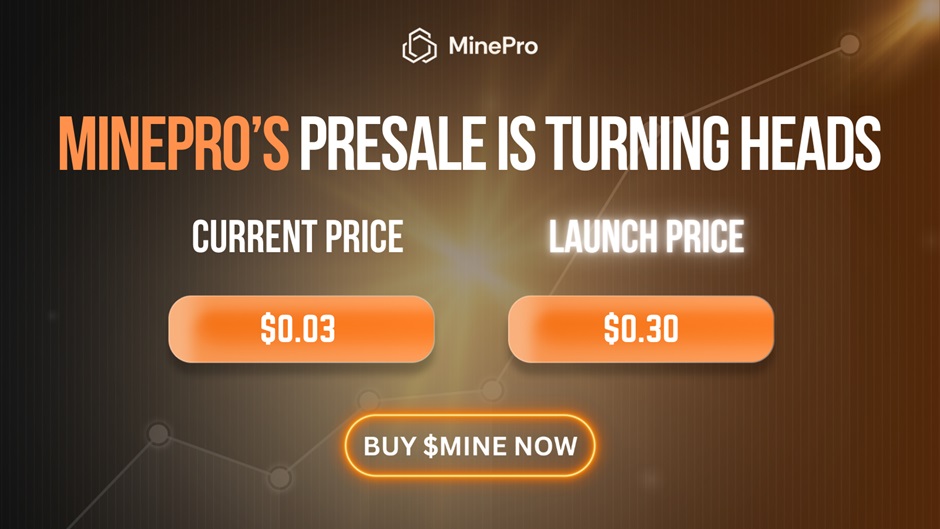
Amidst the rapidly evolving cryptocurrency landscape, MinePro is making waves as a pioneering tokenized Bitcoin mining project. Investors are increasingly drawn to MinePro by the potential to earn 10-20% monthly profits in Bitcoin simply by staking the native $MINE token. This impressive return is made possible through MinePro’s strategic partnership with Logic Mining, a well-established Bitcoin mining operation. What sets MinePro apart is its access to some of the lowest power costs globally—just 0.02 cents per kWh—thanks to this partnership. This low-cost advantage translates into a 95.71% higher profitability rate compared to typical Bitcoin mining operations, ensuring that MinePro remains a highly lucrative investment.

MinePro’s presale has already garnered significant interest, raising $700,000 at the time of writing. Early contributors and airdrop recipients have the opportunity to stake their tokens before the Token Generation Event (TGE), with those who stake early eligible for substantial bonus multipliers on their earnings. This impressive presale figure reflects the broader confidence in MinePro’s innovative approach, positioning it as a potential game-changer in the crypto space.

The partnership with Logic Mining, secured under a five-year contract, guarantees that MinePro will continue to benefit from these low power costs as Bitcoin’s value appreciates over time. This long-term stability is a significant draw for investors looking for sustainable profits in a volatile market. The $MINE token itself plays a crucial role within the MinePro ecosystem, serving as a deflationary governance token that rewards stakers with Bitcoin every month. The longer the tokens are staked, the larger the payouts, encouraging long-term participation and investment.

Conclusion: Exciting Times Ahead for MinePro, and Avalanche, with Potential Further Dumps for Arbitrum

In conclusion, MinePro and Avalanche are each poised for significant bullish developments in the near future, while the future remains rocky at best for Arbitrum. MinePro’s presale success and innovative approach to Bitcoin mining mark it as a standout opportunity in the crypto space. Arbitrum’s unlocks are a worry, and do signal further dumps, but their technology and community remains solid, and we wish the best for them.

Join MinePro Presale Now:

Presale: https://mineprobusiness.net/

Telegram: https://t.me/MineProBitcoin

Discord: https://discord.gg/dWtWJjwNYy


Additional disclaimer: The opinions in this article belong solely to the author and do not reflect those of MinePro or its team. MinePro and its affiliates are not liable for any content provided.

This information is not financial advice and does not consider your individual circumstances or needs. We recommend conducting your own research or seeking independent professional advice before making financial decisions based on this content.

An African market without African products

1
Smiling African American man making purchases in grocery store, pushing full shopping cart

What makes an item, or food product, African? Is it the nationality of the producer(s), the location of production, the source of raw materials, the brand name, or the intended consumers?

Imagine a product labeled “Plantain Fufu” with the brand name “AFRICAN DELIGHT”, it immediately creates the impression of African authenticity. Such slogans coupled with packaging that feature alluring African designs; colors and patterns reinforce this perception. Imagine also the confusion and disappointment evoked when upon consumption and closer scrutiny, one realizes that unconnected products have been packaged in place of plantain, and this product originates from Western Europe, not Africa. This is the sad reality of many Africans in the diaspora, surrounded by products claiming to be something from/of Africa, carrying African-sounding names, and yet containing nothing from/of the African continent.

Ms. Mobolaji, a Nigerian abroad, shares her experience shopping African products in Northern Europe; ‘I often buy a particular brand of ‘poundo-yam’ (also known as, pounded-yam flour) to prepare ‘Iyan’, and I choose this brand because it bears one of my native names. That connection with home appeals to me. It assures me that I am getting a taste of home. Not until recently, did I realize that the product was produced and packaged in Western Europe – it also did not contain any yam, only potato and rice, European and Asian staples. I was shocked.’

While various elements can connect a product to Africa or the African culture, the true authenticity of these products can be elusive, requiring broader discussions about what genuinely constitutes an African product. This African-specific branding raises serious questions about the exploitation of the African brand as a marketing strategy just to lure the huge African population in the Diaspora.

The African Diaspora is estimated to be over 300 million, and scattered across all the different parts of the world. One can rightly imagine, that this growing population corresponds with the expansion of the African market abroad. One expects that this should lead to an increase in the GDP contribution of the agricultural sector in Africa and the growth of its rural economies – since most food production is situated in rural communities. But this is not so and hasn’t been the case. Who is benefiting from the allure of the African Brand abroad?

The answer to this question is not far-fetched, as many of the popular brands of processed African foods in African stores abroad are produced and distributed by companies that aren’t African to begin with. Just industrious people, with knowledge and resources, taking advantage of a waiting market.

In a recent policy intervention webinar, a part series themed ‘Nigeria’s Agricultural Sector – Balancing domestic consumption needs with international export demands’, Olufemi Boyede, an international trade consultant recommended the concept of Export Production Villages. In practice, this would mean earmarking and supporting different locations (or communities) across the country for commercial production of crops and commodities for the export market.

This is not the case of bringing in private (or foreign) investors to produce on these lands, but rather enabling local people, indigenes, to access the resources and technological aids they need to consistently produce internationally desired quality and quantity. This focused and organized export-oriented production has great potential: it will make international trade easier; foreign buyers can easily locate raw material sources, aggregate, and ascertain product quality and standards. It could promote rural development, create jobs, make local livelihoods more resilient, increase forex earnings, and most of all strengthen the country’s currency.

Despite the many challenges and woes that plague most parts of the continent, the African people, home and abroad are proud of their culture and heritage and cherish their Afro identity and connections – including food. Hence there is a market to cater to, and in addition to the insight above, the following recommendations can help ensure that the African diaspora gets the genuine products they desire and that producing African countries get the revenue they deserve.

  • The African diaspora needs to be attentive to details specified on African products when they shop; the country of origin or production, the company responsible for packaging and distribution, and product certifications out of African countries are some examples. Equipped with this knowledge, they can ensure that they are choosing genuinely African products, and supporting the African economy when they buy products labeled – ‘African’. Demand controls supply, and the more a brand is selected, the more local African stores will stock their shelves with that brand.
  • African leaders should recognize that Africa is a brand, a trademark, and until they set standards and controls on the use of that brand as a label, anyone will exploit it. For this to happen all hands must be on deck – it required multi-contributory efforts to enact practicable and useful policies and regulations.
  • Diplomatic relations should be mutually beneficial, not one-sided. And so, collaborating with international trade agencies to establish and enforce policies and regulations that enable the recuperation of revenues due to African countries from the African label should be put in place. For instance, stating that products must contain at least 50% African-sourced raw materials to carry or imply an African identity is one way to go.
  • Many private organizations producing and selling locally within Nigeria for instance, are going the extra mile to showcase the traceability of their products, by including brief captivating stories of their procurement and supply chain systems on their product package or labels. Exporters should do likewise. With details like this on African products, Africans abroad can easily identify what is truly African and support such.

Why Are Litecoin (LTC), RCO Finance (RCOF), and PEPE Likely Entering the Crypto Top 20

0

The crypto market is building momentum, and several strong hands are about to engage in the fight for a top-20 position. The most prominent contenders are Litecoin (LTC), RCO Finance (RCOF), and PEPE, each with special traits that make them strong rivals.

These tokens should easily catch the attention of investors and traders alike as the digital currency unfolds. Their unique value proposition, features, and prevalent dynamics reflect the promise of a bright future.

The Resurgence of Litecoin (LTC) and PEPE

Often called the silver to Bitcoin’s gold, Litecoin (LTC) is undergoing a significant surge. A remarkable 75% increase in active addresses signals growing adoption.

This reflects a broader trend of increased transactions, solidifying Litecoin (LTC) as a viable payment alternative, with over 40 million transactions processed. Additionally, the buzz around a potential Litecoin spot ETF could lead to substantial institutional investment as regulatory bodies recognize it as an asset.

Meanwhile, PEPE, inspired by meme culture, is gaining traction due to strong community support and viral marketing. Its blend of entertainment and investment appeals to diverse investors, positioning it as a contender for the top 20, especially as the market embraces tokens offering fun and functionality.

RCO Finance (RCOF): A New Player with Big Ambitions

RCO Finance is storming the entire crypto world with a unique and different vision of decentralized finance. While most other projects simply copied existing models, RCOF looks to provide exceptional financial solutions that will stay relevant to the changing needs of its users.

Recent analyses have called RCOF a promising investment, especially with its current token presale. Its strategic roadmap and community-driven approach have attracted the attention of both retail and institutional investors.

RCO Finance (RCOF) has become outstandingly unique in the market because of its strong AI capabilities, which are powered by advanced machine learning algorithms. The platform features a robust AI-driven robo-advisor tool that analyzes market data, giving traders and investors a valuable advantage in their decision-making.

Using machine learning applications, the robo-advisor generates customized investment strategies after considering historical data, market trends, and news events related to world events. This helping hand assists in deciding by providing information to help a user make choices about financial goals and risk tolerance.

Furthermore, RCO Finance integrates AMM through a robo-advisor, making trading easier and seamless without requiring manual interventions. Such automation avoids human emotions and mistakes, ensuring more reliable investment results.

By democratizing access to sophisticated trading tools professional investors use, RCO Finance opens up advanced trading strategies to everyone and alleviates the costs and headaches associated with market analysis.

RCO Finance’s Roadmap to the Top 20

RCO Finance (RCOF) is steadily gaining traction as it aims to secure a place among the top 20 in the crypto market in the coming weeks. Its roadmap for becoming a leading crypto asset and platform is anchored in various innovative features.

RCO Finance is not just another DeFi platform; it offers a holistic suite of financial services, including lending and borrowing, staking for passive income, and simplified asset management tools to enhance user experience.

Addressing a significant gap in the crypto market, RCO Finance enables the tokenization of real-world assets. Users can invest in stocks, bonds, and real estate with the RCOF token, bypassing fiat conversions. This feature effectively links digital and traditional finance, appealing to investors looking to diversify their portfolios.

Security is of the essence at RCO Finance. The platform implements the latest security protocols, and smart contracts are regularly subject to SolidProof audits to guarantee the user’s funds’ safety. 

More importantly, it does not require any KYC procedures, giving users the impetus to process privately yet stay compliant with necessary regulations.

Join the RCOF Presale For Over 20x ROI

The RCO Finance (RCOF) token presale is underway and in its first stage. Early investors can buy tokens at a discounted rate of $0.0343. This presale has already attracted considerable interest, raising over $1.5 million.

There’s potential for significant returns, with estimates suggesting the token could debut around $0.40, which translates to a possible ROI of over 2000%. For instance, once the token lists, a $200 investment might yield more than $4,000.

Moreover, RCO Finance provides appealing staking rewards and community incentives, enhancing the overall investment experience. By getting involved, investors can position themselves well as RCO Finance continues to evolve in the DeFi space.

For more information about the RCO Finance (RCOF) Presale:

Visit RCO Finance Presale

Join The RCO Finance Community