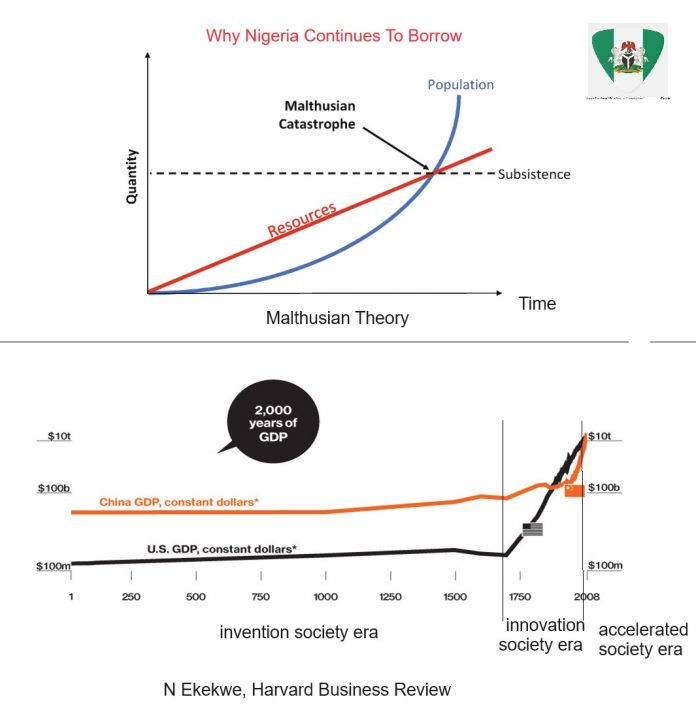
In this piece, I explore the transformation of the world through three distinct eras: Invention Society, Innovation Society, and Accelerated Society eras.
The Invention Society era, pre-1780s, marked by significant inventions in physics and chemistry, provided the foundations for modern science. But it had limited products and services for the needs of markets. Men and women discovered elements but could not make vaccines at scale, dying when epidemics struck.
After the Invention era was the Innovation era, which was characterized by mechanization, mass production, and the rise of producer services. In that age, products and services were created to solve problems in the markets. That era has existed to just about 2020.
At the moment, the Accelerated Society era with AI systems, autonomous machines, and a centralized economy, leading to technical-societal convergence and integration, is at the fledgling level. Technology systems are enabling interconnectedness which is highlighted by seamless global transactions and evolving social norms.
Indeed, these technological advancements foster trust and familiarity among strangers, diminishing traditional barriers and accelerating societal convergence. Yes, you can enter that Uber car without even making eye contact with the driver, and sleep in that Airbnb room in a stranger’s house! Those tech stacks have brought human elements together at scale, seeding economic acceleration, even though not everyone will benefit at the same level.
Developing nations are still operating as Invention Societies, known for ideas everywhere, but limited products and services to solve frictions in markets. Developed economies are transitioning from Innovation Societies to Accelerated Societies, at a rapid level, fueled by the emergence of AI systems.
In these two videos, I explain this developmental evolution, and why many nations remain as Invention Societies, despite latent abundance in the land. As you watch, you will see that inventions do not necessarily create wealth by fiat, what makes wealth happen is innovation which happens when the inventions (yes, ideas) have been turned into products and services to solve real problems in societies.
When a nation does not develop productive capabilities to make that transition from an invention to an innovation society, it remains poor, despite the level of ideas in that economy.