DD
MM
YYYY

PAGES

DD
MM
YYYY

spot_img

PAGES

Home Blog Page 3265

Impacts of Celebrity’s Token Launch on the Crypto Industry

0

The cryptocurrency industry has witnessed a significant transformation with the advent of celebrity-backed digital tokens. This new trend has introduced a unique dynamic to the market, capturing the attention of both investors and fans alike. The recent launch of a token by a renowned Australian rapper on the Solana blockchain is a testament to the growing influence of celebrities in the crypto space.

The Impact of Celebrity Endorsements on Cryptocurrency.

Celebrity endorsements have long been a powerful tool in marketing, capable of swaying public opinion and consumer behavior. In the realm of cryptocurrency, the effect is magnified due to the nascent and highly speculative nature of the market. When celebrities enter the crypto industry, they bring with them a substantial following, which can lead to increased awareness and adoption of digital assets.

The phenomenon of celebrities launching their own tokens has sparked a new level of interest in cryptocurrencies. These tokens often carry the personal brand of the celebrity, offering a unique value proposition to their fans. For instance, the recent launch of ‘MOTHER’ by Iggy Azalea has not only garnered media attention but also highlighted the potential for personal branding in the crypto market.

While the involvement of celebrities can lead to a surge in market activity, it also comes with its own set of challenges. The hype generated by celebrity endorsements can sometimes overshadow the underlying value and utility of the token, leading to inflated prices and speculative bubbles. Moreover, the risk of scams and deceptive practices, as seen in some controversial token launches, remains a concern for the industry.

As the crypto industry continues to mature, the role of celebrity tokens will likely evolve, potentially leading to more sophisticated and integrated use cases. For now, they remain a fascinating aspect of the crypto phenomenon, blending the allure of fame with the potential of blockchain technology.

On the flip side, the successful integration of celebrity tokens into the crypto ecosystem can offer a range of benefits. It can enhance the visibility of blockchain technology, attract new demographics to the market, and potentially lead to innovative use cases for digital assets.

As the crypto industry continues to evolve, the role of celebrities will likely become more pronounced. The key to harnessing the positive aspects of this trend lies in transparency, education, and responsible promotion. By ensuring that celebrity-backed tokens are launched with clear objectives and genuine utility, the industry can mitigate risks and foster a healthy environment for growth.

The impact of celebrity token launches on the crypto industry is multifaceted. It presents opportunities for market expansion and innovation, while also posing challenges that require careful consideration. As the industry matures, the integration of celebrity influence with digital assets will undoubtedly shape the future of cryptocurrency.

The exploration of social tokens and their history offers a comprehensive understanding of this emerging trend and its potential trajectory in the digital economy. The crypto industry stands at the cusp of a new era, one where the convergence of celebrity culture and digital assets could redefine the very nature of value and investment in the years to come.
Nvidia Set to Overtake Apple as World’s Second-Most Valuable Company, Thanks to AI Boom

0

Nvidia, a leading semiconductor company, is on the brink of surpassing Apple to become the world’s second-most valuable company, according to Reuters’ analysis.

This shift stems from the growing influence of artificial intelligence (AI) technologies on the market. Nvidia’s high-end chips, essential for virtually all AI applications such as OpenAI’s ChatGPT, have significantly boosted the company’s valuation, nearly tripling its worth over the past year to $2.68 trillion.

Nvidia’s rapid ascent in the stock market can be attributed to its strategic alignment with major technological trends. Starting with gaming demand, followed by the cryptocurrency boom, and now the AI surge, Nvidia has consistently matched innovation with market demand. This has resulted in explosive growth for the company.

“It is certainly notable because Apple has been so dominant for so long, especially on the growth and innovation front. Recently though, Apple’s innovation curve seems to have flattened, showing slower future growth,” said Brian Mulberry, client portfolio manager at Zacks Investment Management.

“On the other hand, Nvidia has been able to catch wave upon wave of growth. Beginning with gaming demand, then crypto and now AI, they have been able to perfectly match innovation with demand and that equals explosive growth,” he added.

In contrast, Apple has faced significant challenges. The tech giant, which ceded its No. 1 spot to Microsoft earlier this year, is grappling with weak demand for its iPhones and stiff competition in China. Apple’s valuation currently stands at $2.92 trillion, but the company’s innovation trajectory has slowed, impacting its growth prospects.

Nvidia’s influence on the stock market has been profound. The company is heavily weighted on the S&P 500 and the Nasdaq, playing a crucial role in driving U.S. stocks to record highs. It accounted for more than a third of the S&P 500’s gains this year, underscoring its pivotal role in the market.

Nvidia also set a record by becoming the fastest company to grow from $1 trillion to $2 trillion in 2024, outpacing giants like Amazon, Google-parent Alphabet, and Saudi Aramco. This rapid growth is fueled by Nvidia’s consistent ability to exceed Wall Street’s expectations for revenue and profit. The demand for its graphic processors has far outstripped supply as major tech companies race to integrate AI into their systems.

Despite the surge in its stock price, Nvidia’s forward earnings valuation has fallen, trading at 37 times forward earnings compared to 48 times a year ago, according to LSEG data. This indicates a sharp increase in analysts’ earnings estimates, reflecting strong confidence in Nvidia’s future performance.

Nvidia’s popularity extends to the derivatives market as well. The GraniteShares 2x Long NVDA Daily ETF, which tracks twice the daily percentage change in Nvidia, is the largest single-stock ETF. The fund recently clocked $1 billion in daily turnover for the first time ahead of Nvidia’s results, and its total net assets hit a record $2.82 billion this week, according to Lipper data.

Options traders are similarly bullish. Nvidia’s volumes, particularly for call options, have picked up in recent sessions following the surge in its stock price. Thursday marked the fifth straight session where more than a million Nvidia call options changed hands, the longest such streak in the stock’s history, according to a Reuters analysis of Trade Alert data.

Nvidia’s trajectory highlights the transformative impact of AI on the tech industry. The company’s ability to innovate and meet market demands positions it well to continue its upward momentum. As AI applications become more pervasive, Nvidia’s high-end chips will remain in high demand, ensuring sustained growth and market dominance.

Meanwhile, Apple faces the challenge of reinvigorating its innovation pipeline and navigating a highly competitive market. The company’s ability to adapt and innovate will be critical in maintaining its position among the world’s top companies.

Real Madrid Defeats Dortmund in Champions League Final: A Record 15th Title

0

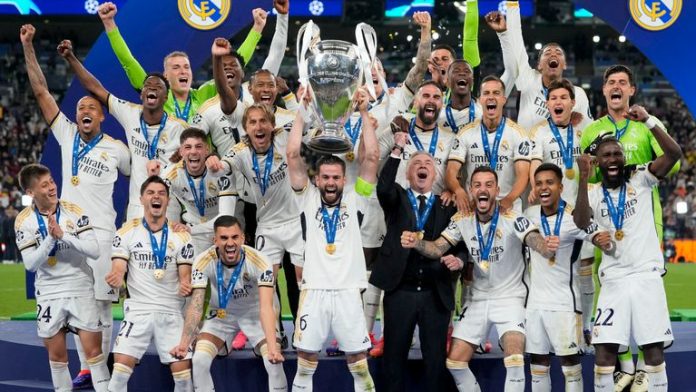
After a night of intense effort and strategy, Real Madrid emerged victorious once again in the Champions League final, with their fans creating a wall of white and serenading their unbeatable team.

The victory at Wembley Stadium marked Real Madrid’s record-extending 15th Champions League title, cementing their status as Europe’s most successful football club.

The Road to Victory

Real Madrid’s manager, Carlo Ancelotti, described the 2023-2024 season as a “10 out of 10” after their 2-0 victory over Borussia Dortmund.

“This season has been 10/10. My players have been spectacular,” Ancelotti said, reflecting on a campaign that also saw Real clinch the La Liga title in Spain.

The final itself was a tense affair, with both goals coming late in the second half from Dani Carvajal and Vinícius Júnior. The success marked Ancelotti’s fifth Champions League win as a manager, another record, and placed players like Toni Kroos, Carvajal, Luka Modric, and Nacho alongside club legend Paco Gento with six Champions League wins each.

Dortmund’s Missed Opportunities

Borussia Dortmund, under the guidance of Edin Terzic, dominated the first half of the match but were unable to capitalize on their chances. Julian Brandt, Niclas Füllkrug, and Karim Adeyemi all missed clear opportunities to put Dortmund ahead.

“They [Dortmund] played better than us and had more chances than us, but they let us get away with 0-0 at half-time,” Ancelotti admitted.

Füllkrug came closest to scoring for Dortmund when he hit the post in the 24th minute. Real Madrid struggled to get into the game initially, with former Dortmund star Jude Bellingham effectively neutralized by his old teammates. However, after weathering the first-half storm, Real Madrid found their rhythm in the second half, leading to their decisive goals.

Real Madrid’s Unyielding Spirit

Reflecting on the season, Ancelotti highlighted the resilience and determination of his squad. “In the second half we had more balance, played better and managed to win the game. This win makes me very satisfied because we never give up and always fight until the end,” he said.

Ancelotti also noted the team’s ability to overcome numerous challenges, including the loss of key players, which they compensated for with commitment and teamwork.

Having secured their 15th Champions League title, Ancelotti emphasized that Real Madrid’s focus would quickly shift to next season.

“In this club, there is a continuous demand and we are never satisfied. After the Euros and Copa America, the players will come back with the same hunger and ambition as before,” he said.

Tribute to Toni Kroos

The final also marked the last club game for midfielder Toni Kroos, who plans to retire after Euro 2024. Ancelotti paid tribute to Kroos, praising his professionalism and impact on the team.

“I’m really grateful to Kroos. He finished at the very top, there is no way to finish higher than this. He is a legend at this club,” Ancelotti said, adding that the club would welcome him back if he ever changed his mind about retiring.

Real Madrid’s Historic Dominance in Europe

Real Madrid’s dominance in the Champions League is unparalleled. The Spanish giants won the first edition of the tournament, then known as the European Cup, in 1955 and retained the trophy for the next four editions—a record for the longest consecutive wins in the competition’s history.

With 15 titles, Real Madrid has more than doubled the tally of the second-most successful club, AC Milan, which has seven titles. German powerhouse Bayern Munich and English club Liverpool have each won the Champions League six times. Other notable multi-time winners include Barcelona (5), Ajax (4), Manchester United (3), Inter Milan (3), Juventus (2), Benfica (2), Nottingham Forest (2), Porto (2), and Chelsea (2).

Since their last European Cup final loss to Liverpool in 1981, Real Madrid has won nine consecutive finals over 43 years, showcasing their enduring prowess in European football.

The Decisive Moments

The final’s turning points came in the latter stages of the match. Dani Carvajal broke the deadlock with a header from a corner, and shortly after, Vinícius Júnior capitalized on a defensive error to secure the second goal. The match was particularly harsh on Dortmund defender Ian Maatsen, who was involved in the mistakes that led to both goals.

“It was a very difficult game,” Carvajal told Movistar. “In the first half we came out alive, they were quite a lot better. We knew our moment would come … We knew how to suffer. That’s football.”

This Champions League victory adds to Real Madrid’s storied legacy and highlights their ability to triumph under pressure. The club’s journey through the season, marked by strategic brilliance and unyielding determination, underlines why they are considered the best club in the world.

Nigeria Minimum Wage: Organized Labour Declares Nationwide Strike Beginning Monday, June 3

0

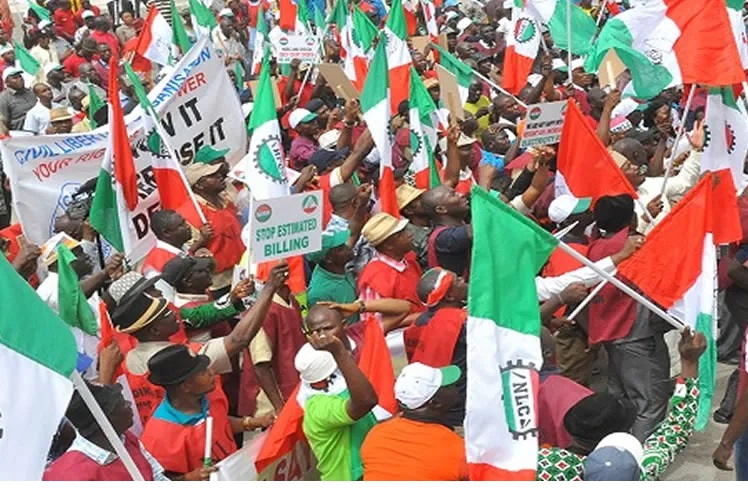
On Friday, the Nigeria Labour Congress (NLC) and the Trade Union Congress (TUC) declared an indefinite nationwide strike starting Monday, June 3rd, 2024, due to the failure of the tripartite committee to agree on a new minimum wage for Nigerian workers.

This decision, announced by Festus Osifo, the President of TUC, during a joint press conference with NLC leadership in Abuja, follows an ultimatum given to the Federal Government to conclude negotiations by the end of May.

The federal government had proposed a new minimum wage of N60,000, but this was rejected by organized labour, which demanded a minimum wage of N494,000. Osifo stated that industrial action was necessary due to the government’s failure to address the workers’ demands, including the reversal of the electricity tariff hike and the cessation of consumer categorization into bands.

“In light of this persistent inaction, we, the Nigeria Labour Congress (NLC) and the Trade Union Congress (TUC), hereby issue a notice of commencement of an indefinite nationwide strike to the Federal Government,” Osifo stated.

Government’s Appeal

In response, the Minister of State for Labour and Employment, Mrs. Nkeiruka Onyejeocha, appealed to organized labour to be considerate, citing the ongoing recovery of the nation’s economy from the effects of the pandemic and other economic challenges.

She stressed that the government was committed to ensuring a fair wage for Nigerian workers but also had to consider the broader economic implications.

“We appeal to organised labour and indeed, other relevant stakeholders to be considerate and patriotic in their demands, recognizing that our economy is still recovering from the devastating effects of the pandemic and other global economic shocks,” Onyejeocha said.

Despite the government’s appeal, various labour unions have begun mobilizing their members for the strike. The Judiciary Staff Union of Nigeria (JUSUN) and the National Union of Petroleum and Natural Gas Workers (NUPENG) are among the unions that have issued directives to their members to prepare for industrial action.

NUPENG’s participation is particularly significant as it involves the shutdown of operations in the distribution and marketing of petroleum products, potentially leading to fuel shortages.

Background to the New Minimum Wage Negotiations

The ongoing dispute over the national minimum wage has a protracted history. In 2019, former President Muhammadu Buhari approved a minimum wage of N30,000. Recently, discussions resumed between the federal and state governments, organized labour, and the private sector, with the NLC and TUC initially proposing N615,500 as the minimum wage, citing the high cost of living.

The federal government’s subsequent offers of N48,000, N54,000, and finally N60,000 were all rejected by labour unions as insufficient. The proposed N494,000 minimum wage from organized labour, the government argues, would result in an unsustainable N9.5 trillion annual bill, a 1,547% increase on the current wage bill.

Minister of Information Mohammed Idris highlighted that while the government aims to ensure adequate remuneration for workers, it also must consider the economic stability of the country. He pointed out that the proposed wage by organized labour could lead to massive job losses, particularly in the private sector.

“The federal government’s new minimum wage proposal amounts to a 100% increase on the existing minimum wage,” Idris stated. “Labour, however, wanted N494,000, which would increase by 1,547% on the existing wage. The sum of N494,000 national minimum wage which labour is seeking would cumulatively amount to the sum N9.5 trillion bill to the Federal Government of Nigeria.”

Interestingly, the organized private sector has shown agreement with the government’s proposal of N60,000 as the new minimum wage. Segun Ajayi-Kadri, Director General of the Manufacturing Association of Nigeria (MAN), mentioned that ongoing negotiations were more focused on establishing a sustainable minimum wage rather than a living wage.

Tinubu’s Economic Policies, the Genesis of the Wage Increase Demand

The push for a substantial increase in the minimum wage by organized labour is significantly influenced by the economic policies implemented under President Bola Tinubu’s administration. Two major policy shifts have had profound impacts on the cost of living: the removal of the fuel subsidy and the floating of the forex market.

The removal of the fuel subsidy, a long-standing practice in Nigeria, has led to a sharp increase in fuel prices. While the subsidy kept fuel prices artificially low, its removal has exposed consumers to the full cost of fuel, leading to increased transportation costs and, consequently, higher prices for goods and services across the board.

This policy was intended to reduce government expenditure and redirect funds to other sectors, but it has significantly burdened Nigerian workers, who now face higher living costs without a corresponding increase in wages.

The decision to float the forex market aimed to stabilize the naira by allowing market forces to determine its value. However, this policy has led to a depreciation of the naira, increasing the cost of imported goods and services. For a country heavily reliant on imports, this has resulted in a surge in inflation, affecting everything from food prices to the cost of electronics and other consumer goods.

The increased cost of living has made it challenging for workers to maintain their standard of living, fueling the demand for a higher minimum wage.

Organized labour’s demand for a minimum wage of N494,000 is a direct response to these economic pressures. The unions argue that the current wage structure is no longer tenable in the face of escalating living costs. The proposed wage is seen as a necessary adjustment to ensure that workers can meet their basic needs and maintain a reasonable quality of life.

The NLC and TUC argue that the removal of the fuel subsidy and the floating of the forex market have disproportionately affected low- and middle-income workers. They contend that the government must take immediate steps to mitigate these impacts by implementing a new minimum wage that reflects the current economic realities.

“We reiterate that since the National Minimum Wage negotiation exercise has not been concluded and the agreed wage passed into law; the hike in electricity tariff has not been reversed and the categorization of consumers into Bands has not stopped as demanded; Nigerian workers are compelled by these failures to embark on an indefinite nationwide industrial action beginning on Monday, the 3rd of June, 2024 to press home our demands,” Osifo stated.

Apple and OpenAI Strike Major Deal: Integrating AI Technology into Apple Software

0

Apple and OpenAI have successfully concluded a deal to integrate OpenAI’s generative AI technology into Apple’s software ecosystem, marking a significant milestone for both companies.

This development was reported by The Information, citing a source familiar with discussions between OpenAI CEO Sam Altman and Apple.

According to The Information, Altman has long aimed to secure a partnership with Apple, envisioning substantial benefits for OpenAI. “Now, [Altman] has fulfilled a longtime goal by striking a deal with Apple to use OpenAI’s conversational artificial intelligence in its products, which could be worth billions of dollars to the startup if it goes well,” stated the source.

This collaboration is expected to bring generative AI capabilities to a broad range of Apple products, potentially transforming user experiences with advanced conversational AI features.

Despite the promising prospects, the deal has faced internal opposition within Apple. John Giannandrea, Apple’s head of machine learning, has reportedly been resistant to integrating large language model-driven chatbots into Apple’s products. Giannandrea’s stance stems from a belief that AI chatbots might not align with Apple’s user-centric design philosophy. He was quoted telling Apple employees, “the last thing people needed was another AI chatbot.”

However, this does not entirely rule out AI’s integration into Apple products. There are multiple ways to incorporate large language models without necessarily creating standalone chatbots. For instance, Apple has been experimenting with OpenAI’s API to enhance Siri, enabling it to respond to a broader array of queries. The plan is to clearly indicate when responses come from a third party like OpenAI, akin to how Siri currently refers users to Google for certain searches.

Concerns from Microsoft

The deal has also raised concerns at Microsoft, a major investor in OpenAI. Microsoft CEO Satya Nadella reportedly expressed apprehension about what the Apple deal could mean for Microsoft’s existing relationship with OpenAI. Microsoft has invested $13 billion in OpenAI, securing a portion of its profits and incorporating its technology into various Microsoft products.

Nadella recently met with Altman to discuss the implications of the Apple agreement. The nature and outcomes of these discussions have not been disclosed, but they highlight the concern of Microsoft over OpenAI’s partnerships within the tech industry.

Interestingly, Apple is also rumored to be in talks with Google for a similar AI integration deal. This could lead to Apple offering users a choice of AI chatbot providers, mirroring its approach to search engines and default browsers. Such a move would emphasize Apple’s commitment to providing flexible and user-oriented solutions while leveraging the best technologies available.

The successful negotiation with Apple is one of several recent achievements solidifying Sam Altman’s leadership within OpenAI, especially following an attempted ouster. Altman’s influence has been further reinforced by ongoing discussions about restructuring OpenAI.

OpenAI operates under a unique structure, with a for-profit entity controlled by a nonprofit organization. However, Altman and his allies are reportedly advocating for a shift to a more conventional structure, such as a traditional for-profit corporation or a benefit corporation (B-Corp). B-Corps are designed to balance profit with social and environmental goals, providing legal protection for corporations to pursue objectives beyond shareholder returns. This change could offer a compromise between the current setup and a full for-profit model.