DD
MM
YYYY

PAGES

DD
MM
YYYY

spot_img

PAGES

Home Blog Page 3293

CBN Clarifies 50% Repatriation Rules for Export Proceeds of International Oil Companies (IOCs)

0

The Central Bank of Nigeria (CBN) issued a detailed clarification on the management of repatriated export proceeds, particularly addressing the handling of the 50 percent balance of these proceeds.

This comes in response to inquiries from banks and stakeholders regarding the policies outlined in recent circulars.

New Guidelines on Repatriated Proceeds

In a circular dated May 31, 2024, and published on its website on Saturday, the CBN clarified that the 50 percent balance of repatriated export proceeds can be sold to authorized dealers or eligible users of Foreign Exchange (FX) with eligible transactions.

Dr. W.J. Kanya, signing on behalf of the Director of the Trade and Exchange Department, outlined that this balance may be sold wholly if the International Oil Companies (IOCs) do not have financial obligations to settle with these funds during or after the 90-day retention period.

Previously, the CBN had stipulated that this 50 percent balance could be used for settling financial obligations within Nigeria as required during the prescribed 90-day period. The clarification reaffirms that the initial 50 percent of repatriated proceeds can be pooled immediately or when needed.

Eligible Uses of the 50 percent Balance

The central bank provided specific guidelines on what the remaining 50 percent of the repatriated proceeds can be used for. Expenses eligible for settlement from this balance include:

  1. Petroleum profit tax
  2. Royalties
  3. Domestic contractor invoices
  4. Cash calls
  5. Domestic loan repayments (principal and interest)
  6. Transaction taxes, such as the Nigerian Content Development (NCD) Levy and education tax
  7. Forex sales at the Nigerian Foreign Exchange Market

Background and Policy Interventions

In February, the CBN introduced several policy interventions aimed at boosting FX liquidity. One significant change was the restriction that IOCs could only repatriate a maximum of 50 percent of their export proceeds initially, with the remaining 50 percent eligible for repatriation after 90 days from the date of inflow.

Additionally, the CBN prohibited the payment of Personal Travel Allowance (PTA) and Business Travel Allowance (BTA) by cash, mandating that such allowances be disbursed through electronic channels like debit or credit cards. This measure aims to curb abuses and enhance transparency in FX transactions.

Addressing Cash Pooling Practices

The CBN’s recent circulars also address the practice of cash pooling by IOCs, where proceeds of crude oil exports are often transferred offshore to fund their parent accounts. This practice, according to the CBN, affects liquidity in the domestic FX market.

While supporting the need for IOCs to access their export proceeds to meet offshore obligations, the CBN emphasizes that such repatriations should minimize the negative impact on domestic FX market liquidity.

These clarifications and guidelines follow inquiries from banks and other stakeholders concerning the CBN’s circulars on cash pooling requests. The central bank has urged banks to submit cash pooling requests ahead of the expected date of receipt, accompanied by the necessary documentation for approval.

By providing these detailed guidelines, the apex bank aims to ensure a balance between meeting the financial obligations of IOCs and maintaining stability and liquidity within Nigeria’s FX market. This approach is part of ongoing reforms designed to foster a more transparent and robust economic environment.

The Notorious $242 million and $29 million Banking Scams

0

In the annals of financial fraud, few cases have captured the public imagination quite like the infamous $242 million scam perpetrated by Emmanuel Nwude in the late 1990s. This staggering con, which remains Africa’s biggest bank scam to date, is a cautionary tale of greed, deception, and the catastrophic consequences of a well-orchestrated financial crime.

Emmanuel Nwude, a former director of the Union Bank of Nigeria, masterminded a scheme that defrauded Nelson Sakaguchi, a director at Brazil’s Banco Noroeste, out of $242 million between 1995 and 1998. The scam was ingeniously simple yet audacious: Nwude impersonated Paul Ogwuma, the then Governor of the Central Bank of Nigeria, and convinced Sakaguchi to invest in a non-existent airport project in Nigeria’s capital, Abuja.

The fallout from this scam was monumental. Banco Noroeste, which had been a significant financial institution in Brazil, collapsed in 2001 as a direct result of the fraud. The personal and professional lives of those involved were irreparably damaged, and the scam had far-reaching implications for the global banking industry, prompting a reevaluation of risk management and due diligence practices.

The case also highlighted the vulnerabilities of the banking system to the machinations of a determined fraudster with insider knowledge. Nwude’s position as a bank director gave him the credibility and access needed to concoct a believable narrative that lured the victims into his trap. His intimate understanding of banking operations and international finance allowed him to navigate the complexities of the scam with a deft hand.

The First Bank $29 Million- or 40 Billion-Naira Fraud.

In a shocking revelation, First Bank of Nigeria has found itself at the center of a massive fraud scandal. An employee, now on the run, is accused of diverting approximately 40 billion Naira (equivalent to $29 million) into various accounts, including those of first beneficiaries and second-tier accounts, in a sophisticated scheme of financial deception.

This incident serves as a stark reminder of the vulnerabilities that exist within financial institutions and the importance of rigorous internal controls. The employee in question, Tijani Muiz Adeyinka, was in a position that allowed him to process reversals for customers, which he exploited to credit funds to accounts he controlled, bypassing the need for further approvals due to his role’s authority.

The fraud was uncovered following a customer complaint, leading to an internal investigation that exposed numerous suspicious transactions. This has prompted First Bank to take swift legal action to recover the stolen funds and work closely with law enforcement agencies to apprehend all individuals involved in this fraudulent activity.

This case highlights the ongoing battle against financial fraud and the need for constant vigilance. It also underscores the importance of customers being aware of their financial transactions and reporting any discrepancies immediately. As the investigation continues, the financial community watches closely, hoping for a resolution that will reinforce trust in the banking system.

The exposure of the Notorious $242 Million Bank Scam led to a multinational criminal investigation, involving authorities from Brazil, Britain, Nigeria, Switzerland, and the United States. The uncovering of the fraud was a pivotal moment for Nigeria, leading to the establishment of the Economic and Financial Crimes Commission in 2002, at the behest of former Nigerian President Olusegun Obasanjo.

Nwude and his accomplices were eventually brought to justice, with Nwude receiving a sentence totaling 25 years in prison. However, the story did not end there. In a twist befitting a Hollywood thriller, Nwude was later implicated in a large-scale attack on a town in Nigeria and arrested on murder charges, although he was subsequently released.

The Emmanuel Nwude scam serves as a stark reminder of the potential for financial crime to destabilize institutions and economies. It underscores the importance of vigilance, transparency, and robust regulatory frameworks to safeguard against such threats. As the world becomes increasingly interconnected, the lessons from this scandal remain as relevant as ever, warning us of the perils that lurk when integrity is compromised in the pursuit of wealth.

The Rains of Profits in Nigerian Banking and Power of Value Capture

1

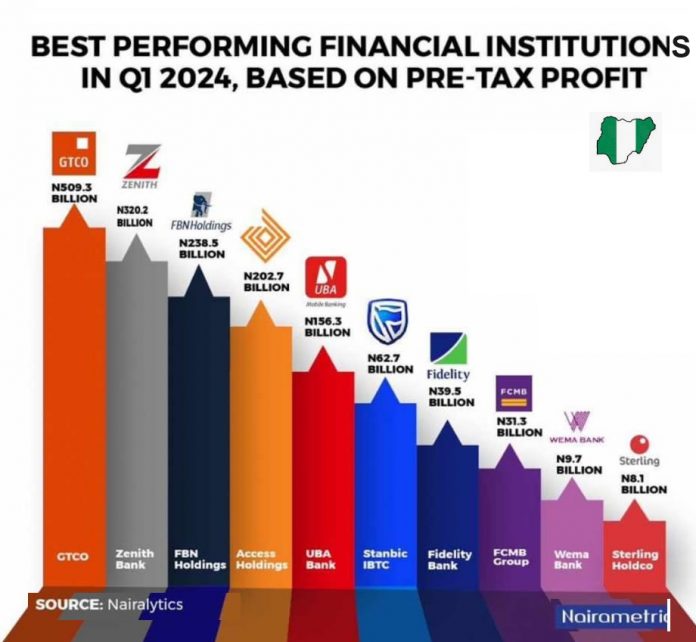
The numbers are out and Nigerian banking is firing on all cylinders: “Nigerian banks recorded a combined pre-tax profit of N1.58 trillion in Q1 2024, marking a 263% year-on-year increase compared to N436 billion in Q1 2023, with GTCO posting the highest profit in Nigeria banking history for the quarter…Top performers in Q1 2024 included Zenith Bank (N320.2 billion pre-tax profit), FBN Holdings (N238.5 billion), Access Holdings (N202.7 billion), and UBA (N156.3 billion)…”, notes Nairametrics.

Congratulations folks and well done. Nigerian bankers are the hardest working professionals in our nation. If everyone has the same level of productivity they have, Nigeria would have been a bigger Singapore. Period.

Yes, it is an industry where excuses are not tolerated, and the workers understand that loud and clear. Those days, I used to board diesel trucks from Apapa to Victoria Island to ensure diesel was delivered to Diamond Bank’s headquarters. I used to go to the VI NEPA office at 1am begging them to keep light on the Diamond Bank line. I worked for 3 years including on Christmas Day, Easter Day, etc without a vacation.  

But I enjoyed it because they elevated your spirit to see a mission which if you drop the ball, that mission could be imperiled. Go to night shift, sleep and the next day, the branches will not open because “system is down”. Why? The entry level engineers in the HQs did not complete the tasking end of day runs on time. Sleep twice, you are out!

So, when you look at these numbers, put everything in context: they’re coming from an industry which works and has figured out how to capture value (read my Harvard piece on capturing value here). 

GTBank’s GTCO has one of the finest genes; it has an industry-leading cost-to-income ratio, averaged over a decade, and that continues to show on its profitability. I am also happy to note that the elephant is dancing well despite the recent paralysis. So, guys, enjoy the party.

Now your question – why are banks breaking profit records when companies are closing and the economy struggling? 

My response: It is not the banking sector’s fault that the Central Bank of Nigeria (CBN) is increasing the prime rate which forces banks to hike interest rates on their customers. It is also not the banking sector’s fault that Nigeria floated its currency which delivers higher value for their foreign currency denominated financial instruments. So, if you visit your bank and the interest rate has gone up, do not curse the bank, ask the apex bank because those rates are partly driven by the central bank policy.

Now, he is defending the banks to protect his friends. That is not fair to a village boy; I hope you can take time and master how banks design their processes and playbooks to capture value in Nigeria.

Matter Labs Trademarking of “ZK”, A Closer Look At IP Licensing in Web3

0

The intersection of intellectual property (IP) and the burgeoning field of Web3 is a complex and evolving landscape. One of the recent developments in this space involves Matter Labs and their efforts around the trademarking of ‘ZK’, a term commonly associated with zero-knowledge proofs, a privacy-preserving cryptographic method. This move has sparked a significant debate within the Web3 community regarding the implications of IP licensing and trademarking in an ecosystem that values decentralization and open-source principles.

Matter Labs, known for their development of the zkSync protocol, filed to claim “zero-knowledge” as a trademark in nine countries, which led to public outcry from other projects working on zero-knowledge-based solutions. The contention lies in the fact that zero-knowledge proofs are not a new concept and have been a part of cryptographic discussions since the 1980s. The technology saw its first real-world application with the launch of the Zcoin and Zcash protocols in 2016, which utilized zero-knowledge proofs to enhance transaction privacy on the blockchain.

The trademark bid by Matter Labs raises questions about the ownership and commercialization of terms and technologies that many believe should remain in the public domain. The Web3 ethos often leans towards collaborative development and shared advancements, with many projects releasing their code under open-source licenses to foster innovation and collective growth.

In response to Matter Labs’ trademark filing, a joint statement from Starkware, Polygon, and Polyhedra—three teams also working on zero-knowledge solutions—called for the Web3 community to demand the withdrawal of these trademarks. They argue that zero-knowledge proofs should be considered a public good, belonging to everyone, and not subject to corporate ownership.

On the flip side, the case of HYPERCOMIC illustrates a different approach to IP in Web3. HYPERCOMIC, a consortium involving Korea’s leading webtoons and Netflix production units, announced a strategic collaboration with Matter Labs to leverage zkSync’s blockchain technology. Their goal is to create a decentralized IP ecosystem that incentivizes and rewards fans for interacting with and supporting HYPERCOMIC’s IPs. This model aims to revolutionize how users engage with IP content, allowing fans to play an active role in the growth and direction of IPs, while also earning rewards for their contributions.

The HYPERCOMIC initiative highlights the potential for Web3 technologies to create novel IP management and monetization models that benefit creators and consumers alike. It presents a contrast to the traditional centralized control of IP growth by distributors and offers a community-driven approach to supporting and developing content.

The debate around Matter Labs’ ‘ZK’ trademark bid and the contrasting models of IP management in Web3 underscores the need for a nuanced understanding of IP rights in the digital age. As the Web3 space continues to evolve, it will be crucial for the community to navigate these issues carefully, balancing the protection of innovations with the ethos of openness and accessibility that many associate with the decentralized web.

The ongoing discussions and actions taken by various stakeholders in the Web3 community will likely shape the future of IP licensing and trademarking in this new digital frontier. It remains to be seen how these tensions will resolve and what precedents will be set for future innovations in the space. For now, the Matter Labs ‘ZK’ trademark controversy serves as a pivotal case study in the complex interplay between IP rights and the principles of Web3.

Impacts of Celebrity’s Token Launch on the Crypto Industry

0

The cryptocurrency industry has witnessed a significant transformation with the advent of celebrity-backed digital tokens. This new trend has introduced a unique dynamic to the market, capturing the attention of both investors and fans alike. The recent launch of a token by a renowned Australian rapper on the Solana blockchain is a testament to the growing influence of celebrities in the crypto space.

The Impact of Celebrity Endorsements on Cryptocurrency.

Celebrity endorsements have long been a powerful tool in marketing, capable of swaying public opinion and consumer behavior. In the realm of cryptocurrency, the effect is magnified due to the nascent and highly speculative nature of the market. When celebrities enter the crypto industry, they bring with them a substantial following, which can lead to increased awareness and adoption of digital assets.

The phenomenon of celebrities launching their own tokens has sparked a new level of interest in cryptocurrencies. These tokens often carry the personal brand of the celebrity, offering a unique value proposition to their fans. For instance, the recent launch of ‘MOTHER’ by Iggy Azalea has not only garnered media attention but also highlighted the potential for personal branding in the crypto market.

While the involvement of celebrities can lead to a surge in market activity, it also comes with its own set of challenges. The hype generated by celebrity endorsements can sometimes overshadow the underlying value and utility of the token, leading to inflated prices and speculative bubbles. Moreover, the risk of scams and deceptive practices, as seen in some controversial token launches, remains a concern for the industry.

As the crypto industry continues to mature, the role of celebrity tokens will likely evolve, potentially leading to more sophisticated and integrated use cases. For now, they remain a fascinating aspect of the crypto phenomenon, blending the allure of fame with the potential of blockchain technology.

On the flip side, the successful integration of celebrity tokens into the crypto ecosystem can offer a range of benefits. It can enhance the visibility of blockchain technology, attract new demographics to the market, and potentially lead to innovative use cases for digital assets.

As the crypto industry continues to evolve, the role of celebrities will likely become more pronounced. The key to harnessing the positive aspects of this trend lies in transparency, education, and responsible promotion. By ensuring that celebrity-backed tokens are launched with clear objectives and genuine utility, the industry can mitigate risks and foster a healthy environment for growth.

The impact of celebrity token launches on the crypto industry is multifaceted. It presents opportunities for market expansion and innovation, while also posing challenges that require careful consideration. As the industry matures, the integration of celebrity influence with digital assets will undoubtedly shape the future of cryptocurrency.

The exploration of social tokens and their history offers a comprehensive understanding of this emerging trend and its potential trajectory in the digital economy. The crypto industry stands at the cusp of a new era, one where the convergence of celebrity culture and digital assets could redefine the very nature of value and investment in the years to come.