DD
MM
YYYY

PAGES

DD
MM
YYYY

spot_img

PAGES

Home Blog Page 3305

The Lesson from the New Yam Festival, And Grand Messaging Unification from Sultan and Bishops

1

“It is getting to a level that traditional leaders could no longer pacify the people from revolting against government and political leaders that are supposed to find solutions to their lingering socio-economic plight…”- Sultan of Sokoto, Muhammad Sa’ad Abubakar.

“If we cast a cursory glance at the present state of our nation, we are inclined to conclude that this seems to be the worst of times for our country in the areas of security and the economy…As a result of the government’s reform agenda, millions of Nigerians have been reduced to a life of grinding poverty, wanton suffering, and untold hardship as never before in our national history” – Bishop Lucius Ugorji, President of Catholic Bishops Conference of Nigeria (CBCN) (in picture below)

Nigerian leaders (economic, political, religious, etc) must wake up. Yet, I do posit that there is even “no hunger” in Nigeria at the moment. At least farmers farmed last year before the current acceleration of insecurity. Largely, no farming is going on now in Benue (the food basket of the nation), Nassarawa, etc. By November this year, Nigeria will experience severe economic turbulence since the harvest will be so low that food prices will hit new records, if our leaders FAIL to lead.

Yes, this is the planting season and our leaders have a window to ensure that our soldiers are deployed into all farmlands so that farmers can farm!!! If we do not do just that, the “soldiers of hunger” will come with vengeance from November.

In ancestral Igbo, new yams are celebrated because the new harvest breaks the “unwu” [famine] period. That period is when yams have been planted but they are not yet ready to be harvested. Due to lack of storage facilities, there is always scarcity and “famine” because during “unwu”, yam is scarce.

But as August arrives, and the new yams are ready for harvest, communities celebrate because the “famine” is  going to be over. That is the heart of the new yam festival which you might have read in Chinua Achebe’s books. The festival honours the earth goddess of wealth for bringing her fertility and increasing the wealth of the village. 

On that context, imagine if there would not be harvest because the “yams” were not planted in March because of insecurity. Do you know the implications? Do not imagine that…for Nigeria!

AI-Tokens Rally as OpenAI’s Sora Drive FOMO, as BTC Hits $51.5k

0

Narratives can often fuel significant bumps in token prices, and there are renewed hopes around AI-related tokens. Over the weekend, tokens related to artificial intelligence (AI) or claiming to be utilizing AI rallied as OpenAI unveiled its groundbreaking text-to-video generator, Sora. This development has boosted hopes among those who view the sector as a key driver of profits this year.

Sector tokens experienced an impressive 7.7% average increase in value within the past 24 hours, according to CoinGecko data. Notably, Ocean Protocol’s OCEAN and Fetch. AI’s FET rose more than 10%. Meanwhile, the CoinDesk 20 Index (CD20)—a benchmark for the biggest and most liquid cryptocurrencies—also saw a positive trend, rising by 2.68% during the same period.

Among all AI tokens, Worldcoin’s WLD stood out with a remarkable 30% surge, setting a new lifetime peak at $7. Worldcoin’s parent company was founded by OpenAI CEO Sam Altman, leading some traders to consider WLD as a bet on OpenAI’s growth.

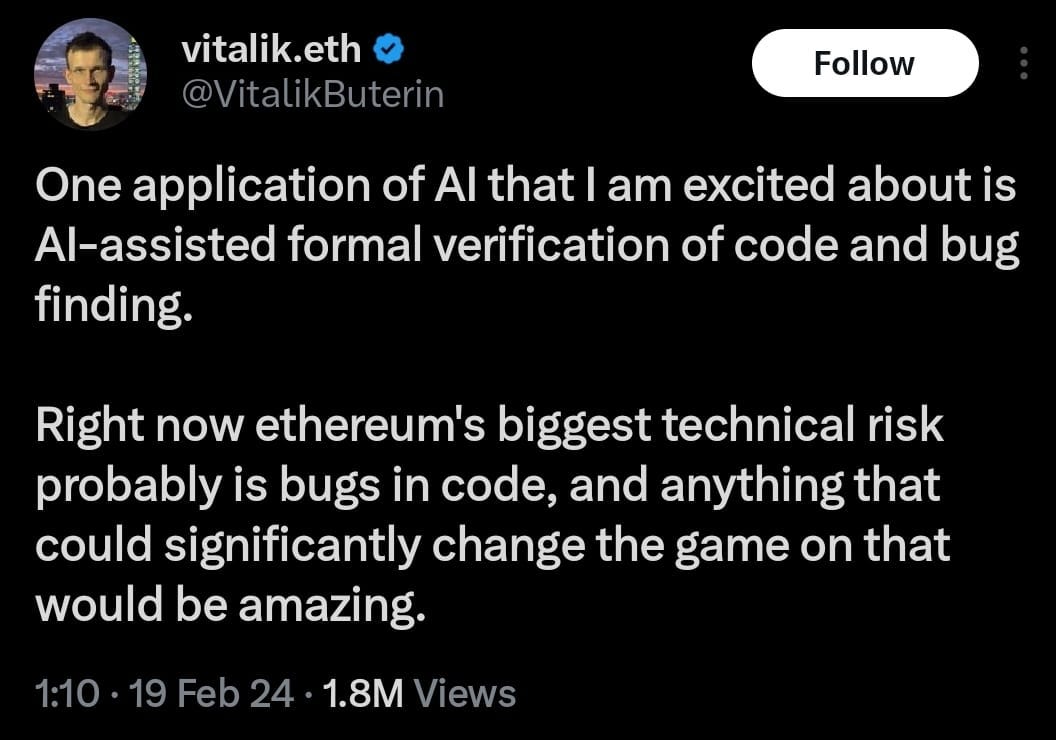
Ethereum co-founder Vitalik Buterin added fuel to the fire by tweeting that AI could find a place for auditing smart contracts. This statement sent lesser-known tokens like 0x0 and Token Fi’s TOKEN up by as much as 15%, given their connection to AI-related topics.

He wrote;

One application of Artificial Intelligence AI that I am excited about is AI-assisted formal verification of code and bug finding.

Right now, Ethereum’s biggest technical risk probably is bugs in code, and anything that could significantly change the game on that would be amazing.

Buterin highlighted the importance of AI-powered auditing to identify and rectify buggy code in the Ethereum network. He specifically mentioned the value of AI-assisted formal verification of code and bug finding emphasizing that this could significantly enhance the network’s robustness.

But why is this so crucial? Let’s delve into the details:

The Challenge of Code Bugs: Ethereum, like any complex software system, faces the risk of bugs in its codebase. These bugs can lead to vulnerabilities, security breaches, or unintended behavior. Identifying and fixing these bugs is essential for maintaining a secure and reliable blockchain platform.

AI-Assisted Formal Verification: Formal verification involves mathematically proving that a program meets its intended specifications. AI-assisted formal verification combines the power of AI algorithms with formal methods to verify code correctness.

By leveraging AI, developers can automatically analyze code for potential issues, ensuring that it adheres to specified properties.

Benefits of AI in Code Verification: AI can perform exhaustive checks on code, exploring various execution paths and identifying subtle bugs that manual inspection might miss. It can help detect issues related to memory leaks, race conditions, buffer overflows, and other common programming pitfalls.

Automated verification tools powered by AI can significantly reduce the time and effort required for manual code reviews.

Interest in AI-related tokens began to spike in early 2023 when ChatGPT and image generation software gained popularity. Although this enthusiasm waned over the past few months, Sora’s Friday launch has seemingly reignited interest. Commercial usage of AI remains limited to virtual tools and chat software.

Bitcoin hovers around $52k per coin on Monday

As the weekend approaches, investors worldwide are taking a moment to reflect and analyze the ever-evolving landscape of cryptocurrency. All eyes are on Bitcoin as it hovers tantalizingly close to the $52,000 mark, while altcoins navigate a landscape marked by slight retractions and nuanced price movements.

Bitcoin is classified as a Currency under CoinDesk’s Digital Asset Classification Standard (DACS). It is the world’s first decentralized cryptocurrency – a type of digital asset that uses public-key cryptography to record, sign, and send transactions over the Bitcoin blockchain – all done without the oversight of a central authority.

Bitcoin, the undisputed leader of the cryptocurrency market, has been on a remarkable journey over the past ten days. It all began on February 7 when Bitcoin finally broke out of its prolonged consolidation phase, which had seen the digital asset trading within a tight range around $43,000.

The breakout ignited a frenzy among bulls, propelling Bitcoin to knock on the $50,000 door by the end of the week. Despite facing initial resistance, Bitcoin’s ascent continued unabated, culminating in a triumphant reclaiming of the $50,000 level on February 12. The cryptocurrency reached a crescendo on Thursday, soaring to a dizzying height of $52,900, marking its highest price since late 2021.

However, as Bitcoin attempted to breach the $52,000 barrier, it encountered stiff opposition, leading to a slight retracement on Friday. As of now, Bitcoin remains locked in a tight range just below the $52,000 threshold, signaling a temporary pause in its upward trajectory.

While its market capitalization remains above $1 trillion, its dominance over the altcoin market has increased to 50%, indicating a shift in market dynamics favoring the king crypto asset. The recent price action in Bitcoin left the token’s market capitalization at $1.02 trillion. So far this year, Bitcoin has experienced a 23.01% change.

The Bitcoin network (with an upper-case “B”) was launched in January 2009 by an anonymous computer programmer or group of programmers under the pseudonym “Satoshi Nakamoto.” The network is a peer-to-peer electronic payment system that uses a cryptocurrency called bitcoin (lower case “b”) to transfer value over the internet or act as a store of value like gold and silver.

Each bitcoin is made up of 100 million Satoshi’s (the smallest units of bitcoin), making individual bitcoin divisible up to eight decimal places. That means anyone can purchase a fraction of a bitcoin with as little as one U.S. dollar.

Bitcoin’s price is renowned for being highly volatile, but despite that, it has become the top-performing asset of any class (including stocks, commodities, and bonds) over the past decade – climbing a staggering 9,000,000% between 2010 and 2020. When the cryptocurrency was launched at the beginning of 2009, as Satoshi Nakamoto mined the bitcoin genesis block (the first-ever block on the Bitcoin network).

Japan Moves Closer to Allowing Venture Capital Firms to Hold Crypto Assets

0

Japan’s government has taken a significant step by approving a bill that permits venture capital firms and investment funds to acquire and hold crypto assets. If this bill is passed by parliament, it could have far-reaching implications for the investment landscape, particularly in the realm of Web3 startups.

The Bill’s Impact

By adding crypto assets to the list of permissible assets for venture capital firms and investment funds, Japan aims to boost investment in innovative startups operating in the Web3 space. This moves position Japan at the forefront of blockchain technology and decentralized finance (DeFi).

Regulatory Framework for Stablecoins

Japan has been proactive in framing a regulatory framework for stablecoins, demonstrating its commitment to fostering a conducive environment for digital assets. While promoting Web3 technologies, Japan remains vigilant about user protection.

Relaxing Rules for VC Firms

In September 2023, Nikkei reported that Japan planned to relax rules for venture capital (VC) firms investing in crypto startups. Now, with the cabinet’s approval of this bill, VC firms could potentially fund Web3 startups in exchange for crypto assets.

Supporting New Businesses

The amendment to the Industrial Competitiveness Enhancement Act aims to “promote the creation of new businesses and investment in industry.” It also provides “intensive support to medium-sized companies and startups that are the driving force of Japan’s economy.”

Parliamentary Approval

The amended bill will be introduced and debated during the current session of parliament (the Diet). If approved, it will open up exciting opportunities for VC firms and investment funds while contributing to Japan’s position as a hub for crypto policy formation.

Japan’s government has approved a bill that allows venture capital firms and investment funds to hold crypto assets. If passed by parliament, this bill could significantly boost investment in Web3 startups. The move is part of Japan’s efforts to create a regulatory framework for stablecoins and promote Web3 technologies while maintaining a focus on user protection.

The amended bill will be introduced and debated in the current session of the Japanese parliament, known as the Diet. If approved, venture capital firms could fund Web3 startups in exchange for crypto assets. This development reflects Japan’s commitment to supporting new businesses and fostering investment in industries that drive its economy.

What does EIP 4844 mean for Ethereum rollups?

EIP-4844 is part of Ethereum’s rollup-centric roadmap, designed to address scalability challenges. While Ethereum has made significant improvements through upgrades like The Merge and rollups, transaction fees remain high for many users, and throughput isn’t where it needs to be for mass adoption. To tackle this issue, Ethereum has long-term plans for data sharding.

Data sharding involves partitioning databases into smaller segments to enhance efficiency and performance. When applied to blockchain, sharding becomes even more interesting. Ethereum aims to implement danksharding, which will significantly lower transaction costs and increase throughput.

Danksharding is expected to boost Ethereum’s transactions per second (TPS) to around 100,000, a substantial improvement compared to the current base layer TPS of approximately 15 and layer 2 rollups’ TPS of about 100 as of Q1 2023.

The Proliferation of Digital Lending Platforms in Nigeria, And The Impact on Credit Access And Financial Inclusion

0

In the past few years, there has been a surge of notable digital lending platforms in Nigeria, which has had a significant impact on credit access and financial inclusion.

According to the World Bank, the number of digital loans disbursed in Nigeria increased from 1.5 million in 2019 to 13.5 million in 2021.

With the dynamics of lending having undergone a remarkable transformation, companies like Carbon and Renmoney, among others, have leveraged digital platforms to offer instant loans to individuals and small businesses alike.

Also, traditional banks have embraced digital platforms to cater to retail consumers and businesses within a range of loan and credit products.

These digital platforms have continued to play a crucial role in financial inclusion as their importance in reaching out to unbanked individuals cannot be overstated.

By leveraging technology to automate the lending process, digital lenders are able to offer lower interest rates, faster approval times, and more flexible repayment terms than traditional banks. This has made it easier and more affordable for people to start and grow businesses, and to invest in other productive assets.

Notably, Digital lending platforms have become an intrinsic part of the broader movement toward financial inclusion. These platforms are having a significant impact on financial inclusion in Nigeria. By making it easier and more affordable for people to access loans, digital lending is helping to level the playing field and create opportunities for everyone.

By leveraging the power of technology, lending institutions can reach a wider range of consumers, providing them with access to much-needed credit. The unbanked population, often excluded from formal financial systems, can now benefit from tailored lending products that are designed to meet their specific needs.

Here is an overview of the several impacts of digital lending platforms on credit access;

Simplified Application Process: Digital lending platforms offer a streamlined and user-friendly application process compared to traditional banks. Borrowers can apply for loans online or through mobile apps, submit required documents electronically, and receive approval decisions rapidly, eliminating the need for lengthy paperwork and in-person visits to bank branches.

Faster Disbursement of Funds: Digital lending platforms enable faster disbursement of funds to borrowers once a loan is approved. Loans are typically disbursed directly to borrowers’ bank accounts or mobile wallets, allowing them to access funds immediately for their financial needs, whether it’s for emergencies, business investments, or personal expenses.

Tailored Products and Flexibility: Digital lending platforms often offer a range of loan products tailored to the needs of different customer segments, including personal loans, business loans, salary advances, and consumer finance. Borrowers can choose loan amounts, repayment terms, and interest rates that suit their preferences and financial circumstances, providing greater flexibility and control over their borrowing experience.

Overall, the proliferation of digital lending platforms in Nigeria has democratized access to credit, empowered individuals and businesses, and advanced financial inclusion by providing convenient, accessible, and affordable financial services to a broader segment of the population.

However, it is imperative for the government to ensure responsible lending practices, consumer protection, and regulatory oversight to mitigate risks and safeguard the interests of borrowers and lenders alike.

Agility in Workplace

0

Companies exist to fix frictions in markets. To do that, they must mobilize factors of production to create products and services. When you examine the whole constellation of that translation of organizing, combining and recombining those factors to make products, you see three things: people, processes and tools.

The People are the heart of every firm. They are the central nervous system of any operating entity, making it possible for the neurons and synapses of markets to operate effectively. The wealth of firms is in the People of the firms.

Join us at Tekedia Mini-MBA tomorrow, as one of the finest minds in this industry of discovering, nurturing, and uplifting the PEOPLE to execute business missions, educate. Ijeoma Anunibe, PHRi, SHRM-SCP, ACIPM is the Head of People at Shuttlers, an innovative transportation startup.

IJ will teach on “Building Agile Workforce in Companies”. It would be an academic excursion from an industry leader with certifications in the critical domains of human resources management and administration.

Tekedia Institute >> the #best school