DD
MM
YYYY

PAGES

DD
MM
YYYY

spot_img

PAGES

Home Blog Page 3318

NVIDIA And How Transistors Rule The World

0

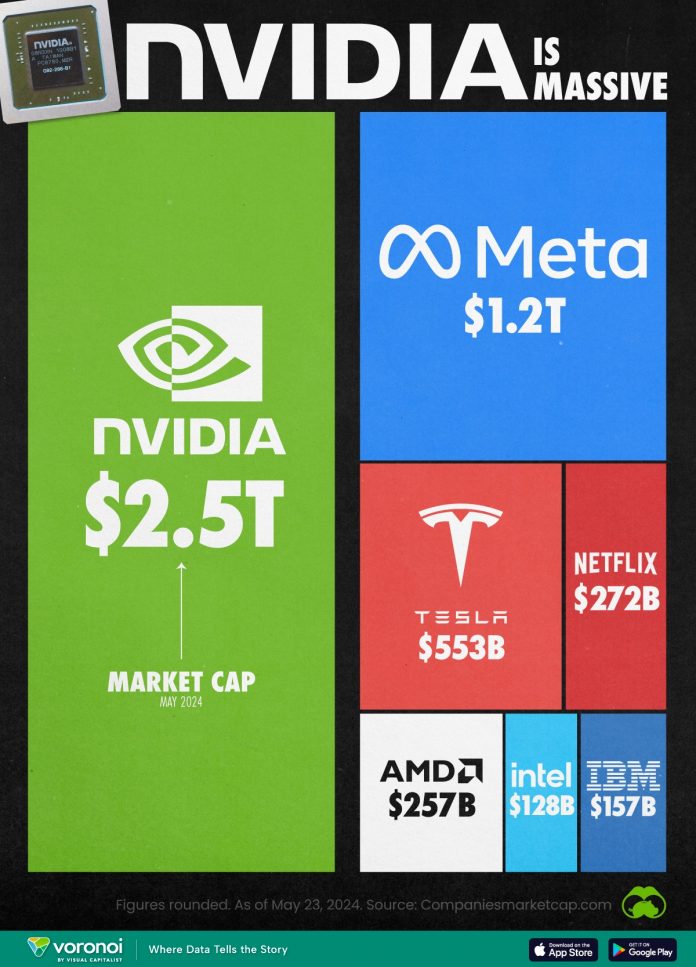
This is now the Nvidia era. Nvidia is to AI what Amazon AWS is to websites. Good People, before this age of AI, Nvidia was just another microelectronics company. When I interviewed for Intel, coming out of PhD, in Ronler Acres campus in Hillsboro Oregon, no one in that panel saw it as something different. A week later, I was in Analog Devices, the conversation was on Texas Instruments, as Nvidia was way off from its focus. I decided for Analog Devices because of an amazing Apple project.

But here we are: Nvidia is now the industry and more. Intel has lost ground to AMD. AMD itself was a failed company which magically resurrected. They say in social media  tech, it is just one click away; I will say in hardware, it is just how transistors are organized.

For Nvidia, though, it goes beyond transistors. Yes, Nvidia’s CUDA (Compute Unified Device Architecture) is a huge moat.  CUDA  allows developers to write code that runs on NVIDIA GPUs (Graphics Processing Units) for various tasks, including scientific simulations, machine learning, and deep learning. By providing a powerful and efficient framework for GPU programming, CUDA has become a cornerstone of NVIDIA’s software ecosystem. You can make better chips, but you still have to beat CUDA.

These companies will power the empires of the future because before those clicks, likes, etc, transistors must fire, and someone must organize them. Borrowing the oil sector for an analogy, these are the upstream players while the social media companies are downstream. Facebook, Microsoft, TikTok, etc will not advance until Nvidia, Intel, Analog Devices, etc have evolved because transistors rule all nations!

Bitcoin Price Rallies Back to $70k as Experts Predict New All-Time High

1

The price of Bitcoin has begun its rally back to the upside, hovering around the $70k zone, as experts predict a new all-time high.

With the price of Bitcoin currently trading at $70,458 as of the time of writing this report, analysts disclosed that the recent approval of Spot Bitcoin exchange-traded funds (ETFs) has amplified the process for investors to gain exposure to Bitcoin.

According to them, this development has the potential to significantly increase demand for Bitcoin and diminish supply. However, as transformative as this has increased access for retail investors, they note that it will pale in comparison to the tidal wave of demand anticipated from institutional investors entering the market.

Recall that after the fourth crypto halving that occurred in April this year, Bitcoin failed to drop below $56k and recovered in a bullish fashion, indicating the emergence of the bullish flag on a broader scale.

With the price of Bitcoin surging to the upside, several crypto experts have rolled out their predictions. Crypto expert Michael van de Poppe outlined an important price level from which Bitcoin must break out.

He claims that once it achieves a successful breakout, the flagship crypto will see a new all-time high (ATH). Poppe adds that Bitcoin needs to break through $70,000 on a lower time frame (LTF) basis.

Once that happens, the analyst claimEd that Bitcoin will likely see a new ATH. He also noted that lower timeframe regions at $67.000 were holding. Meanwhile, he highlighted Bitcoin’s long consolidation, stating that almost three months have passed since the crypto token remained in that range.

Economist and crypto trader Mikybull Crypto on his X handle stated that he doesn’t seem to understand why the majority of traders are screaming that the price of Bitcoin is already at the peak of the bull run. Meanwhile, he says, according to the monthly chart, the market is just getting started for a golden bull run for this cycle.

In this regard, he further hinted that the majority of traders with bearish sentiments will be caught off guard when the price of Bitcoin begins to rally heavily to the upside.

The bitcoin price which is currently trading at around $70,000 per bitcoin, is up almost 400% from its post-FTX collapse lows in late 2022, with the market braced for what’s likely to be a game-changing 2024 US presidential election.

US Former President Donald Trump says he is very positive and open-minded to cryptocurrency companies, stating that country must be the leader in the field.

In his words,

“I will ensure that the future of crypto  Bitcoin will be made in the USA. I will support the right to self custody to the nation’s 50 million crypto holders.”

Also, it is worth noting that there is an explosive alt-season brewing, as several altcoins have seen their price surged, with pontential move to the upside.

The Nigeria’s Option On The Naira FX Paralysis And Slowing Letters of Credit

0
Boniface, a shoemaker, poses for a photograph with a set of finished women's shoes at a shoe factory in Araria market in Aba, Nigeria August 19, 2016. REUTERS/Afolabi Sotunde

This is one of Nigeria’s biggest economic perturbations: “Nigeria’s letter of credit payments has plummeted by 63% in the first quarter of 2024 compared to the same period in the previous year, according to international payments data from the Central Bank of Nigeria (CBN).”

A letter of credit (LOC) is a document issued mainly by a bank that guarantees a buyer will pay a seller on time and in full for goods or services. Largely, with the fall of LOC, it does mean that banks are not offering a lot of those guarantees.

Good People, that is a big problem. But it is expected. Indeed, the problem with our forex paralysis is not that the Naira has lost value, but that it is not stable. And with that volatility, LOCs take a hint, freezing economic activities along the way. Nigeria needs a stable currency urgently.

The deal is clear: FX traders and speculators look at the exchange rate; investors, besides everything, look at the stability of Naira. Naira needs to stay within a variance percentage of -/+ 5% over six months to bring investors back at scale.

One way of doing that is to fix an official rate, and stop the current illusion that Naira can be floated to swim in the waters of international market when it is clear we do not have enough life jackets (factories, services, warehouses, etc) to save it, if it begins to drift, as it is now doing!

Nigeria’s Letter of Credit Payments Drops by 63% in Q1 2024

Financialization of Nigeria – The Species of Bureaux de Change and POS Agents

1

Great feedback on the post on how we financialized Nigeria without the making things components and put the nation on an economic descent. Even a senator sent a note to a village boy with “…my staff forwarded your post to me. We will look into this”. Good People, I told the senator that Nigeria has made Naira a “commodity” which can be bought and sold like any product since people pay fees with POS (post of sale) agents during withdrawals and deposits. Simply, because of our institutional deficiencies, we’ve created a business sector to “tax” the Naira by non-government agents.

Let us continue the financialization of Nigeria conversation. I have noted that between 1989 and 1993, Nigerian financialized its economy.  Nigeria has not recovered from what happened in those four years. Let me add another vector to what we have already discussed. It was in 1989 that Nigeria introduced Bureaux de Change (BDC), creating a meaningless financial institutional category that was mainly designed to “tax” the citizens.

Simply, like the POS business which has turned Naira into a “commodity”, enabling the buying and selling of Naira, BDC and POS share the same genes.

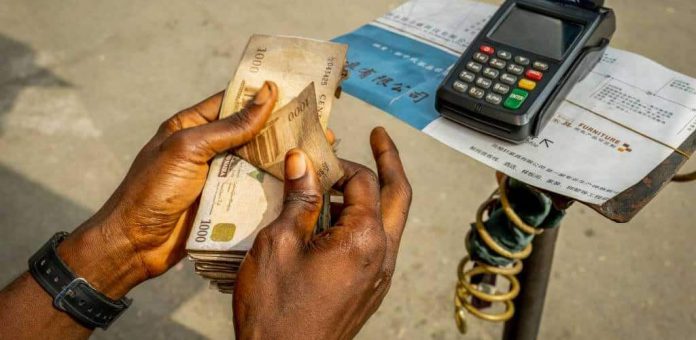
Yes, I want N10,000 and you can take N100 if you can give me this money as a POS agent.  I want to deposit N20,000, please this N500 is my fee. Magically, Naira is now a commodity where to withdraw or deposit, someone has to pay a fee. When you model that the central bank noted that more than 90% of cash in circulation is outside the banking sector, and a big chunk goes through this POS system, you will agree that it is indeed a great sector. Under that system, how do you convince a young man to start a poultry business when he can insert himself with a POS merchant in the village market to tax the citizens? 

That is financialization which is possible because Nigeria has not given banks an ultimatum to reach all local governments and wards to be called national banks, 15 years upon licensing. Because we have allowed banks to operate where they can make profits and avoid where they cannot, we then shifted the “losses” to the citizens.

If this village boy is to be a decision maker, I will give all national banks in Nigeria to be present in all local government areas. We do not want to see those huge profits when Ovim people do not have a decent banking product there!

BDC like the POS offer marginal production value and are products of a financialized Nigeria. But while POS is focusing on Naira, BDC is an international vector. Yes, BDC plays with the national currency, and with that vector, Nigeria created a business sector which can only thrive on the volatility of the Naira! So, more volatility, better gain.  (People who invented POS did it to help in payment of goods and services, not for selling and buying currencies.)

Just like that, we created Naira billionaires for doing largely nothing but get USD from the central bank and sell to the citizens! Tufiakwa! And in a system where that happens, why do you need to create a soap business or start a farming business? In other words, if volatility brings economic gains, why do you think people will not work towards creating it?

Our banks cannot be allowed to choose where they operate to declare huge profits; they should be pushed to go rural, spend the profits, but over time, they will deliver value to themselves and the economy. That will ensure we reduce the POS agent “tax” in our economy.

Also, we need to pay attention if it is time to make everything aspect of BDC operations 100% digitized. In other words, any operator receiving funds from the central bank will get it in a digital form, and the ones in airports or ports must be better regulated with higher accountability. Yet, over time, what BDCs do must be folded into what banks do.

And let me add that POS and BDC have united in Nigeria as you can also engage POS agents when doing your thing with BDCs. In those cases, Nigeria introduced two layers which offer marginal value (and remain necessary because we have not fixed foundational things).

Craig Wright did not invent Bitcoin, Satoshi Nakamoto DID

0

Bitcoin, the first decentralized digital currency, has been surrounded by mystery since its inception. The true identity of its creator, known by the pseudonym Satoshi Nakamoto, remains one of the most intriguing puzzles in the tech world. Over the years, several individuals have been speculated to be the real Satoshi, with one of the most controversial figures being Craig Steven Wright.

Wright, an Australian computer scientist and businessman, has made multiple public claims to be the main part of the team that created Bitcoin and to be the person behind the pseudonym Satoshi Nakamoto. These assertions have been met with skepticism and have been widely disputed by the media and the cryptocurrency community. The debate over Wright’s claims intensified when, in March 2024, the British High Court ruled that Wright is not Nakamoto.

The controversy around Wright’s claims is not just a matter of curiosity but also has significant legal and financial implications. In 2016, Wright was involved in a court case where he claimed to keep a cache of Bitcoin worth billions of dollars. The jury’s decision allowed Wright to retain these assets, although he was ordered to pay $100 million for intellectual property infringement to his late partner’s company.

Despite the legal battles and the claims, the crypto community has not accepted Wright as the creator of Bitcoin. Investigations and reports have raised concerns about the possibility of an elaborate hoax. The lack of conclusive evidence and the refusal to provide irrefutable proof have left many doubting Wright’s narrative.

The question of who created Bitcoin is more than just a quest for the truth about an individual’s identity. It is a reflection of the very nature of the cryptocurrency itself—decentralized, anonymous, and open-source. The ongoing debate about Wright’s claims serves as a reminder of the core values of the Bitcoin community and the importance of transparency and trust in the digital age.

A series of court rulings have cast doubt on the authenticity of documents presented by Wright to support his assertion of being Satoshi Nakamoto. A judge has described the evidence as forgeries created on a “grand scale,” undermining Wright’s claims. The Crypto Open Patent Alliance (COPA) pursued legal action to challenge Wright’s claims, seeking a negative declaration that he is not the pseudonymous author Satoshi Nakamoto.

The implications of these legal proceedings extend beyond the personal claims of Wright. They touch upon the broader principles of open-source development and the collaborative nature of the cryptocurrency community. The court’s findings affirm the community’s commitment to transparency and truth, ensuring that the foundational ethos of Bitcoin remains intact.

What is clear, however, is the enduring legacy of Bitcoin as a transformative financial technology, one that continues to evolve and inspire innovation across the globe. The debate over its origins serves as a reminder of the importance of integrity and honesty in the digital age.

As the saga continues, the crypto world watches on, waiting for the day the true Satoshi Nakamoto steps forward, or perhaps, prefers to remain forever unknown, leaving the legacy of Bitcoin to speak for itself. For now, the mystery endures, and Craig Steven Wright’s role in the history of Bitcoin remains a topic of intense discussion and speculation.