DD
MM
YYYY

PAGES

DD
MM
YYYY

spot_img

PAGES

Home Blog Page 332

China’s Economic Growth Slows to One-Year Low as Trade Tensions Deepen, Raising Calls for Fresh Stimulus

0

China’s economy likely expanded at its weakest pace in a year in the third quarter of 2025, according to a Reuters poll, as renewed trade frictions with the United States and persistent domestic weakness threatened to derail Beijing’s 5% growth target.

The slowdown, which points to mounting structural strains, has intensified pressure on Chinese authorities to roll out new stimulus measures before the year’s end.

According to the poll of 45 economists, China’s gross domestic product (GDP) is forecast to have grown by 4.8% year-on-year between July and September — down from 5.2% recorded in the second quarter and the slowest pace since the third quarter of 2024. The reading would still surpass the 4.5% projection made in a July poll, but remains below the government’s target.

Larry Hu, Chief China Economist at Macquarie, said he expects third-quarter growth to dip to 4.5%, adding that Beijing will likely resort to “mini-stimulus measures in Q4, especially for housing,” as it tries to cushion the economy.

“In the long term, Beijing will use domestic stimulus to cushion external shocks, in order to maintain relatively steady growth,” Hu added.

The slowdown comes despite Beijing’s modest support measures earlier this year, which sought to preserve policy space for future shocks amid resilient exports and buoyant stock markets. However, the renewed U.S.-China trade tensions have dimmed sentiment.

Trade frictions escalated sharply after Beijing tightened export controls on rare earth elements — critical materials for high-tech and defense industries — prompting U.S. President Donald Trump to threaten a 100% increase in tariffs on Chinese goods from November 1. Still, U.S. officials have signaled a willingness to lower the temperature, suggesting both sides could open new channels of dialogue.

China’s reliance on manufacturing and overseas demand has made it highly vulnerable to such shocks. Many exporters are already struggling with steep tariff costs, forcing a pivot toward new markets.

Wang Pengjie, sales manager at a car floor mat exporter, told Reuters that his company has lost between 60% and 70% of its U.S. orders this year.

“We are trying to compensate by expanding into emerging markets, including Southeast Asia, Mexico, and the Middle East,” he said. “But these new markets can’t make up for it. The competition is very intense, and we have to compete more on price.”

To survive, Wang’s company is focusing on high-end products, a strategy increasingly common among Chinese exporters caught in the tariff crossfire.

Economic Indicators Show Softening Across Sectors

On a quarterly basis, GDP is projected to have expanded by just 0.8% in the third quarter, down from 1.1% in the second quarter. Official GDP data, along with September retail sales, industrial output, and fixed-asset investment figures, will be released on Monday.

Despite a slight rebound in export growth in September, much of the recent economic data points to waning momentum. The property sector remains mired in a prolonged slump, while weak consumer demand has continued to exert downward pressure on prices, heightening the risk of deflation. Analysts say these factors support the case for additional fiscal and monetary support.

The People’s Bank of China (PBOC) has so far refrained from aggressive easing, maintaining its key policy rates for four consecutive months. Analysts, however, expect more targeted stimulus steps in the coming weeks. Lynn Song, Chief Greater China Economist at ING, noted that “the recent escalation of tensions between China and the U.S. ahead of potential talks between Presidents Xi and Trump at the end of the month could keep the PBOC on hold for the rest of October.”

“That would leave ammunition to support markets if talks do not go well,” Song said. “November, consequently, remains an interesting window to watch for potential easing.”

More Stimulus on the Horizon

Beijing has announced a range of limited interventions, including interest subsidies on household and business loans to spur consumption. It also plans to deploy about 500 billion yuan in policy-based financial tools to accelerate investment projects and bolster growth.

According to the Reuters poll, analysts expect the PBOC to cut its seven-day reverse repo rate — a key policy benchmark — by 10 basis points in the fourth quarter, alongside a similar reduction in the benchmark loan prime rate (LPR). The central bank is also expected to trim the reserve requirement ratio (RRR) by 20 basis points to ease liquidity conditions.

Even with these measures, full-year growth is projected to fall short of Beijing’s “around 5%” target, with analysts forecasting 4.8% for 2025 and a further slowdown to 4.3% in 2026.

China’s consumer price inflation, meanwhile, remains near zero — well below the government’s 2% target — and is expected to edge up only modestly to 0.9% next year.

Policymakers Eye Long-Term Strategy

Against this backdrop, Chinese leaders are scheduled to meet from Monday to Thursday for a closed-door policy conference that will help shape the country’s 15th Five-Year Plan. The agenda is expected to prioritize high-tech manufacturing and innovation, particularly as China seeks to insulate its economy from the deepening rivalry with Washington.

The leadership meeting will likely emphasize self-reliance in technology and supply chains — a strategic pivot already reflected in recent state-led investment drives in semiconductors, electric vehicles, and green energy.

But analysts warn that these structural shifts will take time to translate into sustainable growth. Currently, China’s policymakers are caught between two imperatives: managing the short-term fallout from the U.S. trade war and addressing long-term vulnerabilities in property, debt, and domestic consumption.

Kraken Acquires Small Exchange for $100 Million

1

Cryptocurrency exchange Kraken announced the completion of its $100 million acquisition of Small Exchange, a U.S.-based, CFTC-regulated Designated Contract Market (DCM) for derivatives trading, from IG Group.

The deal, structured as $32.5 million in cash and $67.5 million in Kraken parent company Payward stock, positions Kraken to launch a fully onshore U.S. derivatives platform, integrating spot crypto, futures, and margin trading under unified CFTC oversight.

This move builds on Kraken’s earlier $1.5 billion purchase of futures platform NinjaTrader in March 2025, aiming to create a “high-performance trading environment” with reduced latency and enhanced risk management for institutional and retail users.

Kraken co-CEO Arjun Sethi described it as laying the groundwork for “a new generation of United States derivatives markets designed for scale, transparency, and efficiency.” IG Group, which acquired Small Exchange in 2023, called the sale a “significant return” while shifting focus to its own crypto expansions in the UK and Australia.

Kraken’s $100M acquisition of Small Exchange strengthens its U.S. presence by enabling a CFTC-regulated platform for crypto spot, margin, and futures trading.

It enhances retail and institutional access to derivatives, improves liquidity, and aligns with regulatory trends, potentially boosting adoption and market efficiency for assets like BTC and ETH.

Both Coinbase and Kraken have aggressively pursued derivatives expansion in 2025 amid surging institutional demand for regulated crypto tools.

Coinbase’s approach emphasizes massive scale through high-value acquisitions and global product diversification, positioning it as a “one-stop shop” for derivatives.

Coinbase International Exchange: 106 perpetual futures listings up from 15 in 2024; $185B+ monthly volumes, $60B open interest post-Deribit. Expanding to altcoins (e.g., SUI futures Oct 20) and hybrids like Mag7 + Crypto Equity Index Futures (Sept 22).

Kraken focuses on U.S.-centric integration, leveraging smaller, targeted buys to unify spot and futures under CFTC oversight for retail and institutional efficiency.

Coinbase leads in global dominance and options volume, ideal for institutions seeking breadth. Kraken excels in U.S.-regulated unification and cost-efficiency, appealing to retail/pro traders wanting seamless onshore access.

Both align with 2025 trends toward regulated hybrids, but Coinbase’s bolder M&A $3B+ spent gives it an edge in market share, while Kraken’s $1.6B investments prioritize practical U.S. integration.

Backpack and Superstate Partner to Launch Tokenized Equities

Backpack Exchange—a Solana-based crypto platform founded by former FTX executives—has partnered with blockchain finance firm Superstate to integrate native, SEC-registered tokenized U.S. equities into its trading venue.

Through Superstate’s Opening Bell platform, eligible non-U.S. users can now trade, buy, sell, and cross-margin real shares of public companies not synthetic wrappers onchain, alongside crypto and stablecoins, with full shareholder rights including dividends and voting.

Unlike custodial products like Kraken’s xStocks, these tokens use the same CUSIP identifiers as traditional NYSE or Nasdaq shares and are issued via Superstate’s SEC-registered transfer agent for direct onchain settlement.

Backpack CEO Armani Ferrante highlighted the partnership as advancing “the future of finance is the future of crypto,” positioning the exchange as the first centralized venue for issuer-backed, compliant tokenized stocks.

Initial supported stocks, including recent examples like Galaxy Digital’s GLXY shares, will roll out soon, amid Backpack’s broader push into regulated real-world assets following its acquisition of FTX’s EU arm earlier this year.

Syndicate Publishes Crypto’s First DUNA Financial Report – Sets Transparency Milestone

0

For years, onchain transparency has been one of crypto’s defining promises. With a known address, anyone can verify a treasury’s holdings or validate outgoing payments. But that onchain transparency has traditionally been paired with offchain occlusion.

Without a viable onshore compliance regime, crypto treasuries and DAOs have too often disappeared into offshore black boxes—with little visibility into how funds were actually managed or reported.

The DUNA changes that. It brings both onchain and offchain operations into the light—aligning onchain transparency with institutional-grade financial reporting and U.S. legal compliance.

For the first time, token-holder–governed organizations can present a holistic, verifiable view of their finances—both onchain and offchain. This is a key step in the professionalization of the industry, and one that’s long overdue.

Public disclosures, paired with onchain transparency, can finally create a full and open picture of the Syndicate Network Collective—and a model for other DUNAs to follow.

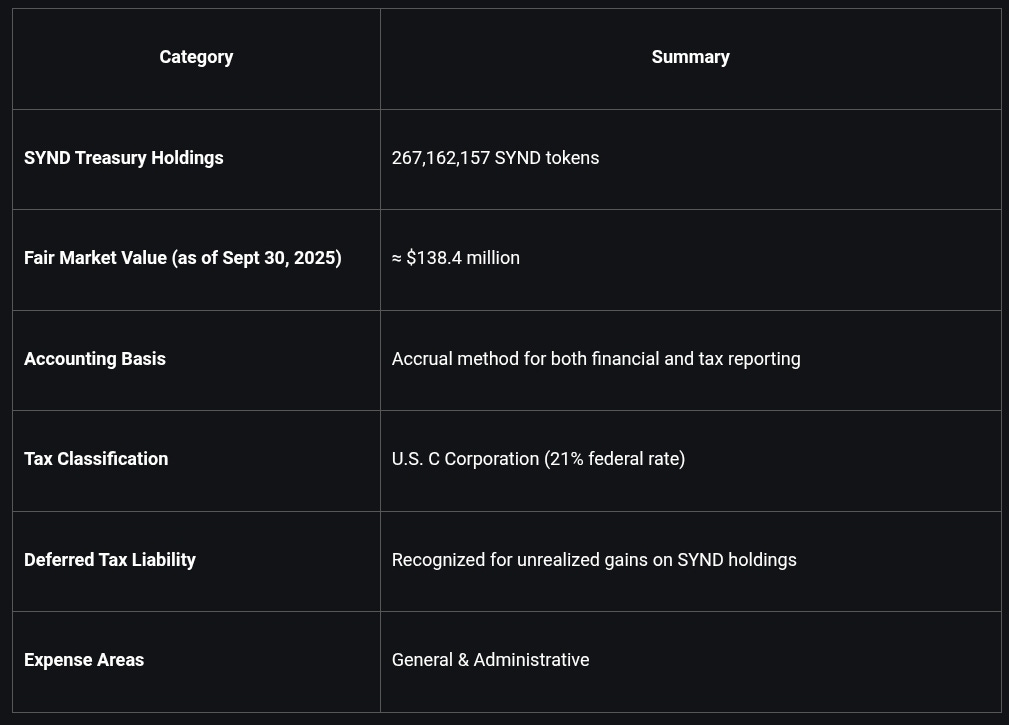
As of September 30, 2025, the DUNA held 267,162,157 SYND tokens and $285,000 cash on hand.

The DUNA’s financials capture its full economic activity, including unrealized gains or losses on token holdings. The treasury funds ecosystem development, governance operations, research, and long-term network security.

All disbursements are approved through governance and accounted for under U.S. tax rules—ensuring transparency and traceability across onchain and offchain records.

Building Trust Through Transparency

Building a community-owned internet requires more than open infrastructure—it requires systems that earn trust through accountability.

The Syndicate Network Collective’s financial framework turns that principle into practice. By applying established accounting standards to onchain activity and publishing those results openly, it sets a precedent for how decentralized networks can operate transparently and responsibly.

Transparency isn’t an afterthought to decentralization—it’s what gives it substance. The Syndicate Network Collective shows how communities can own not just their infrastructure within the Syndicate Network, but the integrity of the systems behind it—laying the groundwork for a more open, accountable, and community-owned internet.

The Framework: How the DUNA Operates

Syndicate Network Collective operates as a Wyoming Decentralized Unincorporated Nonprofit Association (DUNA)—a first-of-its-kind structure that enables collective governance while maintaining compliance with U.S. law.

Members are SYND holders who actively participate in governance—oversee the use of the network’s treasury through open proposals and onchain votes—not mere token ownership.

Upon formation, the DUNA elected to be treated as a U.S. C Corporation for federal tax purposes. This provides clear reporting obligations and accountability while allowing the DUNA to operate transparently within existing law.

Gives token holders real control over the network and its treasury. In the early stages, token holders participate in crucial votes, while a committee manages grants. Over time, we expect governance to shift fully onchain—where smart contracts control the network, keeping power where it belongs: with the community.

Provides a legal entity for contributors and participants to interact with—including limited liability protections to token holders. The DUNA framework defines clear, legally recognized roles for all ecosystem participants, creating a transparent structure for collaboration and accountability.

Manages the network treasury, signs contracts, and engages with traditional service providers with token holder votes and committees. The network can act in the real world—legally and operationally—while remaining governed by its tokenholders.

Operates transparently under U.S. law and regulation by default. This is a structure designed to bring greater transparency, reporting, and accountability to the crypto industry, without compromising its core values of decentralization, privacy, and openness.

Aligns with the future of U.S. policy. With the passage of the GENIUS Act, SEC’s Project Crypto, White House’s establishment of the Strategic Bitcoin Reserve and Digital Asset Stockpile, and the proposed market structure bills that explicitly support decentralized network governance structures like DUNAs, the U.S. is building a clear legal and regulatory foundation for the crypto industry to operate openly at home, not offshore.

Importantly, the DUNA is nonprofit by default—it’s designed for networks and protocols to serve its communities of users, not shareholders. DUNAs reflect a deep commitment to build networks where decentralization isn’t just technical but core to the purpose of the network itself.

Syndicate Network will now operate under a DUNA structure with the Syndicate Network Collective, helping set a new standard for the crypto industry—where community ownership is real, governance is transparent, and compliance doesn’t come at the cost of openness or permissionlessness.

Financial and tax reporting use accrual and fair-value accounting, meaning: Income is recognized when earned, not received. SYND holdings are valued at current market prices each period. Unrealized gains are recorded as income, with a deferred tax liability for future realization.

Paxos Mistakingly Minted $300 Trillion PYUSD Out of Error But Got Burnt Afterwards

0

Stablecoin issuer Paxos accidentally minted 300 trillion PYUSD (PayPal USD) tokens on the Ethereum blockchain during what was intended to be a routine internal transfer.

This massive amount—equivalent to roughly $300 trillion USD at PYUSD’s 1:1 peg to the dollar—far exceeded the stablecoin’s normal circulating supply of about $2.3 billion.

That’s more than twice the global GDP estimated at $117 trillion and over eight times the U.S. national debt $37 trillion. The error occurred around 3:12 PM EST, originating from a Paxos hot wallet interacting with PayPal’s PYUSD smart contract.

Blockchain explorers like Etherscan captured the transaction, which cost just $2.66 in Ethereum gas fees. Paxos quickly identified the issue as an “internal technical error” likely a “fat finger” mistake, such as adding extra zeros—previous transactions that day involved only 300 million PYUSD.

Within 22–30 minutes, the entire minted supply was burned by sending it to a non-retrievable Ethereum address, ensuring no net change in PYUSD’s total supply or circulation.

Paxos confirmed via an official X post: “There is no security breach. Customer funds are safe. We have addressed the root cause.” PYUSD’s price briefly deviated from its $1 peg but stabilized rapidly, and the incident had no impact on user holdings or the stablecoin’s 1:1 backing with U.S. dollars.

Aave, a major lending platform, temporarily froze PYUSD markets as a precaution to verify system integrity and prevent potential exploits. Chaos Labs founder Omer Goldberg also PayPal’s head of blockchain noted this was due to the “unexpected high-magnitude transaction.”

The event sparked brief speculation and memes on social media, with users joking about using the minted tokens to pay off global debt or comparing it to “printing money” cheaper than the Federal Reserve.

Some even theorized it as a deliberate “shadow QE” quantitative easing moment to test stablecoin infrastructure, though Paxos dismissed any malicious intent. Unlike past stablecoin iincidents like the UST’s collapse, this was fully reversed on-chain, highlighting blockchain’s transparency but also the risks of centralized admin controls in permissioned stablecoins.

This glitch underscores vulnerabilities in stablecoin operations, even for regulated issuers like Paxos. While quickly resolved, it raised questions about Centralized stablecoins rely on issuer trust; a similar error in a less responsive system could erode confidence.

Protocols like Aave demonstrated effective risk controls, but such events could trigger flash crashes if not caught early.

With stablecoins increasingly tokenized for real-world assets like real estate via Eric Trump’s World Liberty Financial, incidents like this fuel calls for stricter limits, as seen in the Bank of England’s proposed caps on holdings.

PYUSD remains the eighth-largest stablecoin in DeFi, with strong backing from PayPal. No further issues have been reported as of October 16, 2025, and routine minting like 300 million PYUSD resumed normally.

Algorithmic stablecoin UST lost its $1 peg due to a combination of market sell-off, flawed protocol design, and a death spiral in its LUNA backing mechanism. Systemic failure of a decentralized, algorithmic stablecoin Terra ecosystem.

Catastrophic collapse of the entire Terra ecosystem, wiping out $40 billion in market value. Error detected and resolved within 22–30 minutes by burning the 300 trillion tokens. No change in circulating supply ~$2.3 billion, no loss of user funds, and price stabilized quickly at $1 peg.

Centralized control allowed Paxos to burn tokens using admin keys, leveraging Ethereum’s transparency. Days to weeks, with no effective resolution. UST’s peg began unraveling on May 7, 2022, and collapsed below $0.10 by May 12. UST never regained its peg; LUNA its backing token crashed to near-zero, and investors lost billions.

Brief price deviation from $1 peg, temporary freeze of PYUSD on Aave, and social media buzz. No lasting market disruption. Minor dent in trust, but Paxos’s transparency and quick fix limited fallout. PYUSD remains a niche but stable player in DeFi.

Inherent fragility of algo-stablecoins; vulnerable to market volatility and bank runs.
Overreliance on market confidence and LUNA’s value, no centralized fallback. Highlights risks of centralized stablecoin operations but also the benefits of quick intervention.

Reinforces need for robust internal controls and audits, especially as stablecoins scale.
Likely to draw minor regulatory attention but no systemic threat. The Paxos PYUSD error was a brief, contained operational glitch with no lasting damage, thanks to centralized controls and rapid response.

The UST collapse was a systemic failure of a decentralized protocol, causing massive losses and market-wide fallout. Paxos’s incident underscores the importance of operational rigor, while UST’s collapse revealed the dangers of uncollateralized stablecoin designs.

Binance Completes Acquisition of Gopax, Marking Return to South Korea

0

Binance, the world’s largest cryptocurrency exchange by trading volume, finalized its long-delayed acquisition of South Korean crypto platform Gopax, receiving key regulatory approval from the Financial Intelligence Unit (FIU).

This move ends a regulatory standoff that began over two years ago and positions Binance for a full re-entry into the South Korean market, which it exited in 2021 amid tightening compliance rules.

Binance first acquired a majority stake reportedly 67% in Gopax in February 2023 as a rescue effort. Gopax, one of only five licensed exchanges in South Korea authorized for cash-to-crypto transactions, faced a liquidity crisis earlier that year when its DeFi partner, Genesis Global Capital, froze around $47 million in user assets tied to the GoFi product.

Binance’s initial investment aimed to compensate affected users and stabilize the platform. Full control was stalled due to concerns over anti-money laundering (AML) risks, exacerbated by Binance’s global legal battles, including a $4.3 billion U.S. settlement in 2023.

South Korea’s FIU paused reviews in 2023 but resumed them in August 2025, approving Gopax’s executive changes—effectively vetting Binance as the controlling shareholder—late on October 15.

With the deal now complete, Binance gains operational control of Gopax, enabling integration of its advanced trading tools, global liquidity, and support services. Terms of the final acquisition weren’t disclosed, but it builds on Binance’s prior 41-67% ownership.

Implications for South Korea’s Crypto Market

South Korea boasts one of Asia’s most active retail crypto scenes, with high trading volumes driven by strict investor protections like mandatory real-name verification. The market is dominated by local giants: Upbit (Dunamu): ~63% of trading volume, Bithumb: ~32%.

Gopax’s share is minimal, but Binance’s involvement could inject competition, potentially eroding the duopoly and introducing innovations like better liquidity and institutional tools. This aligns with South Korea’s evolving regulations, including upcoming spot crypto ETFs and won-pegged stablecoins, under a crypto-friendly administration led by President Lee Jae-myung.

The approval may encourage other global players like Coinbase or OKX to pursue local partnerships, fostering a more mature, compliant ecosystem. Binance has not yet commented officially, but the move underscores its post-settlement focus on regulatory adherence in key markets.

South Korea has one of the most robust and stringent cryptocurrency regulatory frameworks globally, balancing investor protection with market innovation. Oversees financial policies, including crypto-related regulations, through its Financial Intelligence Unit (FIU).

Financial Intelligence Unit (FIU): Directly responsible for supervising crypto exchanges, ensuring compliance with anti-money laundering (AML) and counter-terrorism financing (CFT) rules. The Ministry of Economy and Finance, Korea Communications Commission, and regional authorities like the Seoul Metropolitan Government.

Under the Special Financial Information Act (SFIA), amended in March 2020 and enforced since March 2021, all crypto exchanges, wallet providers, and custodians must register with the FIU. Requirements include: Obtaining an Information Security Management System (ISMS) certification.

Partnering with a licensed bank for real-name verified accounts to facilitate won-based trading. Compliance with AML/CFT obligations, including customer due diligence (CDD) and suspicious transaction reporting.

Only five exchanges—Upbit, Bithumb, Coinone, Korbit, and Gopax—currently hold licenses to offer cash-to-crypto trading due to these strict requirements. Unregistered platforms face penalties or shutdowns.

Since 2022, South Korea has enforced the FATF Financial Action Task Force travel rule, requiring VASPs to share sender and recipient information for crypto transactions above a certain threshold aligned with global standards, typically ~$1,000 USD.

These rules have limited the number of operational exchanges, as compliance costs are high, and unregistered platforms risk severe penalties or closure. Crypto gains are not yet subject to a specific capital gains tax, but this is under review.

A proposed 20% tax on crypto gains was delayed from its initial 2022 implementation due to market and political pushback. The government aims to implement a low-value asset exemption gains under 2.5 million KRW ~$1,800 USD may be tax-free to encourage retail participation.

Corporate crypto holdings are already subject to corporate income tax. VASPs must report user transactions to tax authorities, with stricter enforcement expected by 2027 under new virtual asset taxation laws.

All crypto trading accounts must be linked to verified bank accounts to prevent fraud and anonymous trading. Exchanges are required to store a significant portion of user assets in cold wallets to mitigate hacking risks.

Unlike bank deposits, crypto assets are not insured, but the government encourages VASPs to maintain reserve funds for user compensation in case of insolvency or hacks. Strict penalties for pump-and-dump schemes, insider trading, and other manipulative practices, enforced by the FSC and Korea Fair Trade Commission.

The FSC is exploring regulations for won-pegged stablecoins, with guidelines expected in 2026. Issuers must hold 100% reserves in cash or liquid assets and register as VASPs.

The Bank of Korea is piloting a digital won, with trials ongoing in 2025. The CBDC aims to complement, not replace, existing crypto markets, focusing on cross-border payments and financial inclusion.

Projects issuing tokens must register with the FSC, providing whitepapers and financial disclosures. In early 2025, South Korea approved spot Bitcoin and Ethereum ETFs, a significant shift from its cautious stance. These ETFs are traded on the Korea Exchange (KRX) and are subject to strict oversight.

The FIU’s approval of Binance’s acquisition of Gopax in October 2025 signals a more open stance toward compliant foreign players, provided they meet stringent AML/CFT standards.

South Korea is strengthening ties with global regulators to combat crypto-related crime, which may lead to more cross-border compliance requirements.