Businesses across several regions in Nigeria have expressed concerns following the epileptic supply of power, which has forced many to rely on alternative sources of energy.
They however lamented that the alternatives are expensive, unsustainable, and constitute a threat to their continued survival.
Recall that Nigeria witnessed another round of blackouts across the country on Sunday the 4th of February 2024, as the national power grid collapsed again, making it the first grid collapse this year.
At around 11:51 AM, it was reported that the Transmission Company of Nigeria (TCN) grid went down. As a result, the system’s capacity dropped from 2,407 megawatts to just 31MW by midday and to zero by 1 PM.
The constant collapse of the national grid is a significant setback that has continued to pose a serious threat to Nigeria’s economy and development. Due to the incessant power outages, Nigeria is estimated to lose billions of dollars annually.
The outages also harm the quality of life of Nigerians, making it difficult for people to work, study, and run their businesses. While the different distribution companies (DisCos), have given different reasons in the last few weeks to explain the continued drop in power supply to businesses and homes, industries are suffering, as they are forced to rely on diesel and petrol-powered generators to sustain production.
This challenging situation has also forced several companies to lay off some members of their workforce and cut down drastically on production. Most of these businesses are worried that if the situation does not improve, they would be forced to completely halt production.
Speaking on the issue, immediate past chairperson Manufacturers Association of Nigeria (MAN), Apapa branch, Frank Ike Onyebu, stated that despite operating in an industrial estate, the power situation has degenerated so badly. He added that it was not surprising however as this is the dry season but lamented that the outages were too frequent and sometimes, last days.
In his words,
“We have come to accept that 24/7 electricity is a distant dream but what we are getting now is 7/24, seven hours in 24 if we are lucky as it is often less than that. Generation and transmission, in particular, is still very poor despite all the reforms the government claims to have carried out in the sector.
“Most of the transmission and distribution lines inherited from the defunct NEPA by the DisCos are still in use and sadly they are all obsolete. Which is why when there is a break somewhere or wind blows, the light goes off for hours or even days.”
It is worth noting that Nigeria has struggled with poor power supply for decades, a challenge that is estimated to cost businesses about $29 billion yearly, according to the World Bank.
Also, according to the Energy Progress Report 2022 released by Tracking SDG 7, the country had the lowest access to electricity globally, with about 92 million persons out of the country’s 200 million population lacking access to power.
The poultry sector in Nigeria is facing an unprecedented crisis, with poultry farmers revealing staggering losses exceeding N3 trillion due to the harsh economic conditions prevailing in 2023.
The impact is not only economic but extends to the nutritional well-being of the population, particularly children.
The Poultry Association of Nigeria (PAN) reveals a staggering loss of over N3 trillion in investments among its members. The resulting closure of approximately 50% of poultry farms nationwide has led to a domino effect on the economy, leaving a trail of job losses, debts, and concerns about the accessibility of poultry products.
PAN’s Lagos chapter chairman, Mojeed Iyiola, said the gravity of the situation is weighing heavily on the members who are incurring massive economic losses.
“Since the closure of about 50 percent of poultry farms across the country, the sector has lost over N3 trillion,” Iyiola said.
This colossal loss is further broken down, revealing a per-state loss of approximately N6 billion, totaling trillions of naira across the poultry sector’s value chains.
Lanre Bello, a former chairman of PAN in Lagos, noted the multifaceted impact of the poultry farm closures. He said job losses, indebtedness, and the overall economic ramifications are highlighted as severe consequences.
“The economic impacts of the massive closure of poultry farms across the country are numerous. One is the massive loss of jobs in the sector. A lot of people also lost their investments and are now indebted because of their inability to pay back their loans,” he said.
He also draws attention to the nutritional importance of poultry products, particularly eggs, which contribute over 50% of protein requirements in the human diet. Bello expresses concern about potential repercussions on children’s health, stating, “In most of our diets, protein is disappearing, and if we allow it to continue, we will be dealing with a much more dangerous problem.”
The rising cost of poultry products is attributed to the surge in key ingredients for poultry feeds, namely maize and soybeans. Poultry farmers, livestock feed processors, and marketers point to a steep decline in the supply of these crops, attributing it to insecurity and fluctuations in foreign exchange rates.
In most parts of the country, the repercussions of the escalating prices of poultry products are particularly evident. A crate of eggs now sells between N3,500 and N4,200, with concerns raised about the affordability and accessibility of these essential protein sources.
With several poultry farms closed in the last year, farmers have attributed their inability to continue the poultry business to the unbearable cost of production.
Dr. Usman Gwarzo, the Kano State chairman of PAN, who spoke to Daily Trust, sheds light on various factors contributing to the scarcity and price hike. He mentioned the increased cost of maize and soya mills, transportation challenges, and a shortage of capable hatchers for chicks are among the issues faced by poultry farmers.
Gwarzo stressed the urgent need for improved security, increased production through effective engagement with real farmers, and the introduction of credible loans with realistic terms to address the crisis in the poultry sector.
The situation demands immediate attention from both government and stakeholders to prevent further deterioration of the poultry industry, safeguard jobs, and ensure the availability of affordable protein for the population. The impact on Nigeria’s economy cannot be underestimated, making intervention crucial to avert a looming crisis.
Tether is a digital token that claims to be backed by US dollars at a 1:1 ratio, meaning that each USDT is supposed to represent one US dollar in reserve.
However, there are serious doubts about whether this is true, and whether tether has enough collateral to back up its supply.
Tether is the most widely used stablecoin in the crypto market, accounting for more than 60% of the total stablecoin market cap and more than 70% of the Bitcoin trading volume.
Tether is often used as a medium of exchange between different crypto assets, as well as a store of value and a hedge against volatility. However, tether also poses significant risks to the crypto ecosystem, such as:
Lack of transparency and accountability: Tether has not provided a full audit of its reserves since 2018 and has been accused of manipulating the crypto market by issuing new tokens without sufficient backing.
Tether has also been involved in several legal disputes with regulators and law enforcement agencies, such as the New York Attorney General and the US Department of Justice, over its business practices and compliance issues.
Systemic risk and contagion: Tether’s dominance in the crypto market makes it a potential source of systemic risk and contagion, as any disruption or loss of confidence in tether could trigger a massive sell-off and liquidity crisis in the crypto space. This could affect not only tether holders, but also other crypto users and investors who rely on tether as a bridge between different platforms and assets.
Competition and innovation: Tether’s dominance in the stablecoin market could stifle competition and innovation, as it reduces the incentives and opportunities for other stablecoin projects to emerge and challenge its position. Tether could also hinder the adoption and development of central bank digital currencies (CBDCs), which are expected to play a key role in the future of digital finance.
One of the main challenges of regulating stablecoins is the lack of a clear and consistent definition and classification of what constitutes a stablecoin. Different jurisdictions may have different approaches and criteria for determining the legal status, nature, and function of stablecoins, which may create confusion, inconsistency, and arbitrage opportunities for stablecoin issuers and users.
Moreover, some stablecoins may fall outside the scope of existing regulatory frameworks or authorities, creating gaps and loopholes that could be exploited for illicit purposes. Therefore, there is a need for a harmonized and comprehensive definition and taxonomy of stablecoins that can provide clarity and certainty for all parties involved.
Another challenge is the lack of transparency and accountability of some stablecoin arrangements. Stablecoins rely on various mechanisms and algorithms to maintain their peg to the underlying reserve, but these may not be fully disclosed or audited by independent third parties.
This may raise questions about the adequacy, availability, and quality of the reserve assets, as well as the governance and risk management practices of the stablecoin issuers and operators. Furthermore, some stablecoins may not have adequate consumer protection measures in place, such as insurance, dispute resolution, or redress mechanisms.
This may expose users to potential losses or frauds in case of operational failures, cyberattacks, or market shocks. Therefore, there is a need for more disclosure and reporting requirements for stablecoin arrangements, as well as more oversight and supervision by competent authorities.
Therefore, I believe that the increasing dominance of tether is bad for the wider crypto ecosystem, and that we need more diversity and regulation in the stablecoin market. We need more stablecoins that are transparent, accountable, compliant, and backed by real assets or algorithms.
We also need more oversight and governance from regulators and industry stakeholders to ensure that stablecoins are safe, sound, and fair for all users.
Genesis seeking approval to sell Bitcoin, Ethereum worth $1.6B
Genesis, a leading digital asset platform, has announced that it is seeking approval from the US Securities and Exchange Commission (SEC) to sell $1.6 billion worth of bitcoin and ether trust holdings. The company filed a Form S-1 registration statement on January 31, 2024, indicating its intention to offer shares of its Genesis Bitcoin Trust and Genesis Ethereum Trust to the public.
The trusts are designed to provide investors with exposure to the price performance of bitcoin and ether, respectively, without the need to buy, store, or manage the underlying assets.
The trusts hold bitcoin and ether in cold storage with Coinbase Custody Trust Company as the custodian. The trusts also use the CME CF Bitcoin Reference Rate and the CME CF Ether-Dollar Reference Rate as the benchmarks for determining the net asset value (NAV) of the shares.
In January, bankrupt exchange FTX sold over $1 billion worth of GBTC holdings. That coincided with the price dropping to $39,000 from $49,000. Nearly $1.4 billion of Genesis’ assets were held in Grayscale Bitcoin Trust (GBTC), which has since converted to become a spot exchange-traded fund (ETF), CoinDesk review. It also holds $165 million in Grayscale Ethereum Trust and $38 million in Grayscale Ethereum Classic Trust, the filing shows.
Genesis is one of the most established and reputable players in the digital asset space, offering a range of services such as trading, lending, custody, derivatives, and prime brokerage. The company has been operating since 2013 and is a subsidiary of Digital Currency Group, which also owns Grayscale Investments, CoinDesk, and other prominent crypto-related businesses.
By seeking SEC approval for its trusts, Genesis aims to provide more regulatory clarity and investor protection for its products, as well as to expand its market reach and liquidity. The company hopes to attract institutional and retail investors who are looking for a convenient and secure way to gain exposure to the two largest cryptocurrencies by market capitalization.
The SEC has not yet approved any bitcoin or ether exchange-traded products in the US, despite several attempts by various issuers over the years. The regulator has expressed concerns about the potential for market manipulation, fraud, and lack of adequate custody solutions in the crypto space.
However, some analysts believe that the SEC may be more open to approving crypto products under the new leadership of Gary Gensler, who was sworn in as the SEC chairman in April 2023. Gensler is a former MIT professor who taught courses on blockchain and digital currencies and has acknowledged the potential benefits of innovation in the financial sector.
If approved, Genesis’ trusts would compete with similar products offered by Grayscale, which currently dominates the market for crypto trusts in the US. Grayscale’s Bitcoin Trust (GBTC) and Ethereum Trust (ETHE) have over $40 billion and $10 billion in assets under management, respectively, as of February 4, 2024.
However, Grayscale’s trusts trade at a significant premium or discount to their NAVs, depending on the supply and demand dynamics in the secondary market. Genesis’ trusts may offer a more accurate and efficient way to track the prices of bitcoin and ether, as well as to reduce the fees and risks associated with buying and holding the actual cryptocurrencies.
The US government has expressed its concern over China’s recent modification of its flight path over the Taiwan Strait, which it says could increase the risk of miscalculation and conflict in the region.
China announced on January 31 that it had adjusted its civil aviation flight path M503, which runs along the median line of the Taiwan Strait, to make it more efficient and reduce flight delays. China also opened four connecting routes to M503, which it said were for emergency use only.
However, the US State Department said that China’s unilateral action was “inconsistent with the 2015 cross-strait agreement on flight routes in the Taiwan Strait” and urged China to “immediately stop all flights on these routes and engage in constructive dialogue with Taiwan on technical issues related to civil aviation.”
The US also reaffirmed its “rock-solid” commitment to Taiwan, which it considers a key partner and a democratic success story in the Indo-Pacific region. The US has no formal diplomatic ties with Taiwan but provides it with military and economic support under the Taiwan Relations Act of 1979.
Taiwan, which China regards as a renegade province that must be reunited with the mainland by force, if necessary, also protested against China’s move, saying that it violated the 2015 agreement and threatened regional stability. Taiwan’s President Tsai Ing-wen said that her government would not back down in the face of China’s pressure and would defend its sovereignty and security.
China, on the other hand, defended its decision, saying that it was a normal adjustment based on international law and practice, and that it did not affect the safety of flights in the region. China also accused the US of interfering in its internal affairs and undermining peace and stability across the Taiwan Strait.
The dispute over the flight path is the latest sign of rising tensions between China and the US over Taiwan, which has become a flashpoint in their strategic rivalry. The US has increased its military presence and diplomatic contacts with Taiwan in recent years, while China has stepped up its military exercises and coercion against the island. Both sides have accused each other of escalating the situation and provoking a potential crisis.
The US does not have formal diplomatic ties with Taiwan, but maintains a strong unofficial partnership based on shared values and interests. The US also provides Taiwan with defensive weapons and security assistance under the Taiwan Relations Act of 1979.
China, on the other hand, considers Taiwan as a renegade province that must be reunited with the mainland, by force if necessary. China has never renounced the use of military force against Taiwan and has repeatedly warned the US and other countries not to interfere in its internal affairs. China has also increased its pressure on Taiwan by conducting frequent military drills, flying warplanes near its airspace, and imposing economic sanctions and diplomatic isolation.
The US has responded to China’s actions by increasing its military presence and diplomatic contacts with Taiwan in recent years. The US has sent high-level officials to visit Taiwan, such as the former Secretary of Health and Human Services Alex Azar in 2020 and the former Under Secretary of State Keith Krach in 2021.
The US has also approved several arms sales to Taiwan, including F-16 fighter jets, Patriot missiles, and Harpoon anti-ship missiles. The US has also conducted naval exercises and freedom of navigation operations in the Taiwan Strait and the South China Sea, to demonstrate its support for Taiwan’s security and sovereignty.
The US-Taiwan-China triangle is one of the most complex and sensitive issues in international relations. It involves not only strategic and economic interests, but also historical and cultural factors. The US has a longstanding commitment to help Taiwan defend itself from external threats, but also seeks to maintain a stable and constructive relationship with China.
Taiwan values its democracy and autonomy, but also faces the reality of being isolated and marginalized by China. China sees Taiwan as an integral part of its territory, but also faces the challenge of balancing its national pride and regional stability.
The future of Taiwan depends on how these three actors manage their interactions and expectations. There is no easy or simple solution to this problem, but there are some principles that can guide the way forward. First, dialogue and communication are essential to avoid misunderstanding and miscalculation.
Second, respect and restraint are necessary to prevent escalation and confrontation. Third, cooperation and compromise are desirable to find common ground and mutual benefit. By following these principles, the US, Taiwan, and China can hopefully coexist peacefully and prosperously.
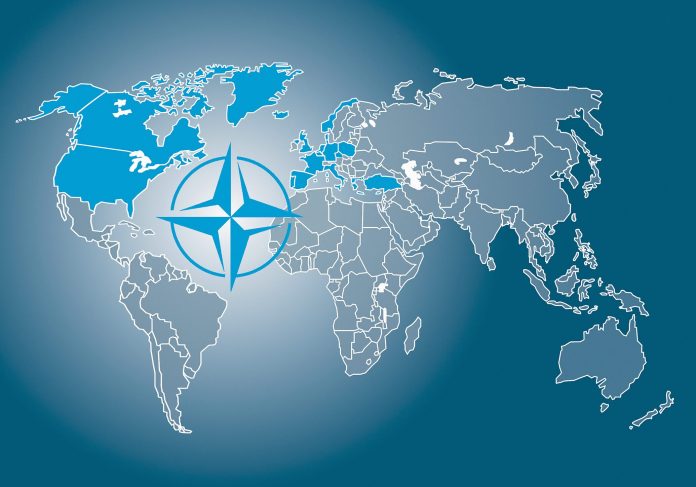
NATO starts huge operation in Europe, Russia makes threats to protect its interests and sovereignty
NATO has launched one of its largest military exercises in recent years, involving more than 40,000 troops from 27 countries, in a show of strength and solidarity amid rising tensions with Russia.
The exercise, dubbed Defender Europe 2024, will take place in several locations across the continent, from the Baltic Sea to the Black Sea, and will test the alliance’s readiness and interoperability.
Russia has reacted with anger and hostility to the exercise, accusing NATO of provoking a conflict and threatening its security. The Kremlin has warned that it will take “all necessary measures” to protect its interests and sovereignty and has deployed additional forces and weapons to its western borders. Russia has also conducted its own drills and snap inspections of its troops, demonstrating its military capabilities and resolve.
The exercise comes at a time of high tension and mistrust between NATO and Russia, following the latter’s annexation of Crimea in 2014, its involvement in the war in eastern Ukraine, its alleged interference in elections and cyberattacks, and its violation of arms control treaties.
NATO has responded by increasing its presence and deterrence posture in eastern Europe, enhancing its defense spending and capabilities, and imposing sanctions and diplomatic pressure on Russia.
The exercise is also a sign of NATO’s commitment to collective defense and transatlantic unity, especially after the turbulent years of the Trump administration, which undermined the alliance’s cohesion and credibility.
The exercise will involve significant participation from the US, which has deployed thousands of troops and equipment from across the Atlantic, as well as from other key allies such as Germany, France, the UK, Poland, and Turkey. The exercise will also include partners such as Finland, Sweden, Georgia, and Ukraine, which share NATO’s concerns about Russia’s aggression and seek closer cooperation with the alliance.
How does Russia view NATO?
Russia views NATO as a hostile and aggressive bloc that seeks to contain and weaken Russia’s influence and interests in Europe and beyond. Russia perceives NATO’s enlargement to include former Soviet republics and Warsaw Pact members as a violation of its security sphere and a threat to its strategic balance.
Russia also opposes NATO’s missile defense system in Europe, which it claims could undermine its nuclear deterrent. Russia accuses NATO of interfering in its internal affairs and supporting regime change in countries such as Georgia, Ukraine, Belarus, Moldova, and Syria. Russia considers NATO as a rival and an obstacle to its vision of a multipolar world order.
The exercise aims to demonstrate NATO’s ability to rapidly deploy and sustain large-scale forces in a complex and contested environment, as well as to enhance its interoperability and coordination with allies and partners.
The exercise will involve various scenarios and domains, such as air defense, amphibious operations, cyber defense, logistics, medical support, and urban warfare. The exercise will also test NATO’s new command structure, which was reformed to improve its responsiveness and resilience.
The exercise is expected to last until June 2024, and will be followed by a series of smaller exercises and activities throughout the year. The exercise is part of NATO’s long-term plan to adapt to the changing security environment and to deter potential adversaries.
The exercise is also an opportunity for dialogue and confidence-building with Russia, as NATO has invited Russian observers to monitor some aspects of the exercise, in accordance with international agreements. NATO has stressed that the exercise is defensive in nature and not directed against any specific country, but rather aimed at strengthening the alliance’s security and stability.
Welcome! Unleash your leadership potential, master business excellence, and embrace transformation with Tekedia Mini-MBA. Join us and experience a cutting-edge business management & leadership program: online, self-paced, and world-class. At Tekedia Institute, we co-learn with thousands of professionals and students, from many countries, on the mechanics of business, connecting innovation, growth and operational execution, across market territories and industrial sectors.
Our Faculty members come from Microsoft, Google, Shell, Flutterwave, Nigerian Breweries, NNPC, Jobberman, Coca Cola, PwC, BUA Cement, and other great organizations. Besides pre-recorded courseware, thrice weekly, we hold live Zoom sessions (Tue, Thur and Sat at 7pm WAT). REGISTER and join us! – Prof Ndubuisi Ekekwe, Tekedia Institute Lead Faculty.
Invent, innovate and drive organizational transformation, performance, and growth. Capture emerging opportunities in changing markets while optimizing innovation and profitability. Digitally evolve your business or functional area, turning digital disruption into a competitive capability and advantage. Master the concepts of building category-king companies, and thrive.
Registration for another edition of Tekedia Mini-MBA opens. Tekedia Mini-MBA, from Tekedia Institute, is an innovation management 12-week program, optimized for business execution and growth, with digital operational overlay. It runs 100% online. The theme is Innovation, Growth & Digital Execution – Techniques for Building Category-King Companies. All contents are self-paced, recorded and archived which means participants do not have to be at any scheduled time to consume contents. Our programs are designed for ALL sectors, from fintech to construction, healthcare to manufacturing, agriculture to real estate, etc.
More so, the sector- and firm-agnostic management program comprises videos, flash cases, challenge assignments, labs, written materials, webinars, etc and is delivered by a global faculty coordinated by Prof Ndubuisi Ekekwe. When we finish, we will issue a certificate from the Tekedia Institute, Boston USA.
Register and join us. You will emerge transformed with tools and capabilities that engineer confidence, performance and growth. Accelerate your leadership ascent with us! Here are our programs and costs.
Program Cost
Code
Description
Cost
MINI
Tekedia Mini-MBA. And WhatsApp School
US$170 or N120,000 naira
MINF
Annual Package: 3 consecutive MINI, and 2 optional capstones.
$340 or N180,000
MINR
(optional) Homework review; faculty will review your homework with feedback.
$30 or N10,000
CAPS
(optional) Tekedia capstone is a research paper, analogous to final college project.
$60 or N20,000 per track
Note: After the early bird deadline, the price of MINI becomes $230 or N120,000; others are not affected.
Supply Chain Management, Global Partnership & Contracting – Adebayo Adeleke, ex-Chief of Contracting and Deputy Chief, Business Operations Division, US Army
Intellectual Property: Strategy, Management & Commercialization – Ifeanyi Okonkwo, University of Cape Town & Jackson, Etti & Edu
Business Relationship Management & Negotiation Skills - Charles Okeibunor, CEO IRMP
Due Diligence and Business Intelligence – Chike Obimma, Partner at NICCOM LLP (Commercial Law Firm)
Week 10: Leadership, Human Capital & Project Management
Leadership, Knowledge Management – Prof. Ayodeji Oyebola, Saint Mary’s University of Minnesota
Human Resources Management - Adora Ikwuemesi, Director Kendor Consulting
Leading and Managing Teams, Stakeholder Management with NICER Model – Dr. Chisom Ezeocha, Project Delivery Manager, Shell
Career Planning – Precious Ajoonu, Manager, Jobberman
Tax Treaties and Their Benefits - Emmanuel Eze, Manager, Federal Inland Revenue Service (FIRS)
Regional Case: Tax Law and Compliance in Lagos State - Abimbola Abdur-Rahman Lekki, Lagos Internal Revenue Service
Effective Product & Service Pricing, Accelerated Revenue, Profit Maximization - Saima Khan, Partner, Strategic Pricing Management Group, Toronto, Canada
Establishing Business Consulting & Advisory Services - Mustafa Yusuf-Adebola, Founder, Provisio Professional
Driving Profitable Growth, Marginal Cost, Scaling – Prof. Ndubuisi Ekekwe
Stimulating New Markets Through Innovation and Perception Demand – Prof Ndubuisi Ekekwe
Week 14: Startups, New Businesses, Products, Markets, Customers
The Mechanics of Minimum Viable Product and Product Development - Prof Ndubuisi Ekekwe
The NEP Framework – Discovering and Listening to Customers - - Prof Ndubuisi Ekekwe
Customer Validation and Building for What Customers Really Want. - - Prof Ndubuisi Ekekwe
Knowing and Defining Your Market - Prof Ndubuisi Ekekwe
Navigating Business Growth Phases - Prof Ndubuisi Ekekwe
ChatGPT, DALL-E 2 and Emerging AI Innovations: Business Opportunities in Africa - Zion Pibowei, Head of Data Science, Periculum Canada
How to Scale a Business/Startup - Jane Egerton-Idehen, Head of Sales Middle East & Africa at Meta (Facebook parent company)
Final Week: Execution and Closure
The Call to Business Execution, Closure – Prof Ndubuisi Ekekwe
Graduation Day – Prof Ndubuisi Ekekwe
Tekedia Live: Optional Zoom session which holds thrice per week (Tue, Thur, Sat at 7pm WAT). It is archived for those unable to make the session live. Our faculty members and invited guests rotate to anchor the sessions. Live provides a platform for members to ask questions and get live responses.
Access to any Facyber Certificate program for free. Facyber offers online cybersecurity programs on policy, technology, management, and forensics.
Capstone Program
Here are the 12 tracks:
CLSM: Certificate in Logistics and Supply Chain Management
CBIS: Certificate in Business Innovation, Growth & Sustainability
CMAB: Certificate in Media, Advertising & Branding
CSBM: Certificate in Startup and Small Business Management
CIBA: Certificate in Business Administration
CPFM: Certificate in Personal Finance & Wealth Management
CMSM: Certificate in Marketing and Sales Management
CDBG: Certificate in Digital Business Growth
CIAM: Certificate in Agribusiness Management
CHRM: Certificate in Human Resources Management
CETS: Certificate in Exponential Technologies and Singularity
CBPM: Certificate in Business Transformation & Project Management
The program is completely capstone-based. Tekedia capstone is a research paper or a case study exploring a topic, market, sector or a company. It is the project component of Tekedia Min-MBA.
Theme: Innovation, Growth & Digital Execution – Techniques for Building Category-King Companies
Introduction
Over the last few decades, digital technology has emerged as a very critical element in organizational competitiveness. It has transformed industrial sectors and anchored new business architectures, redesigning markets and facilitating efficiency in the allocation and utilization of factors of production. The impacts have been consequential: continents like Africa are moving towards knowledge-based economic structures and information societies, comprising networks of individuals, firms and states that are linked electronically and in interdependent relationships. In this program, we will examine this redesign within the context of fixing market frictions and deploying growth business frameworks in a world of perception demand where meeting needs and expectations of customers are not enough.
Program Time: June 3 – Sept 2, 2024
Venue & Format: Online via videos, articles, webinars, and flash cases. Program is self-paced which means you consume the materials at your own time and pace. It is completely online. Where you live or your time zone would not be an issue as program is not live-delivered.
Cost: US$170 (N90,000 naira). We have a payment plan, i.e. installment payment plan (email us for details)
Target Audience: This program is designed for professionals and students across functional areas like sales, marketing, technology, administration, legal, strategy, finance, etc across all business sectors and domains. The program is designed for:
Ambitious mid-level managers seeking to advance their careers by acquiring essential business knowledge and skills.
Busy professionals who value continued education but require a flexible alternative to a traditional MBA program.
Experienced professionals aiming to broaden their business acumen, enhance leadership capabilities, and explore new career opportunities.
Professionals in transition, committed to staying informed about business trends and developing skills for continuous professional growth.
Mid-level managers and executives across industries, driven to accelerate career growth and take on increased responsibilities.
Technology and innovation-focused professionals looking to strengthen business acumen and strategic thinking.
Aspiring entrepreneurs seeking a solid foundation in business management and growth strategies.
Consultants and advisors aiming to expand their knowledge base and provide comprehensive solutions to clients.
Professionals transitioning into new roles or industries, recognizing the value of upskilling for success.
Students and recent graduates seeking a competitive edge in the job market by combining academic qualifications with practical business skills.
Tekedia Mini-MBA program offers a flexible and comprehensive learning experience tailored to the needs of ambitious professionals, providing the tools and knowledge necessary to thrive in today’s dynamic business landscape. Participants will have the opportunity to acquire knowledge that has value and can be used in everyday business activities.
Learning Objectives: To innovate is to set a new basis of competition in an economy, business sector or market. Sometimes, it results in disruption. This program is designed for private (large, SMEs, startups, sole businesses), public and government institutions, and individuals. Participants will:
Master the mechanics of growth – the reward of innovation – through frameworks, cases and evolving strategies.
Understand how to undergo transformation journey that is fully aligned with corporate objectives through measurable and realizable benchmarks.
Acquire business capability tools that do not just RUN their firms but can TRANSFORM them.
Design corporate growth experiments in Lab sessions based on One Oasis Strategy, Aggregation Construct, Double Play Strategy, Accumulation of Capability Construct, and more.
ETC
Why Tekedia Institute
Interactive Online Learning: Engage with industry experts and fellow professionals through our state-of-the-art online learning platform, where you can access course materials, participate in discussions, and collaborate on real-world case studies.
Comprehensive Curriculum: Gain a deep understanding of key functional areas such as strategy, marketing, finance, operations, and more, equipping you with the knowledge and skills to excel in any business environment.
Practical Case Studies: Apply your learning to real-world scenarios through hands-on case studies and projects, allowing you to develop critical thinking and problem-solving skills.
Flexibility and Convenience: Access the program online from anywhere at your own pace, fitting your studies into your busy schedule without compromising your professional and personal commitments.
Expert Faculty: Learn from renowned industry practitioners and thought leaders who bring their expertise and real-world insights to the program, ensuring you receive the most relevant and up-to-date knowledge.
Benefits of Tekedia Mini-MBA
Enhance Your Leadership Potential: Unlock your leadership capabilities and develop the skills to lead teams, drive innovation, and navigate complex business challenges with confidence.
Master Business Excellence: Gain a holistic understanding of business functions, strategies, and best practices, enabling you to make informed decisions and contribute to organizational success.
Embrace Digital Transformation: Stay ahead of the curve by embracing digital technologies and leveraging them to transform your business and stay competitive in the digital age.
Accelerate Your Career: With the Tekedia Mini-MBA on your CV, you’ll stand out to employers, demonstrating your commitment to continuous learning and your readiness to take on new responsibilities.
Network and Collaboration: Connect with a diverse community of professionals, expand your network, and foster collaboration opportunities that can lead to future partnerships and career advancements.
Cost-Effective Investment: Enjoy the benefits of a comprehensive business education at a fraction of the cost of traditional MBA programs, maximizing the return on your investment.
We run optional three Live Zoom sessions (two weekdays and one Saturday). This provides a way for our members to ask our Faculty and experts live questions and get feedback.
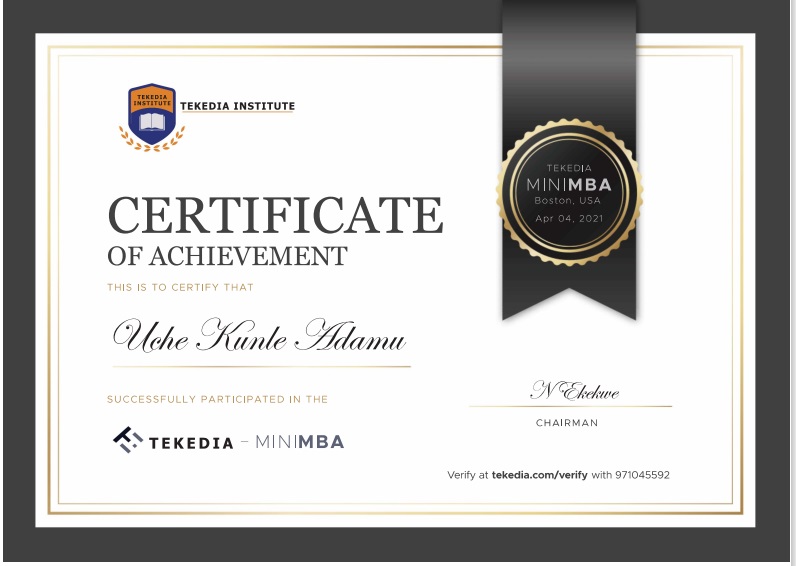
Tekedia Mini-MBA certificate sample
Tekedia Institute offers certificates at the end of all programs.
Our Contact Email: info@tekedia.com
Refund policy is full refund within 6 days from start of a program; after that, none, but we can defer as requested.
Lead Faculty of Tekedia Institute
Prof Ndubuisi Ekekwe is the Lead Faculty of Tekedia Institute
PhD, Electrical & Computer Engineering, Johns Hopkins University, USA
MBA, University of Calabar, Nigeria
BEng Electrical & Electronics Engineering ( Federal University of Technology, Owerri, Nigeria)
Prof Ndubuisi Ekekwe invented and patented a robotic system which the United States Government acquired assignee rights. Dr Ekekwe holds two doctoral and four master’s degrees including a PhD in engineering from the Johns Hopkins University, USA. He earned undergraduate degree from FUT Owerri where he graduated as his class best student. While in Analog Devices Corp, he co-designed an accelerometer for the iPhone. A recipient of IGI Global “Book of the Year” award, a TED Fellow, IBM Global Entrepreneur and World Economic Forum Young Global Leader, Prof. Ekekwe has held professorships in Carnegie Mellon University and Babcock University, and served in the United States National Science Foundation Committee.
The South African press called him “a doctor of innovation” for helping organizations on the mechanics of business innovation, strategy, and growth. Since 2009, the Chairman of Fasmicro Group which controls many startups and entities has been writing in the Harvard Business Review. He was recognized by The Guardian as one of 60 Nigerians Making “Nigerian Lives Matter” on Nigeria’s 60th Independence Day (Oct 1, 2020).