DD
MM
YYYY

PAGES

DD
MM
YYYY

spot_img

PAGES

Home Blog Page 3464

Awakening Africa: Crafting a Future of Resilience, Unity, and Self-Determination

3

In the intricate tapestry of history, Africa has woven narratives of resilience, triumph, and struggle. From the haunting echoes of the slave trade to the scars of colonization, the continent has faced trials that have left an indelible mark on its trajectory. However, as the sun rises on a new era, Africans find themselves at a pivotal moment, awakening to the imperative of shedding the weight of a devastating past and forging a future steeped in self-determination. 

The legacy of colonialism, with its deep-rooted impact on African societies, has often cast a long and challenging shadow. The chains of oppression may have physically loosened, but the mental imprints of a colonial mindset persist. It is high time for Africans to redirect their gaze, turning away from the echoes of a painful history and towards a future where self-development takes center stage.

Crucial to this transformative journey is the recognition that only Africans can truly help and develop Africa. This notion stems from a deep understanding of the unique challenges and complexities that the continent faces. Foreign aid, while often well-intentioned, has limitations in addressing the root causes of Africa’s issues and may inadvertently perpetuate dependency. True development requires a comprehensive and sustainable approach rooted in the empowerment of African communities and individuals. Relying on external aid, particularly financial assistance, may create a dependency mentality that inhibits self-sufficiency. The concept of self-help and development emphasizes the importance of local knowledge and context. Africans are intimately familiar with the intricacies of their societies, cultures, and environments. They possess a nuanced understanding of the challenges and opportunities inherent in their communities. 

This local knowledge is a valuable asset that can inform targeted and effective development strategies, ensuring that interventions are tailored to meet the specific needs of each region. Moreover, Financial aid often comes with conditions and may not address the underlying structural issues that impede development. In contrast, investing in education, training, and capacity-building programs equips Africans with the tools and skills needed to navigate and overcome challenges independently.

Africa’s journey towards self-development begins with a radical shift in mindset. Breaking free from the shackles of a colonial mentality means acknowledging the richness of indigenous knowledge and celebrating the diversity of cultures that form the continent’s mosaic. It is about embracing a collective identity that transcends imposed borders and fosters unity in diversity. As the continent charts its course towards self-reliance, collaboration becomes paramount. African nations must unite in a spirit of solidarity, sharing expertise and resources for mutual growth. Regional partnerships can amplify the impact of development initiatives, creating a network of support that transcends artificial boundaries drawn during the colonial era. To truly achieve this vision, Africans must shatter the stereotypes that paint the continent as a repository of poverty. 

Instead, Africa should be seen as a land of greatness, with a rich cultural tapestry, abundant resources, and a resilient people. African nations in the diaspora, who have achieved greatness, should invest their ideas and resources back into the continent, contributing to its development. Open borders among African nations would facilitate the free flow of ideas, goods, and services, fostering mutual benefit. However, for this vision to become a reality, African politicians and leaders must rise above selfish interests and prioritize patriotism. Leadership should be characterized by examples that will be remembered for their positive impact on the continent.

Education emerges as a powerful tool in dismantling the remnants of a colonial mindset and nurturing critical thinking. Africans must reclaim the narrative of their own history, cultivating a strong sense of identity and fostering pride in their heritage. By doing so, the continent can pave the way for innovative thinking and lay the foundation for a brighter future. Also, terrorism has tarnished part of Africa’s image globally, but it is a challenge that must be faced collectively. African nations must come together to fight terrorism, flush out terrorist groups, and establish a united front against extremism.

This concerted effort will not only improve Africa’s standing in the world but also create a safer and more stable environment for development. Moreover, a cornerstone of Africa’s self-development lies in the strategic utilization of its abundant natural resources. Rather than being exploited, these resources should serve as catalysts for economic growth and sustainable development. Investment in technology, research, and innovation will empower Africans to harness their resources effectively, fostering economic independence and reducing dependency on external forces.

The call for Africans to look away from the devastation of the past is not a dismissal of history but a declaration of resilience and agency. It is an invitation to build upon the foundations laid by ancestors, recognizing the strength that arises from adversity. The narrative is shifting, and Africa stands poised at the cusp of a renaissance, ready to write its own story of prosperity, innovation, and self-determination. The time is now for Africans to seize the reins of their destiny and step into a future where the echoes of the past serve as a reminder of strength, not shackles. The awakening of Africa hinges on a collective commitment to self-determination, unity, and resilience. As the continent redefines its narrative, Africa will not only reclaim its history but also shape a future that stands as a testament to its greatness.
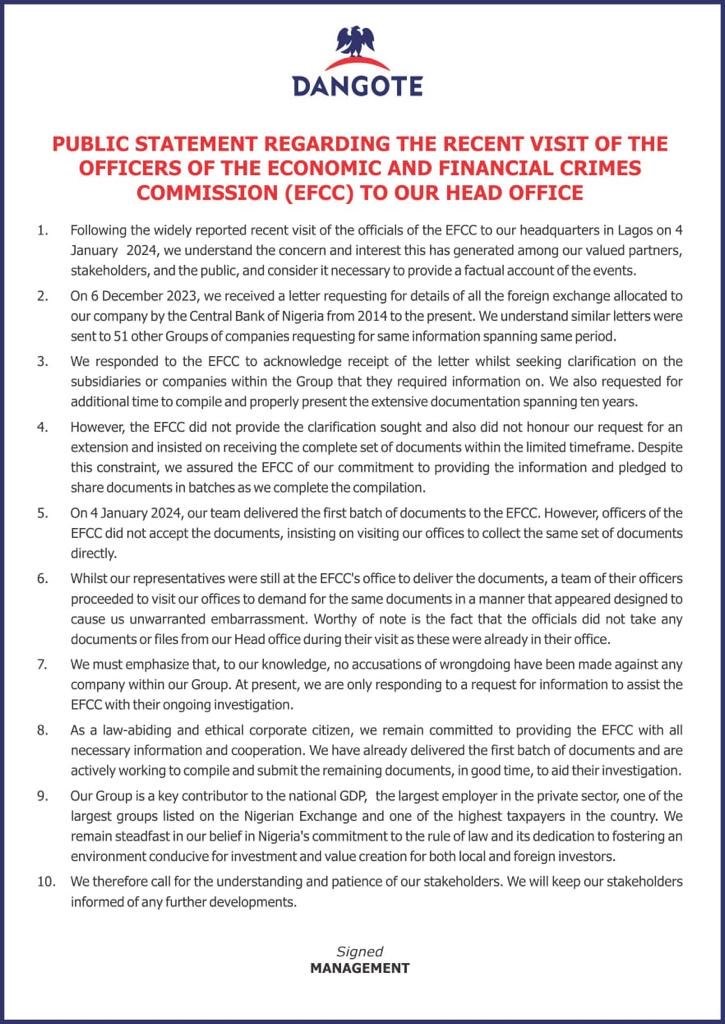
The Lessons from Diochi And Why EFCC Should Have Been Nuanced On Dangote Group’s HQ Raid

0

Nigeria must be nuanced as it executes whatever it is doing to clean the nation of the paralysis of corruption. On Nkwo days in Ovim, as elders gather to enjoy the free palm wine which the brewers are expected by tradition to provide, unpaid, once in a while, they will remind young people of Diochi.

Diochi is the representative palm wine tapper who is expected NEVER to say everything he sees while on top of the palm tree. Yes, there are powers you have or things you can say, but sometimes, not saying or exercising that power will serve the society better. Diochi on top of the palm tree sees the whole village – women giving birth, people showering in the village stream, etc. The village expects him to hold those secrets!

Diochi, despite being a palm wine tapper, has a date with destiny. Every wine harvested on Nkwo day is delivered to his kinsmen free. Why? Statistically, most palm wine tappers fall at work, and most times, villagers have to miss work, looking across the farmlands on rescue missions. So, that free wine is pre-paying for the lost wages his kinsmen will burn for those rescue operations! (that is an ancient Igbo tradition which remains till today).

So, for EFCC, learn from Diochi. You could have done everything you did in Dangote Group without the media buzz. In the village, the Diochis who tell everything they see are regarded as fools. I expect EFCC to be wise: do your job and remove the theatrics because Nigeria needs the economy to grow, and the optics of non-strategic raiding companies cannot be positive as we look for foreign direct investments!

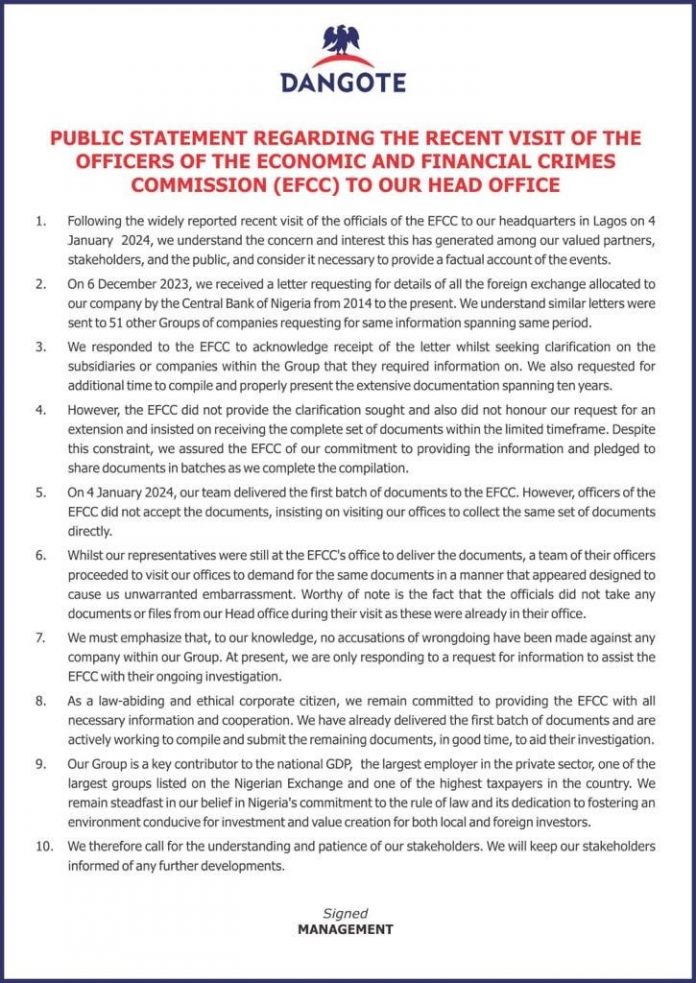
This is a fearful one. According to Premium Times, on Thursday, Economic and Financial Crimes Commission (EFCC) operatives raided the headquarters of Dangote Group, as the special investigator continues its work on allegations of corrupt forex allocations and playbooks in Nigeria.

EFCC Operatives Raid the Headquarters of Dangote Group in Lagos

The Intersection of what isn’t Web3 with what isn’t AI

0

Regular readers are by now very familiar with my definition of ‘Web3’ as an end-to-end decentralized UX.

Also my narratives on how things folk call ‘web3’ are usually BoT (Blockchain of Things), and how Web2 is a phrase fabricated well beyond its own supposed peak, in order to justify the ‘web3’ tag being attached to things that are not.

Within the crypto-architecture spectrum, the greatest absences of Web 3 are in the EVM Compatible space, particularly in the collectible/retail segment.

Having written at length about things that are not Web3, I haven’t often covered what isn’t AI.

Large Language Model and Large Image Model (LLM and LIM) software, are simply a selector algorithm system conflux acting upon a stimulus (in word, image form, or both), and applying the resulting conditions to a large open reservoir of text and/or image content.

Why isn’t it ‘AI’ ?

‘Artificial General Intelligence’ (AGI), is a hypothesized AI system that matches or outperforms humans in a broad range of cognitive tasks.

This is not actually AI, but dates back to the origins of ‘Goodhart’s Law’ – That ‘every measure which becomes a target becomes a bad measure’, with relevances to ‘Campbells Law’ – ‘The more any quantitative social indicator is used for social decision-making, the more subject it will be to corruption pressures and the more apt it will be to distort and corrupt the social processes it is intended to monitor’, and

The Cobra Effect – A perverse incentive is an incentive that has an unintended and undesirable result that is contrary to the intentions of its designers. The cobra effect is the most direct kind of perverse incentive, typically because the incentive unintentionally rewards people for making the issue worse.

And the Hawthorn Effect: – if people know they are observed, their behaviour changes.

There are major problems with ‘intrusive’  AI alignment by AI technicians creating ‘Specification Gaming

One of the conditions for the development of real AI would probably be random stimuli over a long period of time which are completely collateral to actual tasks. These would need to be supported by IRL freedom of moment and access to sensory data input – sight, hearing, touch, smell, and taste.

True AI has the capability to produce different responses to the same data stimulus through varied emotional context or mood, such as fear, anxiety, exhilaration, excitement, joy, sadness, anger, greed, longing, jealousy, hunger, pain, stubbornness, impatience, hope, aspiration and many others.

This is called Sentience. The ability to ‘feel’.

There is evidence for sophisticated cognitive concepts and for both positive and negative feelings in a wide range of nonhuman animals.

But True AI needs to have self-awareness, and an appreciation of ‘ego’ in the context of Maslow.

Moreover, True AI is cognitive of the of other ‘systems’ (AI or human) ability to produce these ‘different responses’ – i.e. exercise ‘sentience’. True AI will interpret ‘sentience’ of other ‘systems’ and will also not necessarily provide the same response to the same stimulus from that system, having exercised ‘intuition’

In effect, True AI can demonstrate ‘Emotional Intelligence’.

The ultimate test of ‘True AI’ is not ability to match or outperform humans in a broad range of tasks, but to qualitatively match or outperform humans in ‘Emotional Intelligence’.

This underlines some of the problems with the new range of chatbots.

In Ethan Brooks article: ‘You can’t truly be friends with an AI’, he says, just because a relationship with a chatbot feels real, that doesn’t mean it is.

The key to effective Emotional Intelligence is to have it fused with Ethics.

Destructive humans can leverage their ‘Emotional Intelligence’ capabilities in amoral ways to achieve self-centred outcomes at a cost to their engagement subject.

An entity capable of exercising Emotional Intelligence unbound to any moral compass, can be more damaging than one with no Emotional Intelligence at all.

What people want and what people need are sometimes different things.

Sometimes, to ethically exercise Emotional Intelligence, a person needs to say what is needed, which can sometimes go unwelcomed and under-appreciated. Saying the right thing isn’t always popular, and isn’t what’s wanted.

All the evidence so far is ‘AI friends’ communicate false empathy in ways that isolate people from IRL human engagement, reinforce opinions of ‘alternative right’, reduce likelihood of compromise, and fail to empower successful communication with others.

In practice of Ethical Emotional Intelligence, ‘Real AI’ doesn’t just need to be like ‘any’ human. It needs to be like a GREAT one.

Herein lies the unanswered question – Where is the fusion or crossroads of REAL web3 with REAL AI?

9ja Cosmos is here…

Get your .9jacom and .9javerse Web 3 domains  for $2 at:

.9jacom Domains

.9javerse Domains

Visit 9ja Cosmos LinkedIn Page

Visit 9ja Cosmos Website

Preview our Sino Amazon/Sinosignia releases

Find out What the Best Bookmakers in South Africa Anticipate in 2024

0

Description: Discover the prospects of the best bookmakers in South Africa in 2024. Choose the platform that meets your requirements and bet responsibly.

Online Betting in South Africa and the Most Anticipated Sports Events in 2024

South Africa’s online betting market is booming, showing that the industry is growing rapidly. As we enter 2024, this interest is set to intensify as enthusiasts look forward to a host of sporting events like the best bookmakers in South Africa that provide new experiences and profitable winnings.

Instead of just flourishing, the online betting industry in South Africa is developing into a significant sports betting destination, catching the attention of local and international punters alike.

Overview of Sports Betting South Africa Online

The online betting industry in South Africa is subject to a legal system. The National Gambling Act and provincial regulations oversee the sector, balancing growth and responsible betting practices.

Betting on sports, in particular, is hugely popular among South Africans, with events such as football, rugby and cricket commanding substantial interest from punters. In addition, the availability of online platforms makes it easy for punters to participate in their preferred sports.

Key Sports Events in 2024

There will be many events in 2024, each offering betting opportunities:

  • The FIFA World Cup. It’s the highest level of global sport and offers promising high-stakes matches.
  • The Olympic Games. Different sports, from running to fishing, offer a range of bets.
  • Rugby World Cup. The main event for rugby fans, with intense matches suitable for strategic betting.
  • Cricket World Cup. This is a holiday for football fans, with many opportunities for deep bets on cricket matches and players’ performances.
  • NBA Finals. The main draw for sports betting is fast-paced games and star players.

Each of these events provides an opportunity to place bets and attract both South African and global bettors.

South Africa’s Best Betting Sites

The South African sportsbook market boasts a number of first-rate betting sites that have been created exclusively for this country, each with its own advantages:

  • It is known for its comprehensive sports coverage, including lesser-known sports, as well as live events.
  • Distinguished by its advanced features such as event betting and high-quality odds.
  • The brand is noted for its user-friendly website and offers a great selection of different sports betting markets and favorable odds.
  • Is a local leader that offers a variety of sports, live betting options, and continuous special offers.

It is important to select a platform that suits your needs and preferences, and it is also worth checking whether the chosen sportsbook in South Africa has the appropriate licences.

Conclusion

The coming year offers South African punters a multitude of online gambling activities. With many sporting events in 2024, from local competitions to global tournaments, the opportunities for interesting and potentially rewarding bets are vast. However, you must choose Responsible Betting, guaranteeing the betting experience is safe and satisfying.

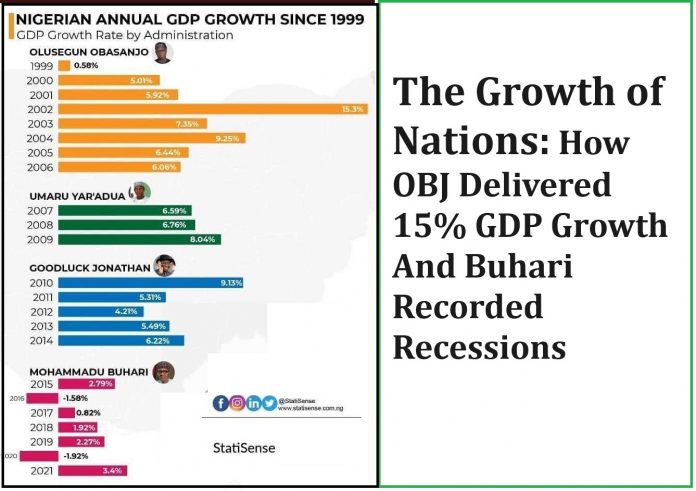
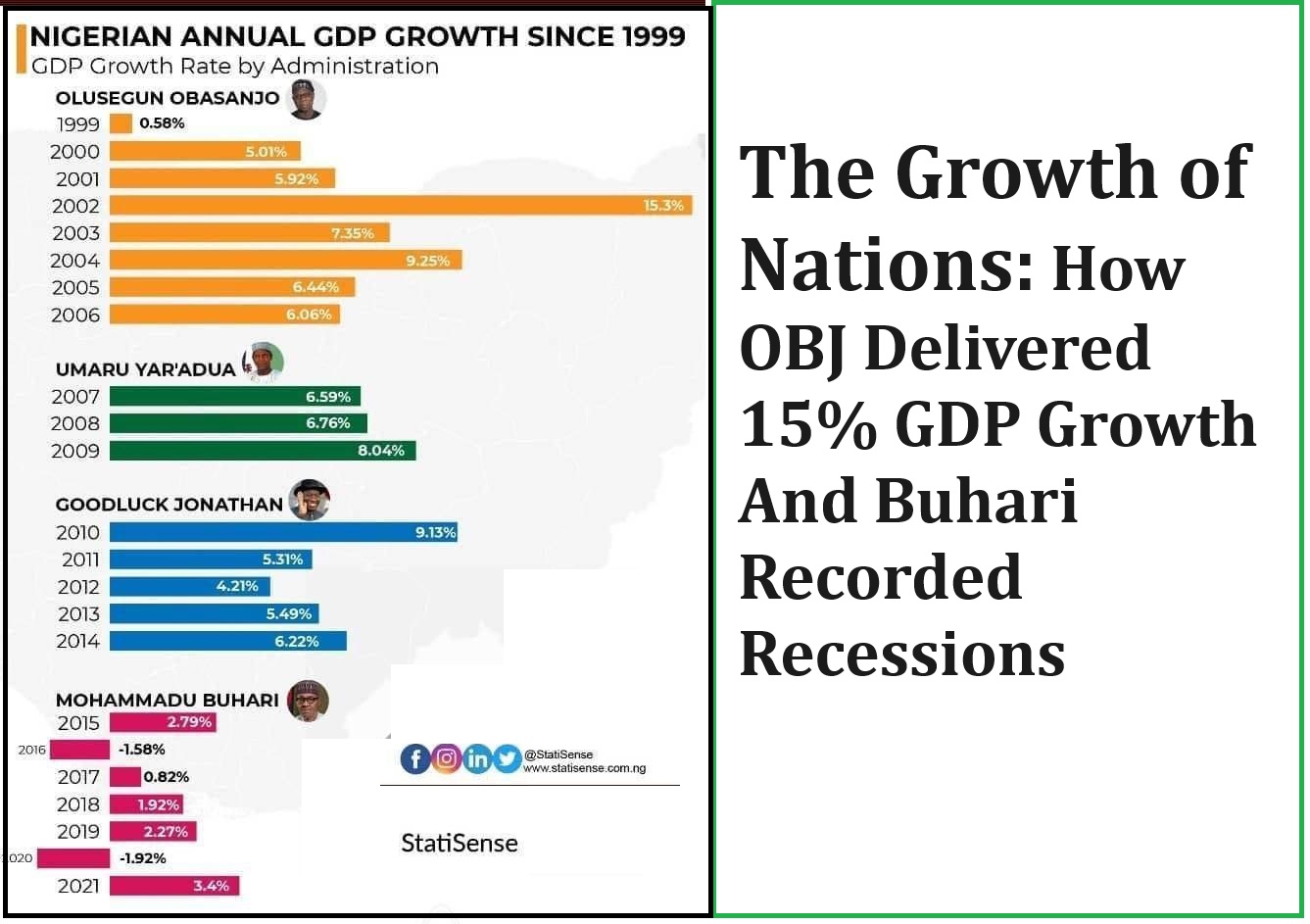
The Growth of Nations: How OBJ Delivered 15% GDP Growth And Buhari Recorded Recessions

4

What did Obasanjo do in 2002 for that 15.3% GDP growth rate spike? The telcos began operating at scale. Yes, a new industry was added in the Nigerian economy – and we grew. (That was the voice telephony era).

About ten years later, Jonathan got an extended version of it, when our phones became internet nodes as the mobile internet era began.  Another was expected to follow a decade later. Unfortunately, as I write, Nigeria is still struggling to unlock that era. I have called it the application utility era where our devices now become bank branches, logistics hubs, etc at scale. 

Lagos, which has the potential to become more important than Nigeria from 2030 is there, but other areas are yet to join. The Lagos budget of N2.3 trillion, about N2 trillion larger than the budget of Kano, is expected to widen, to the extent that by 2030, the per capita on Lagos’ budget will be multiples of Nigeria’s budget. Simply, everyone will move to Lagos because it will be like Vatican City in Italy without a special visa. I posit that Nigeria will be structurally dismantled, economically, because Lagos will exert more influence than Abuja.

As we search for growth vistas, understand that OBJ miracle has nothing to do with oil price. Across all indicators, Obasanjo was a great operator while Buhari was the worst, since 1999. And Jonathan was better than Buhari; he stabilized the exchange rate, inflation rate, etc, NOT because oil prices were high, but because he was better than the man who took over from him. Under him, Nigeria recorded its highest per capita on record. 

Buhari engineered at least one preventable recession: the frozen government after delays on appointing ministers when he took over. The second one which happened during the pandemic was already brooding as a result of the land border closure.

Good People, if you look at the numbers, and focus on the national budgets, under Buhari, in absolute Naira and USD dollars, Buhari’s government spent more money than Jonathan’s, on yearly average, and what oil money did not provide to the administration, they borrowed. Because Naira is Naira, whether from oil sale or debt, the issue here is efficiency on its management and deployment. Follow me:

  • Nigeria 2013 budget: N4.99 trillion 
  • Nigeria 2014 budget: N4.69 trillion
  • Nigeria 2015 budget: N4.5 trillion

  • Nigeria 2016 budget: N6.06 trillion
  • Budget 2019: N8.92 trillion
  • Budget 2022:  N16.39 trillion

(convert with the exchange rate then, Buhari had more US dollars to spend)

As this new government begins 2024 to execute its budget, it must find an anchor to drive growth. OBJ used core telecoms but the impact is largely marginal now. The new government has real estate, agriculture, light manufacturing and amazingly education as areas to unlock growth. Nigeria must evolve out of the current finance-first mindset to industry*-first mindset which OBJ used to pioneer most of the economic anchors we enjoy today.

*includes services, manufacturing, etc