DD
MM
YYYY

PAGES

DD
MM
YYYY

spot_img

PAGES

Home Blog Page 3480

Bitcoin inches higher after outperforming stocks

0

Bitcoin, the leading cryptocurrency by market capitalization, has been on a steady rise in 2023, outperforming most traditional assets such as stocks and bonds. We will explore some of the factors that have contributed to Bitcoin’s impressive performance this year, and what the outlook is for the future.

One of the main drivers of Bitcoin’s growth this year has been the increasing adoption by institutional investors, who see it as a hedge against inflation and currency devaluation.

According to a recent report by Chainalysis, a blockchain analytics firm, institutional investors accounted for 63% of all Bitcoin transactions in the first half of 2023, up from 44% in 2022. Some of the notable institutions that have added Bitcoin to their portfolios include Tesla, MicroStrategy, Square, PayPal, and Morgan Stanley.

Another factor that has boosted Bitcoin’s value this year has been the innovation and development in the crypto space, especially in the areas of decentralized finance (DeFi) and non-fungible tokens (NFTs). DeFi is a term that refers to various applications that use blockchain technology to provide financial services such as lending, borrowing, trading, and investing, without intermediaries.

NFTs are unique digital tokens that represent ownership of various assets such as art, music, games, and collectibles. Both DeFi and NFTs have created new use cases and demand for Bitcoin, as well as increased its network effect and liquidity.

Finally, Bitcoin has also benefited from the regulatory clarity and support that it has received from some governments and central banks around the world. For instance, in June 2021, El Salvador became the first country to adopt Bitcoin as legal tender, allowing its citizens to use it for everyday transactions and tax payments.

In September 2023, Ukraine followed suit and passed a law that recognized and regulated Bitcoin as an asset class. Moreover, some central banks such as the European Central Bank (ECB) and the Bank of England (BoE) have announced plans to launch their own digital currencies, which could potentially increase the public awareness and acceptance of Bitcoin and other cryptocurrencies.

Bitcoin has shown remarkable resilience and growth in 2023, outpacing most traditional assets in terms of returns. While there are still challenges and risks ahead, such as volatility, security breaches, and regulatory uncertainty, the outlook for Bitcoin remains positive, as more investors, developers, and users embrace it as a store of value, a medium of exchange, and a platform for innovation.

A major milestone for the cryptocurrency industry could be reached as early as next week, according to a Reuters report. The U.S. Securities and Exchange Commission (SEC) may give the green light to several Bitcoin exchange-traded funds (ETFs) that have been waiting for approval for months.

Bitcoin ETFs are investment products that track the price of the leading digital currency and trade on traditional stock exchanges. They offer investors a convenient and regulated way to gain exposure to Bitcoin without having to buy and store it directly.

The SEC has been reluctant to approve Bitcoin ETFs in the past, citing concerns about market manipulation, fraud, and investor protection. However, the agency has recently signaled a more open stance, as it has not blocked several applications that use Bitcoin futures contracts as their underlying assets.

Bitcoin futures are contracts that allow traders to bet on the future price of Bitcoin. They are traded on regulated platforms such as the Chicago Mercantile Exchange (CME) and the Intercontinental Exchange (ICE). Unlike spot Bitcoin, which is traded on unregulated and often opaque exchanges, Bitcoin futures are subject to strict oversight and reporting requirements.

The Reuters report, citing unnamed sources familiar with the matter, said that the SEC may notify some of the Bitcoin ETF applicants as soon as Tuesday or Wednesday that they have met the regulatory standards and can launch their products the following week. The report did not specify which applicants were likely to receive the approval but noted that there were at least four contenders in the race.

The news comes amid a strong rally in the Bitcoin market, which has seen the price of the cryptocurrency surge above $60,000 for the first time since April 2021. Many analysts and investors believe that the launch of Bitcoin ETFs will boost the demand and liquidity for Bitcoin, as well as attract more institutional and mainstream investors to the space.

The approval of Bitcoin ETFs in the U.S. would also follow similar developments in other countries, such as Canada and Brazil, where several Bitcoin ETFs have already been launched and have attracted significant inflows. The U.S., however, remains the largest and most influential market for ETFs, with over $6 trillion in assets under management.

If the Reuters report is confirmed, it would mark a historic moment for the cryptocurrency industry and a major validation for Bitcoin as an asset class. It would also open up new opportunities and challenges for both investors and regulators in the rapidly evolving digital economy.


Global rise of income and wealth inequality

0

The global rise of income and wealth inequality is one of the most pressing challenges of our time. It has profound implications for the well-being of billions of people, the stability of democratic institutions, and the sustainability of economic growth. We will explore some of the causes, consequences, and possible solutions to this problem.

One of the main drivers of inequality is the increasing concentration of income and wealth at the top of the distribution. According to the World Inequality Report 2023, the top 1% of the global population captured 27% of the total income growth between 1990 and 2020, while the bottom 50% only got 9%. The top 0.1% alone amassed more wealth than the bottom 80%. This trend is evident in both developed and developing countries, although with different degrees and patterns.

There are many factors that contribute to this phenomenon, such as technological change, globalization, financialization, tax evasion, political capture, and institutional erosion. These factors interact and reinforce each other, creating a vicious cycle that widens the gap between the haves and the have-nots.

For instance, technological change can increase productivity and innovation, but also create winner-take-all markets and displace workers. Globalization can foster trade and integration, but also expose workers to unfair competition and erode social protection.

Financialization can mobilize capital and allocate resources, but also generate instability and rent-seeking. Tax evasion can reduce fiscal burdens, but also deprive governments of revenues and undermine public services.

Political capture can influence policies and regulations, but also distort democracy and accountability. Institutional erosion can weaken checks and balances, but also undermine trust and social cohesion.

The consequences of inequality are manifold and far-reaching. They affect not only material well-being, but also health, education, happiness, security, justice, environment, and democracy.

For example, inequality can reduce economic growth by lowering aggregate demand, discouraging investment, and hampering human capital formation. Inequality can worsen health outcomes by increasing stress, reducing access to care, and spreading diseases.

Inequality can impair education quality by creating disparities in opportunities, resources, and outcomes. Inequality can diminish happiness by generating dissatisfaction, frustration, and resentment. Inequality can increase insecurity by fueling crime, violence, and conflict.

Inequality can erode justice by creating unequal access to rights, representation, and redress. Inequality can harm the environment by accelerating resource depletion, pollution, and climate change. Inequality can undermine democracy by weakening civic participation, representation, and accountability.

The solutions to inequality are complex and context specific. They require a combination of economic, social, political, and institutional reforms that address both the symptoms and the root causes of the problem. Some of the possible measures include:

Promoting inclusive growth that benefits all segments of society. Enhancing social protection that provides adequate coverage and benefits for all. Strengthening fiscal systems that ensure progressive taxation and efficient spending. Regulating financial markets that prevent excessive risk-taking and speculation.

Fostering innovation that creates new opportunities and jobs for all. Supporting education that improves access, quality, and equity. Expanding health care that ensures universal coverage and quality.

Protecting the environment that preserves natural resources and mitigates climate change. Empowering workers that improve their rights, wages, and conditions. Reducing corruption that prevents abuse of power and misuse of public funds. Reforming governance that enhances transparency, accountability, and participation

The global rise of income and wealth inequality is not inevitable or irreversible. It is the result of human choices and actions that can be changed for the better. It is our collective responsibility to ensure that everyone has a fair chance to live a dignified and fulfilling life.

Crypto stocks dip on last trading day of the year

0

As the year 2023 comes to an end, the crypto market is facing a downward pressure from investors who are taking profits or cutting losses. The leading crypto stocks, such as Coinbase, MicroStrategy, and Square, have all seen significant drops in their share prices on the last trading day of the year.

Coinbase, the largest crypto exchange in the US, closed at $180.23, down 8.7% from the previous day. The stock has lost more than 50% of its value since its debut in April, when it reached a peak of $429.54. Coinbase has been struggling with regulatory uncertainty, competition from rivals, and technical issues that have affected its platform.

MicroStrategy, the business intelligence firm that owns more than 100,000 bitcoins, ended the day at $379.12, down 9.4%. The stock has fallen more than 70% from its all-time high of $1,315.00 in February. MicroStrategy has been one of the most vocal and aggressive advocates of bitcoin, but its heavy exposure to the volatile asset has also made it vulnerable to market swings.

Square, the payments company that also offers crypto services, closed at $139.45, down 7.6%. The stock has declined more than 40% from its record high of $283.19 in August. Square has been expanding its crypto offerings, such as launching a bitcoin hardware wallet and a decentralized exchange, but it has also faced challenges from regulators and competitors.

The crypto market as a whole has also suffered a sharp correction in the last quarter of the year, after reaching new highs in October and November. The total market capitalization of all cryptocurrencies has dropped from over $3 trillion to below $2 trillion, according to CoinMarketCap. The main factors behind the sell-off include rising interest rates, regulatory crackdowns, hacking incidents, and environmental concerns.

Despite the gloomy outlook, some analysts and experts remain optimistic about the long-term prospects of the crypto industry. They argue that the fundamentals of crypto are still strong, and that the adoption and innovation will continue to grow in the coming years. They also point out that crypto has historically performed well in January, after a period of consolidation and correction.

Coinbase says its ready for first Spot Bitcoin ETF in the USA

Coinbase, the largest cryptocurrency exchange in the US, has announced that it is prepared to launch the first spot bitcoin exchange-traded fund (ETF) in the country. A spot bitcoin ETF would allow investors to buy and sell shares of a fund that holds actual bitcoins, rather than futures contracts or other derivatives. This would provide more direct exposure to the price movements of the leading cryptocurrency, as well as lower fees and risks.

Coinbase said in a blog post that it has partnered with Invesco, a leading investment management firm, to create the Invesco Coinbase Bitcoin Strategy ETF. The fund would track the Coinbase Bitcoin Index, which measures the performance of bitcoin based on the prices and volumes on Coinbase’s platform. Coinbase would act as the custodian of the fund’s bitcoins, ensuring their security and compliance.

The announcement comes amid a surge of interest and demand for bitcoin ETFs in the US, following the approval of several futures-based bitcoin ETFs by the Securities and Exchange Commission (SEC) in October. However, many experts and investors have argued that spot bitcoin ETFs would be more beneficial for the market and the investors, as they would eliminate the complexities and costs of dealing with futures contracts, such as rollover, contango, and margin requirements.

Coinbase said that it believes that spot bitcoin ETFs are “the next logical step” in the evolution of the crypto industry, and that it is ready to work with regulators and partners to bring them to market. The company also said that it plans to offer more products and services that would enable investors to access and participate in the crypto economy.

“We are excited to partner with Invesco to bring this innovative product to investors,” said Brett Tejpaul, Head of Institutional Sales, Trading, Custody and Prime Services at Coinbase. “We believe that spot bitcoin ETFs will provide a more efficient and transparent way for investors to gain exposure to bitcoin, and we look forward to launching the first one in the US.”

Whether crypto will bounce back or continue to slide in 2024 remains to be seen. For now, investors and traders are bracing for more volatility and uncertainty in the crypto space.

Even if USA gets its bitcoin ETF, success isn’t guaranteed

Many cryptocurrency enthusiasts have been eagerly awaiting the approval of a bitcoin exchange-traded fund (ETF) in the US, hoping that it will boost the adoption and legitimacy of the digital asset. However, even if the Securities and Exchange Commission (SEC) gives the green light to a bitcoin ETF, there is no guarantee that it will be a success.

A bitcoin ETF is a type of investment product that tracks the price of bitcoin and allows investors to buy and sell shares of it on a regulated stock exchange. Unlike buying bitcoin directly from a crypto exchange or a wallet, a bitcoin ETF would offer more convenience, security, and transparency to investors, as well as lower fees and taxes.

However, a bitcoin ETF also faces several challenges and risks that could limit its appeal and performance. Here are some of them:

Regulatory uncertainty: The SEC has not yet approved any bitcoin ETF applications, citing concerns about market manipulation, fraud, custody, liquidity, and investor protection. While some analysts expect the SEC to approve a bitcoin ETF in 2022, there is no guarantee that it will happen or that it will not impose strict conditions or limitations on the product. Moreover, the SEC could also change its stance or revoke its approval in the future, depending on the regulatory environment and the market conditions.

Competition: Even if a bitcoin ETF is approved in the US, it will not be the first or the only one in the world. Several countries, such as Canada, Brazil, Germany, and Switzerland, have already launched their own bitcoin ETFs, attracting billions of dollars in assets.

A US bitcoin ETF would have to compete with these existing products, as well as with other crypto investment vehicles, such as trusts, funds, futures, and options. Additionally, some investors may prefer to buy bitcoin directly from crypto platforms or wallets, rather than through an intermediary.

Volatility: Bitcoin is known for its high volatility, which means that its price can fluctuate significantly in a short period of time. This could pose a challenge for a bitcoin ETF, as it could create tracking errors, liquidity issues, and arbitrage opportunities.

For example, if the price of bitcoin drops sharply on a crypto exchange, but the price of the bitcoin ETF does not adjust quickly enough on the stock exchange, investors could exploit this discrepancy by selling the ETF and buying bitcoin directly, or vice versa. This could cause the ETF to deviate from its underlying asset and lose value.

Demand: The success of a bitcoin ETF depends largely on the demand from investors. While some investors may see a bitcoin ETF as an attractive way to gain exposure to bitcoin without having to deal with the complexities and risks of owning it directly, others may not be interested or convinced by its benefits.

Moreover, the demand for a bitcoin ETF could also be affected by the sentiment and trends in the crypto market. For instance, if bitcoin enters a bear market or faces regulatory crackdowns or technical issues, investors may lose confidence and interest in the digital asset and its related products.

Bitcoin ETF is not a silver bullet for the crypto industry or for investors. Even if it is approved in the US, it will face many challenges and uncertainties that could limit its success. Therefore, investors should be cautious and well-informed before investing in a bitcoin ETF or any other crypto-related product.

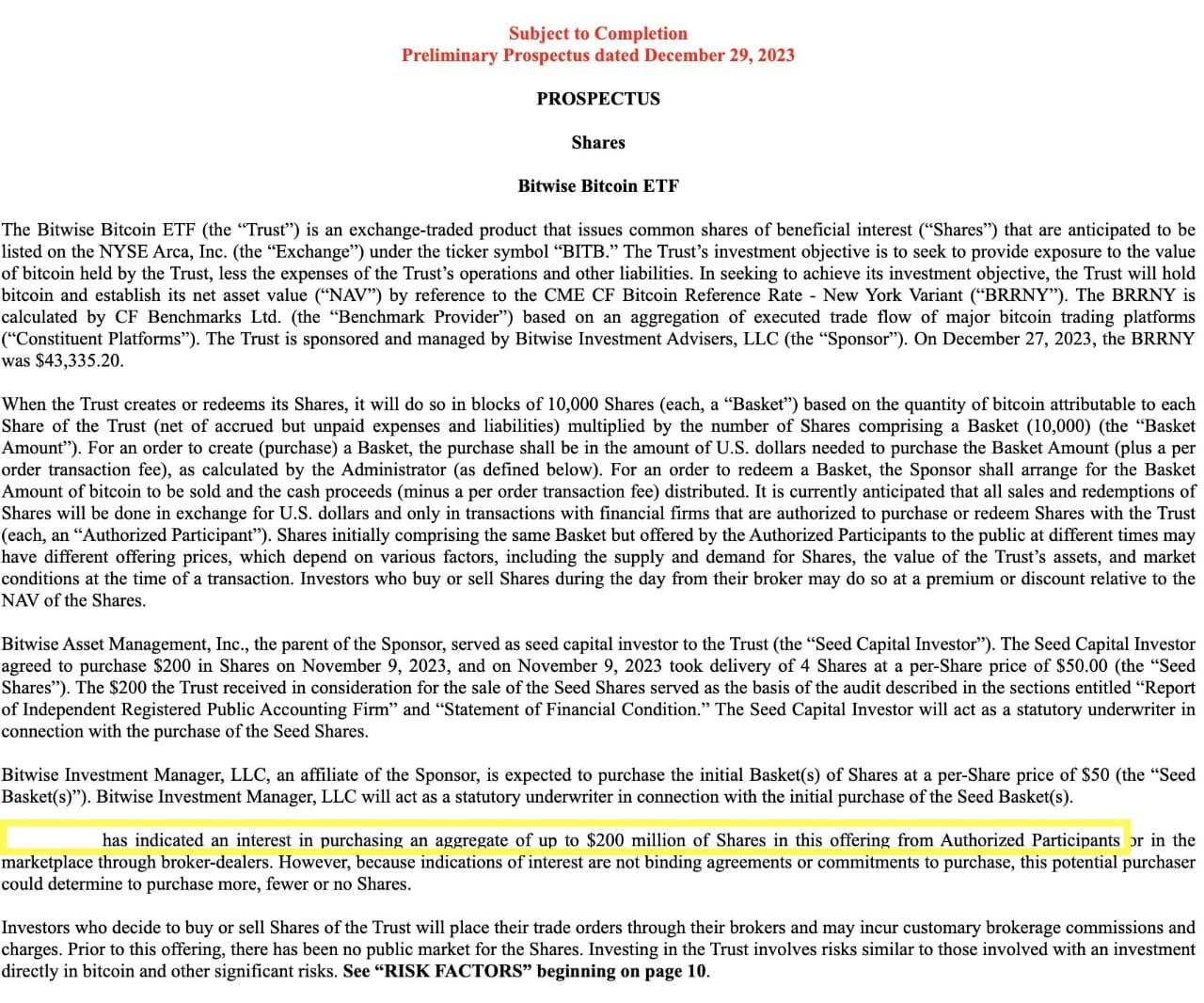
Wormhole Secures $250M as Bitwise seeds $200M on $BITB

0

Wormhole, a decentralized protocol that enables cross-chain communication and asset transfer, has announced that it has raised $250 million in a Series A funding round led by Coinbase Ventures, the investment arm of the leading cryptocurrency exchange. The round also saw participation from other prominent investors, such as Polychain Capital, Alameda Research, Multicoin Capital, and Paradigm.

Wormhole aims to bridge the gap between different blockchains and enable interoperability among various ecosystems. The protocol leverages a network of validators that run specialized nodes to relay data and assets across chains. Wormhole currently supports Ethereum, Solana, Terra, and Binance Smart Chain, and plans to add more chains in the future.

The protocol has seen significant adoption since its launch in August 2021, with over $1 billion worth of assets transferred across chains using Wormhole. Some of the popular applications that use Wormhole include Saber, a cross-chain liquidity network on Solana, and Mirror Protocol, a synthetic asset platform on Terra.

With the new funding, Wormhole plans to expand its team, develop new features, and grow its community. The protocol also intends to launch its own governance token, WHOLE, which will be used to incentivize validators and users, as well as to enable decentralized decision-making.

Coinbase Ventures, the lead investor in the round, expressed its confidence in Wormhole’s vision and potential. “We believe that Wormhole is building a critical piece of infrastructure for the future of crypto.

By enabling seamless cross-chain communication and asset transfer, Wormhole is unlocking new possibilities for innovation and collaboration across different ecosystems. We are excited to support Wormhole as they continue to grow and scale their protocol,” said Shan Aggarwal, Head of Coinbase Ventures.

Bitwise S-1

The crypto world is buzzing with the news that Bitwise, a leading provider of index funds and ETFs for digital assets, has filed its S-1 registration statement with the SEC. This is a big step towards launching the first U.S.-listed bitcoin ETF, which could open the doors for more institutional and retail investors to access the crypto market.

But what’s even more interesting is the revelation that someone (we have a pretty good guess who) is planning to invest a whopping $200 million in the Bitwise Bitcoin Trust (BITB), the fund that will track the performance of the Bitwise Bitcoin Index. This is a huge vote of confidence in Bitwise and its index methodology, which aims to provide the most accurate and transparent representation of bitcoin’s value.

To put this in perspective, the largest investment in a crypto ETF so far was made by BlackRock, the world’s biggest asset manager, which bought $10 million worth of shares in the Canadian Purpose Bitcoin ETF earlier this year. That was already a significant milestone, but Bitwise’s potential investor is taking it to a whole new level.

Who could this mystery investor be? Well, we don’t know for sure, but we have some clues. The S-1 filing states that the investor is an “accredited investor” who has entered into an agreement with Bitwise to purchase BITB shares at the NAV (net asset value) per share on the date of issuance. The agreement also stipulates that the investor will not sell or transfer any of the shares for at least six months after the purchase.

This sounds like someone who has a long-term vision for bitcoin and Bitwise, and who is not afraid to make a bold move in anticipation of the ETF approval. It also sounds like someone who has a lot of money and influence in the crypto space. Could it be one of the well-known bitcoin billionaires, such as Michael Saylor, Jack Dorsey, or the Winklevoss twins? Or could it be a large institutional player, such as MicroStrategy, Square, or Tesla?

We may never find out for sure, but one thing is clear: whoever this investor is, they are making a strong statement about the future of bitcoin and Bitwise. And they are giving us all a reason to be excited about what’s coming next.

Russia Launching Fresh Drone Attacks, Says Ukraine

0

Ukraine has accused Russia of launching new drone attacks on its territory, amid rising tensions between the two countries. According to the Ukrainian military, Russian drones have targeted several positions of the Ukrainian army in the Donbass region, where a conflict has been raging since 2014. The drone attacks have caused material damage and wounded some soldiers, but no fatalities have been reported.

The Ukrainian government has condemned the drone attacks as a violation of the ceasefire agreement that was signed in 2015 and has called on the international community to pressure Russia to stop its aggression. The Ukrainian president, Volodymyr Zelensky, said that Ukraine was ready to defend its sovereignty and territorial integrity, and urged Russia to engage in dialogue to resolve the crisis peacefully.

Russia has denied any involvement in the drone attacks and has accused Ukraine of provoking a war by increasing its military presence near the border. Russia has also claimed that it has the right to protect the interests of the Russian-speaking population in Donbass, who have declared independence from Ukraine with Moscow’s support. Russia has warned that any escalation of the conflict could have serious consequences for the security and stability of Europe.

The drone attacks are the latest sign of the deteriorating relations between Russia and Ukraine, which have been strained since Russia annexed Crimea in 2014 and backed separatist rebels in Donbass. The conflict has killed more than 13,000 people and displaced millions more. Despite several attempts to negotiate a peaceful solution, the implementation of the ceasefire agreement has been hampered by mutual distrust and violations by both sides.

The international community has expressed concern over the situation in Ukraine and has called for restraint and dialogue. The United States and its allies have reaffirmed their support for Ukraine’s sovereignty and territorial integrity and have imposed sanctions on Russia for its actions.

The European Union and the United Nations have also urged both parties to respect the ceasefire agreement and to resume the political process under the Minsk framework. The Organization for Security and Co-operation in Europe (OSCE) has deployed monitors to observe the situation on the ground and to facilitate dialogue.

The drones used by Russia are believed to be of various types and capabilities, ranging from small reconnaissance drones to large combat drones armed with missiles or bombs. Some of the drones are reportedly operated by Russian military personnel, while others are controlled by separatist forces or mercenaries.

The drones pose a serious threat to the Ukrainian forces, as they can evade detection by radar or air defense systems and can strike with precision and stealth. The Ukrainian military has tried to counter the drone attacks by using electronic warfare, anti-aircraft guns, or even hunting rifles, but with limited success.