DD
MM
YYYY

PAGES

DD
MM
YYYY

spot_img

PAGES

Home Blog Page 35

Chowdeck Caps 2025 With 10 Million Deliveries, Sets Bold Vision For 2026

0

Chowdeck has cemented its position as a dominant force in Nigeria’s fast-growing food delivery market, capping off 2025 with a landmark performance that underscores both scale and execution.

The homegrown logistics and food delivery platform closed the year having processed over millions of orders, a milestone that reflects not just rapid user adoption but a deepening reliance on on-demand delivery across Nigeria’s major cities.

According to CEO Femi Aluko, Chowdeck delivered over 10 million orders in 2025 alone and surpassed 2.1 million registered users milestones that underscore a year of rapid growth and execution.

Behind the record-breaking delivery numbers, Aluko noted, were millions of everyday human efforts; team members showing up daily, livelihoods being built, businesses scaling, and bold bets paying off across the ecosystem.

For vendors on the platform, 2025 marked a true year of scale. For the first time, three vendors consistently crossed N1 billion in monthly sales. Businesses that were once local favourites evolved into high-volume operations serving tens of thousands of customers and employing larger teams.

Recall that in June last year, Chowdeck acquired Mira to strengthen its role as a comprehensive technology partner for food and hospitality businesses in Africa, moving beyond just delivery services. Mira is a fast-growing provider of modern point-of-sale (POS) solutions that are tailored to the unique challenges of running food and hospitality businesses on the continent.

The acquisition of Mira and its integration as the operational backbone for vendors was a strategic move aimed at enabling merchants to scale sustainably alongside the platform.

Rider growth also translated directly into economic opportunity. Chowdeck doubled its rider network within the year, expanding from over 12,000 riders to more than 22,000. Beyond the figures, this growth represented increased financial independence and family support for thousands of Nigerians.

Operationally, the company hit new highs. In Q3 alone, Chowdeck delivered 2.63 million orders, becoming the largest marketplace in Nigeria by order volume. The company delivered more local orders than any other platform, while maintaining positive unit economics, a rare feat in the sector.

Notably, Chowdeck also emerged as the most downloaded food delivery app in Nigeria across both iOS and Android, reinforcing its position as the country’s leading platform in the category.

Speed and convenience remained central to its value proposition. In a single month, the platform processed N600 million in Quick Commerce orders, highlighting strong consumer demand for fast delivery. To support this, Chowdeck opened 16 dark stores during the year, bringing essential services even closer to customers.

Building on this momentum, the company began expanding beyond food delivery. With the launch of Bills and Events, Chowdeck signaled its transition into a SuperApp tailored to the modern Nigerian lifestyle.

Since its launch in October 2021, Chowdeck has evolved into a leading technology solutions provider for food and hospitality businesses across Africa. With more than 20,000 riders in 11 cities and a technology-driven logistics network that delivers orders in an average of 30 minutes, the platform offers users a seamless way to order meals, groceries, and essentials.

A key differentiator remains the company’s technology-first approach, utilizing smart algorithms to efficiently connect restaurants, riders, and customers in real time.

Chowdeck’s goal is to become the most reliable and trusted delivery and convenience platform on the continent. As it looks ahead, the company is focused on building on its 2025 success and pushing for even greater impact in 2026.

Coinbase Set Sights on Becoming The Number One Financial App in The World in 2026

0

As 2026 begins, Coinbase one of the world’s largest cryptocurrency exchanges, has unveiled an ambitious strategic roadmap aimed at transforming itself from a crypto-centric platform into the leading global financial application.

Coinbase CEO Brian Armstrong, in a post on X, laid out the company’s top strategic priorities for 2026, signaling an ambitious push to expand the app’s role in the global financial system.

According to Armstrong, a key focus for the year is growing what he described as the “everything exchange” on a global scale. This vision involves broadening Coinbase’s offerings beyond crypto to include equities, prediction markets, and commodities, spanning spot markets as well as futures and options trading.

Another major priority is scaling stablecoins and payments. Coinbase aims to deepen the adoption of stablecoin-based transactions, positioning them as a core infrastructure for faster, cheaper, and more accessible global payments.

Armstrong also emphasized Coinbase’s commitment to bringing the world on-chain. This effort will be driven through Coinbase’s developer ecosystem, Base chain, and the Base app, to onboard more users, developers, and businesses into the on-chain economy.

Underlying these initiatives, Armstrong noted that Coinbase is making significant investments in product quality and automation. These improvements are intended to support scale, reliability, and user experience across all of the company’s platforms.

Coinbase in 2025: Building The Everything Exchange

In 2025, Coinbase evolved far beyond its beginnings as a cryptocurrency trading platform, accelerating efforts to become what CEO Brian Armstrong dubbed the “Everything Exchange”.

A defining feature of Coinbase’s 2025 strategy was the expansion of its product suite to encompass a far broader array of financial services:

Launching New Asset Classes and Trading Tools: Coinbase began rolling out stock trading directly inside its core app, enabling U.S. users to buy and sell equities and ETFs alongside crypto assets without separate interfaces or accounts. This move signals a step toward integrating traditional financial markets into the Coinbase experience.

Derivatives and Institutional Expansion: A major highlight of the year was completing the acquisition of Deribit, the world’s largest crypto options exchange, deepening Coinbase’s footprint in derivatives trading a segment that now serves institutional demand and broadens its revenue base.

Cross-Chain and On-chain Integration: Coinbase broadened trading access by integrating decentralized exchanges and supporting assets across multiple networks, including expanding Solana asset trading within its main app.

Global and Enterprise Platforms: The global launch of the “Base App” an on-chain front door for wallets, social features, payments, mini-apps, and decentralized finance reflects Coinbase’s vision of shifting from a mere exchange to a financial operating system.

In a major “System Update” announced last December, Coinbase unveiled a robust slate of products designed to challenge traditional brokerages like Robinhood and Charles Schwab.

CEO Armstrong’s vision is to replace the fragmented legacy financial system with a unified, always-on platform where stocks, ETFs, prediction markets, and crypto coexist on a single on-chain rail.

Early next year, Coinbase intends to further blur these lines by introducing stock perpetuals, allowing international traders to bet on equity price movements with up to 50x leverage. This move signals Coinbase’s intent to capture the sophisticated derivatives market that has historically been the domain of major investment banks and offshore crypto platforms.

By incorporating these into the “Everything Exchange,” Coinbase is betting that “always-on engagement” will keep users within the app even when crypto markets are stagnant.

Stablecoins: From Supporting Role to Core Growth Engine

Coinbase’s engagement with stablecoin cryptocurrencies designed to maintain a stable value (often pegged to a fiat currency like the U.S. dollar) became central to its strategic narrative in 2025.

The platform rolled out “Stablecoin-as-a-Service” tooling, enabling businesses to create custom-branded stablecoins, custodied and managed by Coinbase, with features like 1:1 backing, interoperability with USDC liquidity, and rewards for holders.

Also, it enhanced its stablecoin payment platforms for business use, including APIs and global payout mechanisms for companies sending USDC to wallets or even email addresses, lowering friction for mass adoption of digital dollar settlement rails.

In Q4 2025 alone, Coinbase reported over $332 million in stablecoin revenue, up significantly year-over-year, driven largely by interest earned on USDC stablecoin reserves and robust trading volumes.

By the end of 2025, Coinbase had made substantial progress toward becoming an Everything Exchange, a platform where digital assets, traditional securities, stablecoins, on-chain apps, and payment rails converge.

Through strategic product launches, acquisitions, stablecoin innovations, and global licensing efforts, the company is increasingly positioning itself as more than just a marketplace, aiming instead to be the financial operating system of the decentralized era.

Outlook

Looking ahead, 2026 is shaping up to be a pivotal year for Coinbase as it attempts to execute one of the most ambitious transformations in modern financial services.

The company’s strategy suggests it is no longer content competing solely within the crypto industry; instead, it is positioning itself at the intersection of traditional finance, decentralized systems, and global payments infrastructure.

Tesla Robotaxi at Year’s End: Big Promises, Small Fleets, and What Elon Musk’s Missed Deadlines Mean for the Future of Autonomous Mobility

0

When Elon Musk talks about Tesla Robotaxi, he is rarely describing a product in isolation. He is outlining an alternate future for transport, one where cars drive themselves, owners earn money while they sleep, and Tesla evolves from an automaker into a dominant artificial intelligence and mobility platform.

By the end of 2025, that future was meant to be largely visible on American roads. Instead, what exists today is something more tentative: a limited rollout, heavy regulatory oversight, and a widening gap between ambition and execution that carries consequences far beyond Tesla itself.

Elon Musk framed 2025 as the year Tesla’s long-promised Robotaxi vision would finally crystallize into a mass-market reality. Fully autonomous paid rides, rapid expansion across US cities, and coverage for half of the American population were all placed firmly on the calendar.

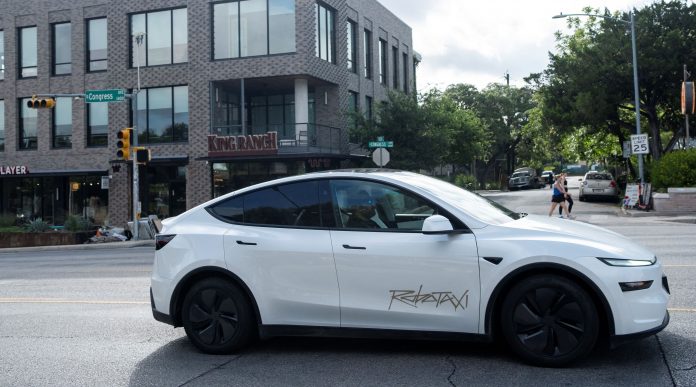
As the year closes, according to a report by Business Insider, what exists on the ground is far more modest: limited pilot services in Austin and the San Francisco Bay Area, a small fleet size, and continued reliance on safety monitors. The gap between ambition and execution has once again become central to the Tesla story, raising deeper questions about the pace of autonomy, regulatory limits, and Tesla’s position in an increasingly competitive global EV and autonomous driving market.

Tesla Robotaxi today operates less like a transformative ride-hailing network and more like a controlled experiment. In Austin, where the pilot launch began, just over 30 vehicles are offering paid rides, with a safety monitor seated in the front passenger seat. In the San Francisco Bay Area, where regulations are stricter, a safety monitor remains behind the steering wheel. These operational details matter. They underline that Tesla is still operating within the bounds of supervised autonomy, even as Musk publicly touts progress toward full autonomy.

This outcome contrasts sharply with Musk’s own projections earlier in the year. In April, he said Tesla was “on track” to begin fully autonomous paid rides in Austin by June, followed by many other US cities by year-end. That timeline slipped almost immediately. By October, Musk was forecasting Robotaxi operations in eight to ten metro areas, including Nevada, Florida, and Arizona, subject to regulatory approval.

While Tesla has secured permits in some of those states and is hiring for Robotaxi-related roles nationwide, paid services remain confined to just two regions.

Fleet size has been another reality check. Musk suggested Tesla could have around 500 Robotaxis operating in Austin and more than 1,000 in the Bay Area by the end of the year. Crowdsourced tracking data points to a far smaller footprint, with roughly 35 vehicles in Austin and about 130 in the Bay Area. Tesla has registered more than 1,600 vehicles and nearly 800 drivers for its ride-hailing service, suggesting preparation for scale, but not yet execution at the level Musk described.

These shortfalls are familiar territory for Musk watchers. “Elon Time” has become shorthand for his chronic optimism around timelines, a trait he has openly acknowledged. For years, Tesla investors have tolerated this tendency on the assumption that delayed delivery is better than no delivery at all. The question now is whether that tolerance is beginning to erode as autonomy becomes the linchpin of Tesla’s long-term valuation story.

Robotaxi is not a side project. It sits at the heart of Tesla’s claim that it is fundamentally different from other electric vehicle makers. While many automakers sell EVs as products, Musk has long argued that a Tesla is a platform capable of generating recurring revenue through autonomous ride-hailing. This idea has helped justify Tesla’s market valuation, even as competitors close the gap in EV technology and manufacturing scale.

What makes Tesla’s approach distinctive and risky is its insistence on solving general autonomy using a camera-only system. Unlike rivals such as Waymo, which rely heavily on lidar and operate within tightly geofenced areas, Tesla is betting that vision-based systems trained on data from millions of consumer vehicles can scale more cheaply and broadly. If Tesla gets this right, the payoff could be enormous, allowing Robotaxi services to expand rapidly without expensive hardware retrofits.

However, the slower-than-promised rollout suggests that the last mile of autonomy is proving as difficult as critics have long argued. Edge cases, unpredictable human behavior, and the challenge of achieving regulatory trust are slowing progress. Regulators, particularly in California, continue to require human oversight, reflecting broader concerns about safety and liability. Any serious incident involving a Robotaxi would not only set Tesla back but could also tighten rules across the entire autonomous driving sector.

This caution is visible even in Musk’s more recent claims. While he said a Tesla without a safety monitor took him around Austin with “perfect driving,” those experiences remain anecdotal and limited. The company has not yet removed safety monitors from its paid public service, underscoring the difference between internal testing and regulated deployment.

The implications extend well beyond Tesla. Globally, the EV market is entering a more competitive and less forgiving phase. Chinese manufacturers such as BYD, XPeng, and others are pushing aggressively into both EVs and assisted-driving technologies, often supported by faster regulatory approval processes at home. In parallel, technology companies and automakers are forming alliances to spread the cost and risk of autonomy development, rather than betting everything on a single, vertically integrated vision.

Tesla’s Robotaxi delays also sharpen the contrast with companies like Waymo, which have achieved fully driverless operations in limited areas. While Waymo’s model is expensive and geographically constrained, it has crossed a regulatory and technical threshold that Tesla has yet to achieve at scale. The market is now weighing two competing philosophies: Tesla’s ambition to solve autonomy everywhere at once, and rivals’ preference for incremental, tightly controlled deployment.

There is also a growing tension between Robotaxi and Tesla’s consumer-facing Full Self-Driving system. FSD remains supervised for private owners, despite years of promises that unsupervised driving is imminent. Musk said earlier this year that FSD Unsupervised would arrive in many US cities before year-end, but that milestone has not been publicly achieved. Incremental changes, such as allowing limited phone use during certain driving conditions, hint at Tesla’s direction, but also highlight how far it still has to go.

As 2025 ends, Tesla Robotaxi stands as a symbol of both progress and restraint. The service exists, customers are paying for rides, and the technology continues to improve. At the same time, the bold milestones Musk outlined remain unmet, reinforcing skepticism about near-term autonomy at scale.

For Tesla, Robotaxi is not just about ride-hailing; it is about redefining the economic value of a vehicle and securing the company’s lead in a future shaped by software, data, and automation.

Some analysts believe that whether Musk’s optimism ultimately proves visionary or premature will depend on how quickly Tesla can turn cautious pilots into widespread, regulator-approved services. But for now, Robotaxi remains a promise in motion, inching forward, but far from the sweeping transformation Musk once said would define 2025.

Why Do We Have Companies? – Ndubuisi Ekekwe Explains

0

Question: “Why Do We Have Companies?”

My Response: The question of why companies exist takes us into the mechanics of markets and the thermodynamics of human civilization. If we see the world as a system of energies, ideas are merely potential energy; yes, dormant, unexpressed, and incapable on their own of fixing hunger, disease, or broken infrastructure. A company, therefore, is not just a legal entity registered with a government; it is a business transducer. Just as a transducer converts energy from one form to another, a company exists to convert a business idea into a product or service that customers can use to overcome real frictions.

Across markets, from the open stalls of Oriendu Market in Ovim to the digital corridors of global trade in New York, frictions are everywhere. These frictions are the ordinary problems of daily life: food scarcity, unreliable electricity, unsafe water, weak connectivity, and inefficient transportation. Because markets are imperfect in nature, and are saturated with information asymmetry, demand and supply rarely meet naturally or smoothly. (Think of this: If there were no restaurants, in all forms, in Lagos, a hungry person might not know who has food to buy from, and the person with food to sell might not know who is hungry; a restaurant is a business)

Therefore, for markets to work, something must disturb that state of disequilibrium between demand and supply. Yes, there must be a perturbation, something to stir the system, so that an equilibrium can emerge. Companies serve that purpose in the market, removing that imperfect system and the associated information asymmetry; they create products and services.

Firms organize people, processes, and tools to deploy products as forces, and when customers consume those products, frictions are reduced or eliminated. At their core, great companies rest on three pillars: People, Processes, and Tools. Every competitive advantage in the market is built by strengthening or reconfiguring these pillars. When the mix is right, the outcome is simple and powerful:

A Great Company =: Awesome Products + Superior Execution.

Note: a brilliant invention alone is not enough. Until it is commercialized and adopted by customers, it remains an academic artifact. This is why we say:

Innovation =: Invention + Commercialization.

Companies provide the framework that converts the physics of an idea into the economics of a product. From elementary physics, we learned a simple rule: only forces overcome frictions. Markets obey the same law. When customers face friction, you must deploy the force of a product or service to overcome it.

In this 2026, the mandate is clear: build forces for the market. Create great products and services, because frictions cannot be wished away; they must be conquered. Only companies are designed to create those forces, and that is why companies exist!

(If you can, join Tekedia Mini-MBA and we will explain over 12 weeks how to build companies)


Baidu Moves to Spin Off AI Chip Arm Kunlunxin With Confidential Hong Kong IPO Filing

0

Chinese internet search giant Baidu has taken a decisive step toward unlocking value from its artificial intelligence hardware ambitions, confirming that its AI chip unit Kunlunxin has confidentially filed for a listing on the Hong Kong stock exchange.

The Chinese search and AI giant said Kunlunxin submitted its application to the Hong Kong Exchanges and Clearing on January 1, laying the groundwork for a spin-off and separate public listing. While the offering size, valuation range, and timetable have yet to be finalized, the filing formalizes months of market expectations around Kunlunxin’s capital-raising plans.

Reuters previously reported that Kunlunxin was preparing for a Hong Kong IPO after a fundraising round that valued the business at about 21 billion yuan ($3 billion), suggesting that Baidu and its backers see growing investor appetite for domestic AI hardware platforms. The confidential filing route gives Baidu flexibility to test market sentiment while shielding sensitive financial and operational details during the early stages of the process.

Kunlunxin was founded in 2012 as an internal Baidu unit focused on developing custom AI chips to support the company’s search, cloud computing, and artificial intelligence workloads. Over time, it evolved into a more independently run business, although Baidu has retained a controlling stake and said Kunlunxin will remain a subsidiary after the proposed spin-off.

That structure mirrors a broader trend among Chinese internet and technology groups, which are increasingly carving out capital-intensive hardware units to give them clearer governance, access to dedicated funding, and strategic focus. For Baidu, separating Kunlunxin also allows investors to more directly value its chip ambitions, which require sustained spending on research, manufacturing partnerships, and ecosystem development.

While Baidu remains Kunlunxin’s largest customer, the chipmaker has expanded external sales over the past two years, supplying processors to other technology companies and data-center operators. That shift is important in the context of an IPO, as it signals a move beyond captive demand toward a more diversified revenue base. It also positions Kunlunxin as a potential national supplier at a time when Chinese companies face uncertainty over access to advanced foreign chips.

The listing plan comes against the backdrop of escalating U.S. export controls on advanced semiconductors, which have limited Chinese firms’ access to high-performance AI processors from companies such as Nvidia. In response, Beijing has intensified policy support for domestic alternatives, encouraging investment, public listings, and consolidation across the chip sector.

Several Chinese AI and semiconductor firms have recently moved toward public markets. Earlier this week, AI startup MiniMax said it expects to raise up to HK$4.19 billion ($538 million) in its Hong Kong offering. Semiconductor designer Shanghai Biren Technology raised HK$5.58 billion in its IPO, according to exchange filings. Other chip specialists, including OmniVision Integrated Circuits and GigaDevice Semiconductor, have begun bookbuilding, each targeting roughly $600 million.

This wave of listings has helped revive Hong Kong’s equity capital markets. According to LSEG data, the city raised $36.5 billion from 114 new listings in 2025, its strongest year since 2021 and more than three times the $11.3 billion raised in 2024. The rebound reflects a combination of pent-up demand from issuers, improved liquidity, and renewed interest in Chinese technology assets after a prolonged downturn.

The IPO could provide fresh capital for Kunlunxin to accelerate chip design, expand production capacity through foundry partners, and invest in software ecosystems that support AI workloads. Competition in China’s AI chip market is intensifying, with players such as Huawei’s Ascend unit and a range of startups vying to fill the gap left by restricted U.S. exports. Sustained funding will be critical for Kunlunxin to keep pace in performance, energy efficiency, and developer adoption.

The move underscores what central AI infrastructure has become to Baidu’s long-term strategy. As generative AI applications proliferate across search, cloud services, and enterprise software, control over underlying hardware is increasingly viewed as a strategic advantage rather than a cost center. Spinning out Kunlunxin allows Baidu to pursue that ambition while sharing the financial burden with public-market investors.

Although the timeline remains uncertain, the confidential filing signals confidence that market conditions are supportive enough to move forward. If successful, Kunlunxin’s listing would add to a growing roster of Chinese AI and semiconductor companies turning to Hong Kong to fund the next phase of development, reinforcing the city’s role as a key financing hub for China’s technology ambitions.