DD
MM
YYYY

PAGES

DD
MM
YYYY

spot_img

PAGES

Home Blog Page 3504

56 countries have over 420 million Cryptocurrencies users

0

The rise of cryptocurrencies has been one of the most remarkable phenomena of the 21st century. From being a niche and obscure technology, they have become a mainstream and widely adopted form of digital money. Today, 56 countries have over 420 million crypto users, according to a recent report by Chainalysis, a blockchain analytics firm.

This is an impressive growth, considering that just a decade ago, there were only a few million people who knew about Bitcoin, the first and most popular cryptocurrency.

But what are the factors behind this rapid adoption? And what are the implications for the global economy and society? we will explore some of the key drivers and challenges of the crypto revolution, as well as some of the opportunities and risks that it presents.

One of the main reasons why cryptocurrencies have gained popularity is their ability to provide fast, cheap and secure transactions across borders. Unlike traditional payment systems, which rely on intermediaries such as banks, credit card companies and governments, cryptocurrencies use a decentralized network of computers, called a blockchain, to verify and record transactions.

This eliminates the need for trust and reduces the costs and delays associated with intermediation. For example, sending money from one country to another using Bitcoin can take minutes and cost a fraction of what it would cost using a bank wire transfer.

Another reason why cryptocurrencies have attracted users is their potential to offer financial inclusion and empowerment. Many people around the world lack access to basic financial services, such as bank accounts, loans and insurance. This limits their ability to save, invest and participate in the formal economy.

Cryptocurrencies can provide an alternative way for these people to access and control their own money, without relying on third parties or facing discrimination or censorship. For example, in countries with high inflation or political instability, such as Venezuela or Zimbabwe, cryptocurrencies can offer a more stable and reliable store of value than the local currency.

However, cryptocurrencies also face significant challenges and risks that could hinder their further adoption and impact. One of these challenges is regulation. While some countries have embraced cryptocurrencies and provided clear and supportive legal frameworks for them, such as Switzerland or Singapore, others have banned or restricted them, such as China or India.

This creates uncertainty and confusion for users, investors and businesses who want to use or offer crypto-related services. Moreover, regulation can also affect the innovation and development of the crypto industry, as it can either foster or stifle its growth.

Another challenge is scalability. As more people use cryptocurrencies, the demand for processing power and storage space increases. This can lead to congestion and high fees on the network, as well as environmental concerns due to the high energy consumption of some cryptocurrencies, such as Bitcoin.

To address this issue, various solutions have been proposed or implemented, such as increasing the block size, using second-layer protocols or switching to more efficient consensus mechanisms. However, these solutions also involve trade-offs between security, decentralization and performance.

A third challenge is education and awareness. Despite their popularity, cryptocurrencies are still complex and unfamiliar to many people. They require a certain level of technical knowledge and skills to use them safely and effectively. For example, users need to understand how to store and protect their private keys, which are essentially passwords that grant access to their crypto funds.

If they lose or compromise their keys, they can lose their money irreversibly. Moreover, users need to be aware of the volatility and unpredictability of cryptocurrency prices, which can fluctuate significantly due to various factors, such as supply and demand, news events or market manipulation.

Cryptocurrencies are a revolutionary technology that has transformed the way we think about and use money. They have enabled millions of people around the world to access faster, cheaper and more secure transactions, as well as financial inclusion and empowerment.

However, they also face significant challenges and risks that need to be addressed and overcome in order to achieve their full potential and benefit society at large.


What Remains After Nigeria Lifts Ban On Bitcoin and Broad Cryptocurrency

1

When Nigeria banned cryptocurrency, I was disappointed: “ There is really no issue here since Nigeria could not engage in conversations with its young people before making decisions. If there were things which needed to be fixed, the nation could have done so through consultations. Using fiat statements like we just did will never win more investments.” https://www.tekedia.com/nigerias-big-ban-on-cryptocurrency-and-what-startups-are-already-doing/

Understand that I am not a Bitcoin or cryptocurrency person. While I own a couple because I accept payments via BTC, ETH, etc, I have never bought one except for an academic purpose. Yes, to enable me write, engage, discuss, etc, with facts, I do trial some technologies as part of learning. 

Where am I going?  Nigeria has just modulated its position on cryptocurrency: “The Central Bank of Nigeria (CBN) has announced a monumental policy shift, effectively lifting its longstanding ban on cryptocurrency transactions within the country. This move comes as the CBN introduces a regulatory framework, aimed at both managing the associated risks of virtual assets and leveraging their immense potential.”

Good People, we should commend the central bank for this reversal. In May 2022, I did ask the apex bank to change its policy, and mirror what SEC Nigeria was doing: “First, I commend the SEC for at least starting a conversation on regulating this fledgling sector. As I noted yesterday, only the government will save Bitcoin from itself. Yes, while some can trade and hodle $200, for the real players with $billions to come along, you need an order which only the government can offer. With what SEC has published, there is a small clarity now for innovators to navigate in Nigeria; that is better than an outright ban.”

Now that CBN and SEC have come along, my other suggestions remain as presented in May 2022: “Secondly, I will also ask the SEC to work on an Act with the National Assembly to make it evident that crypto assets are clearly protected by current law. Decades ago, emails were not admissible in some courts, voiding contracts executed via emails. That loophole has been fixed with updated laws. Crypto assets must be clearly unambiguous and I do think we may need small regulations to bring that up to speed. The SEC needs to check this and ratify where necessary.”

Comment on Feed

Comment 1: In principle, cryptocurrency was never banned in Nigeria.

My Response: On the crypto ban, it is the difference between 12 and a dozen. Provided banks cannot knowingly open bank accounts for crypto firms, it is banned because no one can do business without a bank account.

Comment 2: This is one of the reasons the Naira kept depreciating due to unscrupulous decisions like this, banning cryptocurrency gave birth to many Escrow platforms in Nigeria which meant no good for our FX because there is no way the government can regulate its activities. Being a Crypo Enthusiast myself I reckoned telling some of my associates that this policy will only cause woes for our FX and am happy they are waking up to reality. Another policy they need to reverse with immediate effect is the direct international payments with our Nigerian Cards, for Christ’s sake what is wrong with this people you ban payments with your local cards and people go to sort for dollars through other meas and you are loosing the tax and benefits you could have gotten through direct payments. They are a lot policies that needs review and with involvement of the youths like Prof. Ndubuisi Ekekwe have said.

Comment 3: Spot on Prof! Observing the regulatory framework of countries like Elsavador where Bitcoin has long been embraced as a legal tender can provide insights into how Nigeria could potentially structure regulations and legal protections for crypto assets within its financial system. Understanding how developed nations integrate crypto into everyday transactions and banking services could inform strategies to enhance financial access for underserved populations. The government and the SEC can set up a team to study the adoption rates and infrastructure development.

2024 will be a great year for crypto, the bull market will likely return from the current technical and fundamental analysis. The Bitcoin ETF which is about to be approved signals a significant milestone, potentially unlocking new avenues for investors and institutions. With this impending development, the Federal Government has a unique opportunity to capitalize on the burgeoning crypto market by fostering a regulatory environment that encourages innovation, protects investors, and harnesses the transformative potential of blockchain technology.

My Response: Sure – crypto has a promise in 2024 but Nigeria should not follow that path of El Savador in totality of course. I am not necessarily in support of Bitcoin unless for as a means for exchange of value, but when it comes to an investment vehicle, I am concerned as if we follow all the way, we can lose all tools we need to modulate the monetary policy when suddenly most transactions are happening in BTC, ETH and not the Naira which the central bank can influence. The key thing is a balance and that means allowing the future even as you do not allow that future to destroy today!

Comment 4: Considering Nigeria’s stance on cryptography, implementing fair regulations could indeed unlock numerous benefits. Here are some ways the government could accrue revenue through crypto:

  1. Taxation: Clear tax regulations on crypto transactions.

  2. Regulation and Licensing:Establishing a regulatory framework can generate revenue through licensing fees.

  3. Government-Owned Cryptocurrency: Creating a state-backed digital currency provides a regulated alternative.

  4. Blockchain Projects: Supporting local projects stimulates economic activities, generating revenue.

  5. Education and Training:Promoting blockchain education creates a skilled workforce, attracting investment.

Balancing benefits and regulations is key for a successful crypto approach in Nigeria.

Prof. Thanks for bringing up this.

My Response: Great thesis there. The #5 is a promising opportunity if Nigeria can turn the interests of our young people have into something more productive

Comment 5: Good policy but bad timing. At a time when confidence in the Naira as a storage of value is at all time low, removing the ban on crypto simply creates an avenue for the capital flight of looted resources to decentralized exchanges. I won’t be surprised if the demand for USDT spikes to astronomical numbers. The CBN’s first priority should been to explore policies geared towards strengthening and stabilizing the Naira from free fall. Like I said earlier, it’s a good policy but the timing is wrong.

My Response: You have a point there. But note that many posit that many escrow accounts in Nigeria evolved because of the ban, and those escrows operate outside the banking system. Just like the 43 banned items which are now in NAFEM, CBN is trying to bring everything to where it can see what is happening. 

Allowing the crypto ban is expanding Nigeria’s informal economy which is HUGE. That is why our stock market is worth $50b when South Africa’s is close to $1 trillion. The ban accelerated the crypto informal domain and that is not good.

Central Bank of Nigeria Lifts Ban on Cryptocurrency, Introduces Regulatory Framework

0

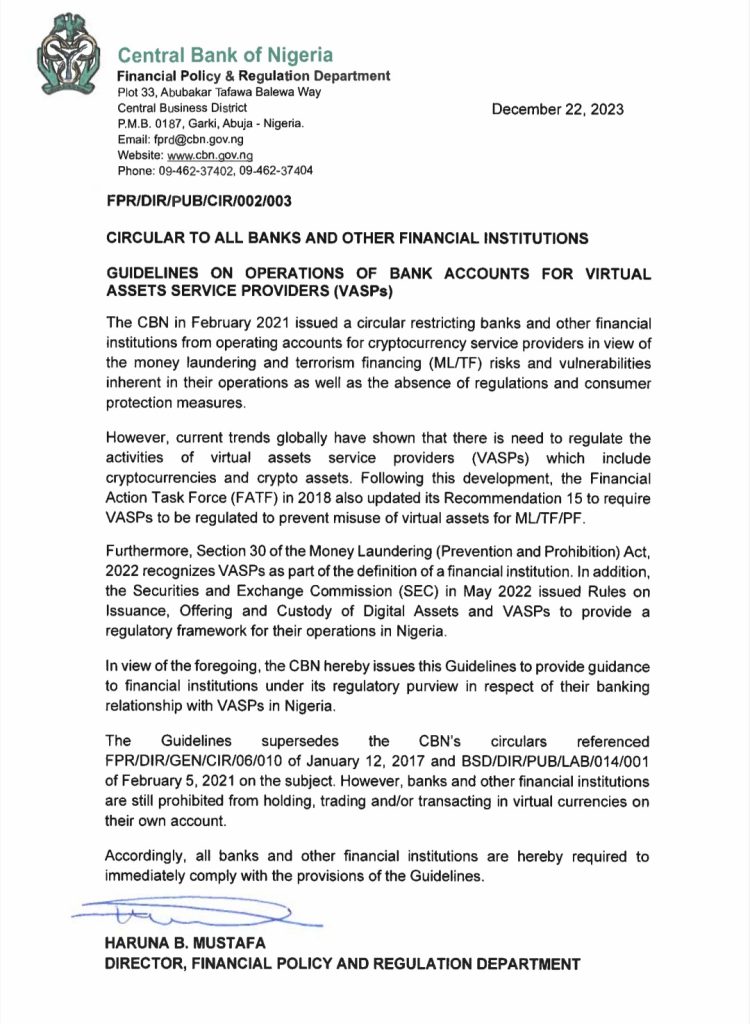
The Central Bank of Nigeria (CBN) has announced a monumental policy shift, effectively lifting its longstanding ban on cryptocurrency transactions within the country.

This move comes as the CBN introduces a regulatory framework, aimed at both managing the associated risks of virtual assets and leveraging their immense potential. The announcement surfaced through Circular FPR/DIR/PUB/CIR/002/003, signed by Haruna Mustapha, the CBN’s Director of Financial Policy and Regulation.

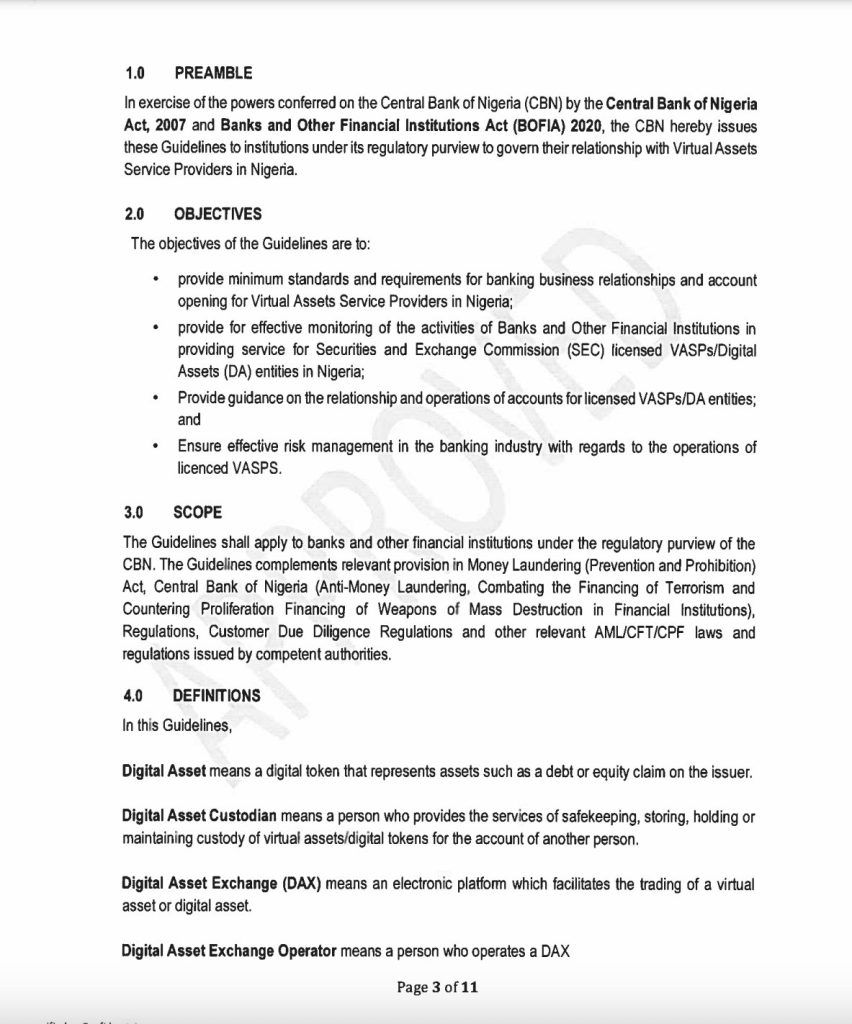
The circular underlines the necessity for regulated operations concerning Virtual Assets Service Providers (VASPs), encompassing cryptocurrencies and crypto assets. Global trends and international directives, particularly the Financial Action Task Force’s (FATF) Recommendation 15, acknowledge the imperative nature of regulating VASPs to curb financial crimes like money laundering and terrorism financing.

Moreover, the circular explicitly references Section 30 of the Money Laundering (Prevention and Prohibition) Act, 2022, recognizing VASPs as part of the financial institution definition. Additionally, it acknowledges the Securities and Exchange Commission’s (SEC) regulations unveiled in May 2022, which established a robust framework for digital asset issuance and VASPs operating in Nigeria.

The newly introduced guidelines within the circular supersede previous directives from the CBN. While maintaining the prohibition for banks and financial institutions from directly holding, trading, or transacting in virtual currencies for their accounts, the directive mandates immediate compliance with the new provisions outlined.

Haruna B. Mustapha, the Director of the Financial Policy and Regulation Department at the CBN, noted the pivotal role of these guidelines in fostering banking relationships between financial institutions and VASPs in Nigeria.

This significant decision represents a monumental departure from the CBN’s earlier stance on cryptocurrencies. Notably, in February 2021, the CBN mandated all banks in the nation to close accounts engaged in crypto-related transactions, citing the risks inherently associated with cryptocurrency transactions in reference to a 2017 cautionary circular on crypto issued by the bank.

Despite the Nigerian Security and Exchange Commission (SEC) acknowledging cryptocurrency as an asset and introducing regulations for digital asset issuance, the CBN had persistently maintained its ban, thereby impeding the full operationalization of the SEC’s guidelines.

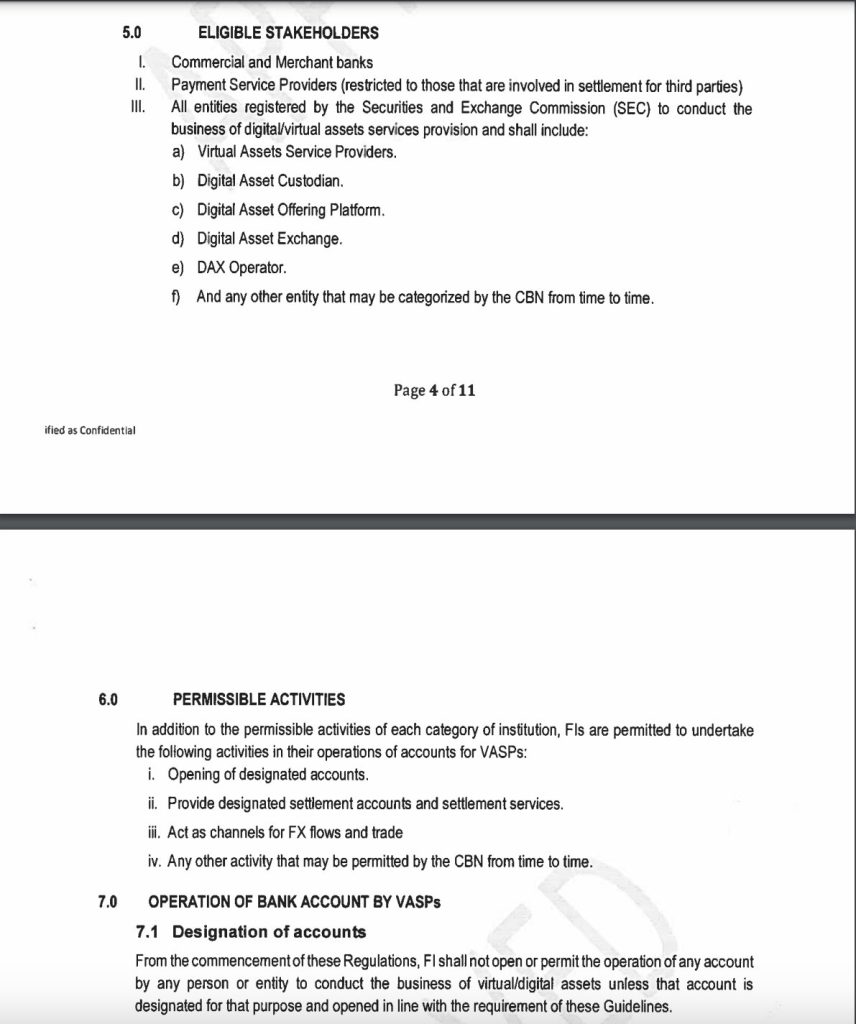
Under this new development, while banks and regulated financial institutions remain prohibited from directly engaging with cryptocurrencies, the circular opens avenues for crypto-native fintechs, possessing SEC authorization such as Virtual Assets Service Providers (VASPs) and Digital Assets Exchanges (DAX), to collaboratively enable fiat on-ramp and off-ramp solutions with banks and eligible financial institutions through the establishment of designated accounts.

This transformative step is expected to redefine Nigeria’s digital asset market, facilitating more structured and regulated crypto-related operations. It signifies a progressive bridging of the gap between traditional financial institutions and the burgeoning digital assets industry, marking a significant milestone in Nigeria’s financial evolution.


Still Waiting for Nigeria To Declassify the Lessons Learned from the Closure of Southern Land Borders

1

When the Nigerian government closed the southern land borders, I wrote that it was a very bad policy. I argued that closing the land borders because the Nigerian Customs was struggling with curtailing petrol smugglers was a bad strategy. Yes, they should have fired the workers,  and replaced them with people who were ready to do their work.

As the heat on why the border was closed intensified, the government shifted that it closed the border to stop the inflow of terrorists. Another nonsensical call since terrorists were not using legal entry points to enter Nigeria. Fellow Citizens, across all indicators, there was no single serious reason why Nigeria should have closed its land borders, considering the fact that Nigeria is the center of West Africa, and the economic fulcrum of the region. The Onitsha Main Market does not serve just Nigeria; it serves West Africa, as the largest open market in Africa on the  volume of trade.

When the land border problem ended, Onitsha, Ibadan, Ife, Aba and most markets in Lagos lost significant customers to other markets as Togo, Benin, and others rerouted their trading patterns. We’re yet to recover from that border policy; Morocco was rewarded and even applied to become a member of ECOWAS even though it was not geographically located in West Africa.

 I served on the Board of a logistics company and I knew the trading pattern; pre- and post-closure trading volumes were significant. And if you extrapolate, the Central Bank of Nigeria began to lose the ability to defend the Naira immediately the closure began. Look at the date and check the correlation.

Understand that Nigeria is an informal economy and many of our market indicators  are never captured in the government statistics. That explains why our stock market is worth about $50 billion when South Africa’s is close to $1 trillion. Nigeria does many things in the informal economy and that economy is BIG. Where am I going? The inflow of USD dollars through the land borders was significant, and when that stopped, reducing supply,  Naira paid the price via poor Naira positioning.

In the spirit of the recent disclosures, I am asking the federal government to share the Lessons Learned from that Land Border Closure. Sure, it has been reopened but I still want to understand the logic of that mindless economic policy where we intentionally disarmed and destroyed hundreds of light manufacturers whose markets were in our neighbouring countries.

In other words, I want to read what was achieved and not achieved, and what the nation could do to avoid mindless policies in the future. Largely, I am looking for any thesis why the nation could have done that, to begin with. If they have good points, I will write and commend them. Nigerian government: why did you close the southern land borders only to re-open them without any explanation?

Comment on Feed

Comment 1: You raise excellent points on the damaging economic impacts of the border closure, especially for small businesses and retailers reliant on cross-border trade. As an e-commerce consultant, I saw many Nigerian merchants struggle when trade flows were disrupted in the region.

Online sellers depending on customers from neighboring countries were severely affected. And as you mentioned, important informal trading channels were severed, restricting access to foreign currency critical for defending the Naira.
There is no doubt the policy created significant unintended consequences.

I hope the government does further analysis on the lessons learned and works to implement more targeted policies in the future that clamp down on smuggling without obstructing legal trade.

Thanks for sharing

Southeast Nigeria Development Commission Bill Passes Third Reading in the House of Representatives

0

The long-debated South-East Development Commission Bill successfully passed the third reading at the House of Representatives on Thursday, marking a historic moment after facing multiple rejections over the years.

Sponsored by the Deputy Speaker, Benjamin Kalu, alongside other lawmakers from the South East region, the bill’s explanatory memorandum outlines the commission’s crucial role in receiving and managing funds from the Federation Account. These funds are earmarked for the reconstruction and rehabilitation of roads, houses, and other infrastructure damaged during the civil war.

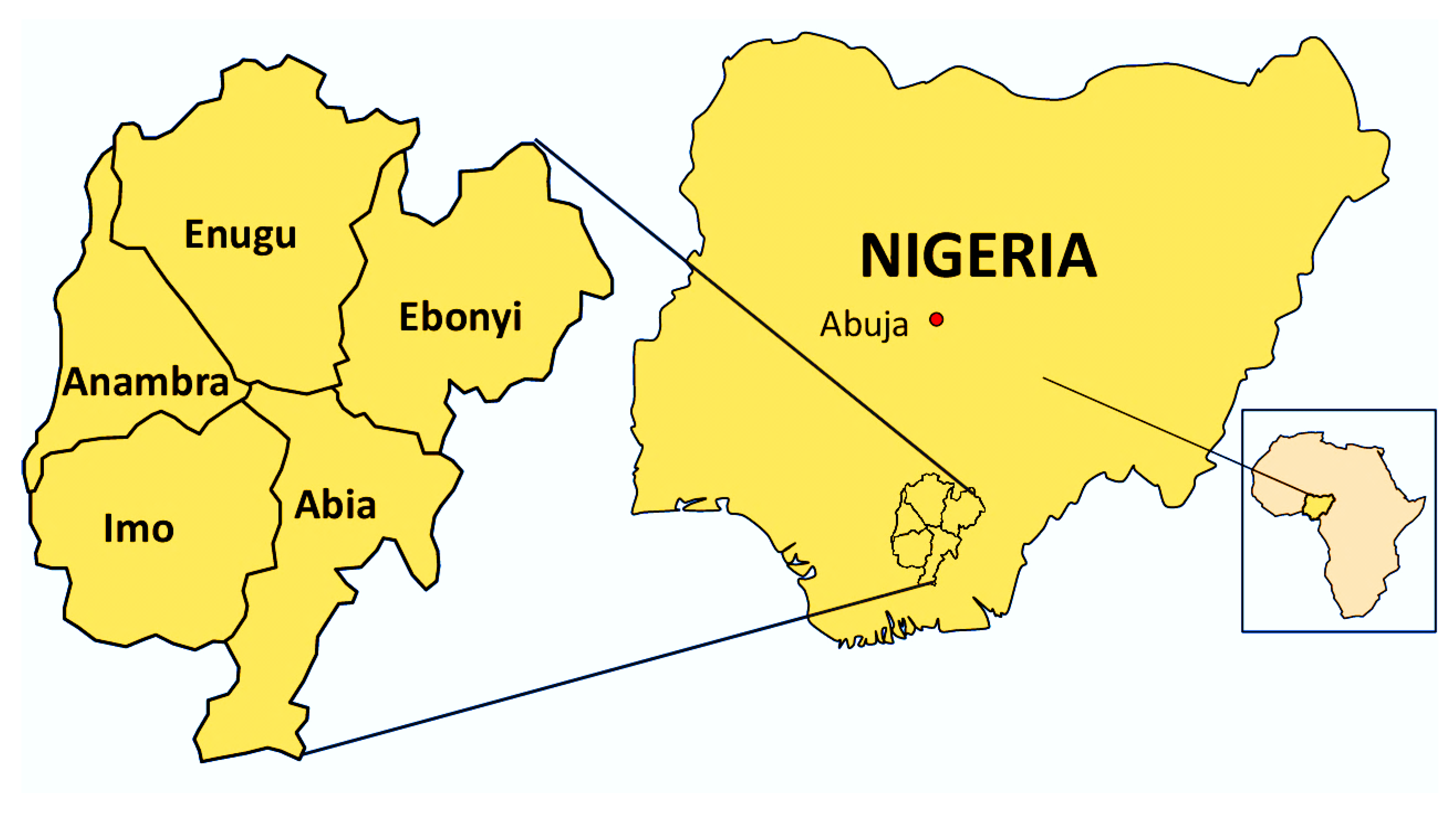
According to a statement from the Chief Press Secretary to the Deputy Speaker, Mr. Levinus Nwabughiogu, the commission, when established, will have the mandate to address not only the physical reconstruction but also ecological problems and other environmental or developmental challenges faced by the Southeast States—Abia, Imo, Enugu, Anambra, and Ebonyi.

“The passage of the bill is coming at a time members of the National Assembly from the region led by the Deputy Speaker are championing a new initiative known as Peace in South East Project,” the statement read.

This initiative seeks a non-kinetic approach to resolving socio-economic and sociological challenges while concurrently boosting the infrastructural development of the region.

The successful third reading of the bill now paves the way for it to move to the Senate for concurrence before being transmitted to President Bola Tinubu for his assent, ultimately transforming it into law.

Since the end of the Nigerian civil war in 1970, the development of the Southeast region through a regional development commission has remained a contentious issue. In 2017, The House of Representatives was thrown into a rowdy session, forcing a hasty adjournment of proceedings. The cause of the rowdiness was the rejection of a bill seeking to establish a South-East Development Commission.

The lawmakers had been debating the need for the Southeast geopolitical zone to have a commission to develop collapsed infrastructure and the damage suffered by the zone as a result of the Nigerian Civil War.

However, the bill failed at the session, which was presided over by the Speaker, Yakubu Dogara, after it had been debated. South-East lawmakers protested the decision because the House could have, at least, allowed the bill to pass the second reading for more views to be collated from Nigerians at a public hearing.

A similar bill to establish the North-East Development Commission had since been passed by the National Assembly and was hastily assented to by President Muhammadu Buhari.

The 2017 failed attempt to pass the bill in the House was proceeded by other failed attempts. Also, after the bill was passed by the Senate in 2018, it failed to scale opposition hurdles to become a law. Buhari was once accused of refusing to sign the bill into law.

With secession agitation, led by the Indigenous People of Biafra (IPOB), heightened in the Southeast since 2015 – calls to revisit the bill as a way of mitigating the tension and insecurity in the region have been on high.

The passage of this bill is believed to be signifying a crucial step towards addressing historical grievances, fostering development, and promoting peace in the South East region of Nigeria.