DD
MM
YYYY

PAGES

DD
MM
YYYY

spot_img

PAGES

Home Blog Page 3514

NERC Implements N1463.3/$ FX Rate for Band A Electricity Customers, Raising Concern Over the Sustainability of Naira Gains

0

The Nigerian Electricity Regulatory Commission (NERC) has implemented an exchange rate of N1463.3/$ in calculating the new electricity tariff for Band A consumers as part of the recent electricity tariff review.

This decision, outlined in the revised Multi-Year Tariff Order (MYTO) sent to all 11 electricity distribution companies (DisCos) across the country in 2024, reflects a significant increase compared to previous rates.

The exchange rate applied in the reviewed order marks a considerable rise from earlier calculations, notably surpassing the figure of N919.38/$ recorded in January. This difference of N543.92 underscores the impact of fluctuations in the foreign exchange market on tariff adjustments.
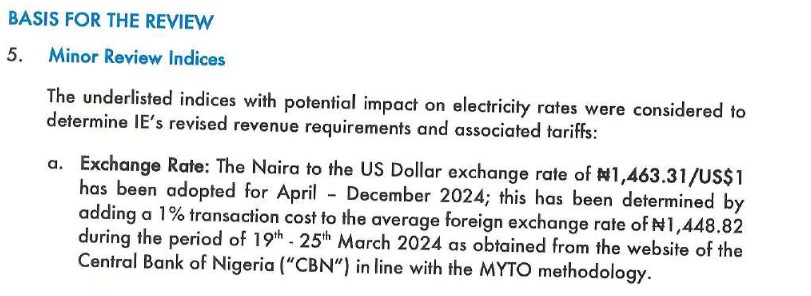
The surge in prices is attributed to ongoing fluctuations in the foreign exchange market since the beginning of the year, with the Nigerian naira experiencing a sharp decline. By March, the naira reached as high as N1800 in the parallel market. However, recent weeks have seen a notable recovery, with the naira dropping to below N1300 in the parallel market, largely due to reforms implemented by the Central Bank of Nigeria (CBN).

CBN’s reforms include raising the interest rate to 24.75%, providing foreign exchange to Bureaux de Change (BDCs) at a set rate, and imposing restrictions on international oil companies to limit their immediate repatriation of 100% of foreign exchange earnings.

In addition to the exchange rate adjustment, NERC has incorporated the new domestic gas price of $2.42/MMBTU, set by the Nigerian Midstream and Downstream Petroleum Regulatory Agency (NMDPRA), into the updated electricity tariff calculation for Band A consumers.

This decision follows NERC’s earlier announcement of increasing the electricity tariff for Band A consumers from N68/KWh to N225 per Kilowatt-hour. Notably, this hike affects approximately 15% of total electricity consumers in the country who enjoy around 20 hours of electricity daily.

Before NERC’s tariff increase for Band A consumers, the NMDPRA had raised the base price for domestic gas supply to power companies nationwide from $2.19/MMBTU to $2.42/MMBTU, further contributing to the adjustments in electricity tariffs.

However, NERC capping electricity tariff calculation at N1463.3/$ is seen as a sign that recent naira gains at the FX market are not sustainable. Financial experts had earlier warned of indications that the central bank wouldn’t be able to maintain FX supplies to the BDCs, which has been instrumental to the naira’s appreciation, for long.

“Why celebrate “strong” Naira and then use weak Naira to do government business?,” Kalu Aja asked. “So you are paying higher power tariffs because of weak naira? Why not use $1: N900?”

Other government agencies, including the Nigerian Customs Service, have also been observed using exchange rates higher than what is obtainable in (NAFEM) Nigeria’s official FX window.

Banking, Prime Lending Rates, Manufacturing Output in Nigeria

1

According to Nairametrics, below are the top 10 banks with the highest prime lending rates for manufacturing companies in Nigeria,  as at March 8, 2024:

Titan Trust Bank: Prime rate – 23.00%; Maximum rate – 30.50%

Optimus Bank: Prime rate – 23.75%; Maximum rate – 35.00%.

Fidelity Bank: Prime rate – 24.00%; Maximum rate – 26.00%

Providus Bank: Prime rate – 25.00%; Maximum rate – 30.00%

Unity Bank: Prime rate – 26.00%; Maximum rate – 33.00%

Ecobank: Prime rate –  26.75%; Maximum rate – 35.00%

Heritage Bank: Prime rate –  27.00%; Maximum rate – 35.00%

United Bank for Africa (UBA): Prime rate –  28.50%; Maximum rate – 32.00%

Wema Bank: Prime rate –  30.50%; Maximum rate – 31.50%

Keystone Bank Ltd: Prime rate –  31.00%; Maximum rate -36.00%

Verdict: there is no manufacturing sector which could be globally competitive at these rates. Yet, you do not blame these banks. This is what drives those interest rates as provided by the Central Bank of Nigeria https://www.cbn.gov.ng/rates/mnymktind.asp

A typical central bank does two main jobs – boost employment through interest rate management and stabilize national currency through the control of inflation. Nigeria’s consistent high rates are designed to manage inflation which remains stubbornly high, and as that happens, the other part of boosting employment is largely neglected.  

Here, I make my point that we may need to try other things, and that could mean boosting Supply (i.e. manufacturing output) via lower rates, if we desire to improve employment and bring inflation down. At lower rates, companies have money to expand production, creating employment along the line.

If the Central Bank of Nigeria is afraid that it could create runaway inflation, I recommend a trial in Orendu Market in Ovim. Yes, make the rates 7% and watch how Supply will improve and within a cycle, we can forget this stubborn high inflation!

*The Prime Lending Rate (PLR) is the interest rate that commercial banks charge their most creditworthy customers for short-term loans. It serves as a benchmark for interest rates on a wide range of financial products, including variable-rate home loan, personal loans, and business loans.

Largely, Western economics textbooks will teach you to raise interest rates to control inflation because they have a decent credit economy. When you raise rates, among many things, you make the cost of borrowing higher, and that can affect consumer spending since credit card rates will move up. If you can depress demand through suppressing consumer spending via high interest rates, you have a good chance of controlling inflation.

But in Nigeria with limited consumer credit, that does not make a lot of sense. In other words, when you increase interest rates, you are not clearly influencing demand since access to credit is limited. Rather, what happens is that when rates go up, companies struggle because the cost of capital is increased, and if that is the case, they do not invest a lot, and that triggers lower supply. With lower supply, inflation jumps up again. That is why for years, inflation has continued to worsen in Nigeria despite our consistent increase in rates.

BlockDAG’s DAGpaper Unveiling Marks A Leap Towards $5M Daily Revenue, Surpassing CORE and Mantle (MNT) Growth

0

As the BlockDAG Network emerges as the premier rapidly expanding entity, it overshadows its peers. With Mantle (MNT) and CORE Token experiencing significant growth, BlockDAG leads with its groundbreaking innovation and $13.4 million presale, signaling an era of unmatched expansion in cryptocurrency investment and technology.

The CORE Token’s Astonishing Growth

CORE, developed by CoretoshisLab, saw an unprecedented rise in interest following a tweet indicating a potential price surge to $100 in anticipation of the Bitcoin halving. The announcement of over 100 crypto funds committing to CORE sets the stage for a potential 3,600% increase from its current price, underscoring the token’s bright prospects and validating its market credibility. 

Mantle (MNT) Innovates with Rewards Station

Mantle’s introduction of the Rewards Station, which incentivizes users to deposit Mantle tokens for rewards, has led to a surge in its value from $0.89 to $1.22, boosting its market cap from $2.91B to $3.93B. With a majority of technical indicators pointing towards positive momentum, Mantle is projected to reach $1.15 before the second quarter of 2024 concludes.

BlockDAG Dominates with Exceptional Growth Forecasts

BlockDAG, setting the crypto world alight, has amassed $13.4 million in funding and sold over 6.5 billion coins, distinguishing itself as a frontrunner in the digital currency realm. This platform’s unique approach to asset management forecasts a soaring potential, with investments expected to reach $10 by 2025, highlighting its dominant position over competitors like Kaspa.

With daily transactions already surpassing $1 million and projections to reach $5 million, BlockDAG represents a significant leap in cryptocurrency innovation. Its diverse revenue streams, including coin investment, mobile mining, dedicated mining units, and trade miners, provide a comprehensive investment ecosystem. BlockDAG offers both passive and active income opportunities, setting a new standard for wealth generation in the cryptocurrency space.

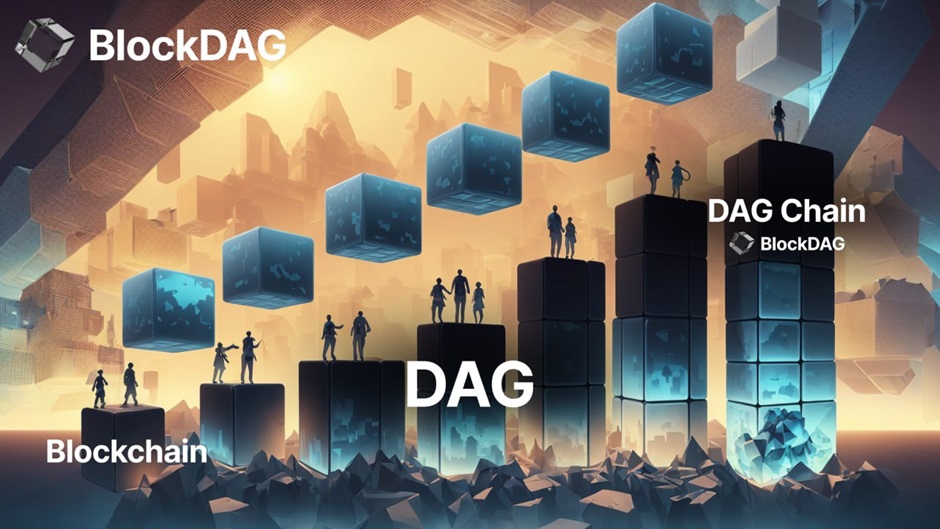
The new network’s technology merges both Directed Acyclic Graphs (DAG), the structure that defy blockchain itself providing exponential transaction speed, and Proof-of-Work (PoW), the most advanced consensus system used by major crypto giants to address matters such as scalability, decentralization, or security.

The Unmatched Investment Opportunity with BlockDAG

BlockDAG stands as the beacon of the crypto universe, driving unprecedented growth and offering a lucrative investment landscape that outshines Mantle (MNT) and CORE Token’s advancements. Its strategic innovation, coupled with a powerful revenue model and increasing transaction volumes, positions BlockDAG as the epitome of cryptocurrency evolution. As we venture into this transformative period, BlockDAG, with a prospect ROI of 20,000x that may soon climb to 30,000, invites investors to partake in what could be the most monumental growth story in digital finance history. Join the revolution and be part of BlockDAG’s journey to redefine the future of investment.

Join BlockDAG Presale Now:

Website: https://blockdag.network

Presale: https://purchase.blockdag.network

Telegram: https://t.me/blockDAGnetworkOfficial

Discord: https://discord.gg/Q7BxghMVyu

UK investors are unable to purchase US Spot Bitcoin ETFs directly

0

The landscape of investment opportunities is constantly evolving, and one area that has garnered significant attention is the realm of cryptocurrency, particularly Bitcoin ETFs. An Exchange-Traded Fund (ETF) that tracks the price of Bitcoin, known as a Spot Bitcoin ETF, allows investors to gain exposure to the price movements of Bitcoin without the complexities of directly owning the digital asset.

In the United States, the regulatory environment has progressed to a point where the Securities & Exchange Commission (SEC) has approved the trading of Spot Bitcoin ETFs. This development marks a significant milestone as it provides a regulated and potentially less risky avenue for investors to participate in the Bitcoin market.

However, for UK investors, the situation is markedly different. The Financial Conduct Authority (FCA), which is the regulatory body for financial services in the UK, has not yet approved Spot Bitcoin ETFs for retail investors. This means that, as of now, UK investors are unable to purchase US Spot Bitcoin ETFs directly.

The reasons for this are multifaceted. The FCA has expressed concerns over the high volatility and speculative nature of cryptocurrencies, as well as the potential for investor harm due to the lack of consumer protection in this space. As a result, the FCA has taken a cautious approach, banning the sale of crypto-based investment products to retail consumers.

Despite this, the interest in cryptocurrencies and related investment products continues to grow among UK investors. Some may seek alternative routes to gain exposure to Bitcoin, such as purchasing shares in companies that hold significant amounts of Bitcoin or investing in international funds that may have some exposure to US Spot Bitcoin ETFs.

It’s also worth noting that the regulatory stance is not set in stone. The FCA and other regulatory bodies worldwide are continually assessing the evolving landscape of cryptocurrencies and blockchain technology. There is a possibility that the regulations in the UK could change, allowing for more direct investment opportunities in the future.

For those considering such investments, it’s crucial to stay informed about the latest regulatory developments and to understand the risks involved. Cryptocurrency investments carry a high level of risk, and it’s important to only invest what one can afford to lose. Seeking advice from financial advisors who are knowledgeable about both the traditional and crypto markets can provide valuable insights for making informed decisions.

The regulatory landscape for cryptocurrencies and related financial products is still evolving. Changes in regulations can have a profound impact on the value and legality of Bitcoin ETFs. This uncertainty can pose a risk to investors if regulatory actions negatively affect the market.

While investing in a Bitcoin ETF eliminates the need to manage private keys associated with direct cryptocurrency ownership, it does not entirely remove security concerns. Investors must trust the ETF provider to securely manage the underlying assets, and any security breaches could impact the value of the investment.

While US investors have the green light to invest in Spot Bitcoin ETFs, UK investors must navigate a more restrictive regulatory environment. The dynamic nature of the financial markets, however, suggests that this could change, and UK investors may eventually have the opportunity to participate in this emerging asset class. Until then, caution and due diligence remain the watchwords for anyone looking to invest in the cryptocurrency space.

Stablecoins Surge as Bitcoin Stabilizes around $66,000

0

In the ever-evolving world of cryptocurrency, a fascinating trend has emerged in early 2024. As Bitcoin hovers around the $66,000 mark, the supply of stablecoins has seen a remarkable increase. This phenomenon presents a dual narrative in the crypto market: on one hand, the stability of Bitcoin’s price suggests a maturing asset less susceptible to extreme volatility; on the other, the surge in stablecoin supply indicates a growing demand for digital assets tied to the stability of fiat currencies.

Stablecoins, digital currencies pegged to stable assets like the US dollar, have become a cornerstone in the cryptocurrency ecosystem. They offer the benefits of digital currency – speed, security, and borderless transactions – without the price volatility associated with assets like Bitcoin and Ethereum. This year alone, the stablecoin market has experienced substantial growth, with supply surging to over $150 billion, a significant increase from the beginning of the year.

The rise in stablecoin supply can be attributed to several factors. Firstly, the expansion reflects heightened optimism within the industry. Investors are increasingly viewing stablecoins as a safe haven, especially in times of uncertainty in the broader financial markets. Secondly, the growth of decentralized finance (DeFi) platforms, which often use stablecoins for transactions, has contributed to the increased demand. Lastly, the entry of new stablecoins into the market, such as FDUSD and USDe, has added to the overall supply, offering more options for users and investors.

Bitcoin’s price stability, meanwhile, tells a different story. After reaching all-time highs above $73,500 in March, Bitcoin has seen a slight correction, stabilizing around the $66,000 mark. This price action may indicate a consolidation phase as the market digests its recent gains and prepares for the next move. Analysts suggest that the current price level could be a prime buying opportunity, with the potential for Bitcoin’s value to either retract to $60,000 or advance towards $70,000.

The contrasting dynamics of stablecoin supply and Bitcoin’s price stability highlight the diverse strategies and sentiments within the crypto market. While some investors are looking for stability and are turning to stablecoins, others are speculating on the future price movements of Bitcoin, anticipating either a dip or a surge.

Another significant risk is the centralization risk inherent in fiat-collateralized stablecoins. These stablecoins, which hold reserves in traditional currencies to back their value, are often under the control of regulated entities that have the authority to mint new coins and freeze assets. This centralization can lead to concerns about transparency and the true backing of the stablecoin.

Algorithmic stablecoins, which use algorithms to maintain their peg, carry the additional risk of endogenous collateral that is susceptible to volatility. The collapse of Terra’s UST stablecoin in 2020 is a stark reminder of how quickly an algorithmic stablecoin can destabilize, leading to a “death spiral” for both the stablecoin and its associated assets.

External factors such as regulatory changes, interest rate fluctuations, and macroeconomic conditions can also impact stablecoins. For instance, a government ban on stablecoins could lead to a rapid devaluation and depegging event. Moreover, technical issues like network congestion or smart contract vulnerabilities can pose significant risks to the stability and security of stablecoins.

Despite these risks, stablecoins continue to play a vital role in the crypto ecosystem, facilitating trades and acting as a store of value. As the market for stablecoins grows, it is essential for investors and users to stay informed about the potential risks and the evolving regulatory landscape. With proper understanding and caution, stablecoins can be a valuable tool in the digital economy.