DD
MM
YYYY

PAGES

DD
MM
YYYY

spot_img

PAGES

Home Blog Page 3536

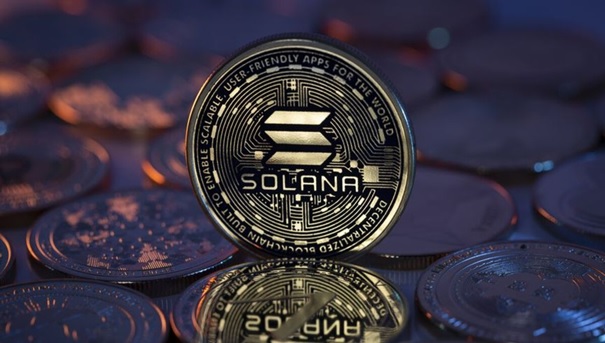
90% of Stablecoin Transaction Volume on Solana is $USDC; LayerZero to launch native token, MadLad #3732 sells for 1299 SOL

0

One of the most remarkable features of the Solana blockchain is its ability to handle a large volume of transactions with low fees and high speed. This makes it an attractive platform for stablecoins, which are cryptocurrencies that maintain a peg to a fiat currency or a basket of assets. Stablecoins are useful for transferring value across borders, hedging against volatility, and enabling decentralized finance (DeFi) applications.

Among the various stablecoins that exist on Solana, USDC stands out as the dominant one. According to data from Solana Beach, USDC accounts for about 90% of the total stablecoin transaction volume on Solana, followed by USDT with 7% and wUSDC with 2%. USDC is also the most widely used stablecoin in terms of number of transactions, holders, and transfers.

What makes USDC so popular on Solana? There are several factors that contribute to its success. USDC is one of the oldest and most trusted stablecoins in the crypto space, backed by US dollars held in reserve by regulated financial institutions. It has a proven track record of maintaining its peg and providing transparency and auditability.

What makes USDC so popular on Solana?

USDC is a stablecoin that is pegged to the US dollar and backed by reserves of real dollars. It is one of the most widely used and trusted cryptocurrencies in the world, with over $40 billion in circulation. USDC is also compatible with multiple blockchains, including Ethereum, Algorand, Stellar, and Solana.

Solana is a high-performance blockchain that can process over 50,000 transactions per second with low fees and high security. Solana is designed to support decentralized applications that require speed, scalability, and interoperability. Solana also has a vibrant ecosystem of projects, developers, and users that are building the future of Web3.

USDC and Solana have a strong synergy that makes them both more attractive and useful for users and developers. Here are some of the reasons why USDC is so popular on Solana:

  • USDC enables fast and cheap transfers of value across the Solana network. Users can send and receive USDC in seconds with minimal fees, making it ideal for payments, remittances, trading, and DeFi.

  • USDC provides a stable and reliable store of value on Solana. Users can avoid the volatility and risk of other cryptocurrencies by holding USDC, which maintains a 1:1 parity with the US dollar. USDC also has regular audits and transparency reports that ensure its solvency and compliance.

  • USDC supports a variety of use cases and applications on Solana. Users can access a wide range of services and products that leverage USDC, such as lending, borrowing, swapping, staking, yield farming, gaming, NFTs, and more. USDC also enables cross-chain interoperability with other blockchains that support it, such as Ethereum.

  • USDC benefits from the innovation and growth of the Solana ecosystem. Users can enjoy the advantages of Solana’s technology and community, such as its high throughput, low latency, rich features, and diverse offerings. Solana also has a strong vision and roadmap for the future of blockchain and Web3.

USDC is not only the most popular stablecoin on Solana, but also one of the most important ones for the growth and development of the Solana ecosystem. By providing a stable and liquid medium of exchange, USDC enables users to access the full potential of Solana’s scalability, speed, and low-cost transactions.

USDC also facilitates interoperability between Solana and other blockchains, such as Ethereum, allowing users to move value across different networks and platforms. As Solana continues to attract more users and projects, USDC will likely remain a key component of its infrastructure and innovation.

USDC is a popular and powerful cryptocurrency that enhances the value proposition of Solana. By combining the stability and trustworthiness of USDC with the performance and potential of Solana, users can experience the best of both worlds in the crypto space.

LayerZero will launch its own native token as MadLad #3732 sells for 1299 SOL

LayerZero, the decentralized protocol for cross-chain interoperability, has announced that it will launch its own native token in the first half of 2024. The token will serve as a governance and utility token for the LayerZero network, enabling users to participate in the decision-making process and access various services and features.

The LayerZero team explained that the token launch is part of their long-term vision to create a fully decentralized and permissionless platform for cross-chain communication and collaboration. The token will also help to align the incentives of the network participants and ensure the security and sustainability of the protocol.

According to the official post, the token will have multiple use cases, such as:

Staking: Users can stake their tokens to secure the network and earn rewards.

Governance: Users can vote on proposals and changes to the protocol parameters and features.

Fees: Users can pay fees for using the LayerZero services, such as cross-chain transfers, swaps, bridges, etc.

Rewards: Users can earn tokens for providing liquidity, data, or other resources to the network.

Grants: Users can apply for grants to fund their projects or initiatives that contribute to the LayerZero ecosystem.

The LayerZero team also revealed some details about the tokenomics, such as:

  • Total supply: The total supply of the token will be fixed at 1 billion.

Distribution: The token distribution will be fair and transparent, with a large portion allocated to the community and ecosystem development. The team and investors will have a long-term vesting schedule to ensure their commitment and alignment with the network’s goals.

Emission: The token emission will be dynamic and adaptive, depending on the network activity and demand. The emission rate will be determined by a governance mechanism that balances inflation and deflation pressures.

The LayerZero protocol is one of the most ambitious and innovative projects in the blockchain space, aiming to create a universal layer for cross-chain interoperability. The protocol leverages zero-knowledge proofs and other cutting-edge technologies to enable fast, secure, and scalable cross-chain transactions and interactions. The protocol supports any blockchain that follows common standards, such as EVM-compatible chains, Substrate-based chains, Cosmos SDK-based chains, etc.

The LayerZero team stated that they are working hard to deliver the token launch and other milestones in their roadmap. They also invited the community to join their social media channels and stay tuned for more updates and announcements.

MadLad #3732 sells for 1299 SOL approximately $85,000.

The NFT market is booming, and one of the hottest collections right now is MadLad, a series of 10,000 unique digital artworks featuring pixelated characters with different traits and rarities. The MadLad project was launched in October 2023 and has quickly gained popularity among collectors and investors who see the potential of this innovative and creative project.

One of the most sought-after MadLads is #3732, a rare mint with a gold crown, sunglasses, a beard, and a red hoodie. This MadLad has a lot of personality and charisma, and it shows in its price. According to the latest data from Solana Art, the leading NFT marketplace on the Solana blockchain, MadLad #3732 was sold for a whopping 1299 SOL, which is approximately $85,000 at the current exchange rate. This is one of the highest prices ever paid for a MadLad NFT, and it reflects the high demand and scarcity of this collection.

The buyer of MadLad #3732 is a well-known NFT collector who goes by the name of Crypto King. He has been active in the NFT space for a long time and has amassed an impressive portfolio of rare and valuable NFTs from various projects. He said that he was attracted by the uniqueness and quality of the MadLad project, and that he believes that MadLad #3732 is one of the best pieces in his collection. He also said that he plans to hold on to his MadLad for a long time and enjoy its appreciation in value.

The seller of MadLad #3732 is a lucky mint who got his MadLad for only 1 SOL during the initial sale. He said that he was happy with his profit and that he decided to sell his MadLad because he needed some funds for other investments. He said that he still loves the MadLad project and that he will continue to support it and buy more MadLads in the future.

The MadLad project is one of the most successful NFT projects on the Solana blockchain, which is known for its fast, cheap, and scalable transactions. The Solana ecosystem has been growing rapidly in recent months, attracting more developers, users, and investors who are looking for alternatives to the congested and expensive Ethereum network. The MadLad project is a testament to the innovation and creativity that Solana enables, and it is likely that we will see more amazing NFT projects emerge on this platform in the near future.
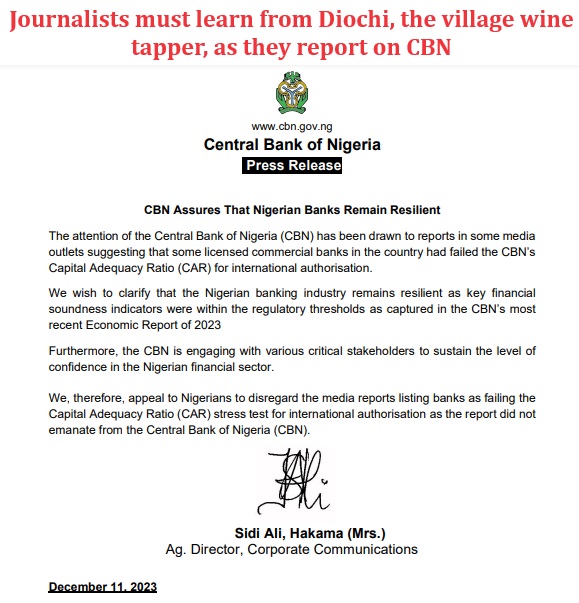
Nigerian Journalists must learn from Diochi, the village wine tapper, as they report on CBN

1

One thing Nigeria does not need now is a bank run because we do not even make enough pillows in Nigeria. So, if a run happens, I am not sure if we will have enough pillows imported on time to store the funds.

The Central Bank of Nigeria (CBN) is under severe stress because it is the only agency we can all flog publicly. But as I have noted, CBN is really a small part of this puzzle. Apex banks have two core functions in economies: maintain the strength of currencies by managing inflation and drive employment through interest rates management. And when you go lower in the system, it cannot manage inflation if there is no production (Supply side), and it cannot boost employment if there are no companies hiring. So, as people hit CBN, remember NDE, SMEDAN, etc as all supposed to be part of the equation.

Yet, as that happens, we must be nuanced and careful not to rattle the market. In Igbo tradition, elders will remind villagers that just like Diochi, the palm wine tapper, it is only a fool who tells everything he sees while on top of a palm tree! What that axiom is postulating is this: there are powers you have or things you can say, but sometimes, not saying or exercising that power will serve the society better. Diochi on top of the palm tree sees the whole village – women giving birth, people showering in the village stream, etc. The village expects him to hold those secrets!

This is why my best analysis are not read on social media. I have learnt my lessons and I can give three samples which convinced me to modulate:

  1. Konga should sell . I posited that old Konga was out of ideas despite raising close to $100m and should just sell itself. Within a month or so, that happened.  Many young people blamed a village boy for causing them to lose their jobs. That was painful.

  2. Andela problem . I noted issues. As you can see in the comments, many were unhappy. Good enough, Andela changed strategy and averted that problem when it stopped building dormitories!

3. Ecommerce problems in Africa, Harvard Business Review  African brothers spoke in one voice: you wanted to destroy ecommerce in Africa, as they neglected my concerns.

After some of these lessons, those deep analytical works are gone because we’re not good at handling academic perspectives.  Please journalists, be nuanced when you write about banking ratios as Nigeria cannot afford a bank run right now.

As Naira Hits Record Low, Nigeria Needs To Focus On The Root Cause

Artist Vera Molnar Passes at 99 years

0

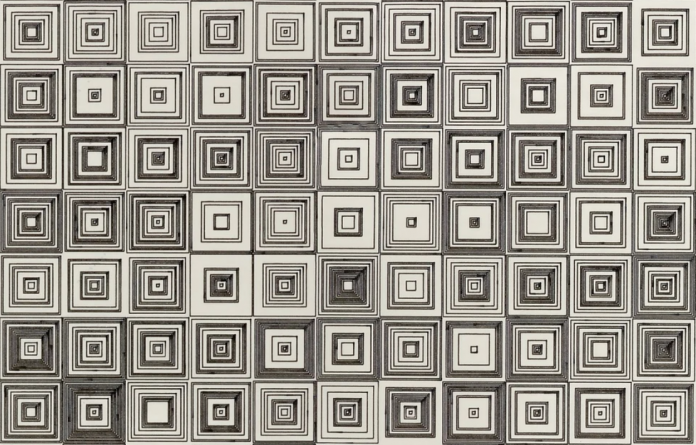
The art world has lost a pioneer of digital and algorithmic art. Vera Molnar, who was born in Hungary in 1924 and lived in France since 1947, passed away on December 9, 2023, at the age of 99. She was one of the first artists to use computers as a creative tool, exploring the possibilities of geometry, randomness and repetition in her abstract paintings and drawings.

Molnar’s work draws from constructivism and conceptual art, as well as cubism and other avant-garde movements, while developing her own form of geometric abstraction. She experimented with various techniques and media, such as drawing, painting, collage, photography, and sculpture, but her most distinctive contribution was her use of algorithms and computers to create complex and dynamic compositions.

Molnar began her artistic career as a painter, influenced by the Bauhaus and constructivism movements. She experimented with geometric forms, grids and patterns, seeking to create visual order and harmony. She was also interested in the concept of chance and disruption, introducing elements of variation and unpredictability into her compositions.

In the 1960s, Molnar discovered the potential of computers to generate and manipulate images. She learned to program in Fortran and Basic and used plotters to print her artworks. She created algorithms that could produce endless variations of shapes, colors and orientations, sometimes following strict rules, sometimes incorporating random factors. She also used computers to simulate the effects of aging, erosion and decay on her works, creating a contrast between the precision of the machine and the imperfection of nature.

One of her most famous series is Machine Imaginaire, which she started in 1974. In this series, she used a plotter to print large-scale drawings based on algorithms that she wrote by hand. The algorithms were inspired by natural phenomena, such as clouds, waves, or mountains, but also by her own imagination and emotions. The resulting images are abstract yet suggestive, evoking landscapes or organic forms.

Another notable series is Quelques lignes à propos de quelques lignes, which she began in 1988. In this series, she used a computer program to generate variations of a simple motif: a group of parallel lines. She then painted the variations by hand on canvas, using different colors and brushstrokes. The series demonstrates her interest in the relationship between human and machine creativity, as well as the tension between order and chaos.

Molnar’s work has been exhibited widely in Europe and beyond and has influenced many generations of artists who work with digital media. She was also a founding member of several groups and associations that promoted computer art, such as GRAV (Groupe de Recherche d’Art Visuel), Art et Informatique, and A.R.C.A.T (Association de Recherche et Création Assistées par Ordinateur). She received numerous awards and honors for her artistic achievements, such as the Prix Ars Electronica Golden Nica in 2018.

Molnar’s legacy is not only her impressive body of work, but also her vision and passion for exploring new forms of expression and communication through technology. She was a pioneer of algorithmic art who challenged the boundaries of art and science, while creating works that are both aesthetically pleasing and intellectually stimulating.

Molnar’s work was innovative and influential, challenging the traditional notions of art and aesthetics. She was a founding member of several groups dedicated to computer art, such as GRAV (Groupe de Recherche d’Art Visuel), Art et Informatique, and Groupe Art et Ordinateur de Paris. She exhibited her work internationally, and received numerous awards and honors, including the Golden Nica at the Prix Ars Electronica in 2016.

Molnar’s legacy will live on through her inspiring and original artworks, which demonstrate the beauty and complexity of mathematics, logic and computation. She was a visionary artist who embraced technology as a means of artistic expression, and who never stopped experimenting and exploring new forms of visual language.

In life, let’s Drive Defensively with A Full View [video]

0

Risk has many shapes. You can be at risk from another object or entity, and seconds later, you can also create risk for another object/entity. Many years ago, Shell had a big billboard at Rumukrushi Port Harcourt junction with “Drive for others; become a defensive driver*”.

As an intern who did not have a driver’s license, I could not understand fully what Shell was saying. How do you drive for others? But later in NYSC when I got my driver’s license, and started driving, I learnt the core of that message: getting home safely requires thinking for the other drivers!

That takes me to the construct of co-opetition and win-win where dominance is not the desired outcome, but mildly thriving together within the spirit of ubuntu. These animals did a very dangerous crossing, posing risks to the motorists. The motorists also posed risks to them  especially if there’re signs with “watch for animal crossing”, making it clear that they do cross! The issue now is who enforces that order; it comes down to the motorists since only the motorists can drive defensively!

When we have that mindset, our companies advance. But if we focus on who’s wrong and right, many bad things happen. Yes, you can be right and still burn down a vision because you did not consider the full view. In life, let’s drive defensively!

*Defensive driving is “a set of safe responses to potential hazards, including other drivers, damaged road surfaces, debris, inclement weather, and more”.

Chipper Cash Once Again Reduces Workforce, Marking The Fourth Consecutive Round of Layoffs in A Year

0

African fintech startup Chipper Cash, in a continuing trend, has once again downsized its workforce, as the company undergoes its fourth successive round of layoffs in a year.

The layoffs are a result of the recent minor restructuring ongoing at the company. Announcing via a statement, Chipper Cash disclosed that only a small number of roles were impacted by the minor restructuring, which saw 15 employees laid off.

The company wrote,

“We constantly look to ensure we have as much efficiency as possible within our global organization, and only a small number of roles were impacted by the minor restructuring. No roles in Africa were affected this year, we have expanded teams on the continent. Our business is doing very well and will be profitable in a few months”.

Beyond the layoffs, Chipper Cash also slashed the salaries of its remaining US and UK employees, people close to the company disclosed.

Starting from 2022, Chipper Cash has so far laid off a significant part of its workforce, after the company attributed it to a shift in focus towards core markets and products, amid a challenging macroeconomic climate.

The company’s first round of layoffs came after its leading investor, FTX shut down operations. Due to the incident, Chipper Cash saw its valuation slashed from $2bn to $1.25bn before the FTX bankruptcy, according to documents shared by the Financial Times on the 6th of December 2022.

The company was also impacted by another similar incident that saw another of its lead investors, Silicon Valley Bank (SVB) shut down. According to Bloomberg’s report, the unicorn was weighing options, which included exploring a sale or seeking new investors.

Meanwhile, the company later disclosed that it never sought to be acquired, after the CEO and Co-founder Ham Serunjogi said that the collapse of Silicon Valley Bank (SVB), which was one of its investors, only had insignificant exposure on the company.

He said,

“Given the scale and complexity of our global operations, Chipper Cash maintains multiple banking relationships across the world, including multiple within the United States. As such, we had a very limited amount of money (only about $1M) held in our SVB account at the time the bank was taken over by the California regulator”.

Founded in 2018 by Ham Serunjogi and Majeed Moujaled, with the vision to unlock global opportunities and connect Africa to the rest of the world, Chipper Cash operates in multiple African markets with a core presence in Nigeria, Kenya, Nigeria, Uganda, Rwanda, South Africa, and Ghana.

The fintech startup enables its users to transfer money across borders in Africa as easily as sending a text. In 2021, it introduced fractional investing in US stocks for all its users as well as crypto trading. 

The Chipper on-chain cryptocurrency wallet supports BTC, ETH, SOL, and many more. From it, users can buy and sell, send, and receive crypto. Almost two million transactions took place in 2022, with each user averaging a total of 11.5 transactions per month.

Since its launch, Chipper Cash has raised over $300 million in venture funding across multiple rounds that originally valued it at $2.2 billion in late 2021.