DD
MM
YYYY

PAGES

DD
MM
YYYY

spot_img

PAGES

Home Blog Page 3556

Chiliz (CHZ), Chia (XCH), and Everlodge (ELDG): The Crypto Titans Leading the Charge! Bulls Are Confident in These Coins

0

With thousands of digital assets battling for attention, spotting the genuine contenders takes more than just luck. Enter Chiliz (CHZ), Chia (XCH), and Everlodge (ELDG) – three cryptocurrencies that have been making waves in the crypto space and have the bulls confidently backing them. This article will dive into what makes these tokens stand out and why they’re capturing the attention of crypto enthusiasts.

Summary

  • Tottenham Hotspur to launch a fan token on the Chiliz blockchain
  • Chia price prediction
  • Everlodge to solve plenty of issues that currently plague the real estate market

Chiliz (CHZ): On an Upward Trajectory

Chiliz (CHZ) is gaining upward momentum, and its recent partnership with Tottenham Hotspur is a testament to its growing influence. In a significant move, Tottenham Hotspur issued its fan token on the Chiliz blockchain, marking the first instance of a Premier League team doing so in two years.

After the launch, holders of SPURS tokens can vote on various team dynamics, such as possible kit modifications. This Chiliz partnership signifies the increasing adoption of blockchain technology in the sports industry and the growing trend of fan engagement through digital assets.

With such high-profile collaborations and real-world utility, experts are optimistic about the Chiliz future. They predict the Chiliz price will soar to $0.097 by December 2023.

Chia (XCH): A Strong Contender

Despite recent internal changes and strategic decisions, Chia (XCH) remains a compelling token. The Chia project recently made headlines by reducing its workforce, a move seen as part of its efforts to go public and possibly conduct token sales.

These developments demonstrate Chia’s commitment to evolving and adapting to the ever-changing crypto landscape. With a continued focus on its long-term goals and potential innovations, some experts predict that the Chia coin could see a rally.

Because of this, they forecast the Chia price could stabilize between $34.66 and $40.26 within the fourth quarter of 2023, making it an exciting asset to keep an eye on.

Everlodge (ELDG): Revolutionizing Real Estate Investment

Through blockchain technology, Everlodge (ELDG) will make strides in real estate investment. This upcoming property marketplace will be the first to combine NFT and timeshare technology with fractional vacation home ownership. In its presale run, the project gained global attention as it aimed to solve all issues plaguing the real estate market.

Traditionally, entering the real estate market required a significant upfront investment. Everlodge will break down this barrier by allowing users to invest fractionally in properties. It will digitize and mint high-end villas or hotels into NFTs. These NFTs are then fractionalized, enabling users to purchase smaller portions of a property. As the property’s value increases, so does the NFT’s.

Additionally, real estate investments often suffer from a lack of liquidity. Everlodge buyers can trade their NFTs on secondary markets, allowing for quicker entry and exit, thus enhancing the liquidity of real estate assets.

Holding the ELDG native token will bring users discounts, staking rewards, and more. It is now worth only $0.025 in stage seven of its presale. With the price already soaring by 150% from its beginning, experts are confident it can reach $0.038 by the time its presale ends. Moreover, they forecast a 30x rally after its launch and Tier-1 CEX listing.

For more information about Everlodge (ELDG) please visit their website.

Notable Provisions Of The Upstream Petroleum Decommissioning and Abandonment Regulations

0

This article will be looking at important provisions of the Upstream Petroleum Decommissioning & Abandonment Regulations as recently issued by the Nigerian Upstream Petroleum Regulatory Commission (or “The Commission”), with a focus on :-

– Objectives of the regulations

– Their application scope

– Decommissioning & abandonment plans

– Updating decommissioning and abandonment plans

– Implementation of approved decommissioning and abandonment plans.

What are the objectives of these regulations?

– To ensure the decommissioning and abandonment of petroleum wells, installations, structure, utilities, plants and pipelines for upstream petroleum operations on land and offshore are conducted in accordance with good international petroleum industry practice.

– To set the framework for the establishment and administration of a decommissioning and abandonment fund.

What is the application scope of these regulations?

These regulations apply to :

– The decommissioning and abandonment of facilities used in upstream petroleum operations in Nigeria.

– Wells, installations, facilities, associated with upstream petroleum operations under a license or lease saved under Section 311(2) of the Petroleum Industry Act and licenses and leases granted under the act.

What are the provisions of the regulations regarding decommissioning and abandonment plans?

– A licensee or lessee engaged in upstream petroleum operation shall within one year from the commencement of these regulations, submit to the NUPRC s decommissioning and abandonment plan and where a decommissioning and abandonment plan exists, provide an updated decommissioning and abandonment plan in accordance with the regulations.

– A licensee or lessee engaged in upstream petroleum operations in Nigeria shall conduct its operations in accordance with a decommissioning and abandonment plan approved by NUPRC.

– The requirement for decommissioning and abandonment plans under these regulations shall apply to upstream petroleum operations, irrespective of whether there is a decommissioning and abandonment plan previously approved –

a). Under any other law by an approving authority before the coming into effect of the Petroleum Industry Act.

b). By the NUPRC prior to these regulations.

– A decommissioning and abandonment plan pursuant to these regulations shall be as prescribed by the NUPRC.

– All new licensees and lessees shall submit a decommissioning and abandonment plan to the NUPRC as part of a field development plan.

What do the regulations say on updating decommissioning and abandonment plans?

– A licensee or lessee shall communicate to NUPRC for approval, any update to the decommissioning and abandonment plan prior to implementation of the decommissioning and abandonment operations.

– The commission shall review the proposed update and approve, where it meets the requirements pursuant to the regulations.

What do the regulations say on the implementation of approved decommissioning and abandonment plans? 

– A licensee or lessee who pursuant to an approved decommissioning and abandonment plan intends to –

a). suspend or abandon any well,

b). decommission any installation, structure, utility, plant or pipeline within its upstream operations,

c). decommission and abandon all or part of a facility in an oil or gas field,

Shall pay applicable fees and obtain approval of NUPRC prior to the commencement of the execution of the abandonment or decommissioning.

– In an emergency, a licensee or lessee may proceed to suspend a well that is at immediate risk to personnel, environment or the asset & shall immediately inform the NUPRC of the risk.

What are the provisions of the regulations on the decommissioning of infrastructure on offshore fields?

– In respect of the decommissioning of infrastructure on offshore fields, a licensee or lessee shall make an application to the commission in the prescribed form for approval to decommission offshore installations, structures, utilities, plant or pipelines, not involving the abandonment of wells, at least 60 months prior to the proposed start date of the commissioning.

Section II

This article installment will be looking at the provisions of the regulations on the acceptance or rejection of decommissioning and abandonment applications by the Nigerian Upstream Petroleum Regulatory Commission (or “The Commission”) as well provisions on the commencement of decommissioning and abandonment.

Approval of applications for abandonment/decommissioning under the regulations?

– An application under this regulation shall be accompanied with a decommissioning programme in a form prescribed by NUPRC which shall comprise of  :

a). A description of items to be decommissioned, inclusive of diagrams, covering – 

(i). Support structures for offshore fixed and floating installations at the time of removal, type, size, arrangements and weights.

(ii). Topsides for offshore fixed and floating installations, type, size, configuration, equipment and weights.

(iii). Subsea equipment and installations on or in the seabed, size, weight, height above seabed, whether piled or not, type of construction and material, details of interaction between equipment and other uses of the sea, such as fishing.

(iv). Pipelines, flow lines and umbilicals – lengths, diameters, type of construction, the extent of burial, trenching and details of any concrete mattresses, frond mattresses, grout bags, rock-dump or other materials used to cover the lines.

What do the regulations say on the rejection of applications ?

– The commission shall not approve a decommissioning application that does not meet the requirement of these regulations.

– Where the commission fails to make and communicate its decision on application to the licensee or lessee within 12 months the application shall be deemed approved by the NUPRC.

What do the regulations say on the commencement of decommissioning and abandonment?

– The decommissioning and abandonment pursuant to these regulations shall commence with an application by the licensee or lessee for approval accompanied by a decommissioning and abandonment programme.

– The NUPRC shall within 120 days of receipt upon an application from a licensee or lessee, communicate its decision to the applicant.

– An approval by the commission pursuant to these regulations shall be subject to directives issued by it on the implementation of the approval.

-Where an application is rejected by the NUPRC, the licensee or lessee shall be given 80 days within which to resubmit an amended application that meets the requirements of the commission.

– Where the licensee or lessee fails to submit an amended application within the time specified above, the NUPRC may invoke its power to access the fund to implement the decommissioning and abandonment of the facilities and notify the licensee or lessee accordingly pursuant to Section 23(3) of the Petroleum Industry Act.

Section III

The focus of this article installment is the provisions of the NUPRC regulations regarding:-

– Public consultations

– Post-completion of decommissioning and abandonment programme

– Obligations for decommissioning and abandonment.

What do the regulations say on the requirement for public consultation?

– Upon the receipt of an application for decommissioning and abandonment, the commission shall, in conjunction with a licensee or lessee, conduct public consultations with relevant stakeholders before giving approval.

– The relevant stakeholders referred to above shall include communities likely to be affected by the decommissioning and abandonment activities, public authorities and bodies and other interested parties, with respect to the planned decommissioning.

Changes to the decommissioning and abandonment programme

– Where a licensee or lessee proposes a change to an approved decommissioning and abandonment programme, such changes shall be submitted to the commission for review and approval.

– The NUPRC shall within 60 days of receipt of the licensee or lessee’s proposed changes, notify the licensee or lessee  of its approval or non-approval of such changes, failure of which shall result in such revisions being deemed approved.

– Where the proposed change is during the execution of the decommissioning and abandonment programme, the licensee or lessee shall obtain approval of the NUPRC before the execution of such change.

Post- Completion of Decommissioning and Abandonment

– Upon completion of decommissioning and abandonment, a licensee or lessee shall – 

a). notify the NUPRC I’m writing within 6 months of the completion of decommissioning and abandonment,

  1. b) submit an end of operations report including :

(i). a statement of measures for monitoring, maintenance and management of any abandoned well and decommissioned site.

(ii). statement of procedure for maintaining of installations or pipelines that may still exist, and

(iii). the actual cost incurred and any other relevant information that may be necessary.

c). submit results of all post-completion monitoring surveys established in paragraph (a)(i), upon completion of each survey.

– Upon the completion of the last survey as provided in the statement of measures pursuant to paragraph 1, any further work shall depend on the results of the monitoring survey and shall be agreed with NUPRC.

What are the obligations for decommissioning and abandonment?

– The obligation to carry out the decommissioning and abandonment of a well, Installations, structure, utilities, plants or pipelines associated with a license or lease under these regulations, shall in respect of a license or lease –

a). terminated by expiration of time, the obligation shall be on the licensee or lessee of the expired license or lease.

b). terminated by surrender, the obligation shall be on the licensee or lessee of the surrendered license or lease.

c). terminated by revocation, the obligation shall be on the licensee or lessee of the revoked license or lease.

d). that has been assigned, wholly or partly, with the consent of the minister of petroleum in accordance with the Petroleum Industry Act or any enactment preserved by the act, the obligation shall be on the assignee to the extent that the assignee has assumed obligations.

Section IV

This final article installment talks about the provisions of the NUPRC regulations regarding :

– The installations, structures and assets database.

– The Decommissioning and Abandonment Fund.

– Utilization of the Decommissioning and Abandonment Fund.

– Reporting.

– Deemed assignee liability.

Database of installations, structures and assets

– The NUPRC shall maintain a database of upstream petroleum installations, structures and pipelines on land and offshore, used in the petroleum operations and their status.

– The database pursuant to the above provision shall be a public document and shall be published on the commission website annually.

– For the purposes of maintaining and updating the database pursuant to this regulation, a licensee or lessee shall submit information relating to its upstream petroleum operations, installations, structures and pipelines to the NUPRC in the prescribed form and within the time frame specified by the commission.

Establishment of the decommissioning and abandonment fund

– There shall be set up for each licensee or lessee, a decommission and abandonment fund (“The Fund”).

– The fund shall be set up –

a). by the licensee or lessee, in respect of operations under the license or lease.

b). not later than 90 days from the date of commencement of production in the case of new licenses or leases.

c). 90 days from the date of commencement of these regulations for existing licenses or lease, of a producing field.

– A licensee or lessee shall submit notice of the setting up of the fund not later than 14 days from the date of setting up the fund.

Contributions to the Fund

– The contributions to the fund shall be made by yearly payments of the cash amount stipulated in the applicable decommissioning and abandonment plan by the licensee or lessee.

– In the case of a joint venture, the contributions to the fund shall be made by yearly payments of the cash amount stipulated in the applicable decommissioning and abandonment plan by the individual parties to the joint venture agreement pro-rata their respective participating interest in such joint venture.

Utilization of the Fund

– The fund shall be used to pay for decommissioning and abandonment costs.

– The licensee or lessee shall have access to the fund upon receipt of a written approval from the NUPRC pursuant to these regulations yo undertake the decommissioning programme & shall use such funds only for conducting an approved decommissioning and abandonment plan.

– The commission shall authorise the refund of any expenditure incurred by the licensee or lessee who carries out decommissioning or abandonment of a facility in an emergency situation from its contribution to the fund.

Reporting

– The licensee or lessee shall not later than 90 days succeeding the end of each calendar year, submit to the NUPRC & the Federal Inland Revenue Service (FIRS), a statement of accounts with respect to its contributions into the fund for the preceding year.

Deemed liability of an assignee

– Where the whole or part of an interest in the license or lease is assigned, novated or otherwise transferred to another party,the proportionate legal and equitable interests,rights and obligations of the license or lease in respect of the decommissioning and abandonment obligations under the Petroleum Industry Act and these regulations, shall be deemed to be attached to the property transferred to the transferee.

Could Cash and Bitcoin be on the same team? – ‘The Enemy of my Enemy is my Friend’ !

0

SCHISM 1:

In the world of Virtual Assets, a storm is brewing.

Keir Finlow-Bates, on the back of the debacle with Binance, created a video about how most people’s perception of the expectations of what ‘decentration’ should deliver miss the point. Keir started out by saying he wanted to talk about ‘decentralization’ in terms of ‘risk of censorship’.

He went on to say.. of systems out there.. Bitcoin is probably the most decentralized.

I would take an aside here, to remind folks that 9ja Cosmos builds off Handshake, which is a Bitcoin blockchain copy.

Bitcoin will just keep ticking along.. there are enough people interested in keeping it running… there are enough miners making money to keep it running… yes, you could be ‘censored’ by a particular mining pool… there are enough mining pools out there, that eventually, as long as you are paying the transaction fee… someone will say ‘I want that money’ and your transaction will get processed..

‘When you get to ‘chains’ such as ‘Binance Smart Chain’ (BSC) the risk is much higher… the validators on that particular chain are smaller in number, and they are all controlled by one or two entities …. as we are seeing, Binance is now in trouble with regulators, there is a risk, they may wake up one day, and it’s not worth running this chain anymore, and then it’s gone… so there, you are back in the arena of centralized service providers.’

In his LinkedIn comments section, I added :

  1. All scaling solutions, L2+ and EVMs off Ethereum carry the same risks Binance do.
  2. Security from a hack vulnerability perspective is another issue running in parallel to censorship resistance, though generally, the poorer the censorship resistance of the model, the higher the potential for hacking as well, so they sort of run in tandem.

The comment garnered a positive reaction from Keir.

One could argue, as I pointed out in last weeks’ ‘Three Bites of the Cherry’ series, in the section:’ IS POLYGON NOW EXITING WEB 3, AND LEVERAGING NO BLOCKCHAIN AT ALL??’ that Polygon now has much much bigger problems than BSC, due to the implementation of their new PRC 20 protocol.

In a recent post by Raymond Chai with a take on a post by Soban Raza (entitled ‘When can we call Ethereum done?’, Raymond leads with:

‘Adding additional layers to Ethereum blockchain protocol can increase the overall security risk. This is because each additional layer introduces new components and interfaces that could potentially be exploited by attackers. ’…

While the fulcrum of the Soban Raza post it was based on was:

‘Layer 2s are highly centralized’

So what we have, living inside this big virtual environment, encompassing blockchains, off-chain architectures, cryptocurrencies and web3, is some free and open blockchains like Bitcoin and Handshake on one hand..

and we have other highly centralized structures who can sensor us, control us, get hacked, lose our assets with no recourse, randomly get shut down driven by commercial imperatives, and are easily pushed around by the SEC and other bodies.

This is a great schism.

SCHISM 2:

In the world of ‘legacy’ value instruments, we have another schism going on.

This is quite simply, a movement to forcibly replace cash with CBDC.

Austin Carstens, General Manager, BIS (Bank for International Settlements) – in cash, we don’t know for example, we don’t know who’s using a 100 dollar bill today… we don’t know who’s using a 1000 peso bill today… with CBDC.. we will have ABSOLUTE CONTROL to determine the use… and the technology to enforce that.

CBDC advocates, in particular the (unelected) President of the European Central Bank, Christine Lagard, want to sell it as super-efficient, and ‘bottleneck’ removing version of ‘cash’.

However, Kristina Lilieneke says: It will be programmable which makes it anything but ”cash-like”

In tandem with this, there is also a plan for a digital wallet, which can track other actions, for example, refusal to take a state rolled out vaccine. The means is there for the state to freeze access to funds, any time failing to act on a ‘request’ is refused. (See also, James Villar Substack Article courtesy – Jason Meyers)

In this way, many personal freedoms we take for granted, while they may exist in theory, will no longer exist in practice.

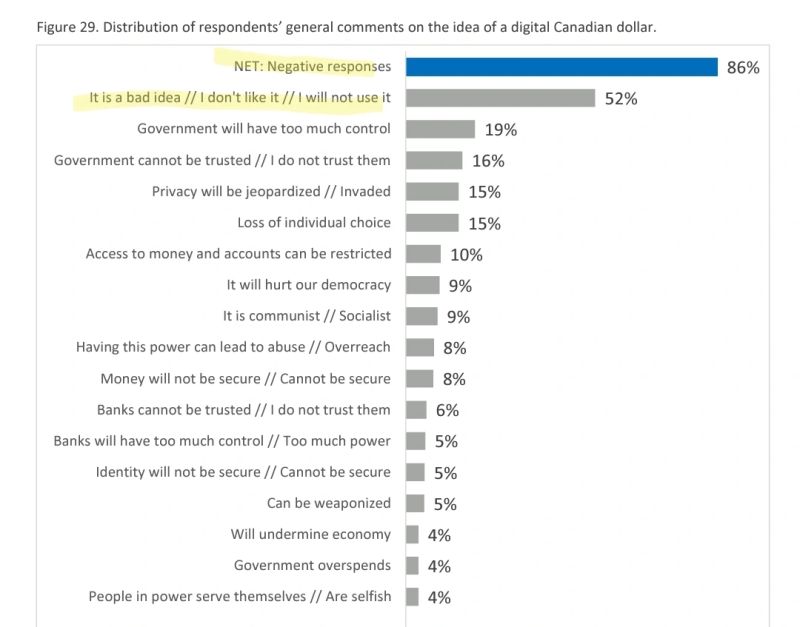
Unwillingness to accept CDBC in Canada, source: Magdalena Grownowska 

Different nations have different plans, but there is an overall plan to phase out cash, either entirely, or reduce it to an impractical limit.

Earlier this year in Nigeria, a currency redesign program was ‘sold’ to the public in advance of the Presidential Election as a measure to curb attempts by political actors to bribe their way to electoral fraud with pre-stockpiled mountains of cash.

However, the process ground availability of cash over a period of around a month almost to a complete halt. It caused intense hardship. Some in hindsight, reflecting on those days, wonder if it was not an experiment to funnel the populous into using the CBDC. The ‘e-Naira’ is deeply unpopular and was a huge waste of funds at a significant cost to the tax payer. If it was an attempt at forced e-Naira adoption, then it dismally failed.

THE UNHOLY ALLIANCE

Behind the scenes, a company from the world of ‘networks built off Ethereum’ has had many meetings with actors behind the intended Euro CBDC. It cannot be named in this section for legal reasons.

So what we have is one of the highly centralized structures built off Ethereum who can sensor us, control us, get hacked, lose our assets with no recourse, randomly get shut down driven by commercial imperatives, and are easily pushed around by the SEC and other bodies… joining with the sovereign forces , or in this case, the unelected ECB, to eliminate cash, and help those other forces control us though CBDC.

This can have serious consequences, especially in countries in the global south, whose disaspora relatives are helping from abroad to keep family members surviving through difficult times. Family remittances is something a CBDC can be programmed to prevent happening either as a general rule, or singling out individuals.

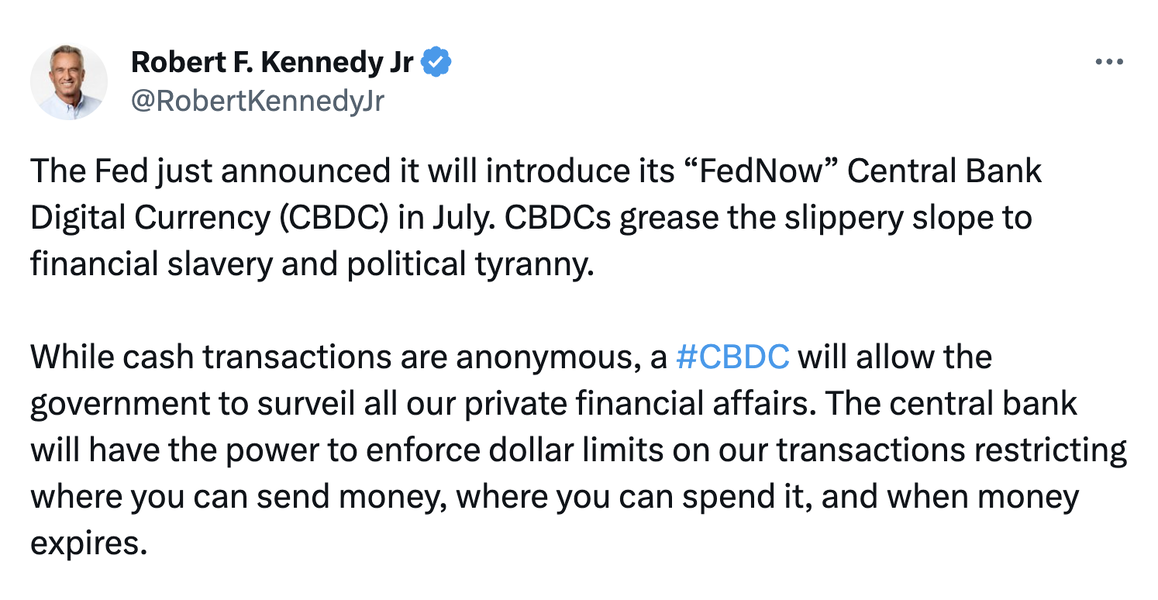
Robert F. Kennedy Jr makes a political statement on what CBDC will bring – ‘financial slavery and political tyranny’

This is an example of one of the types of restrictions programmable in a cash-less or cash restricted society with CBDC, and commercial actors in extended layer 2 and scaling solution networks are helping make this a reality.

This may give some builders, NFT buyers and token speculators some pause for thought. If you are engaging with those networks in ways that give them business, you may be helping to bring CBDCs closer to reality, and everything bad that can come with them.

And perhaps this is about to become a war, that has Bitcoin, cash, and by extension Handshake, on the same side?

9ja Cosmos is here!

Get your .9jacom and .9javerse Web 3 domains  for $2 at:

.9jacom Domains

.9javerse Domains

Visit 9ja Cosmos

Follow us on LinkedIn HERE

Preview Sino Amazons/Sinosignias HERE

Tekedia Black Friday Sales has ended

2

–This promotion has ended.

Happy Thanksgiving, joining our United States-based co-learners. In the spirit of the moment, Tekedia is offering discounts on the following courses, from now till [this has ended]

The normal price returns as the promo has ended:

  • -Tekedia Startup Masterclass – $200 
  • -Tekedia AI in Business Masterclass – $200 
  • -Tekedia Practice with Internship (Energy, Agric, Digital)- $200 
  • -Tekedia Industries (Agro, Energy, Digital Tech) – $200 
  • -Tekedia Investment & Portfolio Management – $200 

You can learn about each of these courses here – https://school.tekedia.com/courses/all/

And depending on your payment options, you can pay via a local bank, Stripe, PayPal, Zelle, etc here https://www.tekedia.com/pay  . After payment, email info@tekedia.com for your login details. 

Note: we’re not changing the prices on our website; we just want only those here to get this discount. Take advantage and let us co-learn at Africa’s largest business school for entrepreneurial capitalism. 

Regards,

Tekedia Team

US Space Force Major sends open letter about Bitcoin to DOD’s Defense Innovation Board, as US Judge Threatens SEC Over False Arguments

0

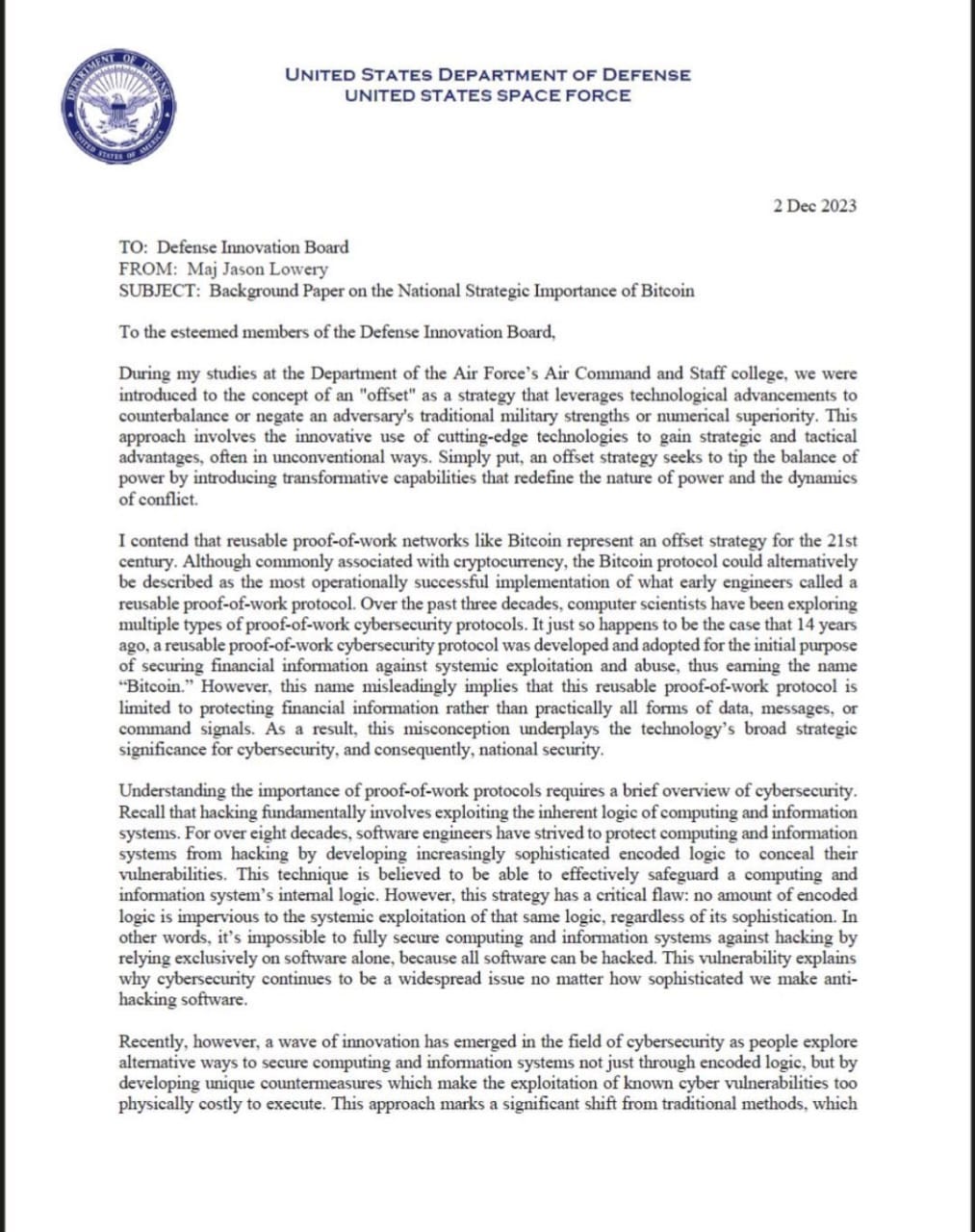
In a bold move, US Space Force Major, Jason Lowery has sent an open letter to the Department of Defense’s Defense Innovation Board (DIB), urging them to consider the potential of Bitcoin as a strategic asset for national security and defense.

The letter, which was published on Medium, argues that Bitcoin is not only a revolutionary technology that can enhance the resilience, efficiency and transparency of the US military, but also a powerful tool to counter the threats posed by adversaries such as China, Russia and Iran.

Major Lowery, who is a space operations officer and a PhD candidate in engineering management at the Air Force Institute of Technology, writes that Bitcoin is “the most significant innovation in the history of money and accounting” and that it has “profound implications for the future of warfare”.

He explains that Bitcoin is a decentralized, peer-to-peer network that enables anyone to transact value without intermediaries, censorship or fraud. He also highlights some of the unique features of Bitcoin, such as its limited supply, its immutability, its transparency and its programmability.

According to Major Lowery, Bitcoin can offer several benefits to the US military, such as:

Reducing the reliance on legacy financial systems that are vulnerable to cyberattacks, corruption and manipulation. Enhancing the operational security and agility of the troops by enabling fast and secure payments across borders and domains. Improving the accountability and auditability of the defense budget by creating a public ledger of all transactions.

Fostering innovation and collaboration among allies and partners by creating a common platform for interoperability and trust. Deterring and disrupting the malicious activities of adversaries by undermining their ability to finance their operations, launder money and evade sanctions.

Major Lowery also warns that ignoring or dismissing Bitcoin could have serious consequences for the US national security and defense. He cites several examples of how adversaries are already exploiting the advantages of Bitcoin, such as:

China’s dominance in Bitcoin mining, which gives it control over a large portion of the network’s computing power and influence over its governance. Russia’s use of Bitcoin to fund its cyberwarfare campaigns, such as the 2016 election interference and the SolarWinds hack.

Iran’s adoption of Bitcoin to circumvent US sanctions and to support its nuclear and ballistic missile programs. North Korea’s theft of Bitcoin from exchanges and wallets to finance its weapons of mass destruction.

Major Lowery concludes his letter by urging the DIB to take action and to embrace Bitcoin as a strategic asset for national security and defense. He proposes several recommendations, such as:

Establishing a Bitcoin Innovation Center within the DOD to research, develop and test Bitcoin-related technologies and applications. Creating a Bitcoin Reserve Fund within the DOD to acquire and hold Bitcoin as a hedge against inflation, currency devaluation and geopolitical instability.

Developing a Bitcoin Education Program within the DOD to train and educate the military personnel on the fundamentals, benefits and risks of Bitcoin. Forming a Bitcoin Alliance with like-minded allies and partners to coordinate policies, standards and best practices regarding Bitcoin.

Major Lowery’s letter is a remarkable example of how some visionary leaders within the US military are recognizing the potential of Bitcoin as a game-changer for national security and defense. It is also a wake-up call for the DOD and the DIB to take Bitcoin seriously and to act swiftly before it is too late.

US Judge Threatens SEC For False Arguments In Crypto Firms Case

A US judge has issued a stern warning to the Securities and Exchange Commission (SEC) for making false claims in its lawsuit against Ripple, a cryptocurrency firm. The SEC had accused Ripple of violating securities laws by selling unregistered tokens, called XRP, to investors. The judge, however, found that the SEC had failed to provide any evidence to support its allegations and had misrepresented the facts of the case.

The judge said that the SEC’s conduct was “unacceptable” and “unprofessional” and that it had wasted the court’s time and resources. He said that he would impose sanctions on the SEC if it continued to make false or misleading arguments in the future. He also urged the SEC to reconsider its approach to regulating the cryptocurrency industry and to work with the stakeholders to develop a clear and consistent framework.

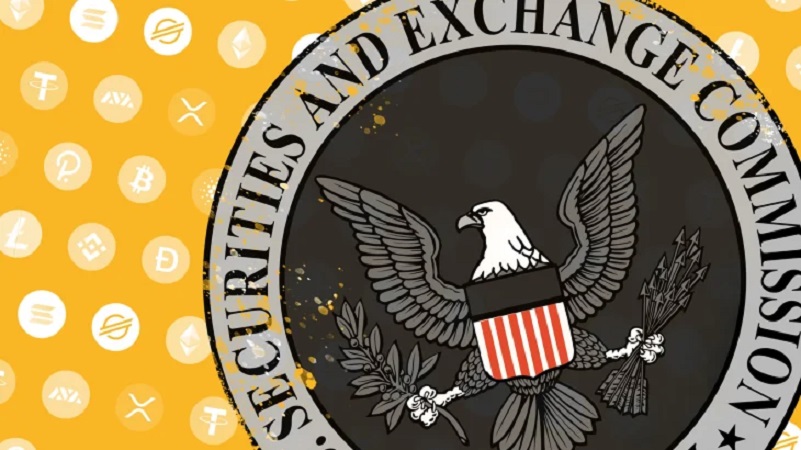
SEC Spot Bitcoin?ETF potential approval window is between January 5th – 10th, 2024.

The cryptocurrency community is eagerly awaiting the decision of the US Securities and Exchange Commission (SEC) on the proposed Bitcoin exchange-traded fund (ETF) from VanEck. The SEC has postponed its ruling several times, but the final deadline is approaching fast. According to the latest notice, the SEC must approve or reject the Bitcoin ETF by January 10th, 2024, although some analysts believe that the decision could come as early as January 5th.

A Bitcoin ETF would allow investors to buy and sell shares of a fund that tracks the price of Bitcoin, without having to deal with the complexities and risks of storing and transferring the digital asset themselves. This would make Bitcoin more accessible and attractive to mainstream investors, especially institutional ones, who are looking for exposure to the growing crypto market. A Bitcoin ETF could also boost the liquidity and legitimacy of Bitcoin, as well as reduce its volatility and price manipulation.

The SEC has been reluctant to approve a Bitcoin ETF so far, citing concerns over investor protection, market integrity, and regulatory oversight. The SEC has rejected several Bitcoin ETF proposals in the past, most notably the ones from the Winklevoss twins in 2017 and 2018. However, some experts believe that the chances of approval are higher this time, as the crypto industry has matured and improved its standards and practices. Moreover, the SEC has a new chairman, Gary Gensler, who is considered to be more crypto-friendly than his predecessor.

The VanEck Bitcoin ETF is not the only one in the pipeline. There are several other contenders, such as Valkyrie, WisdomTree, and NYDIG, who have also filed their applications with the SEC. However, VanEck has a slight edge over the others, as it was the first one to submit its proposal in December 2020, and it has partnered with CBOE BZX Exchange, which has a successful track record of launching innovative products. VanEck also has experience in managing ETFs for other asset classes, such as gold and emerging markets.

If the SEC approves the VanEck Bitcoin ETF, it would be a historic moment for the crypto industry, as it would mark the first time that a major US regulator has given its green light to a Bitcoin-based financial product. This could trigger a wave of adoption and innovation in the crypto space, as well as a surge in the price of Bitcoin. On the other hand, if the SEC rejects the proposal, it would be a setback for the crypto community, as it would signal that the regulator is still not convinced by the merits and potential of Bitcoin. This could dampen the enthusiasm and confidence of investors, as well as depress the price of Bitcoin.

Ripple, which had denied any wrongdoing, welcomed the judge’s ruling and said that it was a victory for innovation and fair competition. Ripple said that it had always complied with the law and that it had cooperated with the SEC throughout the investigation. Ripple said that it hoped that the SEC would drop the case and allow it to continue its mission of providing decentralized financial services to its customers.