DD
MM
YYYY

PAGES

DD
MM
YYYY

spot_img

PAGES

Home Blog Page 3578

The Insurance of Property Under Nigerian Law

0

This article will be looking at the provisions of Nigerian law, specifically the Insurance Act Of Nigeria, regarding the insurance of property, with a focus on public building insurance, insurance of imports, and 3rd party property damage.

What are the provisions of the Insurance Act on the insurance of public buildings?

– No person shall construct any building of more than 2 floors without insuring with an insurer registered under the act, his liability in respect of construction risks caused by his negligence or the negligence of his agents, servants or consultants which may result in bodily injury or loss of life to or damage to property of any workman on the site or any member of the public.

– This duty to insure shall arise when a building is under construction.

– Every public building shall be insured with a registered insurer against the hazards of collapse, fire, earthquake, storms and flooding.

– A public building in this context includes a tenement house, hostel, a building occupied by a tenant, lodger or licensee and any building to which members if the public have ingress and aggress for the purpose of obtaining educational or medical services, for the purpose of recreation or transaction of business.

– Insurance policies in this context shall cover the legal liabilities of an owner or occupier of premises in respect of loss or damage to property or bodily injury or death suffered by any user of the premises and 3rd parties.

What does the law say on money insured on burned houses?

– Where a house or building insured against loss by fire is damaged or destroyed against loss by fire is damaged or destroyed by fire & there is no reasonable ground to suspect that the owner or occupier or other person who insured the house or other building is guilty of fraud in respect of the insurance, or of willfully causing the fire, the insurer who is liable to make good the kids may, on the request of any person entitled or interested in the insured house or building cause the insurance money payable to be paid out and expended as set out in the act.

What are the provisions of the act on the insurance of imports?

– An insurance in respect of goods to nr imported into Nigeria shall be made with an insurer registered under the act.

– Accordingly, the provisions of any law, contract or instrument shall be construed with such modifications, amendments and omissions, as would bring them into conformity with the general intendment of the act.

– Without prejudice yo yjr generality of the foregoing, every letter of credit or such similar document issued by any bank or other financial institution in Nigeria in respect of such goods shall be on a carriage and freight basis only.

What are the provisions of the act on the insurance of 3rd party property damage?

– No person shall use or cause or permit any other person to use a motor vehicle on a road unless a liability which he may thereby incur in respect of damage to the property of 3rd parties is insured with an insurer registered under this act.

– The insurance taken out in this regard shall cover liability of not less than 1 Million Naira.

Section II

This article instalment focuses on the provisions of the Insurance Act Of Nigeria regarding the settlement of claims, the time to settle claims, and the insurance requirement of  police reports regarding motor accident cases. 

What are the provisions of the act on the settlement of claims? 

– The act provides that where:-

a). Civil proceedings are taken in court in respect of a claim relating to any risk required to be insured against under this act or any other law, and 

a). A judgment is obtained against the person insured then, notwithstanding that the insurer may be entitled to avoid or cancel of may have avoided or canceled the policy, the insurer shall, subject to the act, pay to the person entitled to the benefit of such judgment, the sum payable (including costs and interest sums) not later than 30 days from the date of delivery of the judgment. 

– No sum shall be payable by an insurer under the provisions mentioned above – 

a). in respect of any judgment, unless before or within 7 days after the commencement of the proceedings in which the judgment was given, the insurer has notice if the bringing of the proceedings; 

b). in respect of any judgment, if execution thereon is stayed, pending an appeal, or

 c). in connection with any liability, if before the happening of the event which gave rise to the liability, the policy was canceled by mutual consent or by virtue of any provision contained therein. 

What does the act say on the time to settle claims? 

– Subject to the relevant provisions of the act, in every case where a claim is made in writing by the insured or any other party entitled thereto under insurance policy, the insurer shall – 

a). Where he accepts liability, settle the claim not later than 90 days after the insurance of discharge voucher. 

b). Where any claim remains unpaid as provided above, the insured may request the National Insurance Commission (NAICOM) to effect the payment from the statutory deposit of the insurer and the commission shall have power to effect such payment. 

c). Where he does not accept liability, deliver a statement in writing stating the reason for disclaiming such liability to the person making the claim or his authorized representative not later than 90 days from the date on which the person delivered his claim to the insurer.

 What does the act say regarding the dispensation of police reports in certain motor accident cases? 

– Without prejudice to any other mode of proof, it is sufficient evidence of proof of loss or damage for the purpose of this provision:- 

a). Where only one person is involved in an accident, the person delivers a statement of the facts to the insurer or insurers concerned together with a statement of an eyewitness to the accident, if any. 

b). Where more than one person is involved in the accident, such person delivers a statement of the facts to the insurer or insurers concerned and the alleged facts do not differ in any material particular.
The Power of Building Community Culture as OpenAI Rehires Sam Altman

0

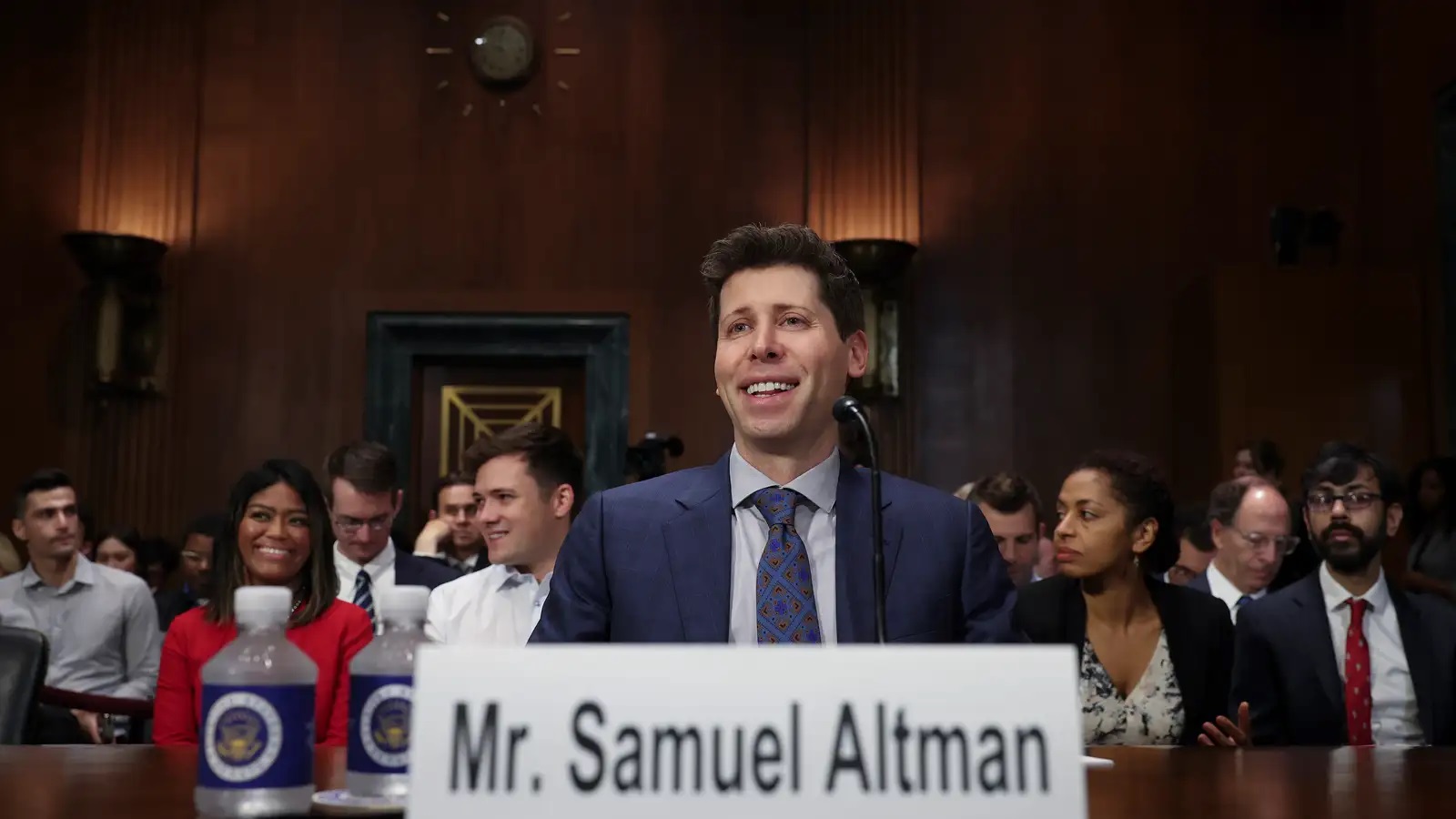
One of the most important aspects of OpenAI’s mission is to create a culture of openness, collaboration and innovation. That is why the recent announcement of Sam Altman’s return as CEO is a significant milestone for the organization and the AI community at large.

Sam Altman’s rehire reflects the power of building community culture in an organization that aims to create artificial intelligence that can benefit humanity. By bringing back one of its original leaders, OpenAI demonstrates its commitment to continuity, stability and trust. It also shows its recognition of the importance of having a visionary and experienced leader who can guide the organization through the challenges and opportunities that lie ahead.

Sam Altman has proven his ability to inspire and mobilize people around a common goal, as well as to balance the trade-offs between exploration and exploitation, risk and reward, and short-term and long-term impact. He has also shown his willingness to learn from his mistakes and adapt to changing circumstances.

OpenAI’s decision to rehire Sam Altman is not only a strategic move, but also a cultural statement. It signals that OpenAI values its history, its identity and its community. It also indicates that OpenAI is confident in its direction, its purpose and its potential. By welcoming back Sam Altman, OpenAI reaffirms its belief in the power of building community culture as a key factor for achieving its vision of creating artificial intelligence that can work for the common good.

Altman also expressed his excitement and gratitude in a tweet. “I’m honored and humbled to rejoin OpenAI as its CEO. I’m incredibly proud of what the team has accomplished in the past two years, and I can’t wait to build on their amazing work. I’m also grateful to Ilya for his outstanding leadership and friendship. He will remain a key advisor and partner to me and OpenAI.”

According to sources familiar with the matter, Altman’s return was initiated by a group of OpenAI’s board members and major donors, who felt that the organization needed a more visionary and charismatic leader to guide it through its next phase of growth and innovation. They also believed that Altman had learned from his mistakes at Worldcoin, and that he still had the trust and respect of the OpenAI community.

OpenAI is one of the most prominent and influential players in the field of artificial intelligence research. It is known for its groundbreaking achievements in natural language processing, computer vision, reinforcement learning, robotics, and generative models. It is also known for its ethical stance on ensuring that artificial intelligence is aligned with human values and can be used for good.

Some of the recent projects that OpenAI has launched or participated in include:

GPT-3: A massive language model that can generate coherent and diverse texts on almost any topic, based on a few words or sentences of input. GPT-3 is widely regarded as one of the most impressive examples of artificial intelligence to date and has been used for various applications such as chatbots, content creation, education, health care, gaming, and more.

DALL-E: A generative model that can create realistic images from text descriptions, such as “a pentagon made of cheese” or “a snail wearing a sombrero”. DALL-E can also manipulate images based on text instructions, such as “add sunglasses to the cat” or “make the sky purple”.

Codex: A system that can generate computer code from natural language commands, such as “create a website that looks like Airbnb” or “write a function that calculates the factorial of a number”. Codex is powered by GPT-3 and can handle multiple programming languages and frameworks.

CLIP: A vision system that can learn from natural language supervision, such as captions, labels, or hashtags. CLIP can perform various tasks such as image classification, object detection, face recognition, scene understanding, and more.

DOTA 2: A popular multiplayer online battle arena game that pits two teams of five players against each other. OpenAI developed a team of artificial agents called OpenAI Five that can play DOTA 2 at a high level, and even defeat some of the world’s top professional players.

Neuralink: A company co-founded by Elon Musk that aims to develop brain-computer interfaces that can enable humans to communicate with machines and enhance their cognitive abilities. OpenAI has collaborated with Neuralink on some of its research projects.

OpenAI said that it plans to continue pursuing its vision of creating artificial general intelligence (AGI), which is defined as artificial intelligence that can perform any intellectual task that a human can. The organization also said that it hopes to create artificial superintelligence (ASI), which is defined as artificial intelligence that surpasses human intelligence in all domains.

OpenAI’s ultimate goal is to ensure that AGI and ASI are aligned with human values and can be used for good. The organization has adopted a set of principles to guide its research and development activities, such as:

  • Ensuring that its research is widely distributed and accessible to everyone.

  • Avoiding creating or enabling systems that harm humans or other sentient beings.

  • Promoting cooperation and collaboration among researchers and stakeholders.

  • Fostering a culture of transparency, accountability, and responsibility.

  • Seeking feedback and input from diverse perspectives and disciplines.

  • Anticipating and mitigating potential risks and challenges.

Altman said that he shares these principles, and that he is committed to making OpenAI a force for good in the world. He also said that he welcomes constructive criticism and dialogue from the public and the broader AI community.

“I believe that artificial intelligence is the most important technology of our time, and that it has the potential to transform every aspect of our society and our lives. I also believe that we have a moral obligation to ensure that artificial intelligence is used for good, and that it benefits everyone. That’s why I’m back at OpenAI, and that’s what I’ll be working on every day. I hope you’ll join me in this journey.”

Corporate governance is now an existential issue, thanks to OpenAI

Yet, despite this rehire, we need to look at corporate governance.

Indeed, the recent announcement of OpenAI’s Codex, a system that can generate code from natural language, has sparked a lot of excitement and debate in the tech industry. Codex is powered by GPT-3, the largest and most advanced language model in the world, which can also produce text on any topic, given a few words or sentences as input.

While Codex and GPT-3 have many potential applications and benefits, they also pose significant challenges and risks for corporate governance. How can companies ensure that the code and text generated by these systems are aligned with their values, policies, and legal obligations? How can they monitor and audit the quality and impact of the outputs? How can they prevent misuse and abuse of these powerful tools by malicious actors?

These are not hypothetical questions. OpenAI has already faced criticism and controversy for some of the outputs of GPT-3, such as generating harmful or biased text, plagiarizing content, or revealing sensitive information. Codex could also generate code that is buggy, insecure, or unethical. Moreover, these systems are not transparent or explainable, making it hard to understand how they work and why they produce certain outputs.

Therefore, corporate governance is now an existential issue for companies that want to use or develop these systems. They need to establish clear and robust frameworks and processes for ensuring the accountability, responsibility, and trustworthiness of their AI products and services.

They need to adopt ethical principles and best practices for designing, testing, deploying, and monitoring these systems. They need to engage with stakeholders and regulators to address the social and legal implications of these technologies.

OpenAI has taken some steps in this direction, such as creating a partnership program for accessing Codex, requiring users to agree to terms of service and a code of conduct, and providing tools and guidelines for reporting issues and feedback. However, these measures are not enough to guarantee the safety and fairness of these systems. More research and collaboration are needed to develop standards and solutions for ensuring the ethical and responsible use of AI.

OpenAI has opened a new frontier for innovation and creativity with Codex and GPT-3. But it has also created a new challenge for corporate governance. Companies that want to leverage these technologies need to be aware of the risks and responsibilities that come with them. They need to act with caution and care, not only for their own interests, but also for the common good.

One Billion Dollars’ worth of USDT minted on the Tron Network as Grayscale Updates Bitcoin ETF Application

0

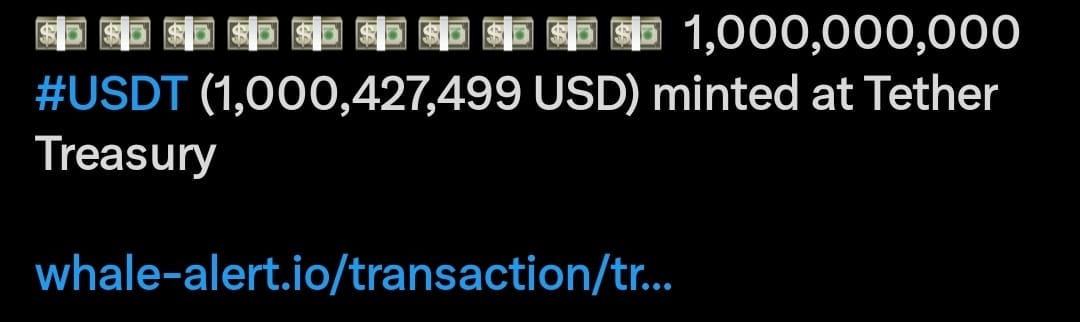
In a major development for the crypto industry, 1 billion dollars’ worth of USDT, the most popular stablecoin in the world, was minted on the Tron network. This is a significant milestone for both Tron and USDT, as it shows the growing demand and adoption of both platforms, the mint flow was announced by Whales Wallet Allert.

USDT, or Tether, is a cryptocurrency that is pegged to the US dollar, meaning that each USDT token is backed by one dollar in reserve. USDT is widely used as a medium of exchange, a store of value, and a hedge against volatility in the crypto market. USDT has a market capitalization of over 70 billion dollars, making it the third-largest cryptocurrency by that metric.

PSA: 1B USDT inventory replenish on Tron Network. Note this is an authorized but not issued transaction, meaning that this amount will be used as inventory for next period issuance requests and chain swaps, CTO USDT wrote on X.

Tron is a blockchain platform that aims to create a decentralized internet, where users can create and share content, applications, and services without intermediaries. Tron boasts high scalability, low fees, and fast transactions, making it an attractive choice for developers and users alike. Tron has a market capitalization of over 10 billion dollars, making it the 12th-largest cryptocurrency by that metric.

The minting of 1 billion dollars’ worth of USDT on the Tron network was announced by Justin Sun, the founder and CEO of Tron, on his Twitter account. He said that this was “an incredible milestone for the growth of the Tron ecosystem and a testament to the hard work and dedication of the Tron community.”

The minting of USDT on Tron has several benefits for both platforms and their users. First, it increases the liquidity and accessibility of USDT, as users can now easily transfer and trade USDT on the Tron network, as well as use it for various decentralized applications (dApps) and services on Tron.

Second, it enhances the security and stability of USDT, as Tron provides a robust and reliable infrastructure for USDT transactions and storage. Third, it boosts the adoption and innovation of Tron, as more users and developers are attracted to its fast, cheap, and scalable network.

The minting of USDT on Tron is also a positive sign for the crypto industry as a whole, as it demonstrates the growing collaboration and interoperability between different blockchain platforms. It also shows the increasing popularity and acceptance of stablecoins as a vital component of the crypto ecosystem.

The minting of 1 billion dollars’ worth of USDT on the Tron network is a remarkable achievement that benefits both Tron and USDT, as well as their users and developers. It also reflects the dynamic and evolving nature of the crypto industry, where new opportunities and challenges arise every day.

Grayscale updates version of its spot Bitcoin ETF application

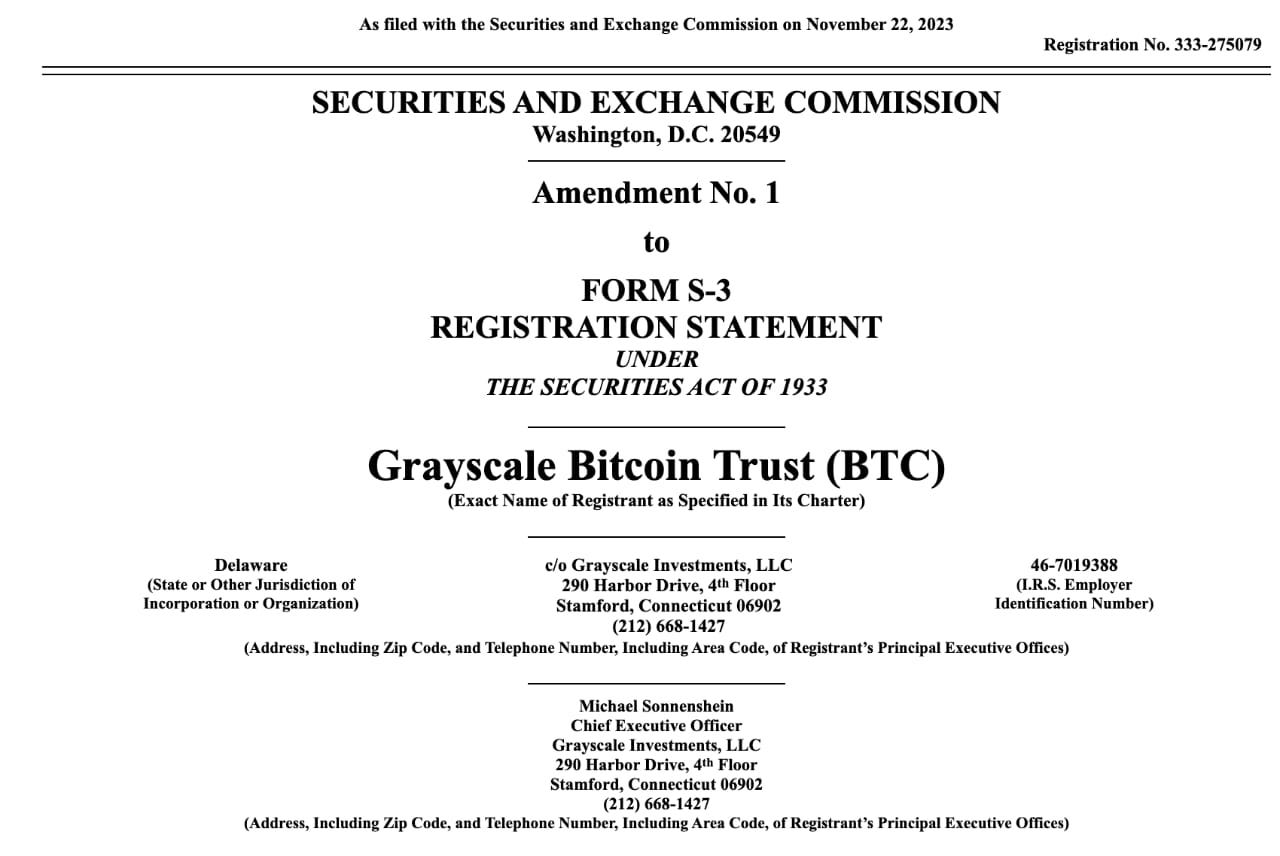
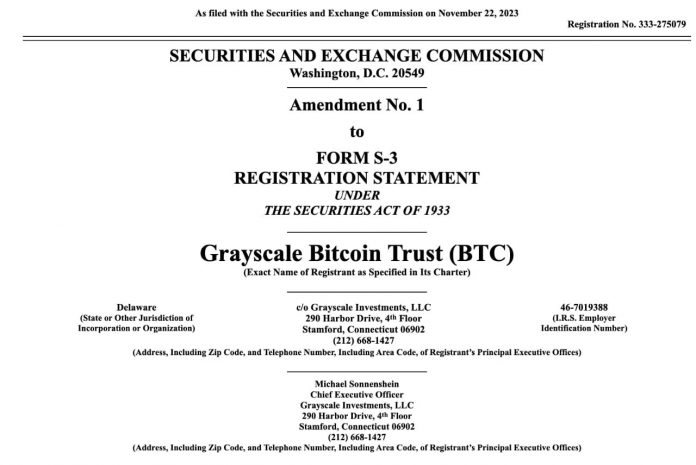
Grayscale, the world’s largest digital asset manager, has filed an updated version of its spot Bitcoin ETF application with the U.S. Securities and Exchange Commission (SEC). The new filing reflects Grayscale’s commitment to bringing a Bitcoin ETF to market as soon as possible and addresses some of the concerns that the SEC has raised about the potential risks and benefits of such a product.

A spot Bitcoin ETF would allow investors to gain exposure to the price of Bitcoin without having to buy, store, or manage the cryptocurrency themselves. It would also provide more liquidity, transparency, and regulatory oversight than existing products that track Bitcoin futures or other derivatives. Grayscale believes that a spot Bitcoin ETF would be in the best interest of investors and the broader crypto ecosystem, as it would lower the barriers to entry and increase adoption.

Grayscale’s updated application includes several enhancements and clarifications that aim to address the SEC’s feedback and questions. Some of the key changes are:

Grayscale has partnered with BNY Mellon, a leading global custodian, to provide fund administration and accounting services for the Bitcoin ETF. BNY Mellon will also act as the transfer agent and ETF service provider, ensuring that the ETF meets the highest standards of operational efficiency and compliance.

Grayscale has revised its valuation methodology for the Bitcoin ETF, which will now use multiple pricing sources that reflect the spot market for Bitcoin across various platforms and geographies. This will ensure that the ETF’s net asset value (NAV) accurately reflects the fair market value of Bitcoin at any given time.

Grayscale has enhanced its security and risk management protocols for the Bitcoin ETF, which will employ multiple layers of protection to safeguard the fund’s assets and investors. These include using qualified custodians with extensive experience in handling digital assets, implementing strict cybersecurity measures and audits, and maintaining adequate insurance coverage and reserves.

Grayscale has provided more details on its plans to educate investors and the public about the Bitcoin ETF and the crypto space in general. Grayscale intends to leverage its existing resources and partnerships, such as its Trust Center, its educational webinars and podcasts, and its relationships with industry associations and media outlets, to raise awareness and understanding of the Bitcoin ETF and its benefits.

Grayscale’s updated application is another milestone in its long-standing efforts to bring a Bitcoin ETF to market. Grayscale first filed for a Bitcoin ETF in 2016 but withdrew its application in 2017 due to regulatory uncertainty. Since then, Grayscale has continued to engage with the SEC and other regulators, as well as with investors and stakeholders, to advocate for a spot Bitcoin ETF. Grayscale hopes that its updated application will demonstrate its readiness and ability to launch a Bitcoin ETF that meets the SEC’s standards and expectations.

Grayscale is confident that a spot Bitcoin ETF will soon become a reality in the U.S., as it has already done in other jurisdictions such as Canada and Europe. Grayscale believes that a spot Bitcoin ETF will be a game-changer for the crypto industry, as it will open up new opportunities for innovation, growth, and inclusion. Grayscale invites investors and the public to learn more about its Bitcoin ETF proposal and to join its mission to make digital assets accessible to everyone.


What I Told The Senator!

1

Senator: I like reading your articles on LinkedIn. And I have a simple question for you: “what can be done to transform Nigeria from your view?”

My Response: (We later had a conversation and I am going to summarize what I told the Senator.) I do believe that nations rise when they implement these critical pillars for transformation and development. From my studies of economies and looking over 2,000 years of gross world product, these pillars are vital:

Merit-based system – no nation has advanced better than its ability to inspire, motivate and reward via merit. Without a nationally transparent merit-based system, Nigeria cannot progress.

Pragmatic Innovation – focus on what works, over the purity of scoring political goals. The implication is that we have to seek and execute the best ideas irrespective of where they may be coming. I gave an example of how the same team of Central Bank leaders who kept our exchange rate stable for years, within 2012 to 2015, blew it up later. Yes, we must allow data to work and follow the best ideas.

Honest Leadership – the citizens are smarter and can only take cues from their leaders. People willingly pay taxes when taxes work in their lives, they say. If we preach one thing and do another thing, you lose the citizens.

Integrate Rural and Urban Nigeria – we need to have a functioning postal service, to bridge the huge gap between rural and urban Nigeria. I explained how years ago, secondary school kids used to have American and European pen pals, relying 100% on NIPOST. A reliable postal service will unlock massive latent opportunities across Nigeria, from agro to arts to entertainment, in this globalizing world.

Put Rural Wealth in Nigeria’s Balance Sheet /Property Rights – those lands (subject to the land use act), houses, etc should be digitized and recorded so that even those in rural Nigeria can enter the formal economy. It is unfortunate that a man with 100 hectares is considered poor because he has no papers to share with banks, to access credits to train his kids and support his family. Simply, Nigeria must advance its property rights governance, not just in land and physical properties but also intellectual properties.

Binta, A Tekedia Capital Portfolio Company, Serves Immigrants and New Arrivals in NA, Europe, etc

0

Welcome to North America. Welcome to Europe. From the day you received that student visa, or that immigration permit, etc, Binta is here to support you, from renting to banking services to most things you need to thrive in that new country.

And you will not leave your home country behind because it will port your credit history into credit bureaus as you land in Canada, United States, UK, etc. Then as you begin that new life, from your rent payment to other basic things, Binta will quickly help you establish credit history by reporting them.

Binta, welcome to Tekedia Capital; you have arrived safely because we fund visions around the world. Binta is on stealth and launching  fully in Canada and the United States in Q1 2024. Immigration and New Arrivals focused organizations, Binta is open for partnerships. Please message the email here .