DD
MM
YYYY

PAGES

DD
MM
YYYY

spot_img

PAGES

Home Blog Page 3595

Could Cash and Bitcoin be on the same team? – ‘The Enemy of my Enemy is my Friend’ !

0

SCHISM 1:

In the world of Virtual Assets, a storm is brewing.

Keir Finlow-Bates, on the back of the debacle with Binance, created a video about how most people’s perception of the expectations of what ‘decentration’ should deliver miss the point. Keir started out by saying he wanted to talk about ‘decentralization’ in terms of ‘risk of censorship’.

He went on to say.. of systems out there.. Bitcoin is probably the most decentralized.

I would take an aside here, to remind folks that 9ja Cosmos builds off Handshake, which is a Bitcoin blockchain copy.

Bitcoin will just keep ticking along.. there are enough people interested in keeping it running… there are enough miners making money to keep it running… yes, you could be ‘censored’ by a particular mining pool… there are enough mining pools out there, that eventually, as long as you are paying the transaction fee… someone will say ‘I want that money’ and your transaction will get processed..

‘When you get to ‘chains’ such as ‘Binance Smart Chain’ (BSC) the risk is much higher… the validators on that particular chain are smaller in number, and they are all controlled by one or two entities …. as we are seeing, Binance is now in trouble with regulators, there is a risk, they may wake up one day, and it’s not worth running this chain anymore, and then it’s gone… so there, you are back in the arena of centralized service providers.’

In his LinkedIn comments section, I added :

  1. All scaling solutions, L2+ and EVMs off Ethereum carry the same risks Binance do.
  2. Security from a hack vulnerability perspective is another issue running in parallel to censorship resistance, though generally, the poorer the censorship resistance of the model, the higher the potential for hacking as well, so they sort of run in tandem.

The comment garnered a positive reaction from Keir.

One could argue, as I pointed out in last weeks’ ‘Three Bites of the Cherry’ series, in the section:’ IS POLYGON NOW EXITING WEB 3, AND LEVERAGING NO BLOCKCHAIN AT ALL??’ that Polygon now has much much bigger problems than BSC, due to the implementation of their new PRC 20 protocol.

In a recent post by Raymond Chai with a take on a post by Soban Raza (entitled ‘When can we call Ethereum done?’, Raymond leads with:

‘Adding additional layers to Ethereum blockchain protocol can increase the overall security risk. This is because each additional layer introduces new components and interfaces that could potentially be exploited by attackers. ’…

While the fulcrum of the Soban Raza post it was based on was:

‘Layer 2s are highly centralized’

So what we have, living inside this big virtual environment, encompassing blockchains, off-chain architectures, cryptocurrencies and web3, is some free and open blockchains like Bitcoin and Handshake on one hand..

and we have other highly centralized structures who can sensor us, control us, get hacked, lose our assets with no recourse, randomly get shut down driven by commercial imperatives, and are easily pushed around by the SEC and other bodies.

This is a great schism.

SCHISM 2:

In the world of ‘legacy’ value instruments, we have another schism going on.

This is quite simply, a movement to forcibly replace cash with CBDC.

Austin Carstens, General Manager, BIS (Bank for International Settlements) – in cash, we don’t know for example, we don’t know who’s using a 100 dollar bill today… we don’t know who’s using a 1000 peso bill today… with CBDC.. we will have ABSOLUTE CONTROL to determine the use… and the technology to enforce that.

CBDC advocates, in particular the (unelected) President of the European Central Bank, Christine Lagard, want to sell it as super-efficient, and ‘bottleneck’ removing version of ‘cash’.

However, Kristina Lilieneke says: It will be programmable which makes it anything but ”cash-like”

In tandem with this, there is also a plan for a digital wallet, which can track other actions, for example, refusal to take a state rolled out vaccine. The means is there for the state to freeze access to funds, any time failing to act on a ‘request’ is refused. (See also, James Villar Substack Article courtesy – Jason Meyers)

In this way, many personal freedoms we take for granted, while they may exist in theory, will no longer exist in practice.
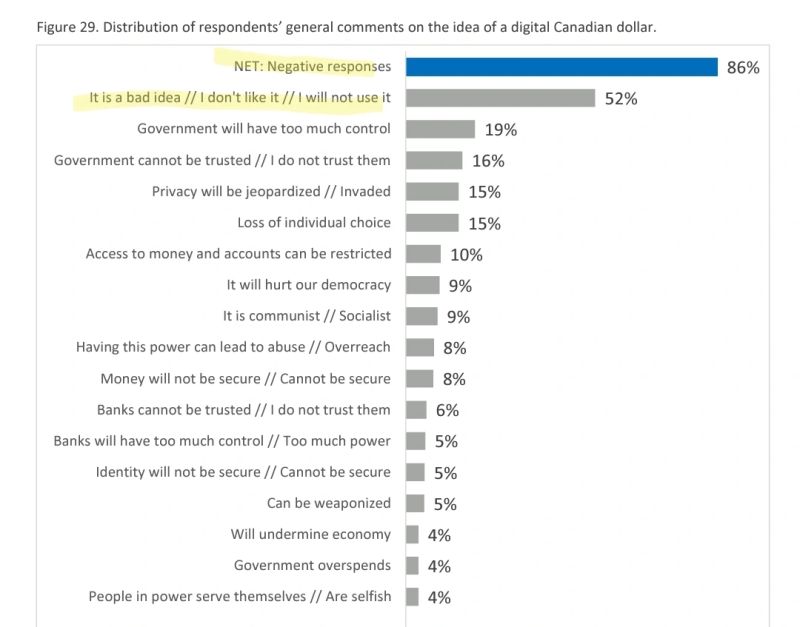
Unwillingness to accept CDBC in Canada, source: Magdalena Grownowska 

Different nations have different plans, but there is an overall plan to phase out cash, either entirely, or reduce it to an impractical limit.

Earlier this year in Nigeria, a currency redesign program was ‘sold’ to the public in advance of the Presidential Election as a measure to curb attempts by political actors to bribe their way to electoral fraud with pre-stockpiled mountains of cash.

However, the process ground availability of cash over a period of around a month almost to a complete halt. It caused intense hardship. Some in hindsight, reflecting on those days, wonder if it was not an experiment to funnel the populous into using the CBDC. The ‘e-Naira’ is deeply unpopular and was a huge waste of funds at a significant cost to the tax payer. If it was an attempt at forced e-Naira adoption, then it dismally failed.

THE UNHOLY ALLIANCE

Behind the scenes, a company from the world of ‘networks built off Ethereum’ has had many meetings with actors behind the intended Euro CBDC. It cannot be named in this section for legal reasons.

So what we have is one of the highly centralized structures built off Ethereum who can sensor us, control us, get hacked, lose our assets with no recourse, randomly get shut down driven by commercial imperatives, and are easily pushed around by the SEC and other bodies… joining with the sovereign forces , or in this case, the unelected ECB, to eliminate cash, and help those other forces control us though CBDC.

This can have serious consequences, especially in countries in the global south, whose disaspora relatives are helping from abroad to keep family members surviving through difficult times. Family remittances is something a CBDC can be programmed to prevent happening either as a general rule, or singling out individuals.
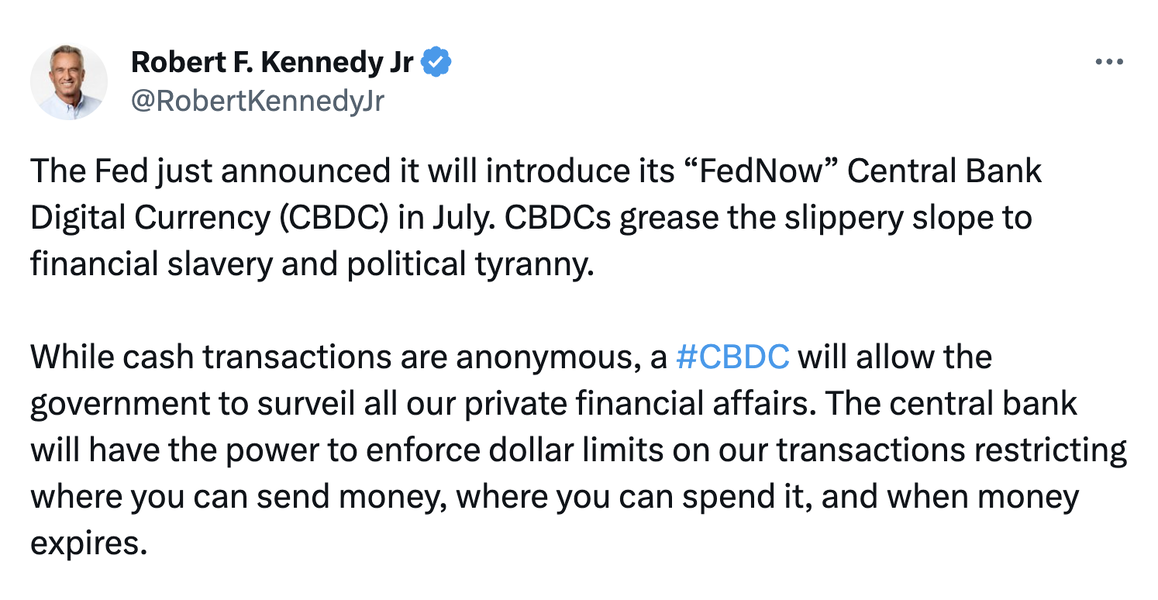
Robert F. Kennedy Jr makes a political statement on what CBDC will bring – ‘financial slavery and political tyranny’

This is an example of one of the types of restrictions programmable in a cash-less or cash restricted society with CBDC, and commercial actors in extended layer 2 and scaling solution networks are helping make this a reality.

This may give some builders, NFT buyers and token speculators some pause for thought. If you are engaging with those networks in ways that give them business, you may be helping to bring CBDCs closer to reality, and everything bad that can come with them.

And perhaps this is about to become a war, that has Bitcoin, cash, and by extension Handshake, on the same side?

9ja Cosmos is here!

Get your .9jacom and .9javerse Web 3 domains  for $2 at:

.9jacom Domains

.9javerse Domains

Visit 9ja Cosmos

Follow us on LinkedIn HERE

Preview Sino Amazons/Sinosignias HERE

Tekedia Black Friday Sales has ended

2

–This promotion has ended.

Happy Thanksgiving, joining our United States-based co-learners. In the spirit of the moment, Tekedia is offering discounts on the following courses, from now till [this has ended]

The normal price returns as the promo has ended:

  • -Tekedia Startup Masterclass – $200 
  • -Tekedia AI in Business Masterclass – $200 
  • -Tekedia Practice with Internship (Energy, Agric, Digital)- $200 
  • -Tekedia Industries (Agro, Energy, Digital Tech) – $200 
  • -Tekedia Investment & Portfolio Management – $200 

You can learn about each of these courses here – https://school.tekedia.com/courses/all/

And depending on your payment options, you can pay via a local bank, Stripe, PayPal, Zelle, etc here https://www.tekedia.com/pay  . After payment, email info@tekedia.com for your login details. 

Note: we’re not changing the prices on our website; we just want only those here to get this discount. Take advantage and let us co-learn at Africa’s largest business school for entrepreneurial capitalism. 

Regards,

Tekedia Team

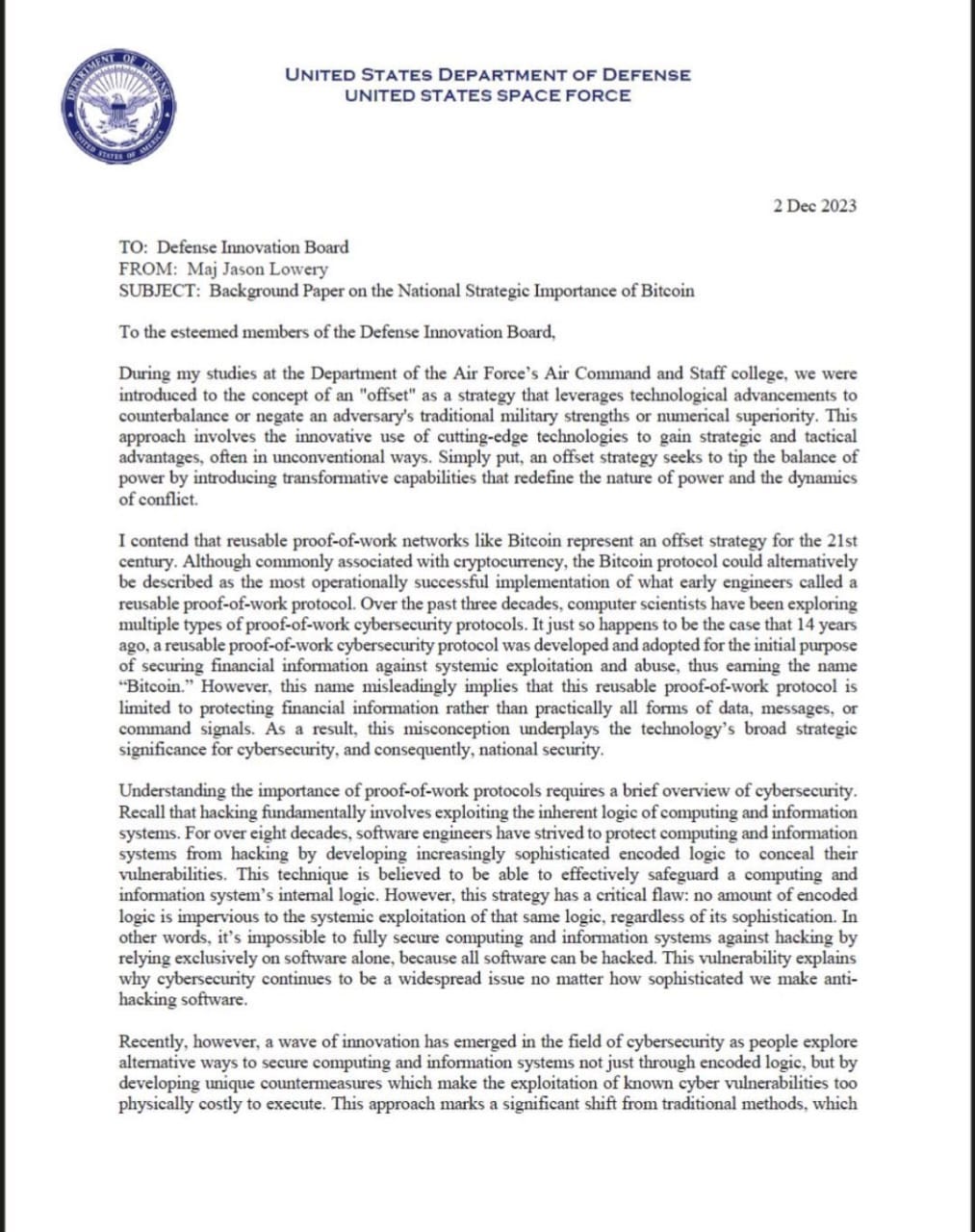
US Space Force Major sends open letter about Bitcoin to DOD’s Defense Innovation Board, as US Judge Threatens SEC Over False Arguments

0

In a bold move, US Space Force Major, Jason Lowery has sent an open letter to the Department of Defense’s Defense Innovation Board (DIB), urging them to consider the potential of Bitcoin as a strategic asset for national security and defense.

The letter, which was published on Medium, argues that Bitcoin is not only a revolutionary technology that can enhance the resilience, efficiency and transparency of the US military, but also a powerful tool to counter the threats posed by adversaries such as China, Russia and Iran.

Major Lowery, who is a space operations officer and a PhD candidate in engineering management at the Air Force Institute of Technology, writes that Bitcoin is “the most significant innovation in the history of money and accounting” and that it has “profound implications for the future of warfare”.

He explains that Bitcoin is a decentralized, peer-to-peer network that enables anyone to transact value without intermediaries, censorship or fraud. He also highlights some of the unique features of Bitcoin, such as its limited supply, its immutability, its transparency and its programmability.

According to Major Lowery, Bitcoin can offer several benefits to the US military, such as:

Reducing the reliance on legacy financial systems that are vulnerable to cyberattacks, corruption and manipulation. Enhancing the operational security and agility of the troops by enabling fast and secure payments across borders and domains. Improving the accountability and auditability of the defense budget by creating a public ledger of all transactions.

Fostering innovation and collaboration among allies and partners by creating a common platform for interoperability and trust. Deterring and disrupting the malicious activities of adversaries by undermining their ability to finance their operations, launder money and evade sanctions.

Major Lowery also warns that ignoring or dismissing Bitcoin could have serious consequences for the US national security and defense. He cites several examples of how adversaries are already exploiting the advantages of Bitcoin, such as:

China’s dominance in Bitcoin mining, which gives it control over a large portion of the network’s computing power and influence over its governance. Russia’s use of Bitcoin to fund its cyberwarfare campaigns, such as the 2016 election interference and the SolarWinds hack.

Iran’s adoption of Bitcoin to circumvent US sanctions and to support its nuclear and ballistic missile programs. North Korea’s theft of Bitcoin from exchanges and wallets to finance its weapons of mass destruction.

Major Lowery concludes his letter by urging the DIB to take action and to embrace Bitcoin as a strategic asset for national security and defense. He proposes several recommendations, such as:

Establishing a Bitcoin Innovation Center within the DOD to research, develop and test Bitcoin-related technologies and applications. Creating a Bitcoin Reserve Fund within the DOD to acquire and hold Bitcoin as a hedge against inflation, currency devaluation and geopolitical instability.

Developing a Bitcoin Education Program within the DOD to train and educate the military personnel on the fundamentals, benefits and risks of Bitcoin. Forming a Bitcoin Alliance with like-minded allies and partners to coordinate policies, standards and best practices regarding Bitcoin.

Major Lowery’s letter is a remarkable example of how some visionary leaders within the US military are recognizing the potential of Bitcoin as a game-changer for national security and defense. It is also a wake-up call for the DOD and the DIB to take Bitcoin seriously and to act swiftly before it is too late.

US Judge Threatens SEC For False Arguments In Crypto Firms Case

A US judge has issued a stern warning to the Securities and Exchange Commission (SEC) for making false claims in its lawsuit against Ripple, a cryptocurrency firm. The SEC had accused Ripple of violating securities laws by selling unregistered tokens, called XRP, to investors. The judge, however, found that the SEC had failed to provide any evidence to support its allegations and had misrepresented the facts of the case.

The judge said that the SEC’s conduct was “unacceptable” and “unprofessional” and that it had wasted the court’s time and resources. He said that he would impose sanctions on the SEC if it continued to make false or misleading arguments in the future. He also urged the SEC to reconsider its approach to regulating the cryptocurrency industry and to work with the stakeholders to develop a clear and consistent framework.

SEC Spot Bitcoin?ETF potential approval window is between January 5th – 10th, 2024.

The cryptocurrency community is eagerly awaiting the decision of the US Securities and Exchange Commission (SEC) on the proposed Bitcoin exchange-traded fund (ETF) from VanEck. The SEC has postponed its ruling several times, but the final deadline is approaching fast. According to the latest notice, the SEC must approve or reject the Bitcoin ETF by January 10th, 2024, although some analysts believe that the decision could come as early as January 5th.

A Bitcoin ETF would allow investors to buy and sell shares of a fund that tracks the price of Bitcoin, without having to deal with the complexities and risks of storing and transferring the digital asset themselves. This would make Bitcoin more accessible and attractive to mainstream investors, especially institutional ones, who are looking for exposure to the growing crypto market. A Bitcoin ETF could also boost the liquidity and legitimacy of Bitcoin, as well as reduce its volatility and price manipulation.

The SEC has been reluctant to approve a Bitcoin ETF so far, citing concerns over investor protection, market integrity, and regulatory oversight. The SEC has rejected several Bitcoin ETF proposals in the past, most notably the ones from the Winklevoss twins in 2017 and 2018. However, some experts believe that the chances of approval are higher this time, as the crypto industry has matured and improved its standards and practices. Moreover, the SEC has a new chairman, Gary Gensler, who is considered to be more crypto-friendly than his predecessor.

The VanEck Bitcoin ETF is not the only one in the pipeline. There are several other contenders, such as Valkyrie, WisdomTree, and NYDIG, who have also filed their applications with the SEC. However, VanEck has a slight edge over the others, as it was the first one to submit its proposal in December 2020, and it has partnered with CBOE BZX Exchange, which has a successful track record of launching innovative products. VanEck also has experience in managing ETFs for other asset classes, such as gold and emerging markets.

If the SEC approves the VanEck Bitcoin ETF, it would be a historic moment for the crypto industry, as it would mark the first time that a major US regulator has given its green light to a Bitcoin-based financial product. This could trigger a wave of adoption and innovation in the crypto space, as well as a surge in the price of Bitcoin. On the other hand, if the SEC rejects the proposal, it would be a setback for the crypto community, as it would signal that the regulator is still not convinced by the merits and potential of Bitcoin. This could dampen the enthusiasm and confidence of investors, as well as depress the price of Bitcoin.

Ripple, which had denied any wrongdoing, welcomed the judge’s ruling and said that it was a victory for innovation and fair competition. Ripple said that it had always complied with the law and that it had cooperated with the SEC throughout the investigation. Ripple said that it hoped that the SEC would drop the case and allow it to continue its mission of providing decentralized financial services to its customers.

MicroStrategy is $1.29 billion in profit on its Bitcoin holdings

0

MicroStrategy, the business intelligence software company, has made a staggering profit of $1.29 billion on its Bitcoin investments. The company started buying Bitcoin in August 2020, when the price was around $11,000. Since then, it has accumulated more than 114,000 Bitcoins, worth over $6 billion at the current market price of around $53,000. This means that MicroStrategy has more than quintupled its initial investment of $1.15 billion in just over a year.

The company’s CEO, Michael Saylor, is a vocal advocate of Bitcoin and believes that it is the best store of value and hedge against inflation. He has repeatedly stated that he plans to hold Bitcoin for the long term and does not intend to sell any of his holdings. He has also encouraged other companies and institutions to adopt Bitcoin as part of their treasury strategy.

MicroStrategy’s bold move to invest in Bitcoin has paid off handsomely, as the cryptocurrency has outperformed every other asset class in the past year. Bitcoin has increased by more than 380% since August 2020, while the S&P 500 index has gained about 30% and gold has dropped by 7%. MicroStrategy’s stock price has also soared by more than 400% in the same period, reflecting the market’s appreciation of its Bitcoin strategy.

But what is the future of Bitcoin? Will it continue to rise in value and adoption, or will it face competition and regulation that will limit its growth? Some experts predict that Bitcoin will reach $100,000 or even $1 million in the next decade, while others warn that it could crash to zero or be banned by governments. The truth is that no one knows for sure what will happen to Bitcoin, as it is a new and innovative technology that is constantly evolving and facing new challenges.

However, one thing is certain: Bitcoin has proven to be a resilient and revolutionary invention that has changed the way people think about money and finance. It has created a global and decentralized network of value that is open, transparent, and censorship resistant. It has also inspired thousands of other cryptocurrencies and blockchain projects that aim to solve various problems and create new opportunities in different sectors and industries. Bitcoin is not just a digital currency; it is a social and economic phenomenon that has the potential to transform the world.

MicroStrategy is not the only company that has benefited from investing in Bitcoin. Other notable examples include Tesla, which bought $1.5 billion worth of Bitcoin in February 2021 and made a profit of about $1 billion by April 2021; Square, which bought $220 million worth of Bitcoin in 2020 and 2021 and made a profit of about $800 million by July 2021; and Galaxy Digital, which bought $134 million worth of Bitcoin in 2018 and made a profit of about $860 million by June 2021.

These companies have shown that investing in Bitcoin can be a lucrative and strategic decision, especially in times of economic uncertainty and currency devaluation. However, investing in Bitcoin also comes with risks and challenges, such as volatility, regulation, security, and taxation. Therefore, investors should do their own research and due diligence before buying or selling any cryptocurrency.

Netanyahu Warns Hezbollah: War means Lebanon’s destruction

0
Benjamin Netanyahu and Joe Biden in Jerusalem, on March 9, 2010.

In a recent speech, Israeli Prime Minister Benjamin Netanyahu issued a stern warning to the Lebanese militant group Hezbollah, saying that any war with Israel would result in Lebanon’s destruction. Netanyahu accused Hezbollah of stockpiling thousands of rockets and missiles in civilian areas, posing a grave threat to Israel’s security and sovereignty. He also blamed Iran for supporting and arming Hezbollah, calling it a “terrorist regime” that seeks to wipe out Israel.

Netanyahu’s remarks came amid rising tensions between Israel and Hezbollah, which have been engaged in a series of cross-border skirmishes and exchanges of fire in recent weeks. The two sides fought a devastating 34-day war in 2006, which ended with an UN-brokered ceasefire that remains fragile and frequently violated. Both sides have vowed to inflict heavy damage on each other in case of another conflict, raising fears of a regional escalation.

Netanyahu’s warning to Hezbollah was also seen as a message to the international community, especially the United States, which is currently engaged in indirect talks with Iran over reviving the 2015 nuclear deal. Netanyahu has been a vocal opponent of the deal, arguing that it would enable Iran to pursue its nuclear ambitions and increase its support for its proxies in the region, such as Hezbollah. He has urged the US and its allies to impose more sanctions on Iran and to confront its aggression in the region.

Netanyahu warns Hezbollah: War means Lebanon’s destruction

In a televised speech on Sunday, Israeli Prime Minister Benjamin Netanyahu issued a stern warning to the Lebanese militant group Hezbollah and its patron Iran, saying that any attack on Israel would result in a devastating response that would destroy Lebanon’s infrastructure and civilian population.

Netanyahu accused Hezbollah of hiding thousands of rockets and missiles in residential areas, using the Lebanese people as human shields. He said that Israel would not hesitate to target those sites if provoked, regardless of the collateral damage.

He also blamed Iran for supplying Hezbollah with advanced weapons and fueling the conflict in the region. He said that Israel would not allow Iran to establish a permanent military presence in Syria or Iraq, and that Israel would defend itself against any Iranian aggression.

Netanyahu’s speech came amid rising tensions between Israel and Hezbollah, following a series of cross-border incidents in recent weeks. On August 25, Hezbollah fired several rockets at northern Israel, claiming to have killed or wounded Israeli soldiers. Israel denied any casualties and retaliated with artillery fire and airstrikes.

On September 1, Israel said it had thwarted an attempted drone attack by Hezbollah near the border with Syria. Hezbollah denied any involvement and accused Israel of fabricating the incident to justify its own attacks.

Both sides have vowed to continue their operations and have warned each other of severe consequences in case of further escalation. The United Nations and several countries have called for restraint and dialogue, fearing a repeat of the 2006 war that killed more than 1,000 people and displaced millions.