DD
MM
YYYY

PAGES

DD
MM
YYYY

spot_img

PAGES

Home Blog Page 3595

Figment Europe and Apex to list Ethereum and Solana Staking ETPss on SIX exchange

0

Figment Europe, a leading provider of blockchain infrastructure and services, has announced that it will partner with Apex, a Swiss-based digital asset manager, to launch two new exchange-traded products (ETPs) on the SIX Swiss Exchange. The ETPs will offer exposure to ether and Solana staking rewards, allowing investors to benefit from the growing demand for proof-of-stake (PoS) assets.

ETPs are financial instruments that track the performance of an underlying asset, such as a cryptocurrency, a commodity, or an index. ETPs can be traded on regulated exchanges, offering investors exposure to the asset without the need to hold it directly or deal with the technical complexities of custody and security.

Staking is the process of locking up a certain amount of cryptocurrency in a smart contract to participate in the consensus mechanism of a PoS blockchain network. Stakers earn rewards for validating transactions and securing the network, while also influencing its governance and direction. Staking can provide an additional source of income for ETP holders, as well as enhance the security and decentralization of the underlying blockchain.

Ether and Solana are two of the most popular and innovative PoS blockchains, with ether transitioning from proof-of-work (PoW) to PoS in the near future. PoS blockchains reward validators for securing the network by locking up their tokens in a smart contract. This creates a passive income stream for token holders, as well as enhancing the security and scalability of the network.

Figment Europe will provide the staking infrastructure and services for the ETPs, ensuring that the underlying assets are securely stored and generating rewards. Apex will manage the ETPs, which will track the performance of ether and Solana staking indices developed by MV Index Solutions (MVIS), a regulated index provider. The ETPs will be listed on the SIX Swiss Exchange, one of the largest and most liquid stock exchanges in Europe.

The ETPs will offer investors a convenient and cost-effective way to access the staking economy, without having to deal with the technical complexities and risks of running a validator node or delegating to a third-party service provider. The ETPs will also provide diversification and exposure to two of the most promising PoS blockchains, which have seen significant growth and adoption in recent months.

Figment Europe and Apex are excited to bring these innovative products to the market, as they believe that staking is a key component of the future of finance. By offering exposure to ether and Solana staking rewards, they aim to democratize access to the staking economy and enable more investors to participate in the decentralized web.

Figment Europe will leverage its expertise and experience in staking and infrastructure to provide ETP issuers with the best-in-class staking solutions for their products. Figment Europe will handle all the technical aspects of staking, such as node operation, monitoring, maintenance, and reporting, as well as ensure compliance with the regulatory requirements of each jurisdiction.

Figment Europe will also offer educational and support services to ETP issuers and investors, to help them understand the benefits and risks of staking, as well as the specific features and nuances of each PoS protocol.

Figment Europe’s CEO, Jonathan Zerah, said: “We are excited to partner with ETP issuers to bring staking to a wider audience of investors. Staking is not only a way to earn passive income, but also a way to participate in the governance and innovation of some of the most cutting-edge blockchain projects in the industry. By providing staking infrastructure and services for ETPs, we aim to lower the barriers to entry and increase the adoption of PoS protocols, while also ensuring security, reliability, and compliance.”


BlockFi settles with FTX, Alameda Estates for $870M, as Pantera Capital Purchases SOL from FTX estate

0

BlockFi, a leading crypto lending and trading platform, has announced that it has reached a settlement agreement with Alameda Estates and FTX, two of its former partners and investors. The settlement resolves a legal dispute that arose in July 2021, when Alameda Estates and FTX filed a lawsuit against BlockFi, accusing it of breaching a contract and misappropriating funds.

The lawsuit alleged that BlockFi had violated the terms of a strategic partnership agreement that it had signed with Alameda Estates and FTX in March 2020. The agreement gave Alameda Estates and FTX the right to purchase up to 30% of BlockFi’s equity at a discounted price, as well as access to BlockFi’s proprietary technology and data. In return, Alameda Estates and FTX agreed to provide BlockFi with liquidity, market making, and other services.

However, according to the lawsuit, BlockFi failed to honor its obligations and instead used the funds provided by Alameda Estates and FTX for its own benefit. The lawsuit claimed that BlockFi had diverted the funds to other projects, such as its Bitcoin rewards credit card and its Bitcoin trust fund. The lawsuit also accused BlockFi of withholding information, inflating its valuation, and engaging in unfair competition.

According to the terms of the settlement, BlockFi will pay $870 million to Alameda Estates and FTX, which represents the full amount of their initial investment plus interest and damages. BlockFi will also transfer back the ownership of some of its assets and intellectual property that were previously acquired by Alameda Estates and FTX. In exchange, Alameda Estates and FTX will drop all claims against BlockFi and release it from any further liability.

BlockFi CEO Zac Prince said in a statement that he was pleased to put this matter behind him and focus on the future of his company. He thanked his customers, employees, and other stakeholders for their support and loyalty throughout the legal process. He also expressed his respect for Alameda Estates and FTX and said that he hoped to collaborate with them again in the future.

Alameda Estates and FTX also issued a joint statement, saying that they were satisfied with the outcome of the settlement and that they wished BlockFi all the best in its endeavors. They said that they remained bullish on the crypto industry and that they would continue to invest in innovative projects and companies.

The settlement marks the end of a long and bitter feud between BlockFi and its former allies, which had caused significant uncertainty and volatility in the crypto market. The lawsuit had also attracted the attention of regulators, who had launched investigations into Block Fi’s business practices and compliance. With the settlement, BlockFi hopes to restore its reputation and regain its momentum in the rapidly growing crypto space.

Pantera Capital is raising funds to purchase a large chunk of SOL tokens from the FTX estate

According to a recent article by Bloomberg, one of the leading cryptocurrency investment firms, Pantera Capital, is in the process of raising funds to acquire a significant stake in SOL, the native token of the Solana blockchain. The deal, which is expected to be worth hundreds of millions of dollars, would involve buying SOL tokens from the FTX estate, the entity that holds the majority of the supply.

Pantera Capital is known for its bullish outlook on the crypto market and its diversified portfolio of digital assets. The firm has invested in several prominent projects, such as Bitcoin, Ethereum, Polkadot, Filecoin, and Uniswap. However, this would be its first major move into the Solana ecosystem, which has been gaining traction as a fast and scalable alternative to Ethereum.

Solana is a high-performance blockchain that claims to offer sub-second finality, low fees, and support for thousands of transactions per second. The network is powered by a novel consensus mechanism called Proof of History, which uses a verifiable timestamp system to order transactions. Solana also supports smart contracts, decentralized applications, and interoperability with other blockchains through the Wormhole bridge.

The FTX estate is the largest holder of SOL tokens, with over 50% of the total supply. The estate was created by the FTX exchange, one of the most popular and innovative platforms for crypto trading and derivatives. FTX has been a key supporter and partner of Solana, launching several products and services on the network, such as Serum, a decentralized exchange; Raydium, an automated market maker; and Solrise Finance, a decentralized asset management platform.

Both Alameda and FTX Estates have significant stakes in the Solana network, as they hold large amounts of SOL tokens, the native currency of Solana. According to some estimates, Alameda alone controls about 20% of the total SOL supply, while FTX Estates has acquired over 10% of the total land supply on Solana.

Some analysts have raised concerns that Alameda and FTX Estates could use their influence and resources to manipulate the price of SOL and other tokens on the Solana chain, either by dumping or pumping them at strategic moments.

They also argue that Alameda and FTX Estates could create artificial scarcity or demand for their own products and services, such as FTX Estates land parcels or FTX exchange listings, by leveraging their access to liquidity and market information.

However, others have countered that Alameda and FTX Estates are actually beneficial for the Solana ecosystem, as they provide valuable support and innovation for the network. They claim that Alameda and FTX Estates are long-term investors in Solana, who have a vested interest in its success and growth.

They also point out that Alameda and FTX Estates have contributed to the development and adoption of Solana, by funding and incubating projects, creating infrastructure and tools, and promoting awareness and education.

The Bloomberg report did not disclose the exact amount or terms of the deal between Pantera Capital and the FTX estate. However, it suggested that the transaction could have a significant impact on the price and liquidity of SOL tokens, which have already surged more than 10,000% since the beginning of the year. At the time of writing, SOL is trading at around $140, with a market capitalization of over $62 billion.

$715,000,000 liquidated from the cryptocurrency market since recent ATH (all time high)

0

The cryptocurrency market has experienced a massive sell-off in the past 24 hours, resulting in over $715,000,000 worth of positions being liquidated across various platforms. This is one of the largest liquidation events in recent history, and it has shaken the confidence of many investors and traders.

The main trigger for the liquidation wave was the sudden drop in the price of Bitcoin, the leading cryptocurrency by market capitalization. Bitcoin fell from around $67,000 to below $63,000 in a matter of hours, breaking several key support levels and triggering a cascade of stop-loss orders and margin calls. The sharp decline was likely driven by a combination of factors, including:

Regulatory uncertainty: The crypto industry is facing increased scrutiny and pressure from regulators around the world, who are concerned about the potential risks and challenges posed by the decentralized and unregulated nature of the sector.

Some countries, such as China and India, have taken a hostile stance towards crypto, banning or restricting its use and development. Others, such as the US and the EU, are seeking to impose stricter rules and oversight on crypto activities, such as taxation, reporting, and compliance. These regulatory developments create uncertainty and fear among crypto investors and businesses, who may face legal hurdles or penalties for operating in the space.

Technical issues: The crypto market relies on a complex network of infrastructure and services, such as exchanges, wallets, custodians, miners, and nodes. These components are not immune to technical glitches, hacks, or outages, which can disrupt the normal functioning of the market and cause price fluctuations.

For example, on February 22nd, 2021, a major outage occurred on AWS (Amazon Web Services), a cloud computing platform that hosts many crypto-related websites and applications. This caused several crypto platforms to experience downtime or reduced performance, affecting their users’ ability to access or trade their funds.

Market sentiment: The crypto market is highly influenced by the emotions and expectations of its participants, who often act based on fear or greed rather than rationality or logic. The market is prone to cycles of euphoria and panic, which can create bubbles and crashes.

The recent rally that pushed Bitcoin to new highs above $68,000 was fueled by a wave of optimism and enthusiasm, driven by factors such as institutional adoption, mainstream media attention, and celebrity endorsement.

However, this also created a sense of overconfidence and complacency among some investors, who may have overextended themselves or taken excessive risks. When the market turned bearish, these investors were forced to sell their positions at a loss or face liquidation.

The liquidation event has had significant impacts on the crypto market and its participants. Some of the effects include:

Loss of capital: The most obvious and direct consequence of the liquidation wave is the loss of capital for those who had their positions closed or reduced. According to data from Bybt.com, a crypto derivatives data provider, more than 142,000 traders were liquidated in the past 24 hours, with an average loss of $5,000 per trader. The largest single liquidation order occurred on Huobi exchange, where a Bitcoin position worth $20.6 million was liquidated.

Loss of confidence: The liquidation wave also eroded the confidence and trust of many investors and traders in the crypto market. Some may have lost faith in the long-term viability or potential of crypto as an asset class or a technology.

Others may have felt betrayed or disappointed by the platforms or services they used to access or trade crypto. Some may have experienced psychological distress or trauma from witnessing their portfolios shrink or vanish in a short span of time.

The liquidation wave also deprived many investors and traders of the opportunity to benefit from the future growth or recovery of the crypto market. Some may have missed out on buying low or selling high due to lack of funds, access, or timing. Others may have been deterred from entering or re-entering the market due to fear or uncertainty.

How can investors and traders cope with the liquidation wave and prepare for the future?

Manage your risk: The most important and fundamental rule of investing or trading is to manage your risk properly. This means setting realistic goals and expectations, diversifying your portfolio, using appropriate tools and strategies (such as stop-losses, hedging, etc.), and avoiding over-leveraging or over-trading.

You should also monitor your positions regularly and adjust them according to changing market conditions or your personal circumstances.

Educate yourself: The crypto market is constantly evolving and innovating, offering new opportunities and challenges for its participants. To succeed in this dynamic and competitive environment, you need to educate yourself constantly about the latest trends, developments, and best practices in the industry.

You should also seek to understand the fundamentals and technicalities of the crypto assets and platforms you use or invest in and be aware of the risks and rewards involved.

Seek support: The crypto market can be a lonely and stressful place, especially during times of crisis or turmoil. It can be helpful to seek support from others who share your interests or goals, such as friends, family, mentors, or communities. You can also seek professional help from experts or advisors who can offer you guidance, advice, or assistance in your crypto journey.

The crypto market is not for the faint-hearted. It is a volatile and unpredictable arena, where fortunes can be made or lost in a matter of minutes. However, it is also a fascinating and rewarding space, where innovation and creativity are abundant and where the future is being shaped. By following some of the tips and suggestions above, you can hopefully survive and thrive in the crypto market and enjoy the ride.

Tron Blockchain processes over $2M in fees amid Binance having Transaction glitches on Solana Networks

0

TRON, the blockchain platform that aims to create a decentralized internet, has reached a new milestone in its daily protocol revenue. According to the TRON Foundation, the network generated over $2 million in fees on March 6, 2024, surpassing its previous record of $1.9 million on February 28, 2024.

This achievement reflects the growing adoption and activity of TRON’s ecosystem, which includes various decentralized applications (dApps), decentralized exchanges (DEXs), stablecoins, non-fungible tokens (NFTs), and more. TRON claims to have over 40 million active users and over 2,000 dApps on its platform, making it one of the most popular and vibrant blockchain networks in the world.

One of the main drivers of TRON’s protocol revenue is its native token, TRX, which is used for paying transaction fees, staking, and governance on the network. TRX has also seen a significant increase in its price and market capitalization in the past year, reaching an all-time high of $0.18 on March 5, 2024. At the time of writing, TRX is trading at $0.17, with a market cap of over $12 billion, ranking it as the 12th largest cryptocurrency by CoinMarketCap.

Another factor that contributes to TRON’s protocol revenue is its innovative incentive mechanism, which rewards users for participating in the network. TRON has a daily reward pool of 100 million TRX, which is distributed to users who stake their tokens, vote for super representatives (SRs), and use dApps.

Additionally, TRON has launched several initiatives to attract more developers and users to its platform, such as the TRON Arcade fund, the TRON Accelerator program, and the SUN Network expansion plan.

TRON’s founder and CEO, Justin Sun, expressed his excitement and gratitude for the network’s performance and community support on Twitter. He wrote: “TRON daily protocol revenue hits new time high with $2 million! Thank you to all our users, developers, SRs, and partners for making this possible! TRON is on track to become the most advanced and user-friendly blockchain platform in the world! #TRX #TRON”

TRON’s daily protocol revenue is an important indicator of its network health and value proposition. As more users and developers join the TRON ecosystem, the demand for TRX and the network’s services will increase, leading to higher fees and rewards. This will create a positive feedback loop that will enhance the security, scalability, and innovation of TRON, as well as its competitiveness in the blockchain industry.

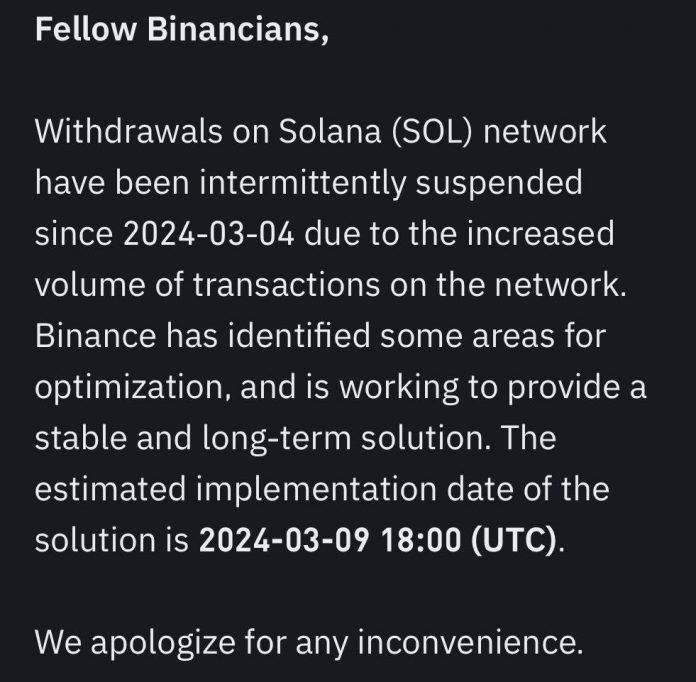
Binance Experiencing Network glitches on Solana transactions.

Binance, one of the largest cryptocurrency exchanges in the world, has announced that it will intermittently suspend withdrawals on the Solana network due to the increased volume of transactions. Solana is a high-performance blockchain that can process up to 50,000 transactions per second, making it one of the fastest and most scalable platforms in the crypto space. However, the recent surge in demand for Solana-based tokens and applications has put a strain on the network, causing delays and congestion.

Binance said in a statement that it is working closely with the Solana team to resolve the issue as soon as possible, and that it will resume withdrawals once the network stabilizes. Binance also advised its users to monitor the status of their transactions on Solana’s official explorer, Solscan, and to contact its customer support if they encounter any problems.

The Solana network has been experiencing unprecedented growth in the past few months, attracting billions of dollars in investments and launching hundreds of projects in various sectors, such as decentralized finance (DeFi), non-fungible tokens (NFTs), gaming, social media, and more.

Solana’s native token, SOL, has also skyrocketed in value, reaching an all-time high of over $200 earlier this week. Solana’s supporters believe that it has the potential to challenge Ethereum, the dominant smart contract platform, by offering faster, cheaper, and more scalable solutions.

Binance apologized for any inconvenience caused by the temporary suspension and thanked its users for their patience and understanding.

What makes us better supervisors at work? [video]

0

What makes us better supervisors at work? Experience, intuition or ability to see the big picture immediately? Watching this video, the lady might have won via experience. And the man possibly had never seen this challenge before.

But that experience must not necessarily be this particular task which is to move all these containers from one location to another? Indeed, the lady scanned the problem, and quickly designed how to execute the tasks, seeing the end right at the beginning, unlike the man.

What they have done is what the mission of firms is all about: who can effectively combine and recombine factors of production to execute tasks towards creating products and services, required to fix the challenges customers have? If you have workers like the lady, you will win your sector, but if you have people like the man, you will possibly go bankrupt.

#TheBigPicture