DD
MM
YYYY

PAGES

DD
MM
YYYY

spot_img

PAGES

Home Blog Page 3604

Nigeria’s Dangote Refinery-Based Model of Strengthening Naira Is Failing and That Must Change

1

Not a great sign for Nigeria if we move from importing petrol to importing crude oil. Yes, “Dangote Refinery will establish an oil trading unit that will help source feedstock for its 650,000 barrels per day plant on the outskirts of Lagos, Reuters reported on Tuesday, citing sources. The oil trading arm, likely to be situated in London, takes away the need to hire commodity traders for crude supply and related services, which could help scale back costs.”

Nigeria can still help Dangote Refinery by providing it with enough crude oil. If not, if the refinery sources for feedstock from outside Nigeria, do not expect it to sell in Naira within Nigeria. Simply, if Nigeria does not fix this feedstock sourcing problem, we can have a lost decade as a result of the currency crisis since we have nothing that will generate significant US dollars for the nation’s balance of payment.

Indeed, the failure of Dangote Refinery to use local crude oil and help Nigeria to disintermediate the importation of petrol will distort all our recent economic models on strengthening the naira. Hope our leaders are paying attention now that Dangote Refinery is likely going to have a trading office in London!

LONDON, March 5 (Reuters) – Africa’s richest man Aliko Dangote is planning to set up an oil trading arm, likely based in London, to help run crude and products supply for his new refinery in Nigeria, six sources familiar with the matter said.
The move would reduce the role of the world’s biggest trading firms, which have been negotiating for months to provide the refinery with financing and crude oil in exchange for products exports. The giant 650,000 barrel-per-day refinery is set to redraw global oil and fuel flows and the trading community is closely watching the way it will operate.

FTX estate is brokering deals to liquidate its Anthropic position

0

FTX estate, the owner of the largest stake in Anthropic, the AI company behind the breakthrough GPT-7 model, has announced that it is looking for buyers for its shares. The estate, which inherited the stake from the late Sam Bankman-Fried, the founder of FTX, the crypto exchange platform, did not reveal the identities of the interested parties, citing confidentiality agreements.

FTX has announced that it is in talks with several potential buyers to sell its stake in Anthropic, the AI research company founded by OpenAI alumni. Anthropic is reportedly valued at $15 billion, making it one of the most valuable AI startups in the world.

According to sources familiar with the matter, FTX estate is looking to cash out on its investment in Anthropic, which it made as part of a $124 million funding round. FTX estate is said to own about 10% of Anthropic, which would imply a $1.5 billion return on its initial $12.4 million investment.

The reason for FTX estate’s decision to liquidate its Anthropic position is unclear, but some speculate that it may be related to the regulatory uncertainty surrounding AI research and development, especially in the US and Europe.

Anthropic’s mission is to create artificial general intelligence (AGI), a level of AI that can perform any intellectual task that a human can. However, this also raises ethical and social concerns about the potential impact of AGI on humanity and the environment.

Another possible factor behind FTX estate’s move is the recent volatility in the crypto market, which may have prompted the exchange to diversify its portfolio and reduce its exposure to high-risk assets. FTX estate has been expanding its business into other sectors, such as sports and entertainment, through partnerships and acquisitions. For instance, FTX estate recently bought the naming rights to the Miami Heat’s arena for $135 million and invested $20 million in the esports organization TSM.

FTX estate has not disclosed the names of the potential buyers for its Anthropic stake, but some analysts suggest that they may include other crypto companies, such as Coinbase or Binance, as well as traditional tech giants, such as Google or Microsoft. The deal is expected to close by the end of this year, subject to regulatory approval and due diligence.

For instance, some crypto platforms may want to use GPT-7 to generate smart contracts, content, or even code for their projects. Others may see Anthropic as a strategic partner or a competitor in the emerging field of AI-powered decentralized applications (DApps).

The sale of FTX estate’s stake in Anthropic could have significant implications for the AI and crypto sectors, as well as for the general public. Anthropic is widely regarded as the leader in natural language processing and generation, and its GPT-7 model has been praised for its ability to produce coherent, diverse, and creative texts across various domains and languages.

The model has also been criticized for its potential ethical and social risks, such as generating misinformation, plagiarism, or harmful content. Therefore, whoever acquires FTX estate’s stake in Anthropic will have a great deal of influence and responsibility over how GPT-7 and its successors are developed and used in the future.

Baanx raises $20M in a Series A funding round for seamless connectivity in Web3

0

Baanx, a cryptocurrency payments specialist authorized by the U.K.’s Financial Conduct Authority (FCA), has raised $20 million in Series A funding round, the company said on Tuesday according to CoinDesk. The investment, which included Ledger, Tezos Foundation, Chiron and British Business Bank, brings the crypto payment enabler’s total funding to over $30 million.

The company, which offers a platform for businesses and consumers to access crypto-based financial services, plans to use the funds to expand its global reach and product offerings.

Baanx was founded in 2018 by Garth Howat, a serial entrepreneur with experience in fintech and e-commerce. The company’s vision is to democratize access to crypto payments and banking, by enabling anyone to create their own branded digital wallets, cards and accounts. Baanx also provides a range of crypto services, such as lending, borrowing, staking, swapping and earning interest.

Baanx claims to have over 100 clients across 40 countries, including banks, fintechs, crypto exchanges and merchants. Some of its notable partners include Wirex, Change Invest, Bitex and Bitwala. The company says it has processed over $2 billion in transactions since its launch and has grown its revenue by 300% year-on-year.

Howat said in a statement: “We are thrilled to have the support of such prestigious investors, who share our vision of bringing crypto payments and banking to the masses. This funding round will enable us to scale our platform, grow our team and launch new products that will make crypto more accessible and useful for everyone.”

Woodford Capital Partners’ partner James Woodford said: “We are impressed by Baanx’s team, technology and traction. They have built a powerful platform that leverages blockchain and smart contracts to provide innovative and secure crypto payment solutions. We believe Baanx has the potential to become a leader in this fast-growing market, and we are excited to back them on their journey.”

London-based Baanx, which runs the Ledger card product, recently signed a three-year partnership with Mastercard for the U.K. and Europe. Large legacy payments companies such as Mastercard and Visa have been quietly exploring things like payments on Ethereum, stablecoins and the Web3 world of non-custodial wallets – areas where Baanx provides seamless connectivity.

One of the key features of Web3 is the use of non-custodial wallets, which are software applications that allow users to store and manage their own cryptocurrencies and tokens, without relying on intermediaries or third parties.

Non-custodial wallets offer users more security, privacy and autonomy, as they are the sole owners of their funds and can access them anytime, anywhere. Non-custodial wallets also enable users to interact with various decentralized applications (DApps) that run on Web3, such as decentralized exchanges, lending platforms, gaming platforms and more.

However, Web3 is not only appealing to individual users, but also to large legacy payments companies that have dominated the traditional financial system for decades. Companies such as Mastercard and Visa have been quietly exploring the potential of Web3 and how they can leverage it to enhance their existing services and offer new solutions to their customers.

For instance, both Mastercard and Visa have announced partnerships with various stablecoin issuers, such as Circle, Paxos and Gemini, to enable their customers to use fiat-backed digital currencies for payments and settlements.

Stablecoins are cryptocurrencies that are pegged to a stable asset, such as the US dollar or gold, and aim to provide stability and liquidity in the volatile crypto market.

Moreover, both Mastercard and Visa have expressed interest in supporting payments on Ethereum, the second largest blockchain network by market capitalization and the most popular platform for DApps.

Ethereum enables users to create and exchange various types of tokens, such as utility tokens, governance tokens and non-fungible tokens (NFTs), which are unique digital assets that represent anything from art to collectibles to sports memorabilia.

Mastercard and Visa have recognized the growing demand for NFTs and have announced initiatives to facilitate their creation and distribution.

For example, Mastercard has launched a platform called Create & Play, which allows artists and creators to design and sell their own NFTs using Mastercard’s payment rails. Visa has also acquired a CryptoPunk NFT, one of the earliest and most iconic NFT projects on Ethereum, as a way to demonstrate its support for the NFT community.

Apple iPhone Sales Plunges by 24% in China, Amid Stiff Competition From Huawei, Others

0

A recent report from analyst firm Counterpoint Research has revealed that Apple iPhone sales have plunged 24% in China, as the company faces stiff competition from Huawei, Xiaomi, Vivo, and Oppo.

China’s overall smartphone unit sales reportedly declined by 7% Year-on-Year (YoY) in the first six weeks of 2024, with key vendors like Apple, Oppo, and Vivo seeing double-digit declines.

In particular, Apple came under intense pressure from Chinese tech giant Huawei, whose consumer business is experiencing a resurgence in China after the launch of its Mate 60 smartphone.

Speaking on the report, Senior Analyst Mengmeng Zhang said,

“Apple’s iPhone struggles during the first few weeks of the year for several reasons. Primarily, it faced stiff competition at the high end from a resurgent Huawei while getting squeezed in the middle on aggressive pricing from the likes of OPPO, Vivo, and Xiaomi. Although the iPhone 15 is a great device, it has no significant upgrades from the previous version, so consumers feel fine holding on to the older-generation iPhones for now”.

iPhone sales decline in China is attributed to the government decision of barring government officials and employees at state-owned enterprises from using iPhones.

Despite offering substantial discounts in the Chinese market, Apple faced a 2.1% decrease in its shipments in the final quarter of 2023. This decline has raised concerns about the company’s position in one of its key markets.

Notably, this decline has spurred Huawei to experience a significant resurgence in the Chinese smartphone market. The company’s substantial growth in shipments has solidified its position as a major player in the Chinese market.

Following Apple’s iPhone decline in shipments in China by 2% in the fourth quarter of 2023, Huawei’s shipments increased by 36.2% during the same period, which has positioned Huawei as the fourth-largest smartphone vendor in China.

The Chinese brand now has a market share of 13.9%, up from 10.3% in the same period a year ago. Huawei’s success can be attributed to its new product launches and the increasing demand for its 5G handsets.

The company also captured a massive 60% share of the 5G smartphone market and reached its highest-ever share in China, capturing 46% of sales volumes.

However, over the next two years, Huawei saw a significant fall in its market performance because of the U.S., ban. Not giving up, in Q3 2023, Huawei’s China smartphone sales surged, with a 37% year-on-year increase in smartphone sales.

This helped the company narrow the market share gap with top brands such as Apple. The company’s growth has been attributed to the success of its new smartphones, such as the Mate 60 Pro, which has contributed to its strong sales performance.

In October 2023, Huawei and Xiaomi led a double-digit rebound in the China phone market, with Huawei improving by 83%. The growth of Huawei’s smartphone sales in China has outpaced that of Apple, with the company being the fastest-growing smartphone maker in China in the third quarter of 2023, according to Counterpoint Research. This growth has been particularly notable in the 5G smartphone segment, where Huawei has made significant strides.

EU Issues A €1.8 billion Fine Against Apple for Alleged Breach of App Store Regulation, Company Vows to Appeal

Meanwhile, the European Union (EU) has imposed a €1.8 billion fine on Apple due to violations related to its App Store regulations, as the tech giant vows to appeal.

The fine is coming after an investigation into allegations that the tech giant company silenced music-streaming rivals, including Spotify Technology SA, on its platforms.

The bloc said that Apple device users in the EU were not able to make a free choice as to where, how, and at what prices to buy music streaming subscriptions.

Commenting on the EU’s decision to fine Apple upon investigation, EU antitrust chief, Margrethe Vestager said,

“For a decade, Apple abused its dominant position in the market for the distribution of music streaming apps through the App Store. They did so by restricting developers from informing consumers about alternative, cheaper music services available outside of the Apple ecosystem.”

The EU further revealed that Apple had behaved this way for almost a decade, which meant many users paid significantly higher prices for music streaming subscriptions. The Union further termed such a move as illegal, which it said has impacted millions of European consumers.

It is worth noting that the 1.8 billion-euro fine imposed on Apple, follows a long-running investigation triggered by a complaint from Swedish streaming service Spotify five years ago.

In a recent development the Cupertino giant says it plans to appeal the fine issued today by the European Commission over alleged anticompetitive practices in the streaming music market.

In a newsroom post, Apple called out Spotify, as the “primary advocate” and “biggest beneficiary” of the EC’s decision, noting that the streaming platform had a 56% share of the streaming music market in Europe.

Apple had also earlier shared various non-public details about Spotify’s business on Apple’s platforms by noting that the streamer accessed thousands of its APIs across 60 frameworks and that it tested its apps using Apple’s Testflight platform.

It also noted that its app had been downloaded re-downloaded or updated more than 119 billion times across Apple devices.

Apple further stressed that Spotify pays the company nothing in terms of App Store commissions because it sells its subscriptions only on its website.

Spotify did not take advantage of the reader app exception, Apple says, but rather “wants to bend the rules in their favor by embedding subscription prices in their app, without using the App Store’s In-App Purchase system,” its announcement states.

“They want to use Apple’s tools and technologies, distribute on the App Store, and benefit from the trust we’ve built with users and to pay Apple nothing for it,” Apple says. “In short, Spotify wants more.”

Apple says that while it respects the European Commission decision, it stated that the facts don’t support the decision, and therefore as a result it will appeal the judgment.

On the other hand, Spotify has lauded the EU’s decision to hold Apple accountable for anticompetitive practices in the streaming music market.

The streamer described the fine as a “powerful message” that sends a signal that even a monopoly like Apple is not able to wield power abusively” to control how other companies interact with their customers.

“Today’s decision marks an important moment in the fight for a more open internet for consumers. The European Commission (EC) has made its conclusion clear: Apple’s behaviour limiting communications to consumers is unlawful,” Spotify shared in a statement via a blogpost.

‘Social’ Storage and Image Display – Ente V Pinterest

0

As 9ja Cosmos gears up for the Airdrop of Sino Amazons and their Sinosignias, we’ve been looking at image storage and display opportunities.

What we want:

A place where we can showcase project images with limited or no local platform engagement – we ‘drive’ the project message from other platforms (like Discord and LinkedIn), so a showcase platform with its own local engagement doctrine can confuse the message.

Community Members, Investment Prospects and others need to be able to easily identify individual images from the showcase platform, and refer to them when discussing with us.

A ‘sandbox’ type environment in which the showcase project images, the message driver platform(s) and the funnel that connects them is shielded from exposure to third party content. This rules out using highly interactive platforms (like Instagram) as a showcase platform.

Low or Zero level (spammy) message intrusion (notifications) by the showcase platform

Modern account setup/security features (Modern, think things like ZKP, Legacy, think things like KYC and 2FA)

As 9ja Cosmos needs to keep with a Web3, Blockchain and NexGen Tech image, it’s preferable we extend our visibility with third parties which conjure up compatible impressions in the minds of enthusiasts, degens, collectors, investors and builders in our space. Pinterest began in 2010, and Instagram began as Burbn, a mobile check-in app, in the same year. 9ja Cosmos launched the first ever Web 3 Country Top Level Domain (TLD) in the world (.9jacom) in 2022, so our ‘break-out’ moment supersedes them by more than a decade.

Discovery:

With this in mind, we explored ‘Ente’ which the home page describes as a ‘Safe home for your photos –  Store, share, and rediscover your memories with absolute privacy’ It was shared as a ‘suggestion’ on Discord by Handshake Director Paul Anthony Webb

‘Ente has apps for Android, iOS, Linux, Mac, Windows and the web’

There are 4 price points ranging from 50GB of storage from $3 US a month, to 2TB at $20 a month, and a 1 year free trial of 1GB

Loading:

The upload took me a few minutes. I uploaded a folders content from an old 1TB external SATA (mechanical) drive.  There were 600 Sino Amazon images of 400-600kb each, and a speed test showed my upload speed at the time to be 5mbps , so that’s not too bad. The run of the project is about 1000 units, and that’s roughly only 0.5 Gb – half of the free 1 Gb allocation.  Someone generating a lot of personal or work related content constantly on-the-fly, might eat that fairly quick.  It’s fine for a finite project under 1 GB

Experience:
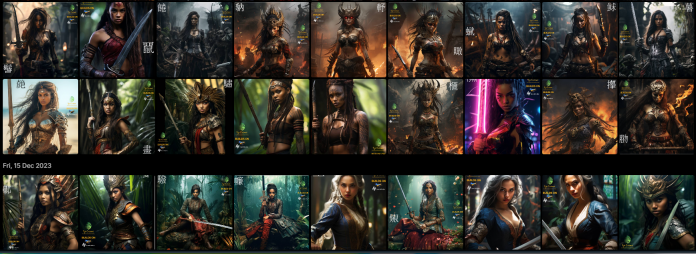
Display has both with Pros and Cons. I like that the Ente environment has a ‘dark mode’ option, which I will always enable if available (easier on my eyes). Pinterest doesn’t. Sino Amazon images have differing aspect ratios, and Pinterest always makes the ‘Portrait’ images (misleadingly) appear bigger to the visitor in thumbnail view, while Ente displays all in rows of the same length irrespective of width. Pinterest however, makes use of all available space in rows. Ente arranges files by creation date, and opens a new row for a different creation date, leaving any slots in an incomplete row unoccupied. Users of Midjourney will be familiar with this format.
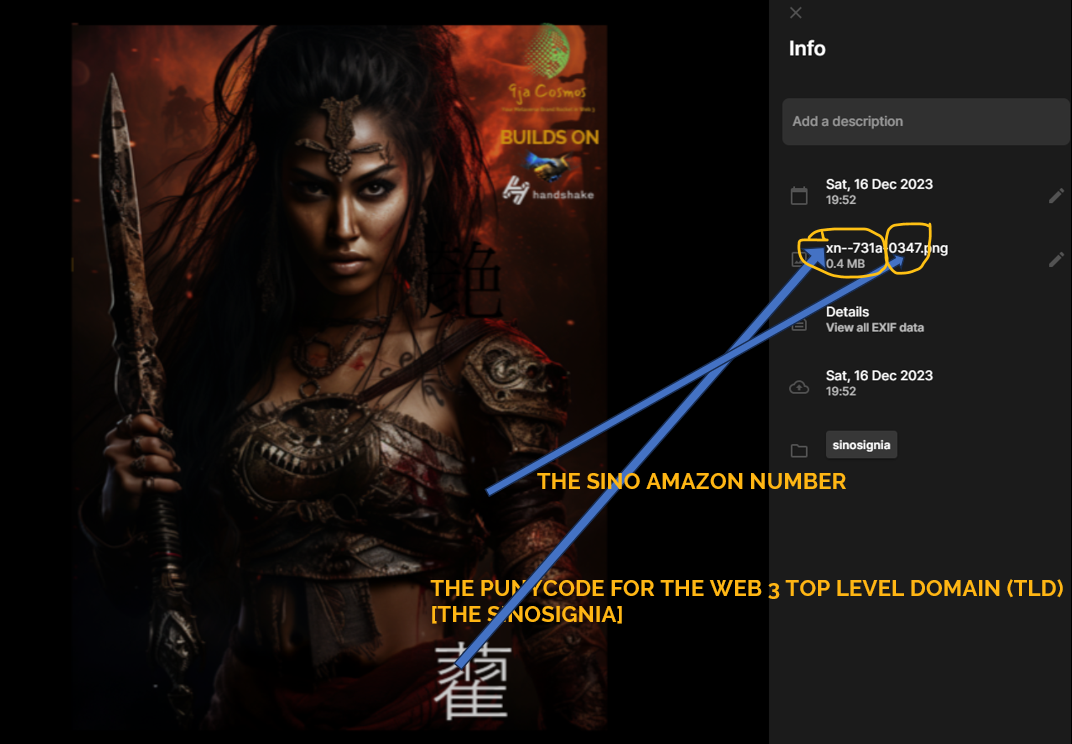
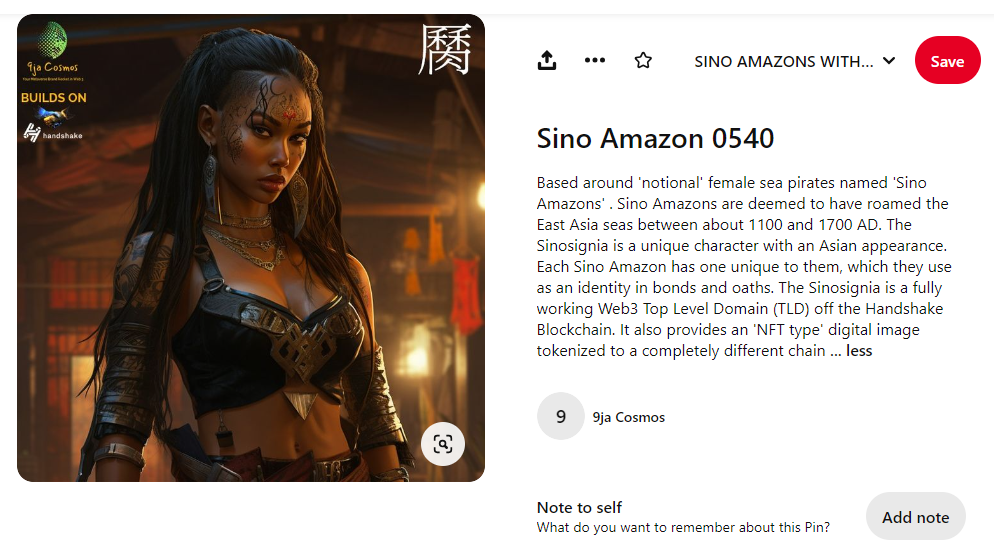
Images can be identified more easily on Pinterest than Ente, just by clicking on an image opens up a record with extra info about it. However, this is seriously negated by the visitor needing to be logged into Pinterest, else, they will just get the thumbnail view. Once someone is given an Ente link by the album owner, they don’t need to be logged in to see the details on a browser.

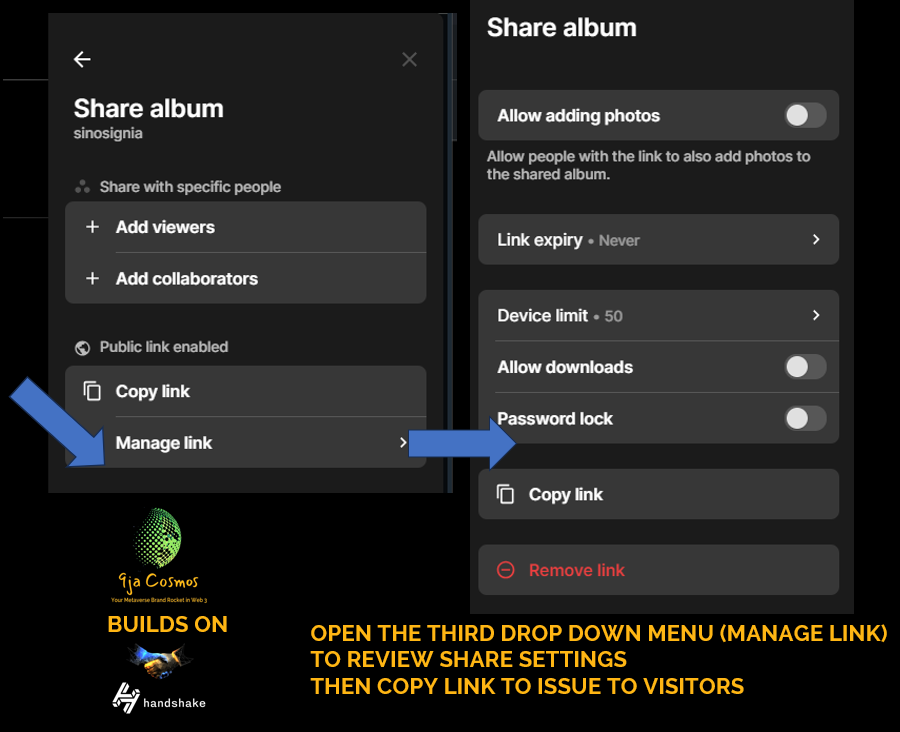
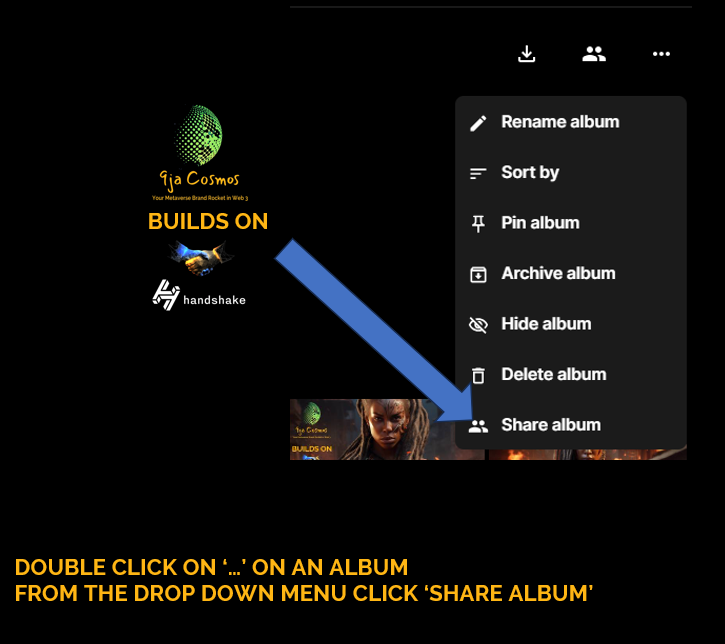
Security and Privacy: Ente is way better than Pinterest. Anybody logged in with Pinterest can copy others ‘Pins’. Ente, however, can simply leave the ‘allow downloads’ option unchecked in the share settings, and this will prevent anybody saving your content.

At signup, Ente issues a ‘seed phrase’ that many with digital wallets will be familiar with. While folks can sign up with an email address, and I choose to use an official 9jacosmos mail account capable of being verified with my registrar – Namecheap, anybody can sign up using a ‘burner’ web based free email address. Ultimately, all that is needed is to keep the  ‘seed phrase’ safe, allowing the account to be recovered on any device bearing any IP address,  so it’s ZKP of sorts.

2FA is available but not compulsory.
Pinterest is way more spammy than Ente, which is a characteristic of many of the platforms of its era.

Excerpt ‘THE MYTH OF SINO AMAZONS’ – Origin, Appearance, Dress Code and Weapon Choices.

‘Nobody knows where Sino Amazons came from … There is no telling to what extent modern graphic representations of Sino Amazons are fact or fiction.

It was known that Sino Amazons were consummate polyglots. Apart from knowing several regional languages, individual Sino Amazons knew different combinations of, example, Arabic, Persian, Kurd, Turk, Sanskrit, and indigenous tribal Central and South American, African and Australasian languages.

From around 1500 forward, they also gained command of the European languages of Colonial Powers – Dutch, English, French, Portuguese and Spanish.

Sino Amazons didn’t have one uniform ethnic appearance.  They bore features which seemed to be some fusion of regional origin with other origins further afield, often individually aligned with the range of languages they spoke.’

This defines the series as a whole, though individual appearances vary. We however constantly get spammed with suggestions that other ‘pins’ have been ‘inspired’ by us.

They are part of boards on themes that vary from ‘African Art’, ‘Vampirella’, ‘Fantasia’, ‘Wonderwomen’ and various other things, which while there may be some vague traits in common between individual ‘pins’ in these collections and a particular Sino Amazon, none of these collections even remotely meet the criteria of the Sino series in entirety.

In many cases, the content we are supposed to have ‘inspired’ has been created before our oldest Sino Amazon. We also get spammed with suggestions of content we might like to see, because apparently ‘we have a good eye’.

The spamming by Pinterest seems to be a ruse to suck ‘collection administrators’ into viewing other collections to drive up site engagement metrics.

So far, with Ente, we have only been emailed once – when we were sent the ‘verification code’ immediately following sign up! – Let’s hope it stays minimalist like this!

Conclusion:

For 9ja Cosmos purposes, both Ente and Pinterest have some trade offs in the display. Pinterest is slightly easier to use initially, but understanding how Ente works, isn’t a significant learning curve.

Ente storms ahead on Privacy and Security. Content curation scales infinitely better than Pinterest does. Pinterest constant spamming with viewing suggestions is pandemic.  Ente is far more in tune with the ‘Product Generation’ 9ja Cosmos is part of.

There are just too many areas where Ente distinguishes itself consistent with the requirements of Sino Amazons, to consider Pinterest a serious contender.

9ja Cosmos is here…

Get your .9jacom and .9javerse Web 3 domains  for $2 at:

.9jacom Domains

.9javerse Domains

Visit 9ja Cosmos LinkedIn Page

Visit 9ja Cosmos Website

Preview our Sino Amazon/Sinosignia releases (Ente)

Preview our Sino Amazon/Sinosignia releases (Pinterest)